
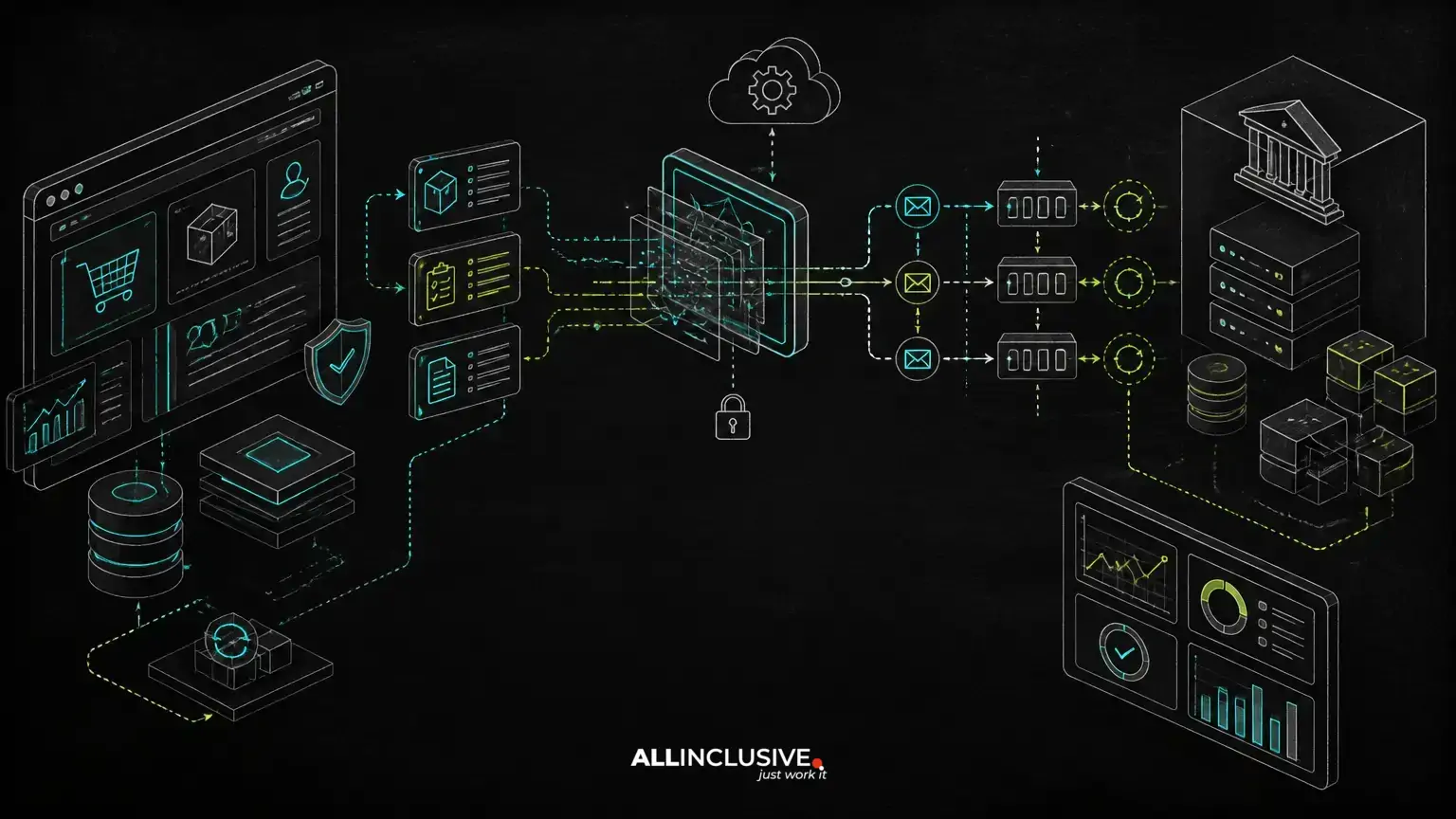
ERP integration for a web application is not simply a matter of sending records between two systems. The difficult work is deciding which system owns each fact, defining what happens when data conflicts, and recovering safely when an API, webhook or background job fails.
A durable integration treats the ERP and web application as separate systems with explicit contracts. It validates data at boundaries, authenticates every request, uses queues for work that does not belong in a user-facing request, and records enough operational information to reconcile differences later.
This approach protects business workflows. Customers can place orders without waiting for a slow ERP response, finance teams can trust inventory and invoice states, and engineering teams can investigate failures without manually guessing what happened.
Start with data ownership, not endpoints
Before selecting an API client or mapping fields, document which system is authoritative for each business object and attribute. Ownership may differ by object:
- The web application may own account registration, shopping-cart state and user preferences.
- The ERP may own inventory availability, tax configuration, fulfillment status and accounting records.
- A shared process may create an order in the web application while the ERP becomes authoritative after acceptance.
Ownership must also cover state transitions. For example, a web application can submit an order, but it should not represent the order as financially posted merely because an outbound request was accepted. Distinguish states such as pending submission, accepted by ERP, rejected, partially fulfilled and reconciliation required.
This prevents a common design error: copying fields in both directions without defining conflict rules. Bidirectional synchronization can create loops, overwrite changes or make it impossible to determine which value should win.
Define an integration contract around business actions
REST endpoints are implementation details. The integration contract should describe business actions, required data, validation rules, response states and retry behavior.
For an order workflow, the contract might specify:
- The web application assigns a stable external order identifier.
- Required customer, line-item, currency and tax data is validated before submission.
- The ERP receives a request containing the external identifier and an idempotency key when supported.
- A successful response records the ERP identifier and current ERP state.
- Validation failures are shown as actionable business errors rather than retried indefinitely.
- Timeouts and transient server errors are retried through a queue.
- Unresolved discrepancies are placed in a review or reconciliation state.
Keep the external contract separate from internal database models where practical. ERP field names and formats may be awkward, vendor-specific or subject to version changes. An integration layer can translate between the ERP schema and a stable domain model used by the web application.
Contract tests are valuable at this boundary. They can verify required fields, accepted enum values, date formats and handling of representative error responses without requiring every test to exercise a live ERP account.
Choose synchronous and asynchronous boundaries deliberately
A user-facing request should perform only the work needed to give the user a clear, accurate response. If creating an ERP record can be slow or intermittently unavailable, submit the operation to a durable queue and show an explicit processing state.
Synchronous calls can still be appropriate when the next screen depends on a small, reliable lookup or when the business action cannot proceed without an immediate authorization response. Even then, set timeouts and define what the application displays when the ERP does not respond.
Asynchronous processing usually requires:
- A durable job record containing the business object, operation and attempt history.
- A queue with controlled concurrency so the ERP is not overwhelmed.
- Retry limits and backoff for transient failures.
- Dead-letter or failed-job handling for work that needs investigation.
- A user-visible status that does not imply success before confirmation.
Laravel can provide a structured option when the application already uses PHP, Laravel queues and scheduled workers. Python can be a strong fit for a dedicated integration service, data transformation pipeline or environment where Python workers are already operational. The decision should follow ownership, deployment, team expertise and operational boundaries—not language preference alone.
Use authentication, validation and rate limits as integration controls
Authentication is only one part of the boundary. Store credentials in a secret-management system, limit permissions to the required ERP operations, rotate credentials through an established process and avoid writing access tokens or sensitive payloads to ordinary logs.
OAuth 2.0 may be appropriate when the ERP supports delegated or token-based access, but the implementation still needs token expiry handling, secure refresh-token storage and clear behavior when authorization is revoked. For a broader explanation of implementation concerns, see OAuth 2.0 API authentication.
Validate both directions of traffic. Outbound validation catches missing identifiers, invalid currencies and malformed dates before a request leaves the application. Inbound validation prevents a malformed webhook or unexpected ERP response from corrupting local data.
Rate limits should influence queue concurrency, polling intervals and retry schedules. A retry policy that ignores the ERP's capacity can turn a temporary outage into sustained throttling. The integration should distinguish rate-limit responses from permanent validation errors and use the server's guidance where available.
Make webhooks useful without treating them as proof of truth
Webhooks reduce the need for constant polling, but they are delivery mechanisms rather than guaranteed system state. A webhook can arrive more than once, arrive out of order, be delayed or fail to arrive.
Process each event with a durable event identifier when the sender provides one. Record receipt before performing side effects, then use idempotent handlers so a repeated event does not duplicate an invoice, shipment update or customer notification. The article API idempotency covers the broader pattern for preventing repeated side effects.
Webhook handlers should acknowledge quickly when the event has been safely accepted for processing. Heavy transformation and downstream calls belong in a worker. Verify signatures or equivalent authenticity controls, enforce timestamp or replay protections where supported, and retain enough event metadata to investigate delivery disputes.
Because webhooks are not infallible, combine them with periodic reconciliation. A scheduled process can compare selected ERP records against local projections and identify missing events, changed totals or mismatched statuses.
Design retries around failure categories
Not every error deserves another attempt. Classify failures before choosing a response:
- Transient transport failures: timeouts, connection interruptions and temporary service errors may be retried with exponential backoff and jitter.
- Capacity failures: rate limits require slower consumption, not immediate repeated requests.
- Business validation failures: missing customer data, invalid tax codes or unavailable products generally require correction.
- Authentication failures: refresh or repair authorization when appropriate; do not retry indefinitely with invalid credentials.
- Ambiguous outcomes: a timeout after submission may mean the ERP created the record even though the response was lost. Query by a stable external identifier before attempting creation again.
Idempotency is essential when retries can repeat a write. If the ERP offers an idempotency mechanism, use it. Otherwise, use a deterministic external reference and a lookup-before-create strategy where the ERP's capabilities permit it. For payment-specific concerns, see payment gateway integration architecture.
Build reconciliation into the operating model
Reconciliation is not an emergency script added after launch. It is a normal integration capability that answers whether two systems agree and what should happen when they do not.
Useful reconciliation records include the local identifier, ERP identifier, operation type, last known states, timestamps, payload or payload hash, attempt count and error category. Avoid storing sensitive data unnecessarily, but retain enough evidence to compare the business facts involved.
Define how discrepancies are resolved. Some can be repaired automatically, such as re-fetching an ERP record or replaying a safely idempotent event. Others require a review queue because changing inventory, invoices or fulfillment records may have financial consequences.
Use a reconciliation schedule appropriate to the business risk. High-value transactions may need frequent checks, while reference data can tolerate slower updates. The important point is that the system has a known path from mismatch detection to resolution.
Version schemas and observe the whole workflow
ERP APIs change. Versions may deprecate fields, alter response formats or introduce new status values. Isolate version-specific code in an adapter and test representative payloads before changing production traffic. Do not assume that a successful HTTP response means the business operation succeeded; inspect the response body and resulting state.
Observability should connect the full lifecycle of an operation:
- A correlation ID carried from the user action to the queued job and outbound request.
- Operation and entity identifiers, including the local and ERP IDs.
- Request duration, response category, retry count and queue delay.
- Webhook receipt, processing outcome and duplicate-event handling.
- Alerts for growing backlogs, repeated authentication failures, reconciliation mismatches and dead-letter jobs.
Log structured metadata rather than unrestricted request bodies. Mask credentials, payment details and other sensitive fields, and define retention based on operational and compliance needs.
A delivery checklist for an ERP-integrated web application
- Map ownership for each object, field and state transition.
- Define stable external identifiers and idempotency behavior.
- Document API contracts, validation rules and error categories.
- Separate user-facing requests from slow or failure-prone ERP work.
- Secure credentials and restrict integration permissions.
- Implement webhook verification, deduplication and replay-safe processing.
- Apply bounded retries, backoff and rate-limit-aware queue controls.
- Record operation history without exposing sensitive payloads.
- Provide reconciliation and human review for ambiguous discrepancies.
- Test outages, duplicate events, delayed responses, schema changes and partial success.
Reliable ERP integration is a product and operations decision as much as an API task. When ownership, state, recovery and observability are designed together, the web application can remain responsive while the ERP remains a dependable system of record. For broader custom web application planning, visit web development services, and for ongoing monitoring and issue response, see support and maintenance. When ERP functionality needs tailoring, custom ERP web applications can help define the system boundary.
Teams evaluating architecture, implementation boundaries or a custom integration can also review API development and the broader software development practice.


