
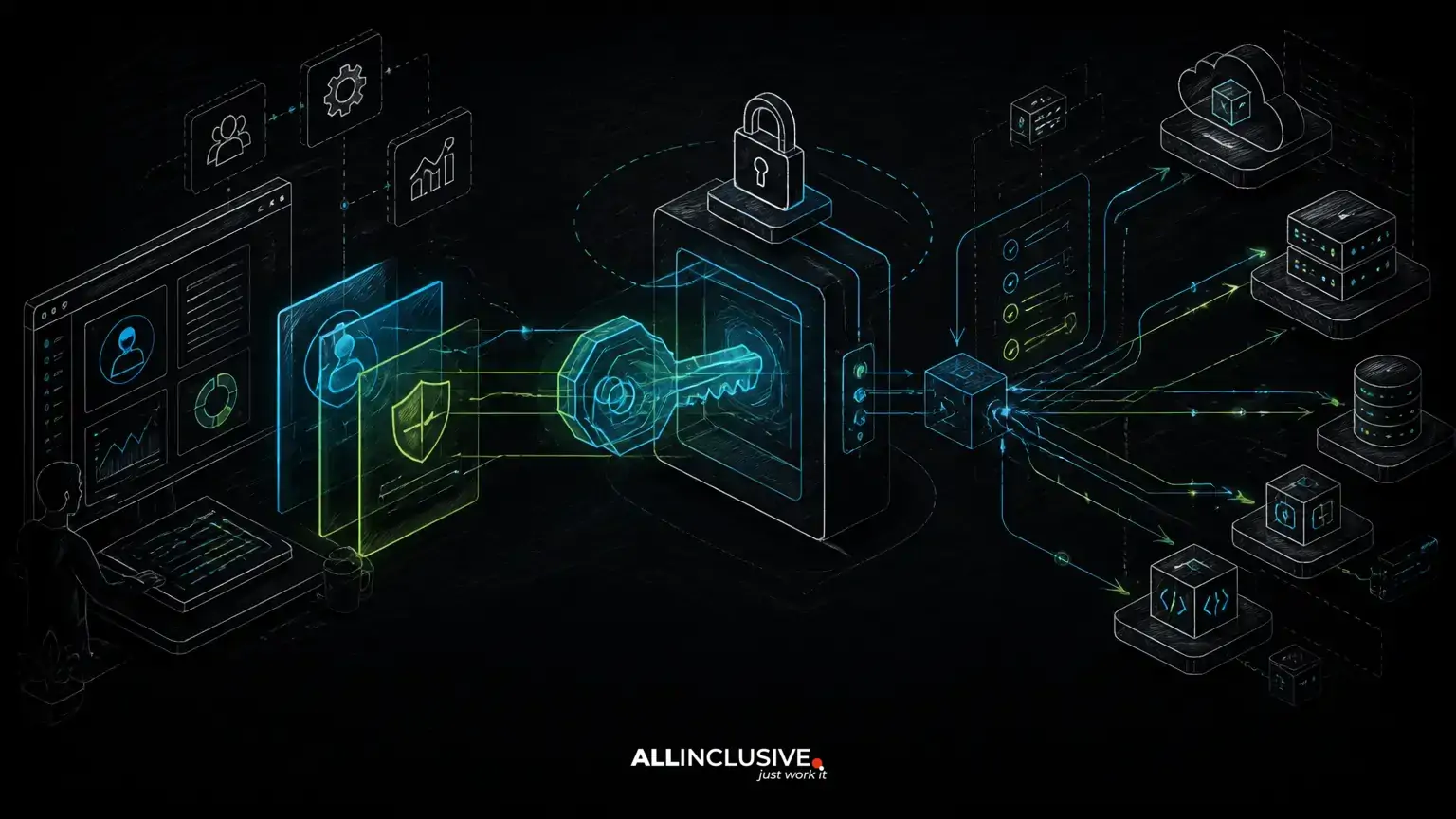
OAuth 2.0 API authentication lets an application access a protected API without asking users or partner systems to expose their primary credentials. That separation is valuable, but OAuth is not a complete integration architecture. A production-ready implementation also needs clear ownership, narrowly defined scopes, safe token storage, expiration handling, retry rules, observability and a plan for revoked or unavailable authorization.
The most important design decision is matching the OAuth flow to the relationship between the application, the user and the API. A browser-based product, a server-side integration, a machine-to-machine job and a user-authorized third-party connection have different security and operational requirements. Treating them as interchangeable is a common source of fragile integrations.
For teams planning a broader integration architecture, API development services can include contract design, authentication, webhooks, background processing and operational safeguards rather than token exchange alone.
What OAuth 2.0 API authentication actually separates
OAuth 2.0 separates authorization from the resource owner’s primary credentials. An authorization server issues a token that a client uses when calling a resource server. The roles are often represented by:
- Resource owner: the person or system that controls the protected data.
- Client: the application requesting access.
- Authorization server: the component that authenticates the owner and issues tokens.
- Resource server: the API that validates tokens and serves protected resources.
An access token represents delegated authority for a limited purpose and period. It should not be treated as a permanent password, a proof that every requested operation is safe, or a substitute for application-level authorization. The API still needs to validate the token and enforce permissions for each resource and action.
Choose the OAuth flow from the integration relationship
Authorization Code with PKCE for user-authorized applications
When a user grants an application access to an external service, the authorization code flow with Proof Key for Code Exchange is generally the appropriate pattern for modern browser-based, mobile and public clients. The client redirects the user to the authorization server, receives a short-lived authorization code, and exchanges it for tokens using a verifier associated with the original request.
PKCE reduces the value of an intercepted authorization code because the party redeeming it must also possess the verifier. It does not remove the need for redirect URI validation, state protection, secure session handling or careful token storage. A server-side application may keep the code exchange and refresh-token handling on the server, while a public client needs stronger controls around what can and cannot be stored locally.
Client credentials for machine-to-machine access
The client credentials flow is designed for a confidential application acting on its own behalf. It can suit scheduled synchronization, backend services and internal workers where there is no user authorization step. The client secret must remain in a protected server-side environment, such as a secrets manager or controlled deployment configuration.
This flow does not establish which individual user initiated an action. If the product needs user-level auditability or permissions, those concerns must be modeled separately or a user-delegated flow may be required.
Refresh tokens require lifecycle ownership
Refresh tokens can allow an application to obtain new access tokens without repeatedly sending a user through authorization. They also create a longer-lived credential that deserves stricter protection. Teams should document where refresh tokens are stored, who can decrypt them, how rotation is handled, and what happens when a refresh attempt is rejected.
A failed refresh is not always a transient network problem. The grant may have been revoked, the client configuration may have changed, or the authorization server may require the user to reconnect. Your application should distinguish those cases from temporary timeouts and present an actionable product state rather than retrying indefinitely.
Design scopes and permissions around business actions
Scopes should reflect the smallest useful set of capabilities. A synchronization service that reads customer records should not automatically receive permission to delete them. A billing workflow may need access to create a transaction but not to alter account settings.
Overly broad scopes increase the potential impact of a compromised token and make customer consent harder to understand. Overly narrow scopes can create avoidable reauthorization events. Define scopes alongside real workflows and document:
- Which product feature requires each scope.
- Whether the scope permits reading, creating, updating or deleting data.
- Whether the scope applies to all tenant data or a restricted account boundary.
- What the product does when a required permission is missing.
- How scope changes affect existing connections and consent.
Scopes are not a replacement for tenant isolation or object-level authorization. An API should still verify that the token’s subject and claims can access the specific account, organization or record requested.
Protect tokens throughout their lifecycle
Token security covers more than encrypting a database column. Access and refresh tokens should be excluded from application logs, exception messages, analytics payloads and support screenshots. Redaction needs to apply to request headers, background-job payloads and structured observability data.
Use secure transport for every authorization and API request. Validate redirect destinations against an explicit allowlist rather than accepting arbitrary callback URLs. Keep client secrets on trusted backend systems and avoid embedding them in browser code, mobile packages or public repositories.
Token storage should follow the application’s threat model. A backend integration may encrypt refresh tokens at rest and restrict decryption to a narrowly scoped service. A browser application may rely on a different session architecture rather than exposing long-lived credentials to client-side storage. The right implementation depends on the client type, not on a framework preference.
Make expiry, revocation and retries explicit
Access tokens expire. External APIs can also revoke grants, rotate credentials, return rate-limit responses or become temporarily unavailable. An integration should classify these states instead of treating every non-success response as the same error.
- Unauthorized: the token may be missing, expired or invalid. Attempt one controlled refresh when appropriate, then require reconnection if the grant cannot be renewed.
- Forbidden: the token may be valid but lack the required scope or resource permission. Retrying the same request will not fix it.
- Rate limited: respect the provider’s documented retry guidance and schedule work through a queue when possible.
- Timeout or server error: use bounded retries with backoff and jitter, while preventing duplicate side effects.
- Validation failure: record the rejected field or contract issue and route it for correction rather than repeatedly replaying it.
Retries must be designed with the operation’s side effects in mind. A GET can often be retried more safely than a request that creates an order or payment. For non-idempotent operations, use provider-supported idempotency keys or maintain an application-level operation record before retrying. See the related guidance on API idempotency for the duplicate-prevention implications.
Connect OAuth to queues, webhooks and reconciliation
Authentication succeeds only when the rest of the integration can operate reliably. Long-running synchronization should generally move out of the request-response path and into background jobs. The job can obtain or reuse a valid token, call the provider, persist a checkpoint and record the result without making a user wait for an external dependency.
Webhooks introduce a separate trust boundary. Validate the provider’s signature or equivalent verification mechanism, reject stale or malformed events, record an event identifier and process the event asynchronously. OAuth authenticates outbound API calls; it does not automatically authenticate inbound webhook requests.
Reconciliation is necessary because neither polling nor webhooks are perfect on their own. A periodic process can compare expected state with provider state, detect missed events and surface records that need review. For data-heavy integrations, define ownership for each field so that a retry or reconciliation job does not overwrite a legitimate update from another system.
For integrations involving customer records, the duplicate and conflict risks discussed in CRM API integration often matter as much as authentication. OAuth determines who can call the API; your data model determines whether those calls preserve business integrity.
Implement authentication as a reusable boundary
In Laravel or another PHP application, OAuth concerns should typically live behind a provider-specific client or integration service. Controllers should not contain token refresh logic, raw HTTP calls and business rules together. Queue jobs can request an authenticated client, while shared middleware or service code applies timeouts, correlation identifiers, redaction and response classification.
Python services benefit from the same separation. A dedicated client can handle authorization-server communication, token caching, refresh synchronization and provider error mapping. Business workflows can then depend on an interface such as “list records” or “submit operation” instead of knowing how headers or token expiry work.
This boundary makes provider changes easier to test and supports different policies for interactive requests, scheduled jobs and webhook-triggered work. It also gives operations teams one place to instrument token failures without exposing secrets.
Instrument the failure states that matter
Useful observability does not mean recording token values or sensitive payloads. Track safe metadata such as provider, integration identifier, operation type, response category, latency, retry count, queue age and correlation ID. Alert on patterns that indicate an operational problem:
- Repeated refresh failures for one connection or many connections.
- A sudden increase in forbidden responses after a scope or provider change.
- Growing queues caused by rate limits or downstream unavailability.
- Webhook signature failures or unexplained gaps in event delivery.
- Reconciliation differences that remain unresolved beyond an agreed period.
Product teams should also expose connection health in the user experience. A disconnected account, expired authorization or missing permission needs a clear next step. Hiding the problem until a user discovers stale data creates support cost and undermines trust.
OAuth implementation checklist for product teams
- Identify whether the integration is user-delegated, machine-to-machine or both.
- Select the appropriate flow and document why it fits the client type.
- Register exact redirect URIs and use state protection and PKCE where applicable.
- Define minimum scopes around concrete product capabilities.
- Store secrets and refresh tokens using controlled, encrypted server-side mechanisms.
- Redact authorization headers, tokens and sensitive provider responses from logs.
- Implement expiration, refresh, revocation and reconnect states explicitly.
- Classify authentication, authorization, rate-limit, validation and transient failures separately.
- Use queues, bounded retries, backoff and idempotency for side-effecting work.
- Verify webhooks independently and reconcile provider state periodically.
- Monitor safe operational metadata and provide actionable connection status to users.
- Document provider ownership, credential rotation, incident response and support procedures.
Make OAuth one part of a maintainable integration architecture
OAuth 2.0 API authentication is a security protocol, not a guarantee that an integration will remain correct under expired tokens, provider changes or partial failure. Reliable systems treat authorization as one boundary within a wider design that includes API contracts, validation, queues, webhooks, idempotency, versioning, reconciliation and observability.
Teams building or extending custom software should decide who owns each failure state before implementation begins. That may mean a reconnect screen, an operations queue, a manual review process or an automated reconciliation job. For ongoing reliability after launch, support and maintenance services can help monitor integrations, manage changes and address failures as external systems evolve.
To place these decisions in the broader delivery context, see custom software development and the related guidance on API rate limiting and API versioning strategy.


