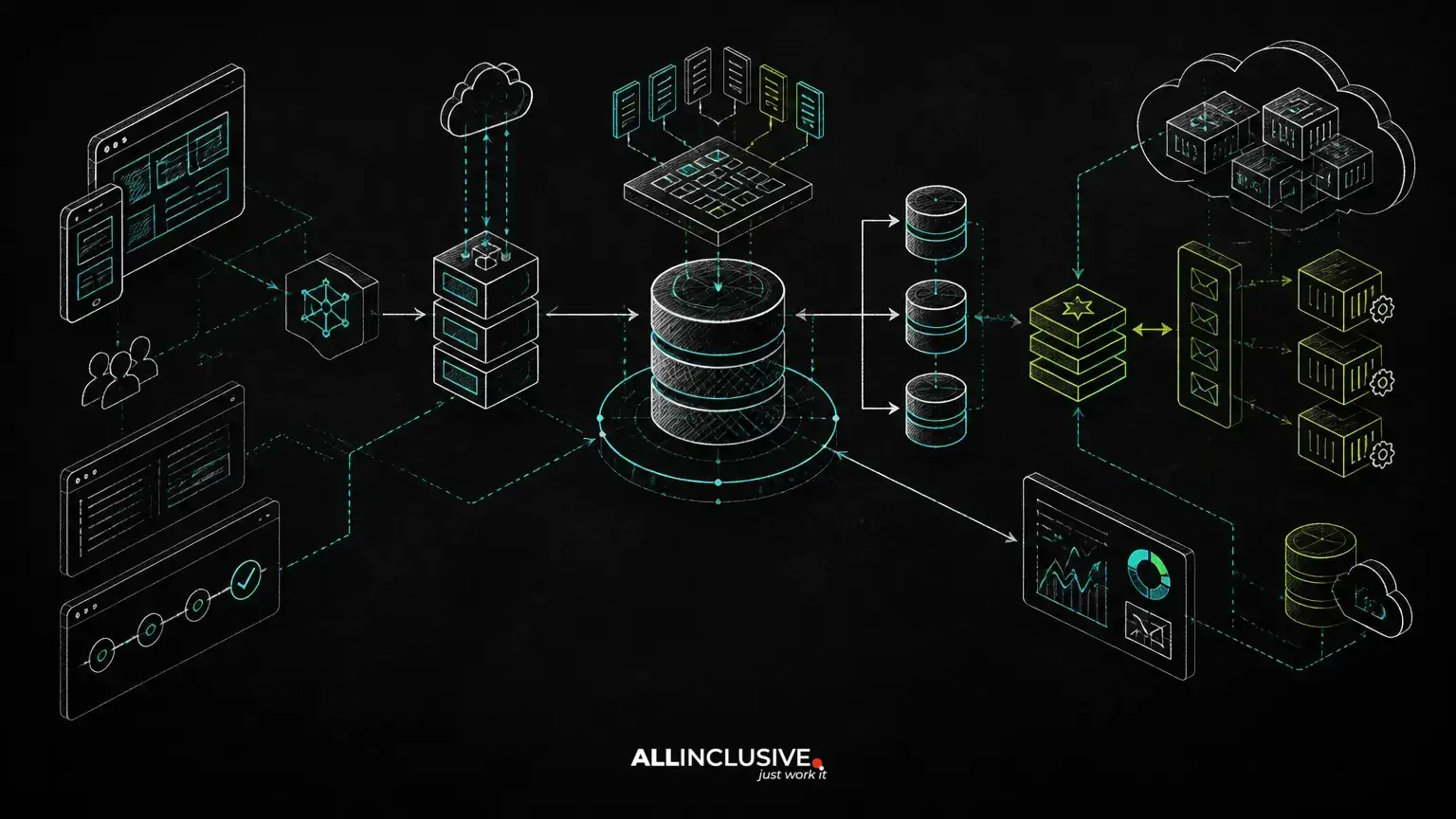
Scalable web architecture is not a plan to add servers after an application slows down. It is a set of design decisions that lets a custom web application handle more traffic, data and background work without making every release, incident or infrastructure change riskier.
The most useful preparation happens before a capacity crisis: separate request handling from long-running work, define database responsibilities, choose caching deliberately, automate delivery, and make failures visible and recoverable. A modular monolith running in containers may be a stronger starting point than a collection of microservices with unclear ownership.
This article outlines the architecture and operating practices worth designing before scale becomes urgent.
Start with workload boundaries, not a server count
“More traffic” can describe several different problems. A web application may receive more simultaneous requests, process larger files, run more database queries, execute longer business workflows or serve a growing number of scheduled jobs. Each workload creates a different bottleneck.
Before selecting infrastructure, document the main workload types:
- Synchronous requests: page loads, API calls and actions that require a user-facing response.
- Asynchronous jobs: email delivery, imports, document processing, notifications and integrations.
- Data operations: transactional writes, reporting queries, full-text searches and analytics workloads.
- Static and media delivery: assets that may be served more efficiently from object storage or a content delivery network.
- Scheduled work: recurring tasks that may compete with interactive traffic if they share resources.
This classification creates useful boundaries without requiring a distributed system. A Laravel or Python application can often remain one deployable product while its web, worker and scheduled-process roles are scaled independently.
Use a modular application before defaulting to microservices
Microservices can provide independent deployment and scaling, but they also introduce network calls, service contracts, distributed tracing, separate failure modes and more operational ownership. Those costs are justified when team boundaries, workload profiles or availability requirements demand them—not simply because an application is growing.
A modular monolith is often a practical architecture for a custom web application. Business capabilities remain separated in code, interfaces are explicit, and shared concerns such as authentication and transactions are easier to manage. The application can still run in separate Docker containers for web requests, queue workers and scheduled tasks.
Consider a service split when a component has a genuinely different scaling profile, release lifecycle, security boundary or ownership model. Document the reason for each boundary. “We may need to scale this later” is not enough by itself.
Design the cloud foundation around replaceable components
A typical AWS or comparable cloud deployment may include a load balancer, application containers, a managed relational database, Redis, object storage and a queue system. The exact services can vary, but the architectural responsibilities should remain clear.
Keep application instances as stateless as practical. A request should not depend on a particular container’s local filesystem or in-memory session. Store durable files in object storage, use a shared session mechanism where required, and treat containers as replaceable units. This makes horizontal scaling and recovery less dependent on manual intervention.
Separate configuration and secrets from the container image. Environment-specific settings should be managed through an appropriate configuration or secret-management process, with access limited by role. Infrastructure changes should be reproducible rather than dependent on undocumented console edits.
Cloud architecture also needs explicit limits. Define expected concurrency, database connections, queue depth, storage growth, log retention and backup retention. Without limits, an application can scale one layer while exhausting another.
Make the database a planned capacity boundary
Relational databases often become the first serious constraint because application traffic, reporting, background jobs and administrative workflows compete for the same resources. Scaling the web tier does not solve inefficient queries or a database connection pool that is already saturated.
Design database capacity around:
- Indexes that support real access patterns rather than every possible filter.
- Query plans and representative data volumes, not only development-sized datasets.
- Connection-pool limits that protect the database when application instances increase.
- Pagination for large collections and bounded queries for administrative screens.
- Migration procedures that account for table size, locks and rollback limitations.
- Read-heavy reporting or search workloads that may need a separate strategy.
Database replicas, partitioning or a dedicated search system may eventually be appropriate, but each adds consistency, synchronization or operational complexity. First establish which queries are slow, which operations are write-sensitive and which data must be strongly consistent.
Use Redis and caching where freshness rules are explicit
Redis can support caching, rate limiting, distributed locks, short-lived session data and queue-related coordination. It is not a substitute for durable application data, and adding it without a freshness policy can make an application harder to reason about.
For every cache, define the key, expiration behavior, invalidation trigger and acceptable staleness. A product catalog may tolerate a short delay; account permissions or inventory availability may require a different approach. Cache failures should usually degrade to a slower but correct path where possible.
Use cache-aside patterns deliberately: read from the cache, load from the system of record on a miss, then populate the cache. Protect expensive misses from causing a simultaneous surge of database requests. For more detailed trade-offs, see Redis caching strategy.
Move slow work out of the request path
Users should not wait for work that does not need to complete before a response. Queue jobs for tasks such as sending email, generating reports, importing records, resizing media and calling slow external APIs.
A production queue design needs more than a worker process. Specify retry limits, retry delays, idempotency rules, visibility or lease behavior, failure handling and dead-letter storage. A job that can safely run twice is designed differently from one that creates a financial or operational side effect.
Watch for backpressure. If jobs arrive faster than workers can process them, queue depth and job age should become visible before users experience a failure. Worker concurrency must also be bounded so that background processing does not consume all database connections or CPU. The article on queue architecture for web applications covers these controls in more detail.
Build CI/CD for repeatable, reversible releases
Scalable systems need a release process that can be repeated under pressure. A CI/CD pipeline should validate code, run relevant tests, build an immutable application artifact or container image, apply controlled configuration, and record what was deployed.
Database changes deserve special treatment. Prefer migrations that can be deployed in stages: add compatible structures, deploy code that can use both versions when necessary, backfill separately, and remove obsolete structures only after dependencies are gone. A migration that requires a long lock can turn an otherwise routine release into downtime.
Zero-downtime deployment does not mean zero risk. Health checks must test meaningful readiness, not merely whether a process exists. Traffic should move only to instances that have loaded required configuration and can reach their dependencies. Failed releases need a documented rollback or forward-fix path, including what happens when a database change cannot be reversed.
For release sequencing and deployment patterns, see CI/CD for web applications and zero-downtime deployment patterns.
Design observability around decisions during incidents
Logs, metrics and traces serve different purposes. Logs describe events, metrics reveal trends and thresholds, and traces show how one request moves through application and infrastructure components.
At minimum, instrument:
- Request rate, latency and error rate by route or operation.
- Database latency, connection usage, slow queries and storage pressure.
- Queue depth, job age, retry counts and dead-letter volume.
- Cache hit behavior, eviction signals and dependency failures.
- Container health, CPU, memory and restart patterns.
- Business-critical workflow failures, not only infrastructure errors.
Use correlation or request identifiers so a user-facing error can be connected to application logs and downstream activity. Avoid placing secrets or sensitive personal data in logs. Alerts should identify actionable conditions and include ownership, severity and a response path. The goal is not to collect every possible signal; it is to shorten diagnosis and reduce guesswork. See web application observability for a focused treatment of these practices.
Test capacity, failure and recovery before production pressure
Load testing should reflect realistic workflows rather than a single endpoint receiving artificial requests. Model authenticated sessions, reads, writes, file operations, queue production and third-party dependencies. Test with representative data volumes and document the environment so results can be interpreted correctly.
Capacity testing should answer practical questions:
- What fails first as concurrency increases?
- Does latency remain acceptable while errors stay controlled?
- How quickly can workers drain a queue after a traffic spike?
- What happens when Redis, a database connection or an external API is unavailable?
- Can operators identify the bottleneck from the available telemetry?
Recovery testing is equally important. Backups are only useful if they can be restored. Define recovery point and recovery time objectives appropriate to the application, then test database restoration, object recovery, secret replacement and deployment into a clean environment. Document dependencies that are easy to overlook, such as scheduled tasks, DNS, certificates, webhook registrations and third-party credentials.
Use an architecture checklist before scaling traffic
- Classify interactive, background, scheduled and data-intensive workloads.
- Keep application instances stateless and make durable storage explicit.
- Define database indexes, connection limits, migration procedures and reporting boundaries.
- Set cache freshness and invalidation rules before introducing Redis.
- Give queue jobs retry, idempotency, backpressure and dead-letter behavior.
- Build a CI/CD path with health checks, migration sequencing and recovery procedures.
- Collect logs, metrics and traces that connect symptoms to responsible components.
- Run workload, dependency-failure and restore tests with documented assumptions.
- Record ownership for infrastructure, releases, incidents, backups and vendor dependencies.
Scalable web architecture is ultimately an operating model as much as a diagram. The strongest design makes capacity visible, isolates failure where practical, and gives the team a repeatable way to change the system. For organizations planning or extending a custom application, custom web development should include these operational decisions alongside product functionality. Ongoing review, monitoring and recovery work can then be treated as part of software support and maintenance, rather than postponed until the next incident.