Zero downtime deployment is not simply a matter of starting a new container before stopping the old one. It is an operating model for changing application code, database schemas, background workers and infrastructure while existing requests continue to complete safely. For zero downtime deployment, an adjacent technical consideration is explained in web development services.
For Laravel and Python applications, the most reliable approach is usually a controlled release process: build an immutable artifact, run a compatible application version beside the current one, switch traffic only after health checks pass, and keep rollback possible. The design must also account for database compatibility, queue behavior, cache changes, long-running requests and operational visibility.
This matters commercially as much as technically. A failed release can interrupt checkout, delay internal workflows, create duplicate jobs or force an emergency rollback that is more expensive than the original deployment. The patterns below are intended for custom web applications running on AWS or another cloud platform, whether deployed with Docker, virtual machines or a managed container service.
What zero-downtime deployment actually requires
A deployment has no meaningful downtime when users can continue to make valid requests throughout the release. That does not mean every request succeeds if the application has an unrelated dependency failure. It means the deployment process itself does not require a maintenance window or an unavoidable period when no healthy application capacity exists.
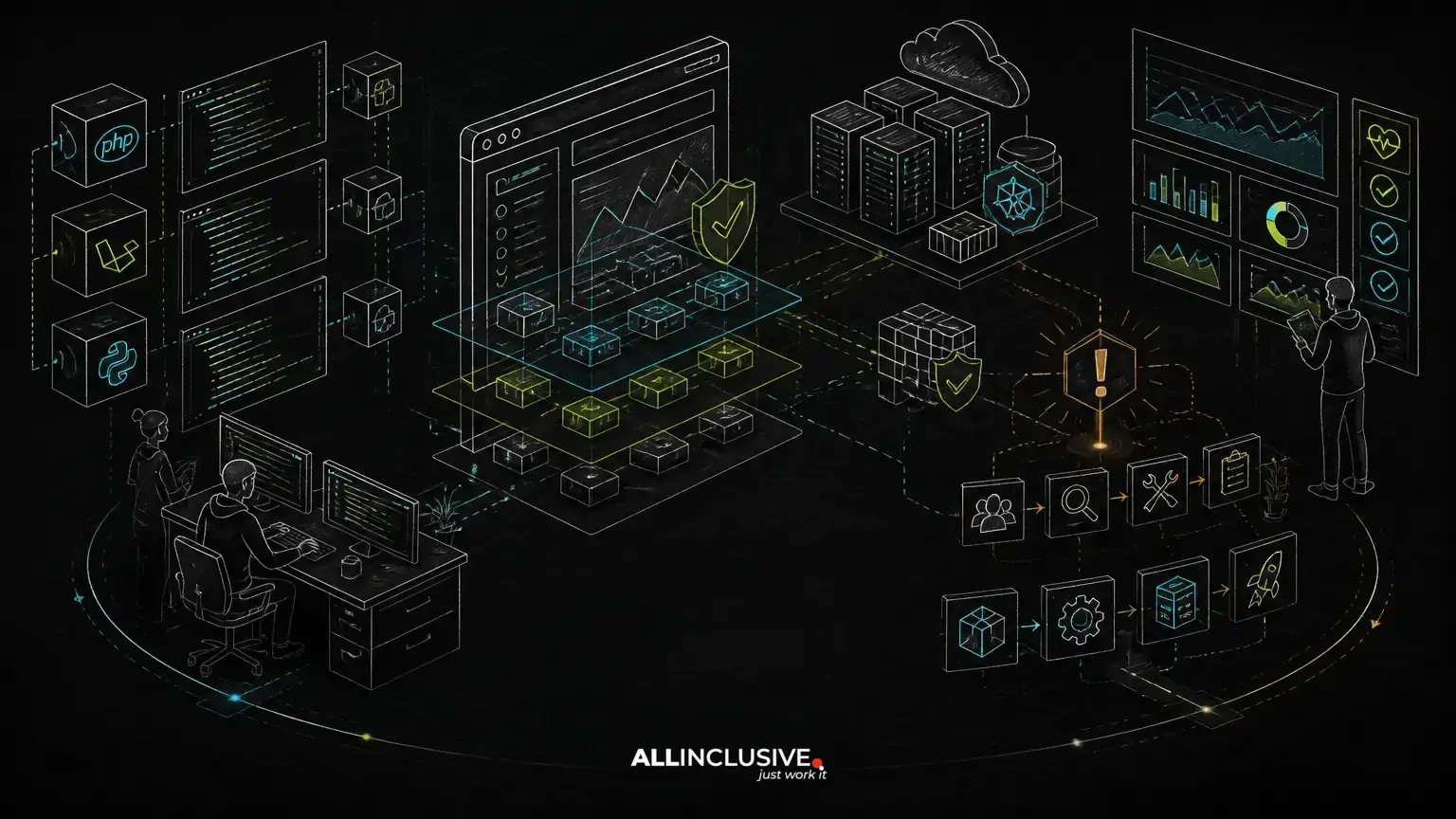
A complete design typically requires:
- Separate build and runtime stages: the production artifact is tested and assembled before it receives traffic.
- Overlapping application versions: old and new instances run together during the transition.
- Compatible database changes: both versions can operate safely while the release is being switched.
- Traffic health checks: routing changes occur only after the new capacity is ready.
- Worker coordination: queue consumers are drained, restarted or versioned without losing jobs.
- Rollback capability: the previous application artifact remains available, and database changes do not make rollback impossible.
- Observability: logs, metrics and traces reveal whether the new release is healthy after traffic moves.
Without these controls, a deployment may appear automated while still depending on a short outage, manual intervention or luck.
Choose a traffic-switching pattern that matches the application
Rolling deployment
In a rolling deployment, instances are replaced in groups. A load balancer continues routing requests to healthy capacity while new instances start and old instances are removed.
This can be efficient for applications with stateless HTTP processes and predictable startup times. It is less forgiving when versions are incompatible, when startup checks are superficial or when the application stores session state locally. Laravel and Python applications should generally keep sessions in a shared store such as a database or Redis when multiple versions may serve the same user during a rollout.
Blue-green deployment
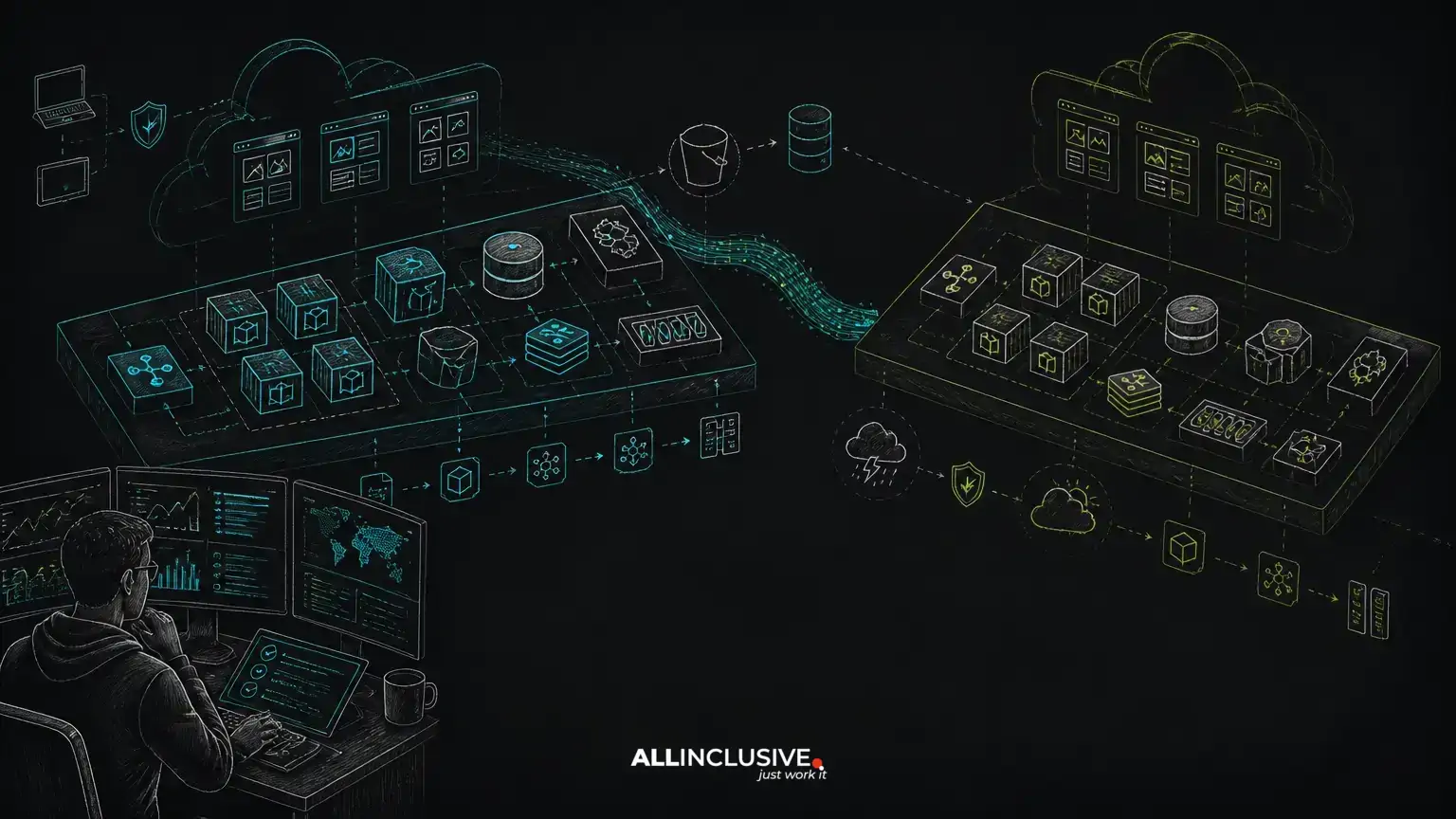
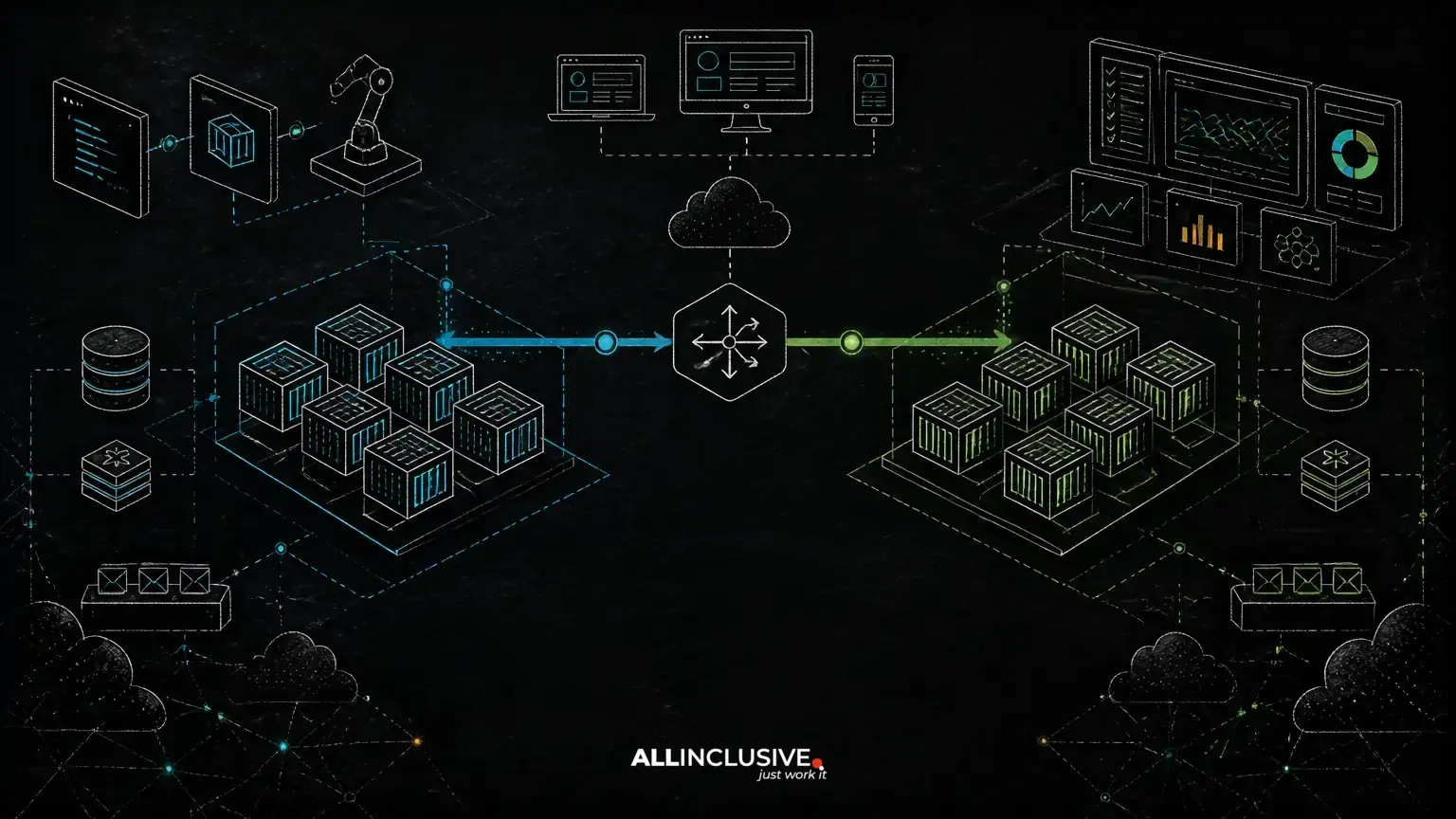
Blue-green deployment maintains two application environments. The blue environment serves production traffic, while the green environment is built, tested and checked before traffic is switched.
This pattern makes rollback straightforward at the application layer: routing can return to the previous environment if error rates or business checks deteriorate. It may require additional cloud capacity and careful handling of shared resources. Both environments must understand the database state during the transition, and background workers must not process the same work twice merely because two environments exist.
Canary release
A canary release sends a limited portion of traffic to the new version before broader rollout. It is useful when a release has uncertainty that automated tests cannot fully eliminate, such as changes to a high-value workflow or an AI-assisted feature with unfamiliar production behavior.
Canary routing is more complex when users need session consistency, when traffic is low or when errors are difficult to distinguish from normal variation. Define the signals that stop the rollout before deployment begins: elevated server errors, queue latency, database load, payment failures or a decline in a key workflow.
Make Laravel and Python releases compatible during the transition
The central database rule is to separate schema expansion from code cleanup. A release should first add structures in a backward-compatible way, then deploy code that can use them, and only later remove obsolete structures after the older version is no longer running.
- Expand: add a nullable column, new table or compatible index without breaking the current application.
- Migrate application behavior: deploy code that can read and write using the new structure while remaining compatible with the old one where necessary.
- Contract: remove old columns, constraints or code only after rollback to the earlier version is no longer required.
For Laravel, this means treating migrations as production rollout steps rather than assuming a migration can run instantly during a release. Large table changes may lock resources or consume substantial database capacity. Run them separately when appropriate, measure their effect and avoid coupling an unbounded data transformation to the moment traffic switches.
For Python applications, the same principle applies whether the application uses Django, Flask, FastAPI or another framework. Database migration tooling can coordinate schema changes, but it cannot automatically make an incompatible application protocol safe. Review model changes, serialization formats, validation rules and transaction behavior across both versions.
Use feature flags when a code path needs to be deployed before it should be enabled. A flag separates deployment from activation, allowing the team to test the new path with controlled exposure and disable it without rebuilding the application.
Package Docker images for repeatable releases
Docker can make deployment more predictable when the image contains the application code and its runtime dependencies, while environment-specific configuration is supplied at runtime. The build should be reproducible, scanned and tested before the image is promoted.
A production image for Laravel commonly needs the application runtime, web-serving process and any required extensions. Python images need the selected interpreter, installed dependencies and process configuration. Avoid putting mutable uploads, generated reports or application logs inside the container filesystem unless they are deliberately exported to durable storage.
Build separate concerns where practical: an image for HTTP requests and another for queue workers may share a base but use different commands and resource limits. This avoids treating web traffic and background work as interchangeable. A worker processing a long task may need a longer termination period than an HTTP container.
Deployment automation should record the exact image digest or release identifier. If a rollback requires guessing which build was previously live, the release process is not sufficiently controlled.
Handle queues, workers and scheduled tasks separately
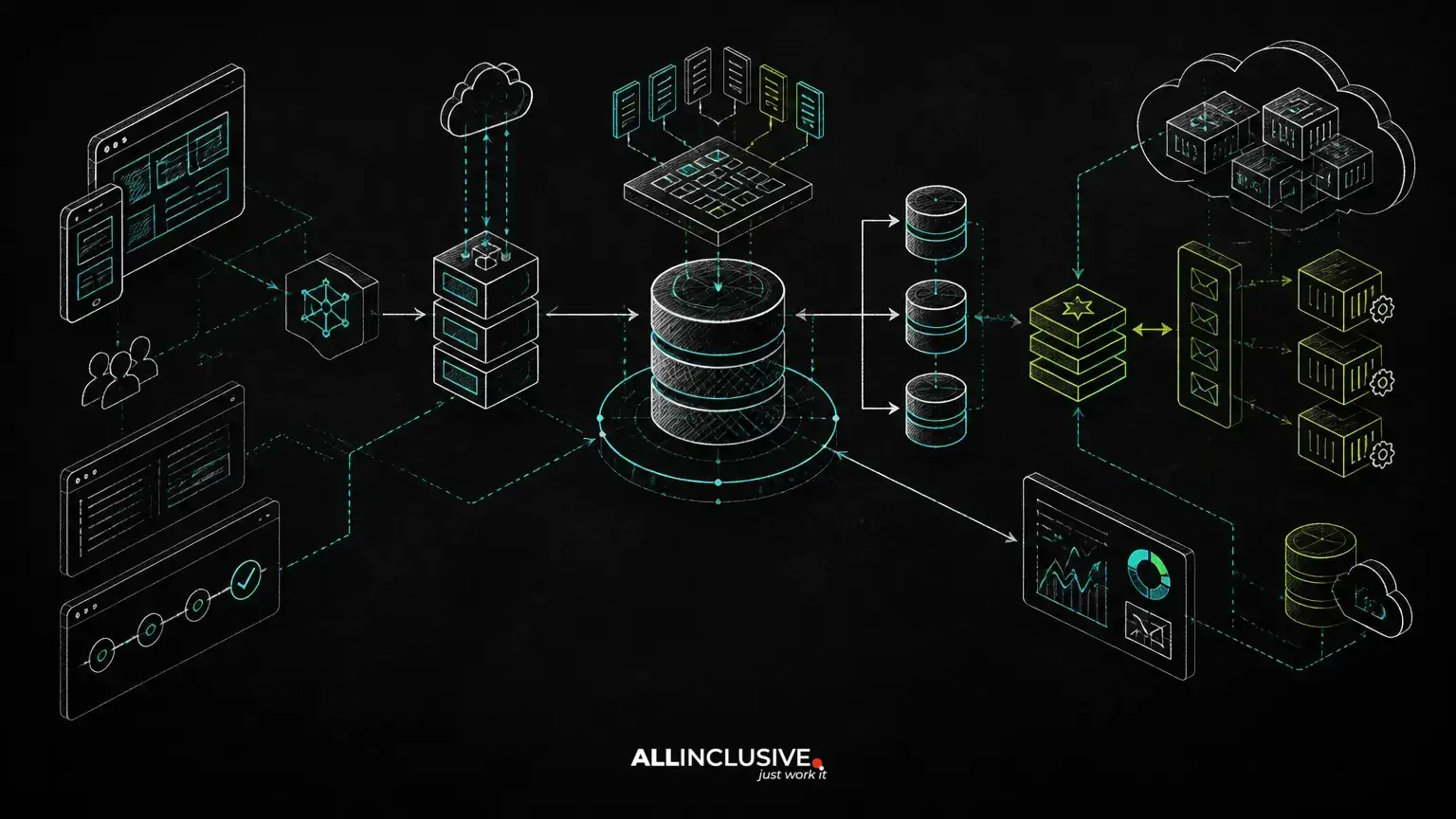
Web traffic is only one part of a Laravel or Python system. Queue workers may be running code for minutes or hours, and a deployment can interrupt them at an unsafe point. Workers should receive a termination signal, stop accepting new work and finish or safely release the current job within a defined grace period.
Job handlers should be designed for retries and idempotency. If a worker loses its connection after completing an external action but before acknowledging the queue, the same job may run again. A safe handler uses an idempotency key, checks whether the business action already occurred and separates retryable failures from permanent failures.
During a mixed-version deployment, new code should be able to consume jobs created by the old code, and vice versa, unless queues are explicitly versioned. Changes to serialized job payloads are a common source of release failures. Prefer additive payload changes and maintain compatibility until old jobs have drained.
Scheduled tasks require ownership as well. Running schedulers in both blue and green environments can duplicate billing, notifications or data processing. Use a single scheduler, a distributed lock or an architecture that makes repeated execution safe.
For deeper design guidance, For zero downtime deployment, an adjacent technical consideration is explained in queue architecture for web applications, particularly its treatment of retries, dead-letter handling and backpressure.
Protect sessions, caches and Redis during a rollout
Multiple application versions must share state deliberately. Local filesystem sessions or per-container cache files can produce inconsistent behavior when requests move between instances. Shared sessions and carefully scoped cache storage are generally safer for horizontally scaled deployments.
Redis can support sessions, cache entries, rate limits and queues, but those uses have different durability and failure implications. Do not assume that a cache is a database backup, or that flushing a cache is harmless during a release. Key formats should remain compatible across the transition, and changes that require invalidation should be intentional rather than an accidental consequence of changing serialization.
Cache warming can reduce the impact of a traffic switch, but it should not overload the database or create a thundering herd. Warm only high-value data, use bounded concurrency and monitor the origin database while the new version becomes active. The companion guide on a Redis caching strategy covers the trade-offs between faster reads, stale data and invalidation complexity.
Use health checks that test readiness, not just process existence
A process-level health check confirms that a server responds. A readiness check should confirm that the application can serve useful traffic: required configuration is present, essential dependencies are reachable and startup tasks have completed.
Keep readiness checks lightweight. A check that performs expensive queries or depends on every optional integration can prevent recovery during a partial outage. Separate liveness from readiness so a temporary dependency problem does not cause a healthy process to restart continuously.
After routing changes, watch both technical and business signals. Useful release indicators include HTTP error rates, latency by endpoint, database connections, queue depth, worker failures, cache errors and traces for critical workflows. A successful health check does not prove that login, checkout, file processing or an internal approval flow works correctly.
Operational practices for these signals are discussed in web application observability: logs, metrics and traces.
Design rollback around data and side effects
Application rollback is only safe when the previous version can still understand the current database and queued work. This is why expand-and-contract changes are preferable to destructive migrations tied to a deployment.
Database rollback is not always a simple reverse migration. Reversing a schema change may discard data, and restoring a backup can remove valid writes made after the release. Define whether recovery means reverting application code, correcting forward, restoring selected records or performing a full disaster-recovery procedure.
External side effects require their own controls. An email, payment request or third-party API call may already have succeeded when the application reports an error. Use idempotency keys, durable event records and reconciliation processes where duplicate actions would create financial or operational harm.
Backups should be tested through restoration exercises, not merely configured. Record recovery objectives, ownership and the steps required to rebuild the application, data stores, secrets and infrastructure. A zero-downtime release process is not a substitute for disaster recovery.
Build zero-downtime deployment into the CI/CD pipeline
A practical pipeline promotes the same artifact through increasingly realistic checks:
- Run unit, integration and static checks on the Laravel or Python code.
- Build and identify the production Docker image.
- Apply database compatibility checks and test migrations against representative data shapes.
- Deploy to a non-production environment and exercise critical workflows.
- Start new production capacity and wait for readiness checks.
- Run smoke tests against the new capacity before traffic moves.
- Shift traffic gradually or switch the active environment.
- Monitor release signals for a defined observation period.
- Complete worker replacement and scheduled-task coordination.
- Retain the previous artifact until the rollback window closes.
Manual approval can be appropriate before a high-risk production switch, but it should confirm evidence rather than compensate for missing automation. The pipeline should show who approved the release, which artifact was deployed, what migrations ran and whether rollback remains available.
For a broader release design, review CI/CD pipelines for web applications. For infrastructure and capacity decisions, the guide to scalable web architecture provides useful context.
A deployment checklist for custom applications
- Can the old and new application versions run against the database at the same time?
- Are sessions, uploads, cache data and secrets stored outside replaceable instances where required?
- Can workers stop safely, retry jobs and avoid duplicate side effects?
- Are scheduled jobs protected from running twice?
- Do readiness checks test useful capacity without creating dependency overload?
- Can traffic be shifted back without rebuilding an older artifact?
- Are logs, metrics and traces correlated to the release identifier?
- Have database backups been restored successfully in a controlled test?
- Are load tests representative of concurrent users, queue volume and database behavior?
When the application has unusual data workflows, long-running jobs or strict availability requirements, deployment architecture should be designed alongside the application rather than added after launch. Allinclusive helps product and engineering teams plan, build and operate custom web applications with the cloud, deployment and maintainability requirements treated as part of the product.
After launch, release safety depends on ongoing maintenance: dependency updates, backup verification, alert review, capacity planning and incident readiness. Those responsibilities are part of reliable software ownership, not separate from development. See support and maintenance services.