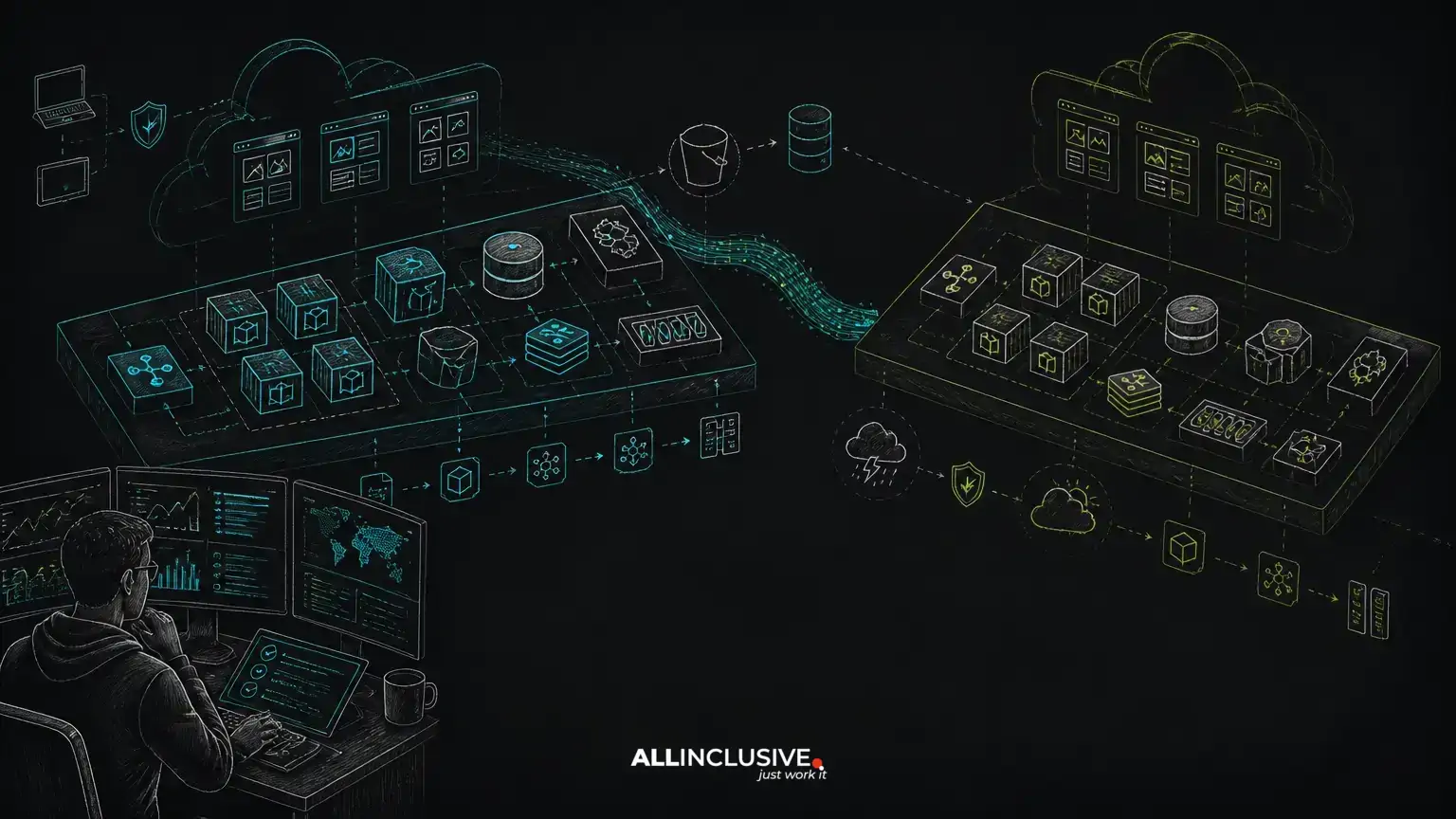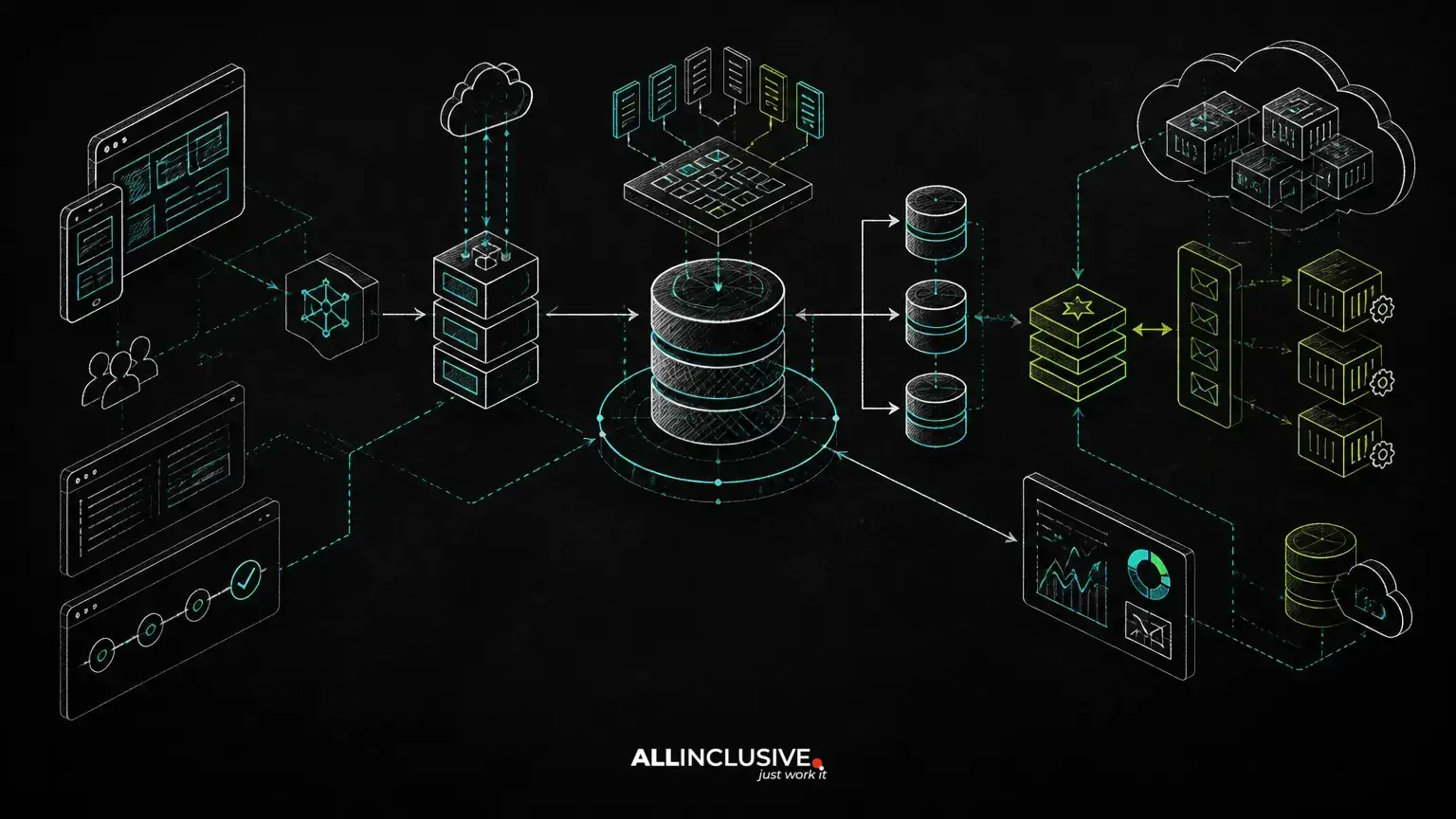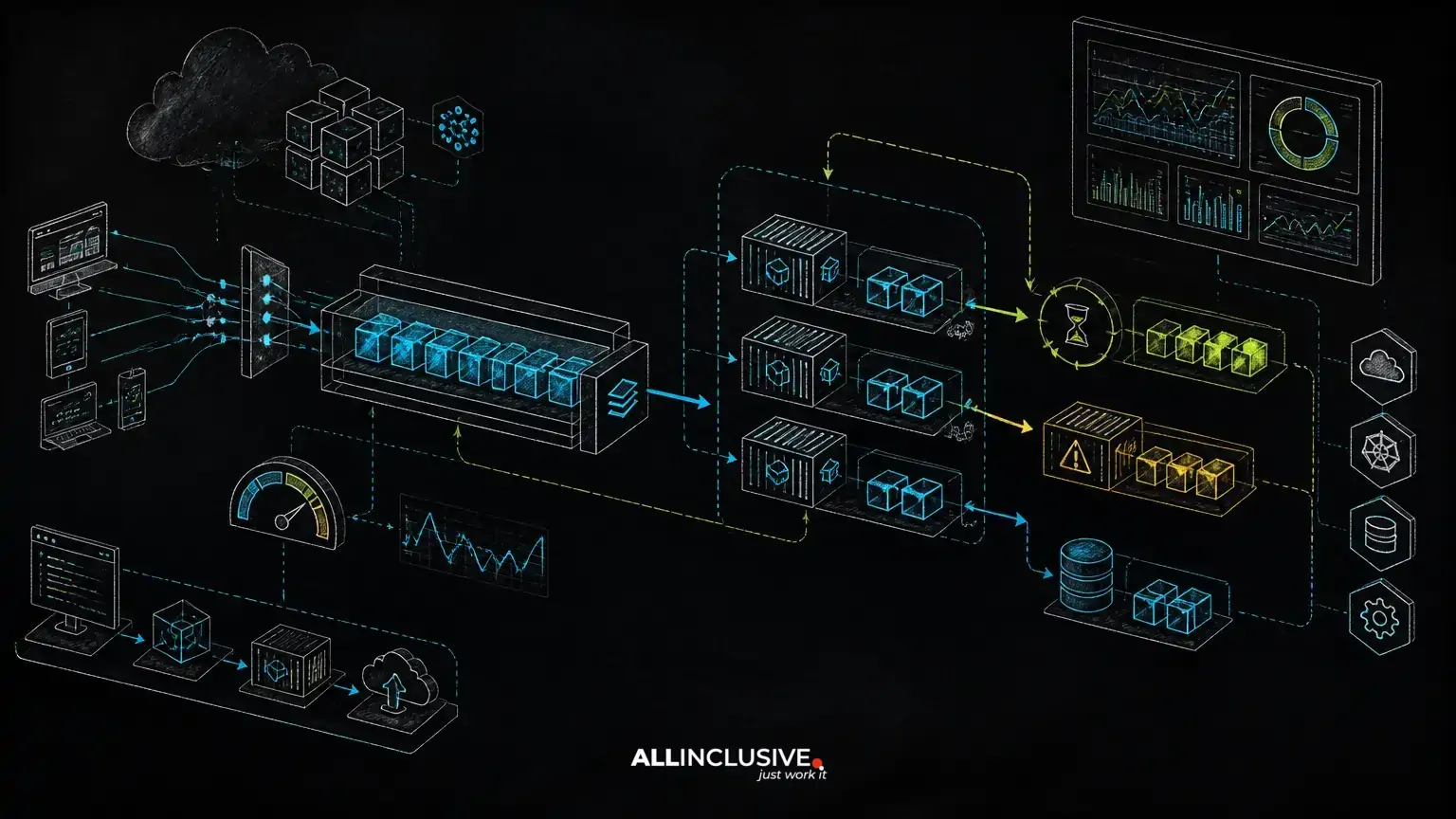
Queue architecture for web applications separates work that must happen during a user request from work that can be processed asynchronously. That separation can improve response times and protect a web application from traffic spikes, but only when the queue has clear delivery, retry, capacity and recovery rules.
A production queue is not simply a broker plus a worker. It is an operating model for delayed work: how jobs are created, claimed, retried, observed, cancelled, deduplicated and recovered. A sound design typically includes a durable job store or broker, independently deployable workers, bounded concurrency, retry policies, dead-letter handling and metrics that show whether the system is keeping up.
This article focuses on the operational decisions behind queue architecture for custom web applications, including AWS and containerized deployments, Redis-backed workloads, databases, CI/CD and incident recovery.
Start by classifying the work, not by choosing a queue product
Queues are useful when work is slow, bursty, failure-prone or independent of the immediate user response. Typical examples include sending email, generating reports, resizing images, importing records, synchronizing with an external API and running an AI inference task that does not need to block the request.
Do not move every expensive operation into a queue automatically. Some actions require an immediate, transactional result. If a user changes an account setting and the application must confirm the change before continuing, asynchronous processing may complicate the workflow rather than improve it.
For each candidate job, define:
- Latency expectation: Must it complete before the response, within seconds, or eventually?
- Durability requirement: Can the work be recreated, or would losing it create a business incident?
- Idempotency: What happens if the same job runs twice?
- Dependency behavior: Which APIs, databases or services can fail or throttle?
- Capacity profile: Is the work CPU-heavy, memory-heavy, I/O-heavy or limited by an external system?
- Ownership: Which team or component is responsible for detecting and resolving failures?
This classification prevents a common architectural mistake: introducing distributed processing without defining the business consequences of delay, duplication or loss.
Separate the request path from the worker path
A conventional web application has at least two execution paths. The request path authenticates the user, validates input, records the job and returns an appropriate response. The worker path claims queued jobs, performs the work and records success or failure.
The request should usually persist the job intention before reporting that the work has been accepted. For example, an application might create an export record with a pending status, enqueue an export job containing the record identifier, and return a status endpoint or notification workflow to the user. The worker then updates the export record as it progresses.
Passing a small identifier through the queue is generally easier to operate than serializing a large object or a snapshot of mutable application state. The worker can load the current data under controlled rules, while the job payload remains inspectable and portable.
For workflows that touch a database and a queue, consider the transaction boundary carefully. A database transaction can commit before a queue publish succeeds, or a queue message can become visible before related database state is committed. An outbox pattern can reduce this inconsistency by writing the intended event or job to a database table in the same transaction as the business change, then publishing it through a separate dispatcher.
Make delivery semantics explicit
Most web application queues should be designed around at-least-once delivery: a job is expected to run one or more times, especially when a worker crashes after completing an action but before acknowledging the message. Exactly-once processing is difficult to guarantee across application code, databases and external services.
At-least-once delivery makes idempotency a core application requirement. A job that sends an email, charges a payment or creates a third-party record needs a way to recognize that the intended operation has already completed. Common techniques include:
- A unique business operation identifier stored with the result.
- A database uniqueness constraint that prevents duplicate creation.
- An idempotency key accepted by an external API.
- A state transition that only permits valid progression, such as pending to completed.
- A reconciliation process for ambiguous external outcomes.
Visibility timeouts, leases or reservation periods should be longer than the normal processing time but not so long that failed work remains invisible for an unreasonable period. Long-running jobs may need heartbeats, checkpoints or deliberate chunking rather than a single large execution.
Design retries around failure type and elapsed time
Retries are useful for transient failures: temporary network errors, rate limits, short database contention or a dependency restarting. They are harmful when applied to permanent failures such as invalid input, missing permissions or a malformed document.
A practical retry policy specifies:
- Maximum attempts: How many executions are allowed before human or automated review?
- Backoff: How long should the worker wait between attempts?
- Jitter: How will the system avoid many jobs retrying at the same moment?
- Exception classification: Which errors are retryable, and which should fail immediately?
- Time budget: How long may the job remain in a retrying state before it becomes operationally irrelevant?
Exponential backoff with jitter is often appropriate for external dependencies because it reduces repeated pressure while the dependency is unhealthy. It is not a universal answer. A user-facing verification message may need a short, bounded retry window, while a nightly data synchronization can tolerate a longer delay.
Retries must also account for side effects. If a worker times out after an external request may have succeeded, retrying can create a duplicate action unless the operation is idempotent or reconciled. Logging the attempt number, job identifier, dependency and error category makes these cases diagnosable.
Use dead-letter handling as a recovery workflow
A dead-letter queue, failed-job store or quarantine table holds work that should not continue retrying automatically. It is not a wastebasket and it is not a substitute for alerting.
Each dead-lettered job should retain enough context to support a safe decision: original payload or reference, creation time, attempt history, error details, dependency response where appropriate and the application version that processed it. Sensitive data should be minimized, protected and subject to retention rules.
Recovery actions usually include:
- Correct the underlying data or configuration, then replay the job.
- Change the retry classification if the failure was incorrectly treated as permanent.
- Cancel the job when the business request is no longer valid.
- Run a compensating action when a partial side effect occurred.
- Escalate to an operator when the external result is ambiguous.
Replay tooling should be controlled and observable. Releasing thousands of failed jobs at once can recreate the incident that caused the backlog. Prefer filtered replay, rate limits and a clear operator identity or audit record.
Apply backpressure before the system reaches failure
Backpressure limits intake or processing when downstream capacity is constrained. Without it, a web application may accept work faster than workers, databases or external APIs can complete it. The visible symptom may be a growing queue, but the deeper problem is often rising memory use, database contention, timeouts and cascading retries.
Backpressure can be implemented at several points:
- Limit the number of jobs accepted for a resource-intensive workflow.
- Use separate queues for interactive, scheduled and bulk workloads.
- Set worker concurrency according to database connections, CPU, memory and dependency limits.
- Throttle calls to external services and honor their rate-limit responses.
- Return an honest pending state rather than allowing unbounded synchronous requests.
- Pause or reduce producers when queue age crosses a defined threshold.
Queue length alone is a weak capacity signal. A small number of long-running jobs can be more dangerous than many short jobs. Track oldest job age, processing duration, retry volume, failure rate, worker saturation and downstream resource utilization.
Redis can be effective for low-latency queues and short-lived coordination, but its operational role should be explicit. Decide whether queued work is recoverable from another source, how persistence and failover are handled, and what happens when Redis memory pressure or connectivity interrupts processing. A database-backed queue may be simpler for some transactional workloads, while a managed cloud queue can reduce infrastructure ownership. The correct choice depends on durability, throughput, ordering, visibility and operational requirements.
Split queues by workload and ownership
A single queue for every job often creates noisy-neighbor behavior. A large report generation task can delay password emails; a retry storm from one integration can consume all worker capacity.
Separate queues when workloads differ in urgency, resource profile, failure behavior or ownership. For example, an application might distinguish user notifications, billing-related operations, media processing and bulk imports. Workers can then use different concurrency, timeout and retry settings.
Ordering also requires deliberate design. Global ordering reduces parallelism and may create bottlenecks. If ordering matters only per customer, account or document, partitioning by that key may provide a better balance, provided the queue technology and worker model support the required behavior.
Instrument the queue as part of the web application
Queue health belongs in the same observability model as HTTP requests and database queries. Useful signals include:
- Jobs accepted, completed, retried and dead-lettered.
- Queue depth and oldest-job age by queue.
- Time spent waiting versus time spent processing.
- Worker availability, concurrency and crash or restart frequency.
- Job duration by type and outcome.
- Dependency latency, throttling and error categories.
- Database connection, lock and storage pressure.
Use a correlation identifier that connects the original request, job record, worker execution and external calls. Structured logs should include the queue name, job type, attempt number, duration and outcome without exposing unnecessary personal or secret data. Traces can show where a job waits or spends time, while metrics provide the trend needed for capacity planning.
Define alerts around user impact and recovery risk, not every transient error. A growing oldest-job age, sustained retry rate or dead-letter increase usually deserves more attention than a single failed attempt.
For a broader implementation model, see web application observability, particularly the relationship between logs, metrics and traces during incidents.
Deploy workers without creating duplicate or incompatible work
Queue workers can outlive the web process that created them, so deployments must account for version compatibility. A worker may be processing a job serialized by an earlier application version, or a job may sit in the queue during a schema migration.
Safer deployment practices include:
- Make job payloads versioned or backward-compatible.
- Deploy additive database changes before code that depends on them.
- Allow old workers to drain before removing behavior they still need.
- Use graceful shutdown so workers stop accepting new jobs and finish or safely release current work.
- Test rollback behavior, including jobs created by the newer version.
- Keep migrations, worker images and application releases coordinated through CI/CD.
Docker can make worker dependencies reproducible, but containers do not solve capacity planning or graceful termination by themselves. In AWS or another cloud environment, scale worker groups based on queue age and resource limits rather than queue length alone. Autoscaling should include stabilization so short bursts do not cause constant worker churn.
Deployment design is closely related to zero-downtime deployment for Laravel and Python applications. The same release must protect both HTTP traffic and asynchronous work.
Test failure modes, not just successful throughput
Load testing should include the queue and its dependencies. Test producers, workers, databases and external integrations under realistic concurrency, payload sizes and failure conditions.
Important scenarios include a worker crash after a side effect, a dependency returning rate limits, a database becoming slow, Redis or the broker becoming unavailable, a full dead-letter store, a deploy during active processing and a backlog that must be drained after recovery.
Measure how the system behaves as capacity is exceeded: Does it reject new work clearly, preserve critical jobs, protect the database and recover without a retry storm? The goal is not merely a high job-per-second figure. It is predictable degradation and a controlled path back to normal operation.
See load testing web applications for a broader approach to finding bottlenecks before launch.
Document recovery and ownership before production
A queue architecture is incomplete until an operator can answer practical questions during an incident. Document who owns each queue, what its normal latency is, which errors are safe to retry, how to pause producers, how to replay dead-lettered work and how to verify that recovery succeeded.
Include backup and disaster-recovery decisions for the job store, application database and any source data needed to rebuild work. Backups do not automatically preserve in-flight queue state, and restoring a queue without restoring the related database state can create duplicate or invalid processing.
For custom web applications, the most maintainable design is usually the smallest queue system that meets the business workflow: explicit job states, bounded concurrency, idempotent handlers, selective retries, useful dead-letter records and observable recovery. Architecture should add operational control where it matters, not distributed complexity for its own sake. Teams planning or improving this kind of system can review custom web application development services and the practical responsibilities covered by support and maintenance.