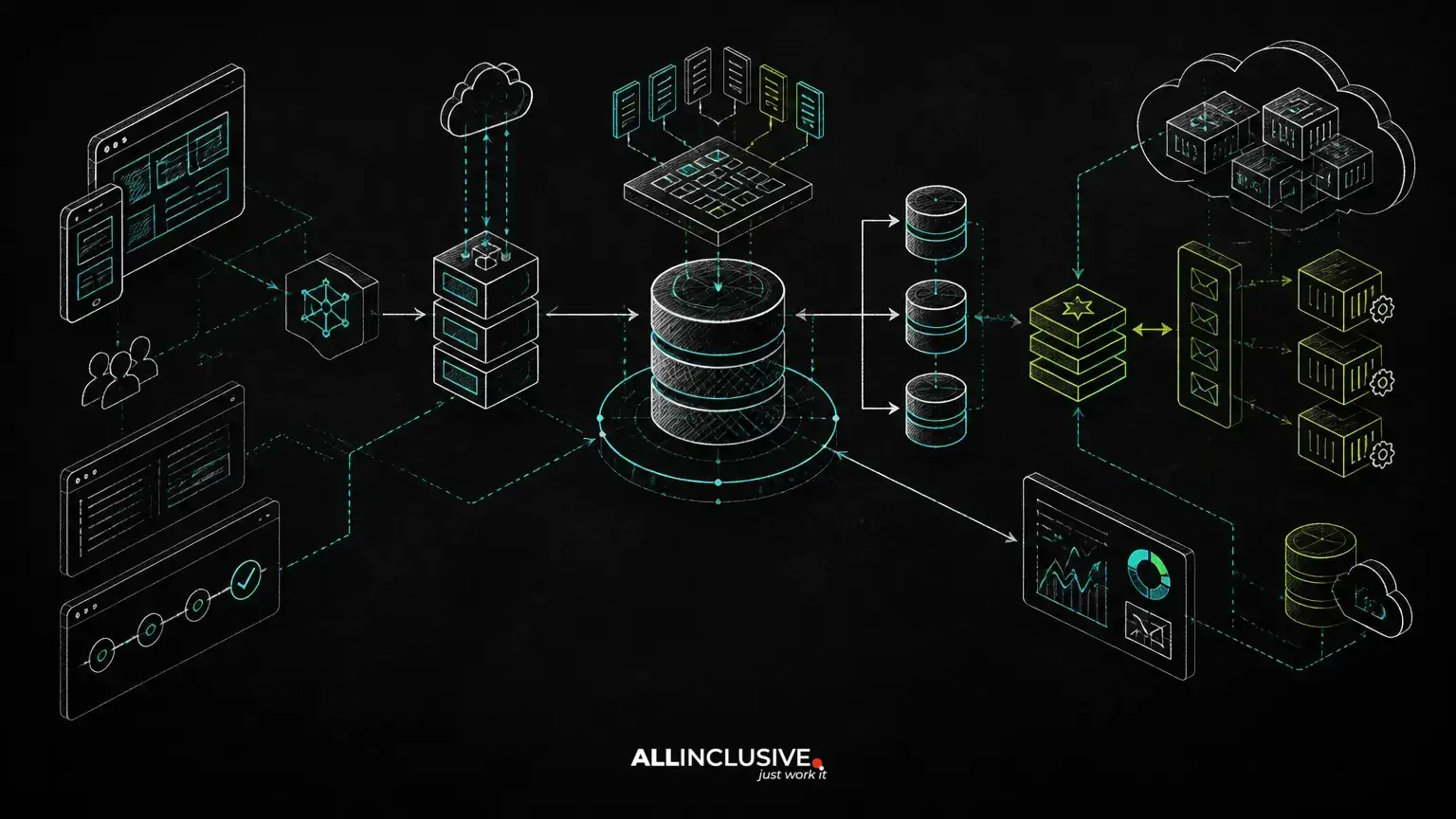
Backup and disaster recovery for a web application is not simply a scheduled database export. A usable recovery plan must restore the application, its data, infrastructure configuration, background jobs, file storage, secrets and operational procedures in an order that supports real business workflows.
For a custom web application, the right design starts with two questions: how much data can the business afford to lose, and how quickly must important workflows resume? Those answers shape the recovery point objective (RPO), recovery time objective (RTO), backup frequency, infrastructure design, deployment process and testing schedule.
The goal is not to make every component redundant at any cost. It is to identify the failure modes that matter, reduce the blast radius, and create a recovery process that the team can execute under pressure.
Define recovery objectives before choosing backup tools
RPO and RTO provide a practical way to connect technical planning with business consequences.
- Recovery point objective: the maximum acceptable amount of recent data that could be lost after an incident.
- Recovery time objective: the target time for restoring an application or a specific business capability.
A customer portal that records orders, payments or regulated information usually has different recovery requirements from an internal reporting tool. Even within one application, the primary transaction path may require faster recovery than historical analytics or administrative features.
Document these objectives by workflow rather than using one broad number for the entire system. A useful recovery policy can state which functions must return first, which data must be restored before the application becomes usable, and which temporary limitations are acceptable during recovery.
Map everything the application must recover
A database backup alone rarely represents the complete state of a modern web application. Create an inventory of the components that influence user-visible behavior and data integrity.
- Primary databases: relational or document data, schemas, extensions, users, permissions and transaction history.
- Object storage: uploaded documents, images, exports, generated files and customer-provided assets.
- Application configuration: environment values, feature flags, connection settings and deployment configuration.
- Secrets: credentials, encryption keys, signing keys and third-party integration tokens, stored through an appropriate secrets-management process.
- Queues and workers: pending jobs, retry state, scheduled tasks and idempotency records.
- Redis or other caches: usually disposable data, but sometimes sessions, locks, rate-limit state or queues that require separate treatment.
- Infrastructure: network rules, compute definitions, load balancers, DNS, certificates, storage policies and monitoring configuration.
- Source and release artifacts: version-controlled code, dependency manifests, container images and migration history.
This inventory helps distinguish data that must be backed up from state that can be rebuilt. It also exposes dependencies that are easy to overlook. For example, restoring a database without the matching object-storage files may leave orders, profiles or records that reference unavailable documents.
Build layered backups in the cloud
A resilient AWS or other cloud architecture usually combines several recovery layers instead of depending on a single backup mechanism.
Use database backups for point-in-time recovery
Scheduled snapshots provide restore points, while transaction-log or equivalent continuous recovery mechanisms can reduce the gap between backups where the platform supports them. Retention should reflect business requirements, legal obligations and the risk of accidental deletion or corruption.
Backups should be protected from the same failure that affects the primary database. That can mean separate accounts, regions, storage locations or access controls, depending on the threat model and recovery objectives. The design should also cover who can delete backups and how administrative access is audited.
Protect object storage independently
Files often grow faster than database data and may have different retention requirements. Versioning, lifecycle rules, replication and immutable retention can be useful, but each adds operational and storage considerations. Do not assume that enabling a feature automatically creates a tested recovery process.
Keep infrastructure reproducible
Infrastructure as code and containerized deployments can make it possible to rebuild compute and supporting services rather than preserving every server indefinitely. Docker images, dependency versions and deployment manifests should be available from systems that remain accessible during an incident.
Reproducibility also improves routine delivery. A team that can create a clean environment for a release is generally better positioned to recreate one during disaster recovery.
Separate recoverable state from rebuildable state
Not every component deserves the same backup strategy. A useful classification is:
- Critical durable state: customer records, financial transactions, permissions and other information that cannot be recreated reliably.
- Recoverable artifacts: uploaded files, generated reports or configuration exports that may require backup or regeneration.
- Rebuildable infrastructure: containers, worker processes, application servers and temporary environments defined through deployment automation.
- Disposable state: cache entries and derived data that can be repopulated after recovery.
Redis deserves careful classification. A cache can usually be cleared and rebuilt. Redis may require stronger recovery controls when it holds sessions, distributed locks, rate-limit state or queue data. If losing that state could duplicate work or create authorization problems, document the recovery behavior explicitly.
Design recovery around queues, retries and consistency
Background processing creates a common recovery problem: the database may be restored while the queue contains jobs from before the incident, or the queue may be restored without the state those jobs expect.
Workers should be designed for safe retry where practical. Idempotency keys, transactional status changes and deduplication records can help prevent an email, payment request or external API operation from being performed twice. Dead-letter handling gives operators a way to isolate jobs that cannot be safely retried.
After restoring a system, decide whether to discard, replay or rebuild pending work. That decision should be made per job type. Rebuilding a search index may be straightforward; replaying a financial side effect requires substantially more control.
For related guidance on failure handling and operational flow, see queue architecture for web applications.
Make deployment recovery part of disaster recovery
A backup is not useful if the team cannot deploy the compatible application version that reads it. Release automation should preserve the relationship between code, database migrations, container images and configuration.
Prefer deployment processes that support controlled rollback and backward-compatible schema changes. A database migration that removes a column immediately may make application rollback impossible. Expand-and-contract patterns can reduce this risk by adding compatible structures first, migrating usage, and removing obsolete structures only after the old version is no longer required.
Zero-downtime deployment patterns can reduce planned disruption, but they do not replace disaster recovery. They address how to release during normal operations; disaster recovery addresses how to restore service after infrastructure failure, data corruption, an operational mistake or a security incident. Read more about zero-downtime deployment for Laravel and Python applications when release continuity is part of the operating model.
Test restoration, not just backup completion
A successful backup job proves that data was written somewhere. It does not prove that the data can be restored within the required time or that the application will function afterward.
Recovery testing should include several levels:
- File-level validation: confirm that backup jobs complete, retention is correct and stored objects are readable.
- Database restore tests: restore into an isolated environment and verify schemas, permissions, migrations and representative records.
- Application recovery tests: deploy the intended application version, connect dependencies and exercise important user workflows.
- Failure simulations: rehearse scenarios such as accidental deletion, corrupted data, unavailable infrastructure, compromised credentials or a failed release.
- Operational drills: have the people responsible for recovery perform the steps using documented access and escalation paths.
Record the duration, missing prerequisites, confusing instructions and validation results. A recovery runbook should improve after every exercise. Testing also reveals hidden assumptions, such as a required manual DNS change, an unavailable credential or a vendor dependency that cannot be recreated in the recovery environment.
Use observability to confirm that recovery worked
Recovery is incomplete when servers are running but users cannot complete important actions. Logs, metrics and traces help distinguish a successful infrastructure restart from a usable application recovery.
Monitor database connectivity, error rates, queue depth, worker health, cache behavior, storage access and third-party integration failures. Compare restored behavior with known normal signals where possible, while avoiding assumptions that a temporary recovery environment will have identical capacity.
Observability should also support incident diagnosis. Structured logs can show which release and configuration were active; metrics can reveal whether processing is catching up; traces can identify a dependency that remains unavailable. The article on web application observability covers how these signals work together during incidents.
Account for scale and recovery capacity
A recovery environment must be capable of handling the workload expected during restoration. Rebuilding a database on undersized infrastructure may technically succeed while leaving the application unusable for hours.
Load testing and capacity planning can inform recovery decisions, especially for applications with large queues, high read traffic or resource-intensive imports. Test the most important workflows and the recovery sequence rather than focusing only on normal peak traffic. See load testing web applications for a broader approach to finding capacity limits before they become incidents.
Cost is part of the design. Warm standby environments, cross-region replicas and extensive retention can shorten recovery but increase ongoing spend. A rebuild-from-code strategy may cost less to operate but demands stronger automation and accepts a longer recovery window. The right balance depends on the business value of availability and data freshness.
Assign ownership and keep the runbook usable
Disaster recovery fails operationally when responsibility is vague. Define who can declare an incident, approve a failover, access backups, communicate with stakeholders, validate business workflows and return the system to normal operation.
The runbook should contain concrete steps, decision points, links to dashboards, access prerequisites, rollback conditions and post-recovery checks. Avoid documenting only ideal conditions. Include what to do when a restore fails, a backup is incomplete, a dependency is unavailable or credentials cannot be used.
For custom applications, recovery ownership may span product, engineering, infrastructure, security and business operations. Clear boundaries reduce delays and help teams decide which features can remain offline while the highest-value workflows are restored.
A practical backup and recovery checklist
- Document RPO and RTO by business-critical workflow.
- Inventory databases, files, secrets, queues, caches, infrastructure and external dependencies.
- Define which state must be backed up and which state can be rebuilt.
- Protect backups from accidental deletion, credential compromise and failure of the primary environment.
- Preserve compatible code, images, migrations and infrastructure definitions.
- Design queue jobs and external side effects for safe retry where appropriate.
- Test database and object-storage restoration in an isolated environment.
- Validate real user workflows, not just service health checks.
- Use logs, metrics and traces to verify recovery and investigate gaps.
- Run drills, measure recovery time and update the runbook.
A resilient custom web application is not defined by having the most elaborate infrastructure. It is defined by whether the organization can restore important workflows, protect trustworthy data and make informed trade-offs during failure. For broader guidance on planning and building maintainable custom systems, visit custom web development. Ongoing backup reviews, recovery drills and production monitoring can also be part of a structured support and maintenance plan.