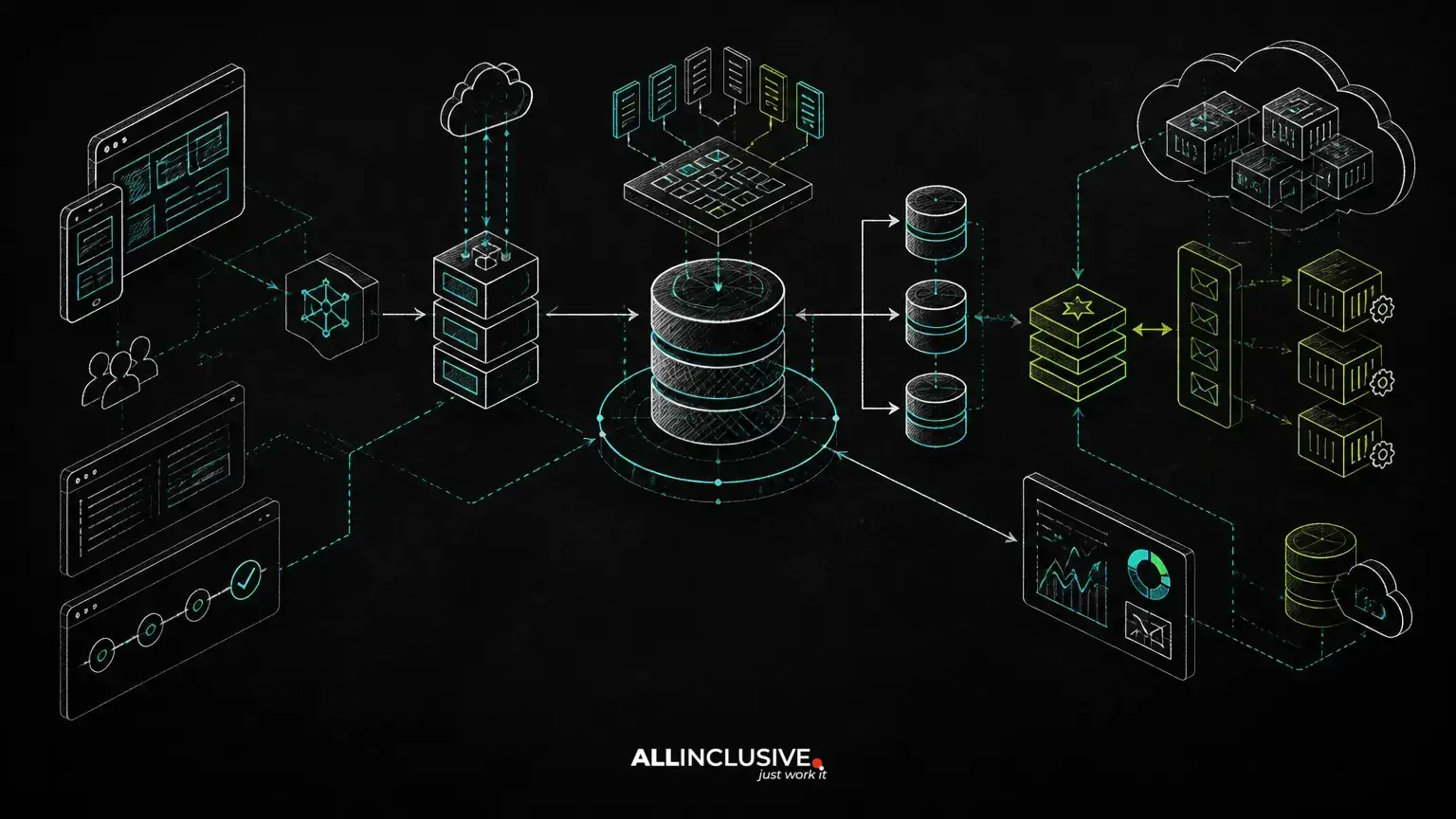
Database scaling for a web application is rarely solved by adding hardware alone. The durable approach is to identify the workload constraint, improve query behavior, separate read and write pressure where appropriate, and add operational controls that protect data during deployments, traffic spikes and failures. The database scaling web application workflow also connects to the guidance in support and maintenance.
For most custom web applications, scaling should proceed incrementally: measure the workload, fix inefficient access patterns, add carefully designed indexes, introduce caching for suitable reads, and only then consider replicas or partitioning. This sequence reduces cost and avoids turning a manageable application into a distributed system before the product requires one.
Start with the workload, not the database feature list
A database may appear slow when the actual bottleneck is elsewhere. Application code can issue too many queries, a queue worker can consume connections, a load balancer can send uneven traffic to application containers, or a slow external integration can hold database transactions open.
Before changing the architecture, establish what is happening in production-like conditions. Useful signals include:
- Query latency by operation, not only average database latency.
- Slow-query samples with execution plans and representative parameters.
- Connection utilization, lock waits, transaction duration and storage I/O.
- Read-to-write volume and traffic patterns by endpoint or workflow.
- Cache hit and miss behavior where caching already exists.
- Queue depth and worker concurrency when background jobs use the database.
Application logs, database metrics and distributed traces should be correlated so a slow user workflow can be followed to the query, lock or downstream dependency causing it. The web application observability practices used for incident response are equally valuable during capacity planning.
Indexes improve access paths, but they are not free
An index helps the database locate rows without scanning an entire table. It is often the first database scaling measure because it can improve a high-volume query without changing the application’s overall architecture.
Good index design starts with actual query patterns. A filter, join, sort or uniqueness rule may justify an index, but adding indexes for every column can create new costs. Each additional index consumes storage, increases write work and can make maintenance more expensive. An index that matches a query in development may be less useful in production if data distribution or parameter values differ.
Review composite indexes against real queries
Composite indexes can support queries involving several columns, but column order matters. The most useful order depends on the application’s filtering, sorting and selectivity patterns. A query that filters by account and status, then sorts by creation time, may require a different index from one that searches globally by status.
Use execution plans to verify whether the database selects the intended index and whether the resulting plan reduces rows examined. Recheck plans after data growth, schema changes and major shifts in user behavior. Index tuning is an ongoing operational task, not a one-time migration.
Connection and transaction management limit application scale
Adding application containers can increase throughput only until the database reaches its connection, CPU, I/O or lock limits. A containerized deployment should therefore treat database connections as a shared budget. If every container opens a large pool, horizontal scaling can exhaust the database even when each container appears healthy in isolation.
Transactions should be short and should contain only the work that must be atomic. Avoid holding a transaction open while calling an external API, waiting for a user interaction or performing expensive application-side processing. Long transactions can retain locks, delay cleanup and make otherwise independent requests queue behind one another.
Connection pooling can reduce connection setup overhead, but it does not remove database capacity limits. Pool sizes should be tested with the expected number of application instances, workers and administrative processes. Timeouts and graceful failure behavior are important: a saturated database should produce controlled errors and backpressure rather than an uncontrolled retry storm.
Read replicas separate some read pressure from writes
A read replica maintains a copy of data that can serve selected read queries. This can help when read volume is the dominant pressure and the application can tolerate the replica’s consistency behavior.
Replicas are not a universal performance solution. Writes still go to the primary in many common designs, and replication introduces operational concerns such as lag, failover procedures, monitoring and routing. A request that writes data and immediately reads it may need to read from the primary to guarantee read-after-write behavior. Otherwise, the user could temporarily see stale state.
Route reads by consistency requirement
Do not classify every query simply as “read” or “write.” Classify it by business consequence:
- Reads that confirm a just-completed payment, account change or permission update often require current data.
- Reports, search results and historical dashboards may tolerate bounded staleness.
- Administrative and reconciliation workflows may require explicit primary-database reads.
Routing logic should be visible in application code or a well-defined data-access layer. It should also be covered by tests that exercise failover, replica lag and primary-only workflows. A replica that cannot be monitored or safely removed from service is an operational liability rather than a scaling improvement.
Use Redis caching for repeatable, non-authoritative reads
Caching reduces repeated database work by serving suitable data from a faster store. Redis can be useful for frequently requested data, short-lived session state, rate-limit counters, computed responses and coordination primitives, depending on the design.
The central question is not whether a value is expensive to calculate. It is whether the application can safely serve a cached version and define when that version becomes invalid. Cache keys, expiration policies and invalidation rules should be designed together.
Common failure modes include stale permissions, outdated inventory, unbounded key growth and a cache stampede when many requests regenerate the same missing value. Mitigations can include short or explicit expiration, event-driven invalidation, request coalescing, bounded memory policies and fallback behavior when Redis is unavailable.
For a more detailed treatment of these trade-offs, see the Redis caching strategy guide. Caching should reduce database pressure without becoming a second, undocumented source of truth.
Partition large tables when data boundaries are clear
Partitioning divides a logical table into smaller physical segments according to a key such as time, tenant or geographic scope. It can help large workloads by limiting the data considered by queries, simplifying retention operations or isolating maintenance work.
Partitioning adds design and operational complexity. Queries need partition-friendly predicates, indexes may need to be managed across partitions, and cross-partition operations can be expensive. A poor partition key can create hotspots or leave most queries scanning many partitions.
Time-based partitioning is often considered for event, audit or transaction history where retention follows a date boundary. Tenant-based partitioning may fit specific isolation or lifecycle requirements, but it requires careful handling of tenants with very different sizes. Partitioning is usually a later-stage decision supported by measured table growth and query patterns, not a default requirement for a new application.
Move non-interactive work to queues
Some database load comes from work that does not need to complete during the user’s request: report generation, imports, notifications, search indexing and data synchronization are common examples. A queue allows the request to acknowledge the work while workers process it at controlled concurrency.
Queues do not eliminate database load. They make it possible to regulate that load, retry transient failures and schedule work away from peak traffic. Workers still need idempotency, transaction boundaries, visibility into failures and a plan for poison messages. Backpressure matters: allowing an unlimited worker fleet to process a backlog can overwhelm the database faster than the original traffic did.
The queue architecture for web applications guide covers retries, dead-letter handling and backpressure in more detail.
Make scaling changes safe to deploy and operate
Database performance work is inseparable from delivery practices. Schema migrations should be reviewed for lock duration, table size and compatibility with the application versions deployed before and after the change. A migration that is safe on a small staging dataset may behave differently on a large production table.
For containerized applications, CI/CD should validate migrations, query behavior and rollback assumptions. Prefer backward-compatible changes when deploying multiple application instances: add new structures first, deploy code that can use both old and new forms, migrate data where needed, and remove obsolete structures only after the old code path is gone.
Zero-downtime deployment also requires attention to connection draining, worker coordination and replica health. See zero-downtime deployment patterns for Laravel and Python applications.
Test the database under realistic load
Load testing should reproduce the workflows that create database pressure rather than sending artificial requests to a single endpoint. Include realistic read and write ratios, concurrent users, background workers, cache behavior, connection limits and data volumes.
Measure latency percentiles, error rates, lock waits, connection saturation, queue depth and resource utilization. Test degraded conditions as well: a slow replica, unavailable cache, delayed worker, failed database connection or partial deployment. The objective is not only to find a maximum request rate. It is to learn how the system behaves as it approaches its limits and whether it fails in a controlled way.
Use the load testing web applications checklist to connect test scenarios with capacity and release decisions.
Protect recoverability while increasing capacity
Scaling introduces more components and therefore more failure modes. Backups, point-in-time recovery where supported, restoration testing and documented recovery ownership should accompany changes to replicas, caches, queues and partitioned data.
A replica is not automatically a backup. Replication can copy accidental deletions or corruption, while a cache can be rebuilt but still affect user workflows during recovery. Define which data is authoritative, how it is restored, how applications are placed into a safe operating mode and how recovery is verified.
The backup and disaster recovery guidance for custom web applications covers these controls in greater depth.
A staged database scaling plan for custom web applications
- Measure the workload: correlate application traces, query plans, database metrics and user-facing latency.
- Fix inefficient access: remove query multiplication, reduce unnecessary fields, shorten transactions and add only justified indexes.
- Control asynchronous work: move suitable jobs to queues and limit worker concurrency.
- Add caching deliberately: document ownership, expiration, invalidation and fallback behavior.
- Separate read pressure: evaluate replicas only after consistency requirements and lag handling are explicit.
- Partition based on evidence: use clear data boundaries, tested queries and an operational plan.
- Verify delivery and recovery: test migrations, deployments, backups, restoration and degraded service behavior.
For teams planning a new system or stabilizing an existing one, database decisions should fit the broader application architecture rather than being made in isolation. Allinclusive’s custom web development services can be evaluated alongside the application, cloud, CI/CD and operational requirements that shape long-term scalability. Ongoing ownership also matters; maintenance processes should cover monitoring, upgrades, capacity review and recovery exercises, not just urgent bug fixes.