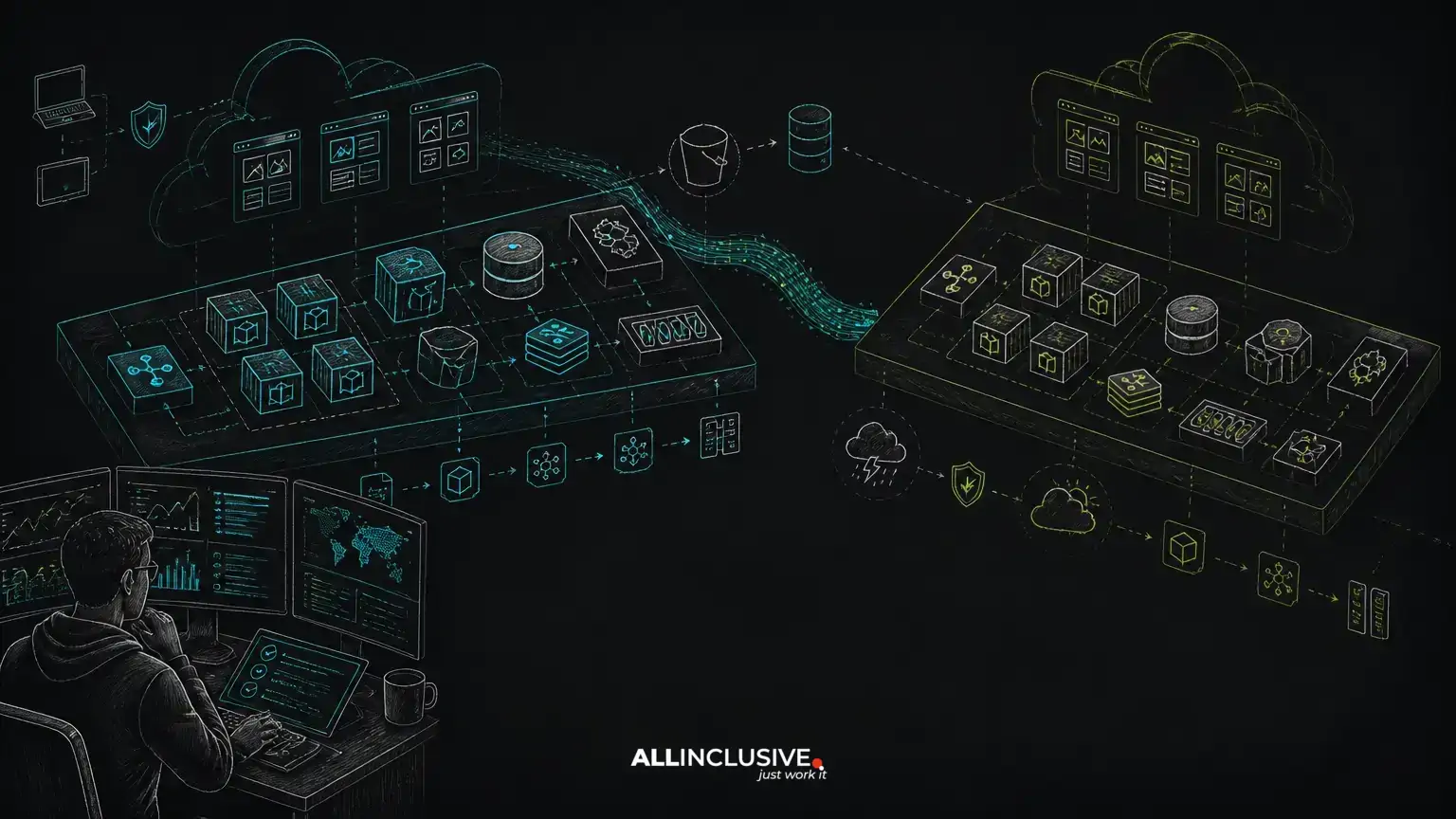
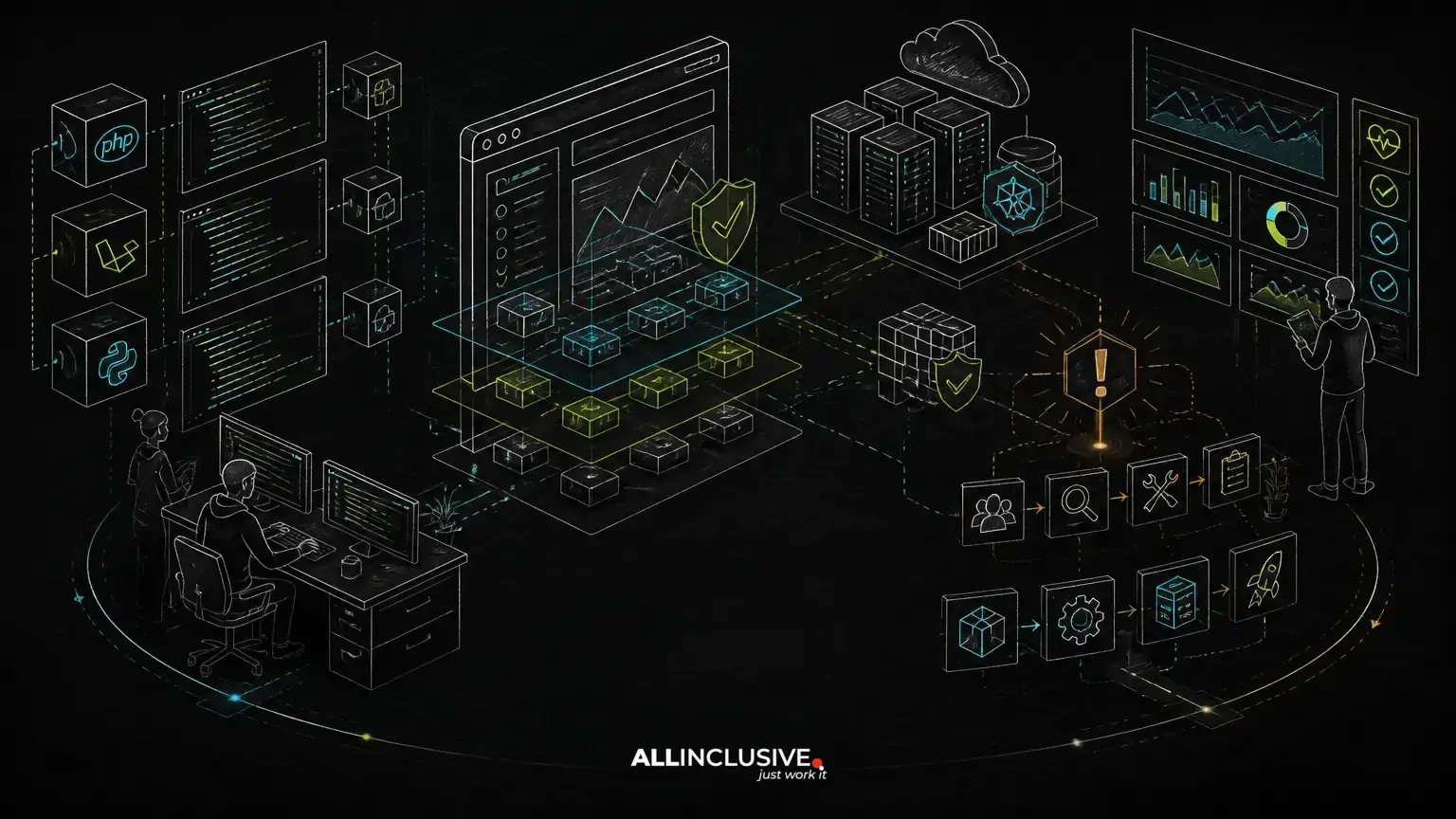
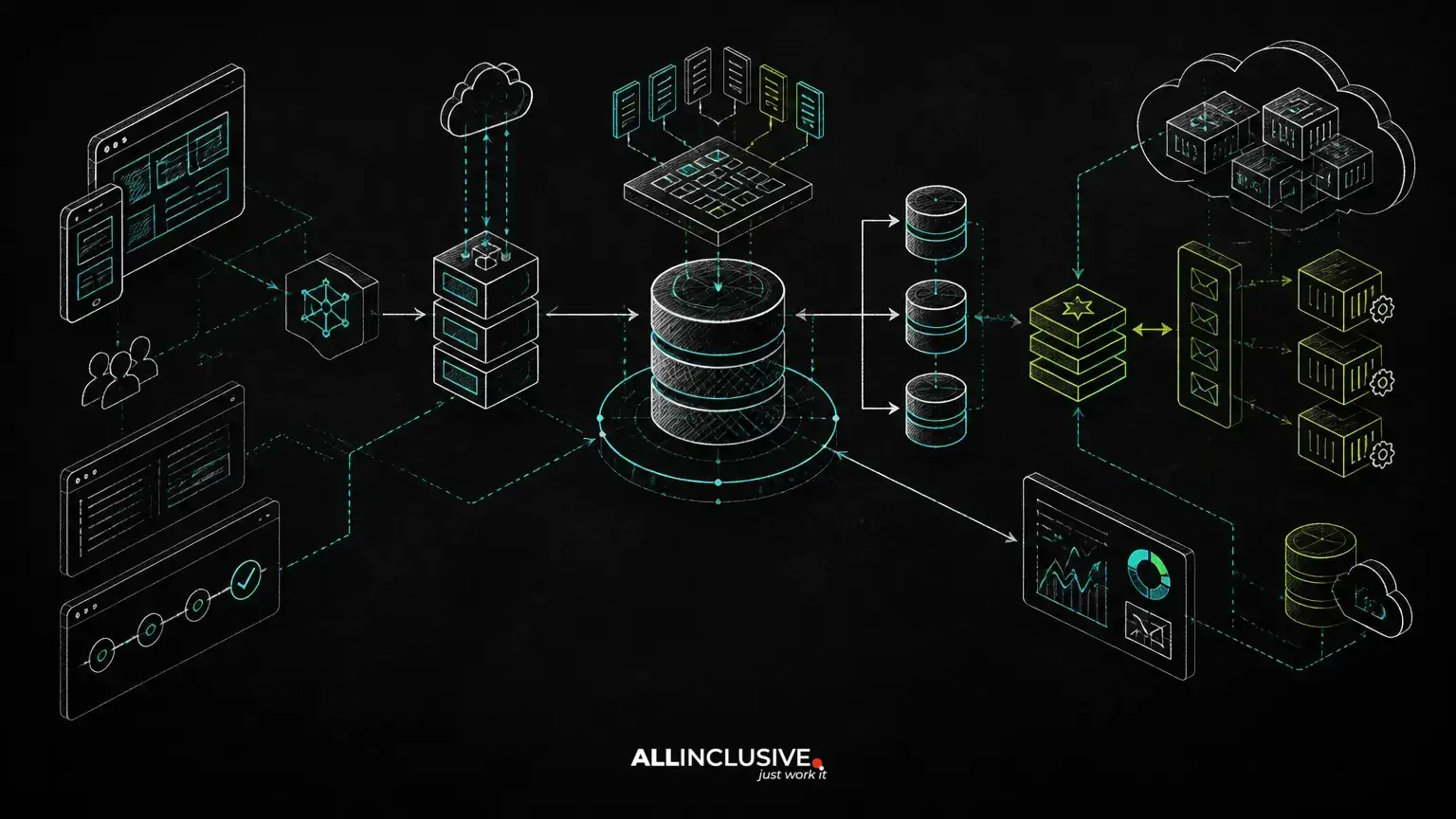
A ci cd pipeline web application workflow should do more than move code from a repository to a server. It should provide a repeatable path for validating changes, deploying them safely, observing their behavior and recovering when a release does not perform as expected. The ci cd pipeline web application workflow also connects to the guidance in custom software development.
For custom web applications, that path often includes Docker images, automated tests, database migrations, background queues, Redis, cloud infrastructure and production monitoring. The right design is not necessarily the most complex one. A well-structured pipeline should match the application’s risk, release frequency and operational ownership while leaving room to scale.
What a CI/CD pipeline should control
Continuous integration validates proposed changes before they are merged. Continuous delivery or deployment moves an approved version through environments and, depending on the organization’s controls, into production.
A useful pipeline establishes clear answers to five questions:
- Does the code build consistently?
- Does it pass the tests and quality checks appropriate to the application?
- Can the version be deployed without damaging data or interrupting active users?
- Can the team see whether the release is healthy?
- What is the recovery path if the release fails?
These controls reduce operational risk, but they also improve maintainability. When environment configuration, build steps and deployment procedures are explicit, fewer release decisions depend on undocumented knowledge held by one developer.
Stage one: validate every pull request
The first pipeline stage should provide fast, actionable feedback on each pull request. It commonly includes dependency installation, formatting or lint checks, static analysis, unit tests and an application build.
Tests should be layered rather than treated as one undifferentiated suite. Unit tests can validate isolated business rules quickly. Integration tests can exercise database access, queues, caching or external-service boundaries. Browser or end-to-end tests should cover the highest-value user workflows, such as authentication, checkout, approval or content publishing.
Running every expensive test on every small change may slow delivery without adding equivalent confidence. A practical design runs fast checks on all pull requests, uses targeted integration tests where appropriate and reserves broader suites for merge, release or scheduled validation.
Make failures diagnosable
A failed check should identify the changed component, preserve relevant logs and return quickly enough that developers can act on it. Flaky tests require ownership; repeatedly rerunning them until they pass weakens the signal the pipeline is intended to provide.
Dependency and security checks can also run during CI. Their exact configuration depends on the language, package ecosystem and risk profile, but the principle is consistent: identify vulnerable or disallowed dependencies before they become part of a release artifact.
Build one deployable artifact
Build the application once and promote the resulting artifact through environments whenever possible. For containerized applications, this usually means producing a versioned Docker image that contains the application code and its runtime dependencies.
Separating build from deployment prevents a production server from silently compiling a different version than the one tested in CI. It also makes releases easier to identify and roll back. The image or package should be traceable to a commit, pull request or release identifier.
Environment-specific values should remain configuration, not be baked into the artifact. Database credentials, API keys, queue endpoints and feature settings should be supplied through an appropriate secrets and configuration mechanism. Secrets should not appear in source control, build logs or container images.
Promote through environments with purpose
A staging environment is useful when it resembles production in the areas that matter: runtime versions, database behavior, queue processing, cache usage and deployment procedures. It does not need to match production capacity exactly, but major environmental differences can invalidate test results.
Promotion rules should reflect business risk. A low-risk internal change may require automated checks and one approval. A migration affecting billing, permissions or customer data may require a review by an engineer who understands the data model and a documented release window.
Do not treat staging as a permanent substitute for production observability. A release can pass functional tests and still fail because of traffic patterns, resource limits, slow queries or a downstream dependency. Production safeguards remain necessary.
Handle database migrations as release operations
Application code and database schema changes often have different lifecycles. A deployment can fail even when the application code is correct if a migration locks a large table, consumes excessive resources or removes a field still needed by an older application instance.
Prefer backward-compatible migration sequences for releases that may overlap during deployment:
- Add the new column, table or index without removing the old path.
- Deploy application code that can use the new structure while remaining compatible with the existing one.
- Backfill or transform data through a controlled process when necessary.
- Remove obsolete structures only after the old code path is no longer active and recovery requirements have been considered.
Migration execution should be observable and should have a clear owner. For large datasets, schema changes and data backfills may need separate jobs rather than running as part of the request-serving deployment.
Deploy web, queue and scheduled processes together
Many web applications include more than a request-serving process. Laravel and Python systems, for example, may have web workers, queue workers, scheduled tasks and administrative commands. The pipeline should define how each component receives the new version and how compatibility is maintained during the transition.
Queue workers are particularly important. Workers may continue processing jobs created by an earlier application version while a new version is being deployed. Job payloads should therefore be designed with version tolerance in mind, and workers should be restarted or drained according to the runtime and deployment strategy.
Scheduled tasks also need protection against duplicate execution. A release process should identify which scheduler is authoritative, how overlapping runs are prevented and how failed jobs are retried or investigated.
For a deeper treatment of retries, dead letters and backpressure, see queue architecture for web applications.
Choose a deployment strategy based on failure tolerance
Deployment strategy determines how traffic moves from the old version to the new one.
- Rolling deployment: instances are updated in groups. This can limit disruption, but old and new versions may run simultaneously.
- Blue-green deployment: two environments are maintained and traffic switches between them. This can simplify rollback, though it requires additional infrastructure and careful database compatibility.
- Canary deployment: a limited portion of traffic reaches the new version before broader rollout. This provides useful production feedback, but requires routing, monitoring and explicit promotion criteria.
- Recreate deployment: the old version is stopped before the new one starts. It is simpler but creates an interruption and is generally unsuitable for availability-sensitive workflows.
Zero-downtime is not achieved merely by selecting a deployment label. It depends on connection draining, health checks, compatible migrations, session handling, worker behavior and the ability to remove unhealthy instances from service. Review the operational trade-offs in zero-downtime deployment patterns.
Use AWS and cloud services without hiding operational ownership
AWS or another cloud platform can provide managed compute, databases, object storage, queues, load balancing and observability services. Managed infrastructure can reduce maintenance work, but it does not remove architectural responsibility.
The team still needs to define network boundaries, identity permissions, backup policies, scaling rules, deployment triggers and ownership for incidents. Infrastructure as code can make these decisions reviewable and reproducible, especially when environments are created or changed through the same source-control process as application code.
Docker can provide consistency between local development, CI and deployment, but containers do not automatically solve capacity planning or service discovery. Keep the runtime topology understandable. A modular application with a web tier, database, Redis instance and queue workers may be easier to operate than a collection of microservices with unnecessary coordination overhead.
Observe the release after deployment
A deployment is incomplete until the team verifies its behavior. Automated smoke tests can confirm that the application starts, essential endpoints respond and basic authentication or data access works. Monitoring should then evaluate both technical health and user-facing behavior.
Useful release signals include:
- Request error rates and latency by endpoint or operation.
- Container, host or runtime CPU and memory pressure.
- Database connection saturation, slow queries and lock activity.
- Queue depth, job age, retry counts and failed-job volume.
- Cache hit behavior and Redis memory or availability signals.
- Application exceptions correlated with the deployed version.
- Business workflow failures, such as incomplete submissions or payment-state mismatches.
Logs provide event detail, metrics show trends and traces help connect work across application and service boundaries. Together they shorten diagnosis when a release changes behavior without producing an obvious outage. See web application observability practices for a more detailed instrumentation model.
Test scale before production traffic exposes limits
Load testing should reflect realistic workflows rather than only requesting a public homepage. Test the operations that consume database connections, invoke external APIs, enqueue jobs or invalidate caches.
Record the assumptions behind the test: concurrent users, request mix, payload size, data volume, cache state and expected background activity. The purpose is not to produce a universal capacity number. It is to identify bottlenecks and establish a repeatable way to compare changes.
Common findings include an inefficient query, an unbounded export, insufficient worker concurrency, a cache stampede or a third-party rate limit. Each requires a different response. Adding servers may help capacity, but it will not correct a lock, an unindexed query or a retry storm.
Design rollback and recovery separately
Rollback means returning application behavior to an earlier version. Recovery means restoring service and data after a broader failure. They are related but not interchangeable.
A rollback may be unsafe after an irreversible schema change or a data transformation. Before release, document whether the application can return to the previous artifact, how queues created by the new version will be handled and whether feature flags can disable the changed workflow.
Recovery planning should include automated backups, retention requirements, restore testing and a defined recovery point and recovery time objective where the business has established them. Backups that have never been restored are assumptions, not a verified recovery capability.
A practical pipeline checklist for custom web applications
- Pull requests run repeatable formatting, analysis, security and test checks.
- Builds produce traceable, versioned artifacts.
- Secrets and environment configuration are separated from source code.
- Staging validates the runtime and deployment process that matter.
- Database migrations are backward-compatible or have an explicit transition plan.
- Web processes, queue workers and schedulers have coordinated release procedures.
- Health checks and traffic management prevent unhealthy instances from serving requests.
- Smoke tests and post-deployment monitoring verify release health.
- Logs, metrics and traces identify the deployed version.
- Rollback, backup restoration and disaster recovery responsibilities are documented.
For teams planning or extending a custom application, web development services should include the operational design required to build, deploy and support the product—not only the code that runs on a developer’s machine. Ongoing ownership may also require support and maintenance planning for monitoring, dependency updates, incident response and controlled infrastructure changes.