An application maintenance checklist turns ongoing ownership into a repeatable operating practice. For a mature custom PHP, Laravel or Python system, maintenance should cover more than bug fixes: teams need visibility into application health, a reliable incident process, current dependencies, controlled releases, security response, performance trends and a credible plan for technical debt.
The checklist below is designed for product owners, engineering leaders and support teams responsible for software after launch. It helps distinguish routine maintenance from urgent operational work and gives teams a practical basis for deciding what to monitor, document, schedule and improve.
1. Confirm ownership and operational responsibilities
Maintenance becomes unreliable when responsibility is ambiguous. Start by documenting who owns the application, infrastructure, data, deployments, security response and business decisions. This is particularly important when a team inherits a custom codebase or when the original developers are no longer available.
- Name the technical owner and business owner.
- Document repositories, hosting accounts, environments and deployment access.
- Identify who can approve emergency changes and production rollbacks.
- Define support hours, escalation paths and service-level expectations.
- Record critical workflows, integrations and data dependencies.
- Keep an up-to-date system diagram and runbook.
Ownership should include decision rights, not just a contact list. Someone must be able to prioritize a security patch, accept a temporary workaround or defer a feature when operational risk is higher.
2. Establish application and infrastructure monitoring
Monitoring should reveal user-impacting problems before support tickets become the first signal. Application-level telemetry is often more useful than infrastructure metrics alone because a server can appear healthy while authentication, checkout, reporting or background processing is failing.
Review the following monitoring areas:
- Request errors, exception rates and response-time trends.
- Availability of critical user journeys, not only the home page.
- Queue depth, scheduled jobs, failed workers and retry behavior.
- Database connection failures, slow queries and capacity indicators.
- Storage, memory, CPU and network saturation.
- Third-party API failures, timeouts and rate-limit responses.
- Log ingestion, alert delivery and monitoring-system health.
For Laravel applications, this may include queue workers, scheduled commands, failed jobs and application logs. For Python systems, review task workers, scheduled processes, web-server errors and framework-specific exception reporting. PHP systems without a modern framework still need consistent error capture, request correlation and meaningful operational logs.
Alerts should be actionable. An alert that fires frequently without a clear response path creates noise and encourages teams to ignore future warnings. Each production alert should have an owner, severity, expected response and documented first checks.
3. Test critical workflows and recovery paths
Automated tests are part of maintenance, but they are not the entire test strategy. Mature applications also need targeted checks for business workflows that are difficult to infer from unit coverage alone.
- Run unit and integration tests on every relevant change.
- Cover authentication, authorization and permission boundaries.
- Test critical forms, payments, imports, exports and notifications.
- Verify scheduled jobs and asynchronous processing.
- Exercise failure paths such as timeouts, duplicate requests and partial third-party outages.
- Perform smoke tests after deployment.
- Periodically test backups and restoration procedures.
A passing test suite does not prove that production recovery works. Confirm that the team can restore the application, retrieve required secrets, rebuild an environment and validate essential workflows. Recovery instructions should be tested rather than treated as permanent documentation.
4. Review security exposure and patch priorities
Security maintenance is a continuous process of identifying, prioritizing and reducing exposure. It includes application code, dependencies, infrastructure, credentials, access controls and operational procedures.
- Review dependency advisories and available security updates.
- Remove unused packages, extensions, services and credentials.
- Check authentication, authorization and administrative access.
- Rotate secrets according to the system’s risk and access model.
- Review audit logs for sensitive actions.
- Validate input handling, output encoding and file-upload controls.
- Confirm that production data is not unnecessarily copied into development environments.
- Document how a suspected vulnerability is triaged and escalated.
Do not treat every update as equally urgent. A practical risk review considers exploitability, exposure, affected functionality, compensating controls and the effort required to test the change. Critical updates may require an expedited release, while routine maintenance can follow the normal delivery cycle.
5. Manage PHP, Laravel and Python dependencies deliberately
Dependency updates are easier to manage when they are continuous and bounded. Deferring all updates creates a larger upgrade event, increases compatibility uncertainty and can leave the team with fewer supported paths.
For each application, maintain an inventory of direct and transitive dependencies, runtime versions, extensions and deployment tools. Then define a regular review cadence that includes:
- Reviewing security and compatibility advisories.
- Updating within supported version ranges where practical.
- Testing major runtime or framework changes separately from routine patches.
- Checking database drivers, queue libraries, SDKs and build tools.
- Reviewing lockfiles and reproducible build behavior.
- Recording exceptions where an update is intentionally deferred.
Laravel upgrades can affect framework conventions, configuration, queues, authentication and package compatibility. PHP runtime upgrades may expose deprecated behavior or extension differences. Python upgrades can affect package resolution, native dependencies, asynchronous behavior or web-server integration. Treat these as application-specific compatibility projects rather than automatic maintenance tasks.
For a detailed planning approach, see this dependency update strategy for long-lived web applications.
6. Control releases, migrations and rollback decisions
A safe release process reduces the operational cost of change. It should make it clear what is being deployed, how it will be verified and what happens if the release fails.
- Use version control with reviewed changes and traceable release identifiers.
- Separate development, testing and production configuration.
- Automate repeatable build and deployment steps where possible.
- Review database migrations for locking, duration, reversibility and data volume.
- Define pre-release checks and post-release smoke tests.
- Use feature flags or phased activation when a change has material risk.
- Document rollback limits, especially for irreversible schema or data changes.
Rollback is not always a simple code reversal. A migration may change data shape, an external service may receive new events, or a background worker may process records using a new assumption. Release planning should address those dependencies before production deployment.
7. Track performance as a trend, not a single number
Performance maintenance is about understanding user workflows and system behavior over time. A single response-time value rarely explains whether the problem is caused by application code, database access, infrastructure, an external service or a change in traffic.
Review:
- Response times for the most important user journeys.
- Slow endpoints and queries, including changes after releases.
- Database indexes, query plans and connection usage.
- Cache effectiveness and invalidation behavior.
- Queue wait time and job processing duration.
- Large payloads, file operations and batch workloads.
- Resource consumption during predictable demand peaks.
Prioritize performance work by user and business impact. A technically elegant optimization may be less valuable than fixing a slow administrative workflow used by every customer-support agent or preventing a batch job from delaying time-sensitive notifications.
8. Maintain documentation and reduce knowledge concentration
Documentation is an operational control. It lowers the risk that one developer becomes the only person who understands deployment, data repair, scheduled jobs or a critical integration.
Keep the following current:
- Local development and environment setup instructions.
- Deployment, rollback and database migration procedures.
- Architecture decisions and known constraints.
- Integration contracts, credentials ownership and failure behavior.
- Scheduled tasks, queues and data-retention rules.
- Incident runbooks and escalation contacts.
- Known technical debt and deferred maintenance decisions.
Documentation should be close to the code or operational system it describes and updated as part of change work. If a procedure cannot be followed by another qualified engineer, it is not yet a dependable runbook.
9. Use incidents to improve the system
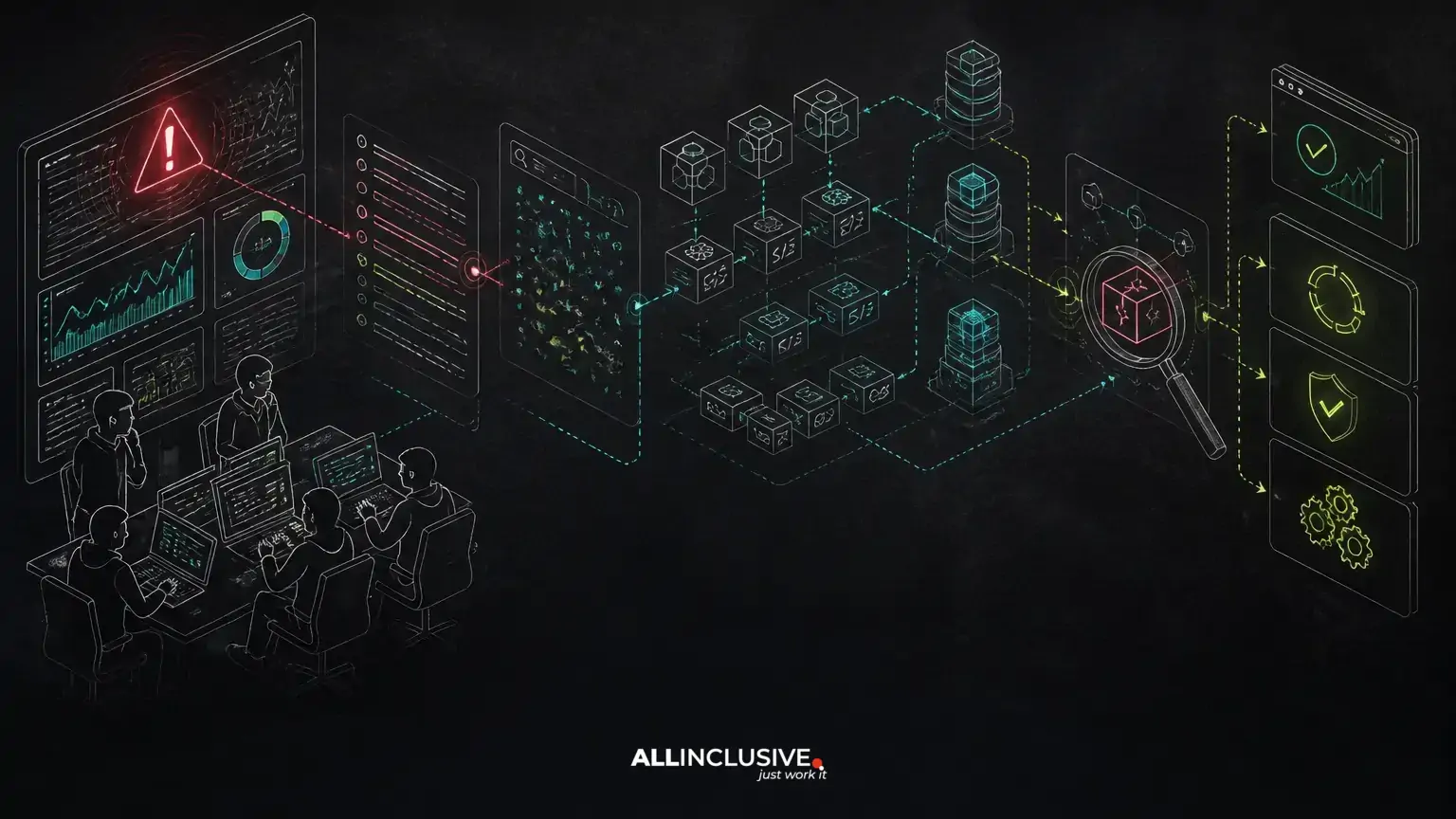
Incident response should restore service first, then improve the conditions that allowed the incident to occur. Capture a timeline, customer impact, detection method, mitigation, root cause and follow-up actions.
Useful follow-up actions may include:
- Adding an alert for a previously invisible failure.
- Improving an error message or diagnostic log.
- Adding a regression test.
- Changing a deployment or rollback step.
- Adding a timeout, retry limit or circuit-breaking behavior.
- Removing a fragile manual operation.
- Updating ownership or escalation documentation.
A post-incident review should focus on system conditions and decisions rather than blame. For the operational sequence from detection through root-cause analysis, see the guide to web application incident response.
10. Make technical debt visible and schedulable
Technical debt is not automatically a reason to rebuild. The maintenance question is whether a known constraint is increasing incident risk, slowing delivery, limiting scalability or making future changes disproportionately expensive.
For each significant debt item, record:
- The affected workflow or component.
- The operational or delivery consequence.
- The evidence supporting the concern.
- The safest short-term mitigation.
- The likely remediation options: stabilize, refactor, migrate or rebuild.
- The effort, dependencies and sequencing constraints.
This approach keeps maintenance connected to product priorities. A brittle reporting module may deserve attention because it blocks a roadmap initiative; an isolated legacy utility may be safe to monitor until a larger migration makes sense.
Teams can use a technical debt reduction roadmap to turn scattered concerns into prioritized engineering work.
How often should an application maintenance checklist be reviewed?
Use different review frequencies for different risks rather than treating maintenance as one monthly meeting.
- Continuously: monitor alerts, incidents, failed jobs and deployment health.
- Per release: run tests, review migrations, verify configuration and perform smoke checks.
- Monthly or on an agreed cadence: review dependencies, vulnerabilities, performance trends and technical debt.
- Quarterly: test recovery procedures, review access, update architecture documentation and reassess roadmap risks.
- After major incidents or platform changes: revise runbooks, tests, monitoring and ownership.
The right cadence depends on application risk, release frequency, data sensitivity, integration complexity and available operational capacity. The important point is to assign each activity an owner and a trigger.
When internal maintenance capacity is not enough
Some teams can operate a mature application internally; others need dependable engineering coverage for inherited code, security work, upgrades or incident response. The decision should be based on required capabilities and continuity, not simply on the number of open tickets.
External support is most useful when it includes access to the codebase, deployment context, monitoring data and product priorities. A maintenance partner should be able to stabilize urgent issues while also improving the system’s ability to change safely.
Allinclusive supports custom software ownership across development and ongoing engineering needs. Learn more about custom software development and explore how dedicated product teams can provide continuity across maintenance, releases and roadmap delivery.
Turn the checklist into an operating rhythm
An application maintenance checklist is valuable when it drives decisions, not when it becomes a static document. Assign owners, define evidence for completion, connect maintenance work to business risk and reserve capacity for upgrades and technical debt before they become emergencies.
For custom PHP, Laravel and Python systems, effective ownership means balancing reliability with forward progress. Monitor the workflows users depend on, patch and upgrade deliberately, learn from incidents, and keep enough architectural knowledge available to make the next change safely.