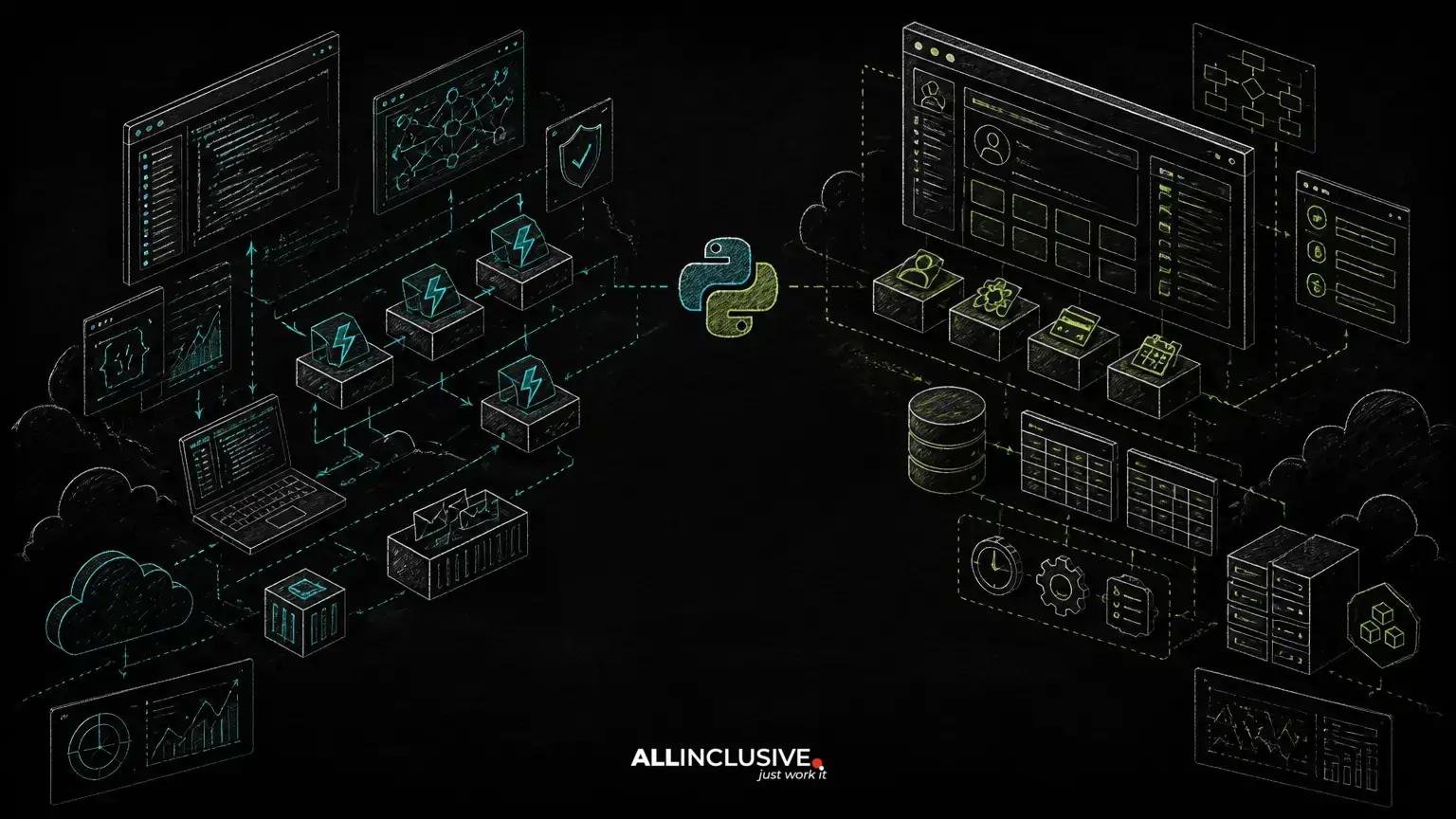
FastAPI vs Django is not a contest between a newer framework and an older one. The better choice depends on what your product must deliver: a typed API platform, a data-heavy business application, an administration workflow, an asynchronous service, or a combination of these.
FastAPI is often a strong fit for API-first services, integrations, automation endpoints and AI or data workloads where explicit schemas and asynchronous request handling matter. Django is often the better starting point for a product that needs batteries-included web capabilities, relational data modeling, authentication, administration and mature conventions. Either can support production software, but they place different responsibilities on your engineering team.
This comparison focuses on architecture and ownership rather than framework popularity. For broader decisions about a custom software development approach, the framework should be evaluated alongside domain complexity, team capability, deployment requirements and the product roadmap.
FastAPI and Django solve different backend problems
FastAPI is a focused Python web framework for building APIs. It uses Python type annotations to define request and response contracts and can generate interactive API documentation from those declarations. That makes it useful when a frontend, mobile client, partner integration or machine-learning service communicates with the backend through clearly defined endpoints.
Django is a broader web framework. Its conventional project structure, ORM, authentication features, administration interface, forms and middleware can reduce the amount of infrastructure a team must assemble for a business application. Django can expose APIs, but its value is not limited to API delivery; it is designed to support the surrounding application as well.
The distinction matters commercially. A narrowly scoped API may be faster to maintain in a focused framework. A product with complex internal workflows may reach a stable release sooner when common backend capabilities are already integrated.
FastAPI vs Django across the decisions that affect delivery
API contracts and client integration
FastAPI makes API contracts a central part of development. Typed request models, response models and generated documentation can improve coordination between backend and frontend teams, particularly when several clients consume the same service. Validation at the boundary also helps reject malformed input before it reaches business logic.
Django can provide equally deliberate API design, commonly through an API layer such as Django REST Framework or a custom approach. That flexibility is useful, but the team must choose and standardize more of the API conventions. Django is therefore not unsuitable for API products; it simply does not make a focused API workflow the entire center of the framework.
Built-in product capabilities
Django has a meaningful advantage when the product needs relational models, user accounts, permissions, forms, server-rendered pages or an internal administration interface. These features still require design and security review, but the framework provides established patterns rather than asking the team to compose every capability from separate packages.
FastAPI keeps the core smaller. That can be an advantage for services that should remain narrowly scoped, but authentication, administration, persistence conventions and background processing usually need to be selected and integrated. The resulting system can be clean and well-fitted, but the architecture depends more heavily on the team’s decisions.
Asynchronous workloads and concurrency
FastAPI supports asynchronous endpoint patterns, which can be valuable for I/O-heavy services such as aggregation, notifications, external API orchestration and inference gateways. Async code is not automatically faster, however. It introduces its own testing, error-handling and dependency rules, and blocking operations can undermine the intended benefits.
Django supports asynchronous request handling in modern versions, while much of its ecosystem and many typical applications remain synchronous in design. For a conventional transactional application, synchronous code may be easier to reason about. For high-concurrency integration services, FastAPI may offer a more natural starting point, provided database drivers, libraries and deployment practices support the chosen model.
Data modeling and administration
Django’s ORM and administration interface can shorten the path from a relational data model to a usable internal tool. This is especially valuable for products with catalog management, operational review, customer records, workflow queues or other back-office tasks.
FastAPI does not prescribe a comparable application-wide data layer. Teams can use SQLAlchemy, SQLModel, another ORM or direct database access, but they must establish conventions for migrations, transactions, repositories and administrative operations. That additional choice can be appropriate for a service boundary, but it is an avoidable burden when the product is fundamentally a data-centric business application.
Testing and maintainability
Both frameworks can support unit, integration and end-to-end testing. The important difference is where complexity accumulates. FastAPI services often benefit from contract tests, dependency overrides, database integration tests and tests for external service failures. Django applications commonly need model, permission, form, view, API and workflow tests.
Framework choice does not replace engineering discipline. Teams should define test boundaries, isolate external dependencies, run migrations in controlled environments and test authorization separately from authentication. A framework that accelerates the first release but leaves unclear ownership can increase long-term maintenance cost.
When FastAPI is the stronger choice
FastAPI is a good candidate when most of the following describe the product:
- The primary interface is a documented HTTP API rather than server-rendered pages.
- Several clients or external systems need stable, explicit request and response contracts.
- The service coordinates external APIs, event streams, automation tasks or data processing.
- Asynchronous I/O is important and the team can operate an async-compatible stack.
- The application should remain a focused service within a broader platform.
- The product includes AI inference or data capabilities that are already being developed in Python.
For an AI-backed product, FastAPI can provide a practical boundary between model execution and client applications. Production readiness still requires request limits, authentication, observability, model versioning, timeout behavior, queueing and a plan for expensive or long-running work. An endpoint that works in a prototype is not automatically a reliable production inference service.
Background work should also be designed explicitly. Long jobs such as document processing, report generation or model inference generally belong in a queue and worker system rather than inside an HTTP request that may time out. FastAPI can expose the submission and status endpoints, while workers handle the durable task.
When Django is the stronger choice
Django is often the better starting point when the product is a complete business application rather than a small service:
- The domain has substantial relational data and transactional workflows.
- Operations teams need an administration interface early.
- Authentication, permissions, forms and content management are central requirements.
- The product has server-rendered pages or a hybrid web experience.
- The team values strong conventions over assembling many independent components.
- The roadmap includes workflows that are not naturally expressed as a collection of narrow APIs.
Django can also act as the core of a modular platform. A team may add API endpoints, background jobs, scheduled tasks and integrations without splitting the application into services prematurely. That can reduce operational overhead while the product’s boundaries are still changing.
Its integrated approach does not remove the need for architecture. Teams still need clear domain modules, explicit service boundaries, database indexing, permission reviews, queue design and deployment controls. Django helps provide a foundation; it does not determine whether the resulting system is maintainable.
Can FastAPI and Django coexist?
Yes. A product can use Django for the core business application and administration while running FastAPI for a specialized API, high-concurrency integration service or AI gateway. Conversely, a FastAPI platform can include a separate Django application for internal operations where its administration capabilities provide more value than a custom admin interface.
Coexistence should be justified by a clear boundary, not by framework enthusiasm. Each service introduces deployment, monitoring, security and ownership responsibilities. Shared authentication, data consistency, migrations, retries and local development also become more complex when two application stacks interact.
A practical boundary might be a separately deployable inference service with its own scaling profile, or an operational application that needs a richer administration workflow than the public API. If the boundary is only theoretical, one well-structured application may be cheaper to operate.
Production concerns that matter more than the framework label
Whichever framework you choose, production planning should cover the complete request and data lifecycle:
- Persistence: define database ownership, migrations, transactions, indexing and backup recovery procedures.
- Background processing: move long-running or retryable work into durable queues and make jobs idempotent where possible.
- Security: validate input, enforce authorization at the business boundary, protect secrets and review dependency updates.
- Observability: capture structured logs, meaningful metrics, traces where useful and correlation identifiers for distributed workflows.
- Deployment: separate configuration from code, define health checks and test the release and rollback process.
- Failure behavior: specify timeouts, retries, rate limits, partial-failure handling and user-visible status for asynchronous work.
These concerns affect operating cost and customer experience more directly than the framework name. A carefully designed Django service can outperform a poorly operated FastAPI service in business value, and the reverse can also be true.
A decision guide for product and engineering teams
Choose FastAPI when the central problem is building a focused, typed and integration-friendly API, especially when asynchronous I/O, automation, data services or AI capabilities are core to the product. Choose Django when the central problem is delivering a complete, relational, workflow-oriented application with administration and established web capabilities.
Before committing, answer these questions:
- What is the first user workflow that must work reliably?
- Is the primary product surface an API, a web application, an internal tool or a combination?
- Which capabilities would the team otherwise need to assemble and maintain?
- Will background jobs, queues or data pipelines be first-class parts of the system?
- Does the team have proven experience operating asynchronous services?
- Where should the product boundary remain modular, and where would separation add needless operational cost?
- How will the application be tested, observed, secured and deployed six months after launch?
Teams evaluating the wider Python ecosystem may also benefit from this overview of Python backend development, while API-focused projects can review FastAPI API development in more detail. For products that combine backend engineering with intelligent workflows, AI development planning should include data quality, evaluation, cost controls and production monitoring—not just model access.
The right framework is the one that makes the product’s important work easier to build, test and operate. FastAPI and Django can both support serious Python backends; the decision should follow the product’s workflows, operational constraints and likely evolution rather than a universal preference.