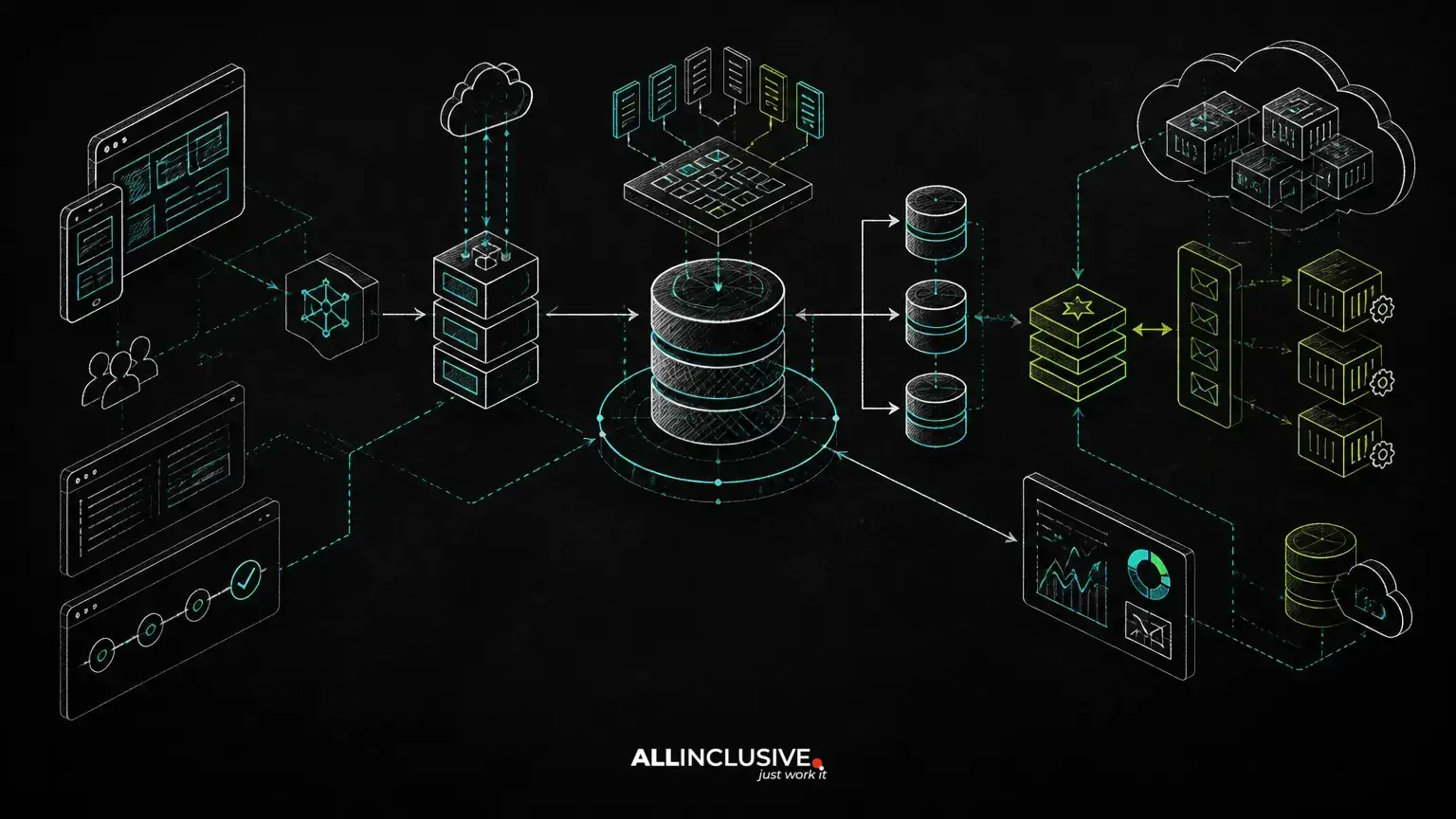
Choosing between Laravel API vs FastAPI is less about whether PHP or Python is universally faster and more about which service layer fits the product around it. Laravel is often the stronger choice for teams already operating a PHP application, database-backed business workflows and Laravel conventions. FastAPI is often attractive when Python is already central to data processing, automation or AI services, or when a small typed API needs to expose asynchronous work clearly. A related decision for laravel api vs fastapi is covered in custom software development.
Both can support reliable REST APIs, authentication, validation, webhooks, queues and observability. The decision should therefore be based on integration boundaries, ownership and failure handling—not on a framework comparison made in isolation. This article explains the trade-offs that matter when building a custom service layer or replacing an unreliable integration.
Laravel API vs FastAPI: the architectural difference
Laravel is a full-stack PHP framework with a broad application ecosystem. An API built with Laravel can share models, authentication, authorization, database migrations, queues, scheduled jobs and operational conventions with an existing Laravel application. That makes it a natural fit when the API is part of a larger business system.
FastAPI is a Python web framework designed around type hints, request validation and modern asynchronous service patterns. It is particularly useful when the API sits close to Python libraries for data transformation, machine learning, document processing or automation. It can also serve ordinary CRUD and integration workloads, provided the surrounding architecture is designed deliberately.
The practical distinction is often this: Laravel tends to reduce coordination costs inside a mature business application, while FastAPI can reduce friction around Python-based processing services. Neither choice removes the need for sound contracts, security controls and operational design.
When Laravel is the better service-layer choice
An existing Laravel or PHP product owns the workflow
If the API must read and write the same business entities as an existing Laravel application, staying within that ecosystem can simplify delivery and maintenance. Teams can reuse domain rules, authorization policies, migrations, queues and deployment knowledge rather than creating a second runtime with duplicated behavior.
This matters when an integration changes important business state: payment status, subscription access, inventory, customer records or fulfillment. A shared application boundary can make ownership clearer, although the domain model should still be separated from controller code and external payload formats.
The service is integration-heavy rather than compute-heavy
Laravel is well suited to APIs that coordinate external systems. A typical flow might authenticate a request, validate an order, persist an outbound operation, dispatch a queued job, call a partner API, process a webhook and reconcile the result later. Laravel's surrounding application conventions can make these workflows easier to organize for a PHP team.
The business needs a coherent application platform
For an internal platform or customer-facing product that includes administration, reporting, background jobs and an API, one established ecosystem may be preferable to multiple specialized services. Fewer runtimes can reduce deployment, monitoring and on-call complexity, assuming the application remains modular.
When FastAPI is the better service-layer choice
Python already owns the adjacent processing
FastAPI is a strong candidate when the service must call Python libraries for classification, forecasting, document extraction, scientific processing or AI-assisted workflows. Keeping those capabilities in the same language can avoid unnecessary service boundaries and serialization steps.
That does not mean every AI-enabled product needs FastAPI. A Laravel application may call a separate Python service when the processing workload has a different scaling profile or team ownership. The right boundary depends on deployment, data sensitivity, latency expectations and operational maturity.
The API benefits from explicit typed contracts
FastAPI's type-hint-driven approach can make request and response schemas visible during development. This is useful for teams that want API contracts to be reviewed alongside Python models and automatically reflected in developer documentation. The framework does not replace contract governance, compatibility testing or careful error design, but it can support those practices.
The service is intentionally small and focused
A focused Python service can be a good fit for a bounded capability such as document processing or model inference. The service should still have explicit authentication, timeouts, rate limits, structured logs, health checks and a clear ownership model. A small codebase is not automatically a reliable production service.
Compare the two frameworks by integration responsibility
Framework selection becomes clearer when the decision is mapped to the responsibilities the service must perform.
- REST resources and contracts: Both frameworks can expose resource-oriented endpoints. Define ownership, field semantics, pagination, filtering and compatibility rules before implementation.
- Validation: Validate at the boundary, then apply domain rules separately. A syntactically valid request can still violate business constraints.
- Authentication and authorization: Choose a consistent identity model, token lifetime, scope strategy and permission model. Authentication confirms identity; authorization decides what that identity may do.
- OAuth: Treat provider tokens, scopes, refresh behavior and revocation as integration state. Do not hide provider-specific failures behind a generic success response.
- Webhooks: Verify authenticity, record the event, acknowledge only when appropriate and process business effects asynchronously when delivery can be retried.
- Idempotency: Give retriable write operations a stable idempotency key or equivalent deduplication record. This is essential when a client cannot tell whether a timeout occurred before or after the server committed.
- Retries: Retry only failures that are likely temporary, use bounded exponential backoff and honor provider guidance. Retrying a non-idempotent operation without protection can create duplicate effects.
- Queues: Put slow, interruptible or externally dependent work behind a queue. Define retry limits, dead-letter handling and operator visibility.
- Reconciliation: Build scheduled comparison or repair workflows when external systems can miss events, return ambiguous results or change state independently.
- Observability: Use correlation IDs, structured logs, metrics for latency and failure classes, and traces where cross-service diagnosis requires them.
These controls are available in either ecosystem. The important question is whether the team will implement and operate them consistently.
Reliability patterns that matter more than framework preference
A service layer becomes business-critical when it coordinates state across systems. For example, an order API might accept a request, reserve inventory, create a payment attempt and receive a delayed fulfillment update. A successful HTTP response from one step does not prove that the entire workflow succeeded.
Design the workflow around explicit states such as received, validated, queued, submitted, confirmed, failed and requires reconciliation. Store enough evidence to explain transitions, including provider identifiers, request correlation IDs and relevant timestamps.
For inbound webhooks, verify the signature or equivalent authentication mechanism before processing. Persist the event identity before applying effects when duplicate delivery is possible. Return an appropriate acknowledgment, then let a worker perform work that may exceed the provider's delivery timeout.
For outbound calls, set connection and response timeouts, classify errors, protect writes with idempotency and record the external response. A retry policy should distinguish temporary network failure from invalid credentials, rejected business data and rate limiting. These distinctions are more valuable than simply increasing the retry count.
Operational and ownership trade-offs
The runtime choice affects more than developer syntax. It influences hiring, deployment, incident response and the number of systems a team must understand.
Laravel may be the lower-risk option when the organization already has PHP hosting, Laravel conventions and engineers who own the application end to end. Introducing FastAPI can be justified, but the team should account for a second language, dependency set, CI pipeline, observability configuration and security review process.
FastAPI may be the lower-friction option when Python is already the operational standard for a data or AI capability. Conversely, using Python solely because a service is called an “API” can create unnecessary fragmentation if the core domain already lives in Laravel.
Performance should be evaluated against the actual bottleneck. Database queries, external provider latency, serialization, queue design and inefficient business logic often dominate end-to-end response time. A representative load test and production-like failure test are more useful than a generic framework benchmark.
How to choose Laravel API vs FastAPI for a custom service
- Map the system boundary. Identify which application owns the data, rules and user workflow. Avoid creating a service boundary merely to separate files.
- List external dependencies. Document authentication methods, provider limits, webhook behavior, timeout expectations and reconciliation needs.
- Assess language fit. Choose Laravel when PHP and the existing domain model are central. Choose FastAPI when Python processing or AI capabilities are a first-class part of the service.
- Define failure states before endpoints. Specify what happens after timeouts, duplicate webhooks, partial completion, expired tokens and provider outages.
- Choose the smallest operable architecture. A modular monolith may be safer than multiple services when one team owns the workflow. Split services when deployment, scaling, data ownership or team boundaries justify it.
- Test the contract and the recovery path. Test validation, authorization, duplicate requests, retries, rate limits, queue failures and reconciliation—not only successful responses.
Making the decision without creating avoidable platform debt
For many business systems, Laravel is the practical choice when the service belongs to an established PHP product and the primary challenge is coordinating transactional workflows. FastAPI is compelling when the service is natively Python, especially where data, automation or AI processing is central and independently owned.
A hybrid architecture can also be appropriate: Laravel can own customer-facing workflows and transactional business state, while FastAPI handles a bounded processing capability. That arrangement requires explicit contracts, authentication between services, idempotent commands, observability and clear responsibility for failures.
Whichever framework you select, treat the service as integration infrastructure rather than a collection of endpoints. A well-designed API makes state transitions visible, protects against duplicate effects, handles provider uncertainty and gives operators enough evidence to repair failures. Those properties determine long-term value more than the language label.
For broader implementation planning, review our API development services and the guidance on web development. Teams evaluating operational ownership can also use our support and maintenance capabilities to plan monitoring, incident response and ongoing integration changes.
Related planning resources include how to choose an API development company, API development cost drivers and the API security checklist.