
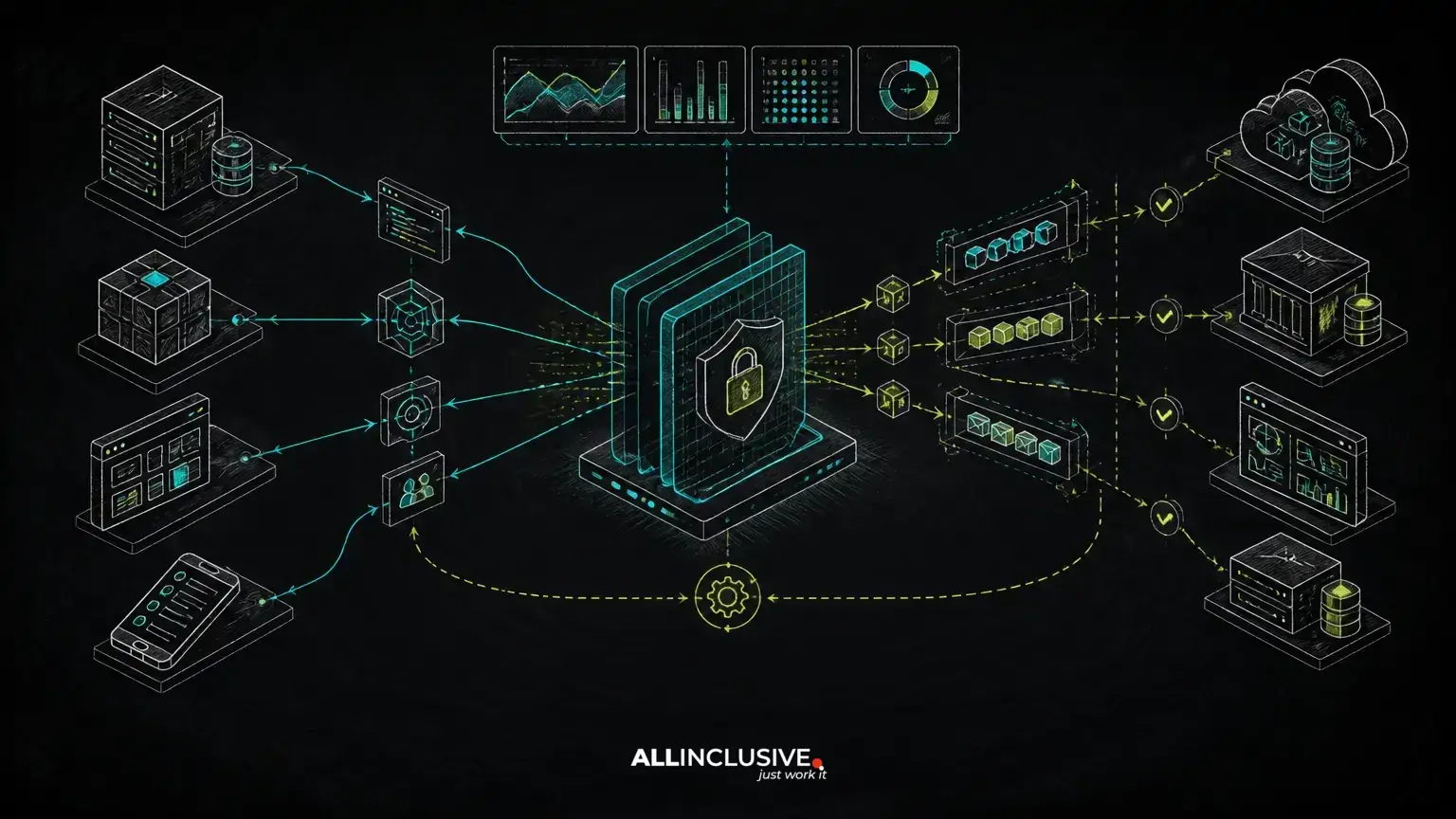
Choosing an API development company is not primarily a matter of comparing programming languages or selecting the lowest estimate. For a business-critical integration, the right partner must be able to model data accurately, handle failure states, protect credentials, make behavior observable and support the system after launch.
Start by evaluating how a company approaches the complete integration lifecycle: discovery, API design, implementation, testing, deployment, monitoring, reconciliation and maintenance. A technically strong delivery team should be able to explain trade-offs in plain language and connect them to business consequences such as delayed workflows, duplicate transactions, manual operations and ownership cost.
This guide outlines the questions, technical criteria and commercial signals to use when comparing API development companies.
1. Define the integration before evaluating vendors
Companies often request an API project before documenting the operational problem it must solve. That creates ambiguity in estimates and makes proposals difficult to compare. Before speaking with vendors, define:
- Which systems must exchange data and which system owns each important record.
- Whether the integration is synchronous, asynchronous or a combination of both.
- Which workflows are business-critical, such as payments, provisioning, fulfillment or account synchronization.
- What happens when a request times out, a webhook arrives twice or a downstream service is unavailable.
- What data must be stored, transformed, audited or deleted.
- Who will operate the integration after launch.
This preparation does not need to be a complete technical specification. A capable API development company should help convert business workflows into contracts, state transitions, failure handling and an implementation plan.
2. Look for integration engineering, not just endpoint delivery
A proposal that lists endpoints without discussing operational behavior is incomplete. Reliable integrations require more than request and response formats.
Contracts and validation
Ask how the company will define API contracts, validate input and handle incompatible changes. The contract should describe required fields, types, permitted states, error responses and ownership of each value. Validation should occur at appropriate boundaries so malformed data does not silently enter internal systems.
Authentication and authorization
Authentication proves who is making a request; authorization determines what that caller may do. Depending on the integration, the design may involve API keys, signed requests, OAuth flows, service accounts or another mechanism supported by the connected platform. Ask how credentials will be stored, rotated and restricted, and how access will be separated between development, staging and production.
Webhooks and asynchronous events
Webhooks are useful for notifying an application about changes, but they introduce delivery uncertainty. Providers may retry events, deliver them out of order or send duplicates. A robust design verifies signatures where applicable, records event identifiers, processes events safely and exposes a recovery path for failed handling.
Idempotency and duplicate prevention
Network failures make it possible for a client to submit a request without knowing whether the server completed it. Idempotency keys or equivalent safeguards allow the same logical operation to be retried without creating duplicate payments, orders, records or notifications. Ask the company to identify which operations require idempotency and where the keys and results will be retained.
Retries, queues and rate limits
Not every error should be retried. Temporary network failures or service unavailability may justify controlled retries with backoff, while validation errors usually require correction rather than repetition. Queues can isolate user-facing workflows from slow or unreliable dependencies, but they also require visibility into pending, failed and dead-lettered work. Rate limits should be handled deliberately rather than discovered through production incidents.
These concerns are central to API development because they determine whether an integration remains dependable when external systems behave unpredictably.
3. Evaluate architecture choices by responsibility
There is no universally correct framework for API work. The better question is whether the proposed architecture matches the application’s responsibilities, team skills and operational requirements.
Laravel can be a strong choice when an API belongs inside a broader PHP application that already handles users, business rules, administration, billing or database workflows. Keeping related responsibilities in one well-structured codebase can simplify delivery and ownership.
Python may be appropriate when the integration includes data processing, automation, specialized libraries, machine learning workflows or a service boundary that benefits from Python’s ecosystem. A Python service should still have clear contracts, deployment controls and operational ownership; choosing the language alone does not create a reliable architecture.
Ask prospective partners to explain:
- Why the proposed framework fits the current product and team.
- Whether the integration belongs in the existing application or should be a separate service.
- How background jobs, scheduled reconciliation and event processing will run.
- How shared models and transformations will be maintained as systems change.
- What deployment, rollback and environment strategy the implementation requires.
For a more specific comparison of PHP and Python service-layer choices, see Laravel API vs FastAPI.
4. Ask how the company will manage state and reconciliation
Many integrations fail not because an API request cannot be sent, but because systems eventually disagree. A vendor should describe how it will detect and resolve that disagreement.
Useful design elements may include local synchronization records, external identifiers, status mappings, timestamps, audit events and reconciliation jobs. A reconciliation process can compare local and remote state, identify missing or conflicting records and route exceptions for review. It should not blindly overwrite data without defining system-of-record rules.
Ask for examples of how the proposed design handles:
- A successful remote operation followed by a local database failure.
- A webhook that arrives before the original request finishes.
- A deleted or archived object in one system.
- A changed field that is not supported by the other system.
- A partial batch failure.
- An integration that has been offline for several hours or days.
These scenarios reveal whether the company is designing a dependable workflow or merely connecting happy-path endpoints.
5. Review testing and observability before signing
API testing should cover more than whether a valid request returns a successful response. Ask how the team will test authentication failures, malformed payloads, timeouts, duplicate events, rate limits, provider errors, expired tokens and out-of-order processing.
A useful test strategy may include contract tests, integration tests against controlled environments, end-to-end workflow tests and failure injection for important dependencies. Test data should avoid exposing production secrets or personal information.
Observability is equally important. The delivered system should provide enough information to answer:
- Which operation failed and when?
- Which internal and external identifiers were involved?
- Was the request retried, queued or rejected?
- What response or event caused the failure?
- Can an operator safely replay or reconcile the work?
Logs, metrics and alerts must be designed with privacy in mind. Sensitive tokens and unnecessary personal data should not appear in logs. For broader application security considerations, use the API security checklist as a review companion.
6. Compare proposals by scope, assumptions and ownership
API estimates are difficult to compare when one proposal includes only implementation and another includes discovery, monitoring, deployment and support. Request a scope that separates:
- Discovery and technical design.
- API contract and data mapping.
- Authentication and authorization.
- Core endpoints and workflow orchestration.
- Webhooks, queues, retries and reconciliation.
- Testing, documentation and environment setup.
- Deployment, monitoring and incident response.
- Post-launch support and change management.
Also ask which assumptions affect the estimate. Examples include access to sandbox environments, provider documentation quality, expected data volume, legacy constraints, approval workflows and the availability of internal stakeholders.
A lower initial estimate may exclude the work that prevents operational problems later. Conversely, a larger proposal is not automatically better if it introduces unnecessary services or speculative features. Compare the reasoning behind the scope, not just the total.
7. Check documentation and knowledge transfer
Your organization should not depend on one external developer to understand the integration. Require documentation that covers contracts, environment variables, authentication flows, data mappings, retry behavior, webhook processing, failure recovery and deployment steps.
Ask how the team will transfer knowledge to internal developers and operators. Good handover includes walkthroughs, architecture decisions, runbooks and clear ownership boundaries. If the integration is part of custom-made software, documentation should explain both the API boundary and the business rules that depend on it.
8. Assess post-launch support realistically
External APIs change. Credentials expire, providers introduce new fields, rate limits evolve and business workflows acquire new states. A support plan should explain how issues are reported, prioritized, diagnosed and released.
Clarify whether ongoing work includes dependency updates, security fixes, provider changes, monitoring review, incident support and small workflow changes. If your organization needs a continuing maintenance arrangement, review the available support and maintenance approach before the project begins.
Questions to ask during vendor interviews
- What failure modes do you expect in this integration, and how would you handle each?
- Where would you use synchronous requests, queues and webhooks?
- How would you prevent duplicate operations?
- How would you reconcile records when the two systems disagree?
- What will be logged, alerted and available for replay?
- Which parts belong in Laravel, Python or the existing application, and why?
- What assumptions are included in the estimate?
- What documentation and operational handover will we receive?
- How will changes to the external API be tested and released?
- Who owns the integration after launch?
How to evaluate an API development company
Shortlist companies that can demonstrate four qualities: technical depth, disciplined scope, operational awareness and clear communication. Then score each proposal against the same criteria: contract quality, security model, failure handling, data ownership, observability, testing, maintainability, delivery process and support.
The strongest choice is usually the company that can make risk visible before implementation begins. It should be able to explain what happens when dependencies fail, requirements change or data becomes inconsistent—not only how the successful request is sent.
For related architectural decisions, compare REST and GraphQL, and review how integration scope affects API development cost. When you need a broader view of custom software capabilities and delivery options, the development team can help connect API decisions to the rest of the product architecture.


