
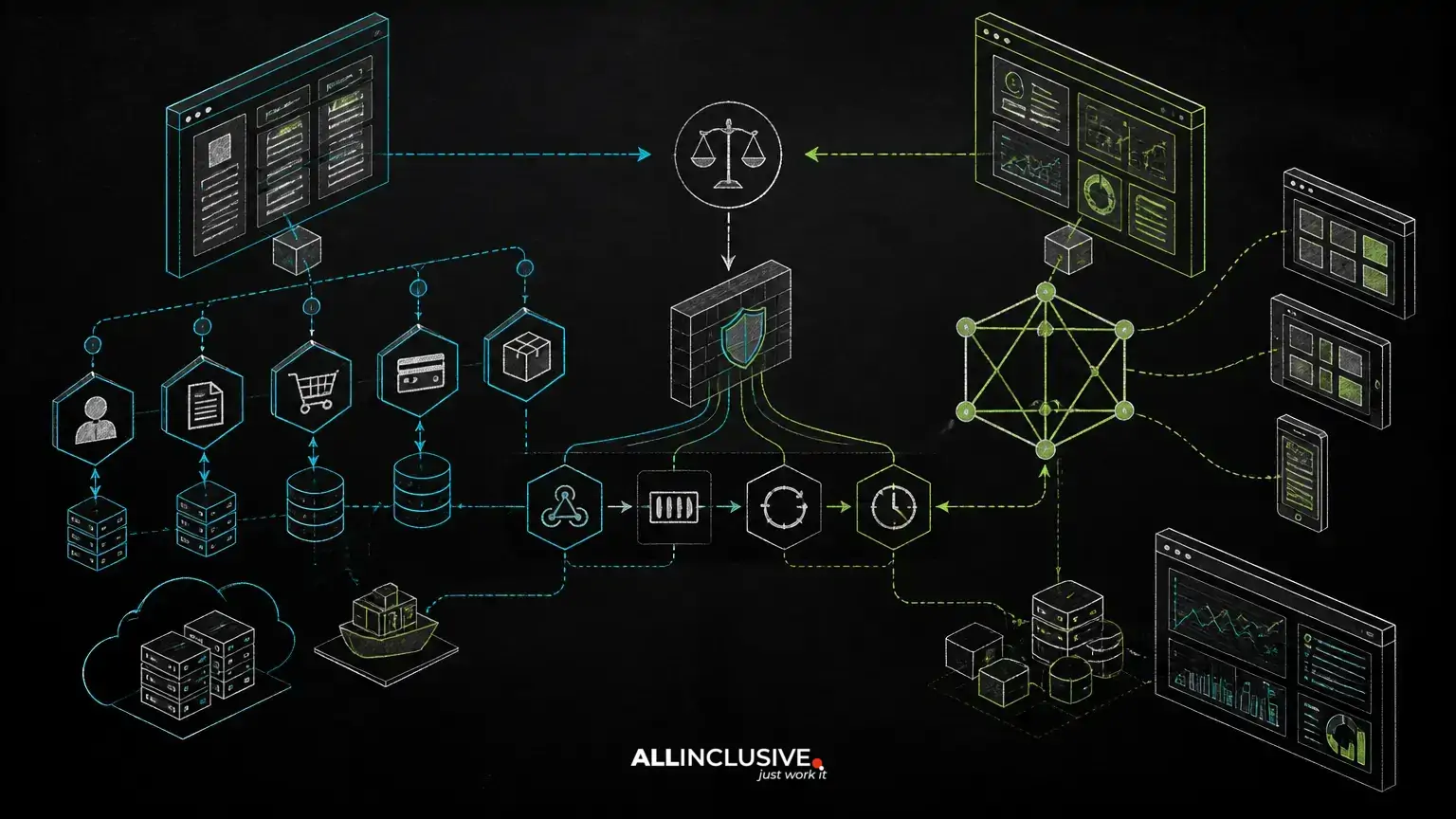
REST vs GraphQL is not a contest with one universal winner. REST usually offers simpler operational behavior, broad tooling support and predictable resource-oriented contracts. GraphQL can give clients more control over data shape and reduce over-fetching when products have complex, rapidly changing interfaces. The better choice depends on who owns the clients, how integrations fail, how much schema governance your team can support and which workflows the API must protect.
For many products, the most reliable answer is not to force every endpoint into one style. A public integration API may use REST, while an internal application gateway or mobile-facing read layer uses GraphQL. Either approach still requires disciplined validation, authentication, rate limits, retries, idempotency, observability and clear ownership.
REST and GraphQL solve different API design problems
REST models a system around resources and representations. A client might request /customers/42, update an order with a particular HTTP method, or follow a relationship through another resource. HTTP status codes, caching semantics and established gateway tooling are central to the design.
GraphQL exposes a schema and usually a single endpoint through which clients specify the fields and relationships they need. The server validates a query against the schema and resolves the requested data. This can be valuable when several clients need different views of the same domain, but it transfers more responsibility to schema design, query governance and resolver performance.
Neither style automatically creates a reliable integration. A well-designed REST API can fail through ambiguous errors or duplicate writes, and a poorly governed GraphQL API can create expensive queries and difficult operational debugging.
REST advantages: predictable resources and integration compatibility
- Familiar contracts: Resource paths, HTTP methods, status codes and JSON representations are widely understood by developers and integration platforms.
- Operational visibility: Gateways, access logs, metrics and caching layers often map naturally to REST requests.
- Independent resource evolution: Teams can change one resource without necessarily changing every consumer, provided compatibility rules are respected.
- Useful HTTP semantics: Conditional requests, cache controls and method behavior can support efficient reads and safer writes.
- Strong fit for partner integrations: External consumers often value stable documentation, straightforward authentication and predictable error handling over query flexibility.
REST is often the safer default for public APIs, administrative integrations and workflows involving payments, fulfillment, CRM synchronization or other external systems. Those systems need explicit state transitions, repeatable requests and easy reconciliation more than they need arbitrary data traversal.
GraphQL advantages: client-shaped data and a governed schema
- Flexible reads: A client can request the fields needed for a screen or workflow rather than receiving a fixed server response.
- Relationship traversal: Related data can be represented through one schema, reducing the need for clients to coordinate many read requests.
- Schema discoverability: A typed schema can make available operations and fields more explicit when it is documented and governed carefully.
- Client autonomy: Multiple front ends can evolve their read requirements without requiring a new REST endpoint for every presentation change.
GraphQL is particularly useful when a product has several first-party clients, complex connected data and a team capable of managing schema evolution. It can also serve as a backend-for-frontend layer over existing REST services. That does not eliminate the underlying integration work; it changes where composition and policy are implemented.
Compare REST vs GraphQL across the decisions that affect ownership
API contracts and versioning
REST commonly evolves through additive fields, new endpoints or explicit versions. A versioning policy is still necessary: removing a field, changing its meaning or altering validation can break consumers even when the URL remains unchanged.
GraphQL typically evolves through a shared schema. Deprecation metadata and usage tracking can help teams retire fields, but the process depends on knowing which clients query them. A flexible schema is not permission to change business meaning without migration planning.
Performance and query control
REST makes request cost easier to estimate when endpoints return bounded representations, although poorly designed endpoints can still be expensive. GraphQL lets clients request less data, but nested queries may trigger excessive database work, repeated resolver calls or unexpectedly large responses.
GraphQL implementations should consider query depth and complexity limits, pagination, field-level authorization, batching and response-size controls. REST implementations should consider pagination, filtering limits, payload bounds and protection against unbounded exports. In both styles, performance should be measured at the database, application and dependency layers rather than inferred from the protocol alone.
Caching and delivery infrastructure
REST requests can align naturally with HTTP caching because resource URLs and methods expose a familiar cache model. Caching still requires correct invalidation and careful treatment of user-specific data.
GraphQL commonly concentrates requests at one endpoint, which can make generic HTTP caching less direct. Teams may use persisted queries, application-level caching or resolver-level caching, but those mechanisms add policy and operational responsibility.
Errors and partial success
REST can communicate outcome through HTTP status codes and a consistent error body. That is useful for clients, logs and monitoring, but only when the API distinguishes validation failures, authorization failures, transient dependency errors and permanent business conflicts.
GraphQL can return data alongside an errors array, including partial results. This is useful for some read experiences, but clients and monitoring systems must distinguish a valid partial response from a workflow that must be treated as failed. Mutation design should make business outcomes explicit rather than hiding them in generic resolver errors.
Security and abuse controls
Both styles require strong authentication and authorization. OAuth may be appropriate when a user grants scoped access to another system, while service credentials or signed requests may fit controlled machine-to-machine integrations. Authorization must be checked at the resource, operation and field level where applicable.
REST needs protection against excessive request rates, replayed writes and overly broad access. GraphQL additionally needs query-cost controls, introspection policy decisions appropriate to the environment, resolver authorization and safeguards against deeply nested or repeated queries. An API security review should cover identity, secrets, input validation, sensitive data exposure, audit events and dependency behavior.
Use the API security checklist as a companion to protocol selection rather than treating security as a feature supplied by REST or GraphQL.
Reliable integrations matter more than the protocol label
External APIs, webhooks and background jobs introduce failure modes that neither REST nor GraphQL resolves automatically. A production integration should define:
- Idempotency: Repeated requests should not create duplicate orders, charges or records when the business operation should happen once.
- Retry policy: Transient network failures and rate limits need bounded retries with backoff, while validation and authorization errors should not be retried blindly.
- Webhook handling: Verify authenticity, acknowledge quickly when appropriate, persist event data, process asynchronously and tolerate duplicate or out-of-order delivery.
- Queues and workers: Long-running synchronization and third-party calls should not block interactive requests unnecessarily.
- Reconciliation: Scheduled comparison with the source system can detect missed events, state drift and partial failures.
- Observability: Correlation IDs, structured logs, latency and error metrics should connect an API request to downstream jobs and provider responses.
- Explicit state models: Pending, succeeded, failed, canceled and unknown states are safer than assuming a timeout means a transaction did not occur.
For payment and billing workflows, these concerns deserve special treatment because a timeout can leave the local system uncertain about an external outcome. A protocol comparison should never obscure the need for durable state transitions and reconciliation.
For a deeper integration perspective, see third-party API integration strategy and payment gateway integration architecture.
Laravel and Python choices should follow responsibility
Laravel is often a practical fit when the API belongs to a broader PHP product with established authentication, validation, queues, scheduled jobs and administrative workflows. A Laravel REST service can keep resource rules, policies, jobs and persistence close to the product domain. It can also provide a stable integration boundary while workers handle webhook processing and retries.
Python can be a strong choice when the API sits beside data processing, automation, machine-learning services or an existing Python platform. Its usefulness depends on the team’s operational conventions and the surrounding system, not on the language alone. A Python service should still define ownership of schemas, authentication, persistence, background work and deployment operations.
GraphQL should be introduced where its client-composition benefits justify the additional schema and query governance. In either Laravel or Python, keep business rules out of thin protocol adapters where possible. A mutation or resolver should call a domain operation with explicit validation and authorization, rather than becoming an untestable collection of database and provider calls.
Choose REST when the workflow needs explicit boundaries
REST is usually the better starting point when:
- External partners or customers will consume the API.
- Resources and state transitions are clear and stable.
- HTTP caching, gateway controls and conventional tooling are important.
- The API manages writes that require idempotency, auditing and reconciliation.
- The team wants a smaller operational surface and broad implementation compatibility.
- Different consumers can work with a deliberately designed representation and pagination model.
REST does not mean creating one endpoint per database table. A mature REST design can expose task-oriented operations, bounded representations and domain-specific actions where those better express business behavior.
Choose GraphQL when client composition is the hard problem
GraphQL is worth serious consideration when:
- Several first-party clients need different projections of connected domain data.
- Front-end teams need to evolve read requirements faster than server teams can add endpoints.
- A typed, centrally governed schema improves collaboration across product teams.
- The organization can implement query-cost controls, authorization, monitoring and schema deprecation.
- GraphQL will compose services or data sources without hiding ownership and failure boundaries.
Be cautious when the API is primarily a partner contract, exposes sensitive operations or depends heavily on third-party side effects. GraphQL can still work, but its flexibility may add complexity without improving the integration experience.
A practical selection checklist for product teams
- List the consumers: Separate first-party interfaces, internal services, partners and public developers.
- Map the workflows: Identify reads, writes, asynchronous events, approvals, retries and reconciliation requirements.
- Define the contract owner: Decide which team approves schema changes, deprecations, authentication policy and operational limits.
- Model failure states: Document timeouts, duplicate requests, partial responses, provider outages and unknown transaction outcomes.
- Choose the simplest protocol that satisfies the consumer: Do not add GraphQL to solve a data-shaping problem that a well-designed REST representation already handles.
- Test operational behavior: Include authorization, rate limits, queue recovery, webhook duplication, dependency failures and backward compatibility in acceptance testing.
The API style should support the product’s ownership model. A flexible interface with unclear responsibility can cost more to operate than a conventional interface with strict, well-documented boundaries.
Design the API around durable business behavior
REST and GraphQL are interface styles, not reliability strategies. The decision should follow consumer needs, domain boundaries, data access patterns and the team’s ability to operate the result. REST is often the strongest default for stable resource contracts and external integrations. GraphQL can be a strong fit for governed, client-driven composition across connected data.
When the product needs more than an isolated endpoint—such as authentication, webhooks, queues, retries, reconciliation and ongoing maintenance—API design should be treated as part of the wider API development lifecycle. Teams planning a custom application can also review custom software development capabilities, while ongoing monitoring, fixes and dependency changes belong in a defined support and maintenance plan.


