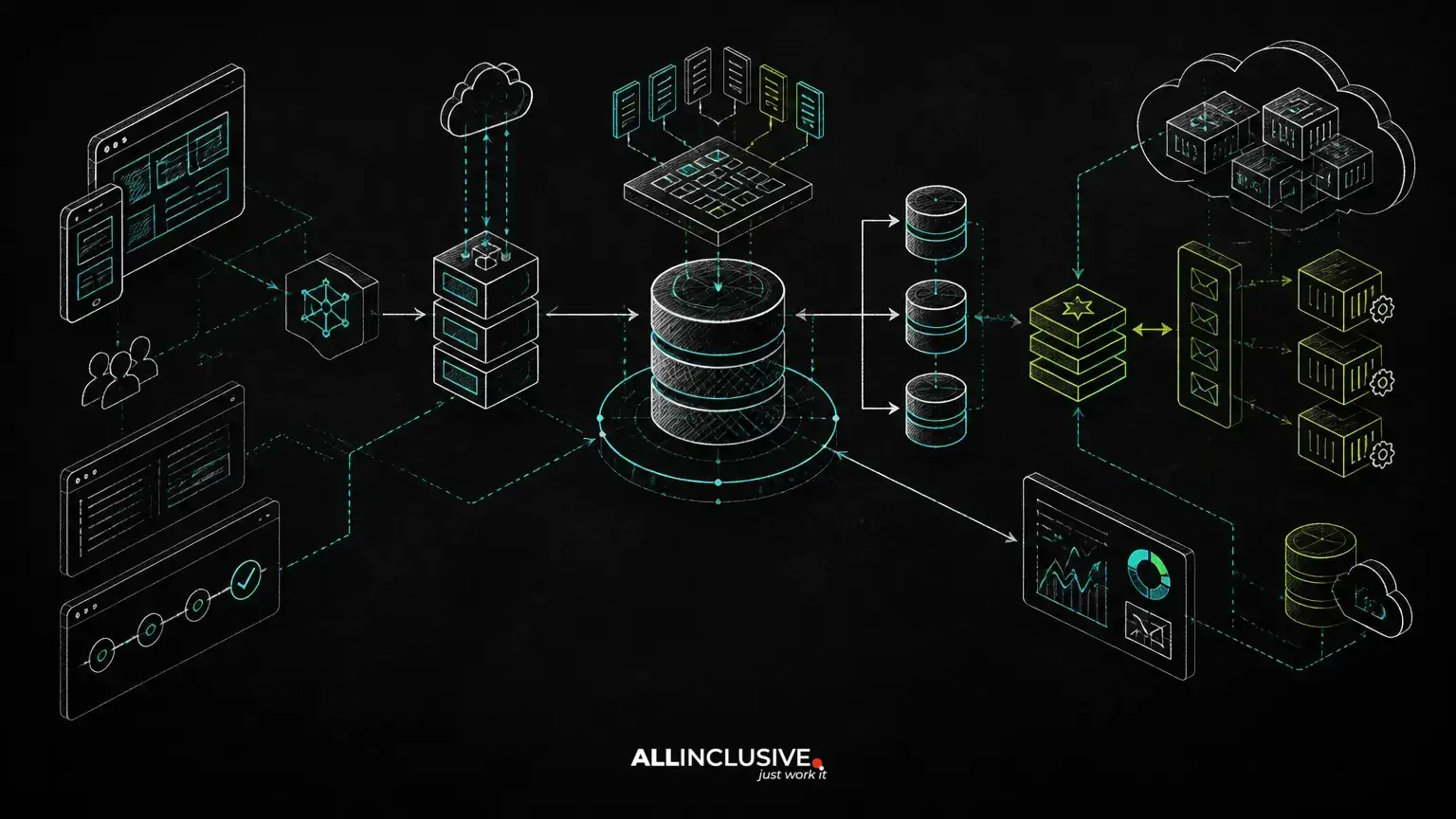
For a custom product, Laravel vs Symfony is not a contest between a “simple” framework and an “enterprise” framework. Both can support production APIs, SaaS applications, internal platforms and complex business workflows. The practical decision is which framework gives your team the clearest path to maintainable domain logic, reliable delivery and sensible long-term operations.
Laravel often provides a faster, more opinionated starting point for teams building a complete application. Symfony can be a strong fit when explicit architecture, component-level reuse and highly tailored application design are central requirements. Neither choice removes the need for sound modeling, testing, security controls, deployment practices or product engineering.
This comparison focuses on those decisions rather than template-first website development. For broader guidance on planning and building custom software, A related decision for laravel vs symfony is covered in Allinclusive development services.
Laravel vs Symfony at a glance
- Laravel: Often well suited to teams that want an integrated application framework with productive conventions for routing, data access, authentication, queues, notifications, validation and common SaaS features.
- Symfony: Often well suited to teams that value explicit configuration, modular components, carefully defined boundaries and a framework that can be assembled around a specialized architecture.
- Both: Can be used for APIs, background processing, role-based applications, integrations, testing, scheduled jobs and business-critical workflows.
- The deciding factor: Usually the product’s domain complexity, existing PHP expertise, integration requirements and expected maintenance model—not a framework popularity claim.
How Laravel and Symfony approach application architecture
Laravel is an opinionated framework. Its conventions help a team establish a recognizable structure quickly, especially when the product includes common application capabilities such as authentication, validation, database-backed models, queues and notifications. That consistency can reduce decision overhead during early delivery.
The trade-off is that teams must actively protect domain boundaries as the codebase grows. If business rules are placed indiscriminately in controllers, models or framework-specific helpers, a fast initial implementation can become difficult to test and change. Laravel works best when its conveniences support a deliberate application architecture rather than replace one.
Symfony is more explicit and modular. Its dependency injection patterns, configuration approach and reusable components can suit products with demanding boundaries between domains, integrations or application layers. This can make design decisions visible to the team, which is useful when multiple developers or services must coordinate around stable contracts.
The trade-off is that Symfony may require more architectural decisions before a team reaches a productive application baseline. That is not inherently a disadvantage, but it affects onboarding, delivery planning and the amount of framework experience needed to keep the system coherent.
Choosing based on product complexity
Laravel may fit when the product needs integrated delivery
Laravel is often a practical choice for a custom SaaS product, operational platform or customer portal when the team wants to move from domain modeling to working workflows without assembling every application concern independently. A typical product might include organizations, users, permissions, subscriptions, invoices, notifications, reporting and an API. Laravel’s integrated conventions can provide a productive foundation for these capabilities.
This does not mean the product should be built as a collection of framework defaults. Billing rules, entitlements, approval flows and audit requirements still need explicit domain models and tests. Laravel simply gives the team a cohesive application environment in which to implement them.
Symfony may fit when boundaries and modularity dominate
Symfony can be attractive when the product has several distinct business domains, unusual workflows or significant integration requirements. A platform coordinating inventory, pricing, fulfillment and external enterprise systems may benefit from clear service boundaries and carefully controlled dependencies.
Symfony’s component ecosystem can also be useful when an organization wants to reuse selected framework capabilities across applications rather than standardize every application around one integrated stack. The value comes from architectural fit and team capability, not from using more components for their own sake.
Data modeling and business logic
Laravel commonly uses Eloquent, an active-record-style ORM, which can make routine data access readable and efficient to implement. It is well suited to many CRUD-heavy workflows and can remain effective in complex systems when relationships, query boundaries and domain operations are designed carefully.
The risk is allowing database records to become the entire domain model. Business rules involving state transitions, authorization, billing or external side effects should not be scattered across controllers and ad hoc model callbacks. Service classes, domain objects, policies, commands and explicit application workflows may be appropriate depending on the product.
Symfony projects frequently use Doctrine, although Symfony does not require one particular persistence approach. Doctrine’s mapping and unit-of-work model can support a more separated domain design, but it also introduces concepts that the team must understand. The right choice depends on how much persistence abstraction the product needs and how comfortable the team is maintaining it.
In either framework, the important questions are the same:
- Where does a business rule live?
- How are state changes validated and recorded?
- Can important workflows be tested without a browser or live external service?
- How will schema changes be reviewed and deployed?
- What prevents an integration detail from leaking into core domain logic?
APIs, integrations and background processing
Both frameworks can support versioned APIs, webhook consumers, scheduled jobs and queue-based processing. The framework choice should follow the product’s integration model.
Laravel can be a strong fit when an application combines browser workflows and APIs in one cohesive codebase. Its conventions can help teams implement request validation, policies, queued jobs, notifications and scheduled work without introducing many separate infrastructure patterns.
Symfony can be a strong fit when API contracts, message handling or integration boundaries need especially explicit treatment. Teams may choose Symfony components or related tooling to model messages, handlers and transport concerns independently from HTTP controllers.
For either framework, reliable integration design requires more than an endpoint that returns JSON. Plan for authentication, authorization, idempotency, retries, timeouts, rate controls, observability, versioning and failure recovery. A queue does not make a workflow reliable unless the system also handles duplicate delivery, partial completion and operator visibility.
For a deeper API-specific comparison of design concerns, see Laravel API development.
Authentication, authorization and security
Laravel offers a familiar path for implementing application authentication and authorization, but teams still need to define the security model. Authentication identifies a user or service; authorization determines what that identity may do in a particular tenant, record or workflow.
Symfony provides comparable capabilities through its security architecture, with a more configurable approach that can suit complex identity providers, firewalls or authorization rules. The additional flexibility can be valuable when a product must integrate with enterprise identity systems or support several authentication contexts.
Regardless of framework, production security work should include:
- Clear authorization policies for every sensitive operation.
- Secure session, token and credential handling.
- Input validation and output controls.
- Protection against insecure direct object access and tenant data leakage.
- Secret management separated from source code.
- Dependency, framework and runtime upgrades.
- Audit logging for high-impact administrative actions.
Authentication package selection is a separate decision from the framework comparison. For example, teams designing Laravel APIs may also need to evaluate the use cases discussed in Laravel Sanctum vs Passport.
Testing and maintainability
Laravel’s conventions can make feature testing approachable, particularly for workflows that cross routing, validation, persistence and authorization. Teams should combine these tests with focused unit tests for important domain rules and integration tests for external systems.
Symfony’s explicit services and dependency injection can make isolated testing natural when boundaries are designed well. However, testability still depends on architecture. A highly coupled Symfony application can be just as difficult to test as a highly coupled Laravel application.
A maintainable test strategy should cover:
- Core business rules and state transitions.
- Authorization decisions and tenant isolation.
- API contracts and validation behavior.
- Payment, messaging and other external integrations through controlled test doubles.
- Queue retry and failure behavior.
- Database migrations and representative production-like data constraints.
The business consequence is significant. Tests reduce the risk of changing billing, permissions or workflow logic, but only when they verify meaningful behavior instead of mirroring implementation details.
Delivery speed versus long-term ownership
Laravel can shorten the path to a working product because teams can rely on coherent conventions and integrated application features. That can be valuable for validating a product direction, releasing an internal platform or replacing manual operational work.
Symfony can justify its additional design effort when the product is expected to have several teams, multiple bounded domains or a long operational life with frequent architectural change. Explicitness can make ownership clearer, particularly when the system must be extended by developers who did not create the first version.
Neither framework guarantees lower total cost. Delivery speed, hiring, onboarding, refactoring, infrastructure, incident response and upgrades all contribute to ownership cost. A fast first release that creates unclear domain boundaries may require expensive remediation later. A highly abstract initial architecture may delay useful feedback without reducing real risk.
Migration, upgrades and operational risk
Framework selection should include the product’s expected upgrade process. PHP runtime versions, framework releases, third-party packages and infrastructure dependencies all need periodic review. A product with untested business logic or abandoned packages can become difficult to upgrade regardless of whether it uses Laravel or Symfony.
Before choosing, assess the team’s ability to:
- Track framework and package compatibility.
- Run automated tests during dependency upgrades.
- Separate framework concerns from core business rules.
- Deploy database changes safely.
- Monitor queues, scheduled jobs, API errors and external integrations.
- Document operational recovery procedures.
If you are modernizing an existing PHP application, the best answer may not be a full rewrite. Stabilizing production issues, extracting a bounded domain, upgrading dependencies or migrating one workflow at a time can reduce risk. The target framework should follow the migration strategy rather than dictate it.
How to choose between Laravel and Symfony
Use Laravel as the leading candidate when:
- You want an integrated, opinionated foundation for a complete application.
- Your team is strongest in Laravel and PHP.
- The product needs conventional SaaS, API and workflow capabilities quickly.
- You can enforce domain boundaries as the codebase expands.
Use Symfony as the leading candidate when:
- The product requires highly explicit architecture or modular composition.
- Several domains and integrations need carefully controlled boundaries.
- Your team already has strong Symfony experience.
- Component-level reuse and configuration flexibility are important organizational goals.
Choose neither based solely on a framework label. Build a short technical proof around one representative workflow: for example, a tenant-scoped approval process that includes authorization, persistence, an external integration, a queued follow-up and an audit record. Compare clarity, testability, failure handling and the effort required to change the workflow.
Final recommendation
Laravel and Symfony are both credible foundations for custom PHP products. Laravel is often the efficient choice for teams seeking integrated conventions and fast application delivery. Symfony is often the better fit when explicit boundaries, modularity and architectural control outweigh the convenience of a more opinionated application framework.
The strongest decision is the one your team can operate for years: modeling business rules clearly, testing important behavior, securing every boundary, upgrading dependencies and supporting real users. Framework selection matters, but engineering discipline determines whether the resulting product remains adaptable.
Once the application is live, ongoing dependency upgrades, monitoring, fixes and controlled improvements are part of product ownership. See software support and maintenance.