
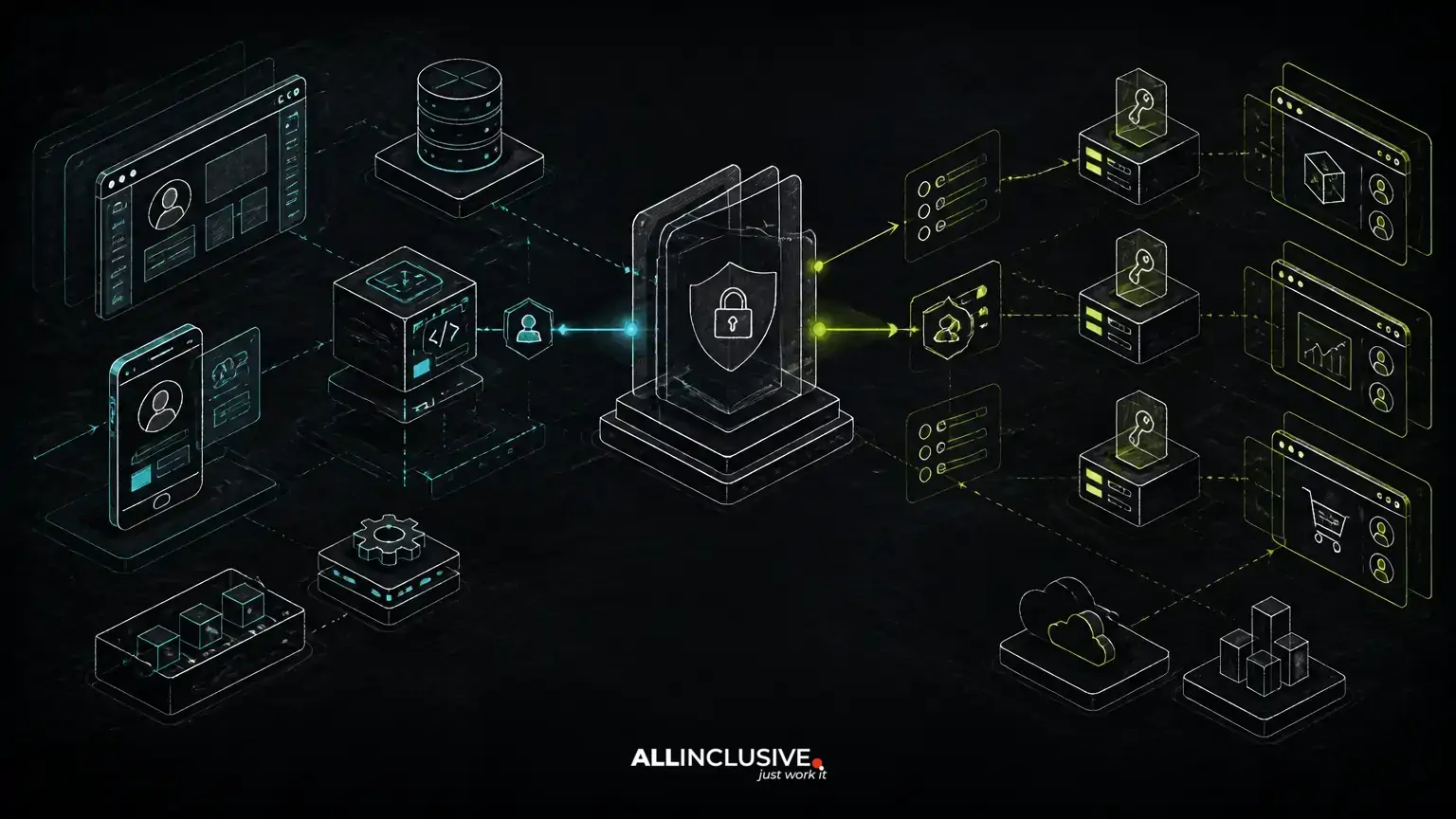
Laravel Sanctum is usually the better fit for first-party applications, while Laravel Passport is designed for APIs that must operate as an OAuth 2.0 authorization server. The right choice depends less on token preference and more on who consumes the API, how clients authenticate, whether third-party delegation is required, and how much identity infrastructure your team wants to operate. Another decision connected with laravel sanctum vs passport is covered in custom software development.
For a single Laravel application with a browser frontend, mobile app, internal tool, or controlled set of first-party clients, Sanctum generally offers a smaller and easier-to-maintain authentication surface. Passport becomes more appropriate when independent third-party applications need delegated access, authorization flows, client registration, refresh tokens, or standards-based OAuth behavior.
This distinction matters during custom API development because authentication becomes part of the product’s long-term contract. Replacing an authentication model later can affect mobile releases, integrations, user sessions, database records, documentation, and security procedures.
What Laravel Sanctum and Passport are designed to do
Sanctum provides lightweight authentication for Laravel applications. It supports session-based authentication for first-party web applications and token-based authentication for APIs, including personal access tokens. The same application can use its web authentication flow for a browser SPA and token authentication for other controlled clients, provided the architecture is configured carefully.
Passport is Laravel’s OAuth 2.0 server implementation. It is intended for systems where a Laravel application issues access tokens to clients and controls delegated access to protected resources. That can include external integrations, partner applications, multiple independently operated products, or a platform where users authorize another application to act on their behalf.
Both options can protect API routes, but they express different ownership models:
- Sanctum: “These are our application clients, and we need practical authentication for them.”
- Passport: “Our API is an authorization server, and other clients need standardized delegated access.”
Laravel Sanctum vs Passport: the core differences
Authentication model
Sanctum is intentionally lightweight. For first-party browser applications, it can use Laravel’s cookie-based session authentication, allowing the frontend and backend to share a conventional application login model. For mobile applications, scripts, or controlled external consumers, it can issue API tokens that are sent with requests.
Passport implements OAuth 2.0 concepts such as clients, access tokens, scopes, and grant-based authorization. OAuth is useful when a resource owner must authorize a separate client, but it introduces more concepts and lifecycle management than a simple first-party token system.
Client ownership
Sanctum is a strong default when the engineering team controls the frontend, mobile app, or internal client. You can design the API contract around your own product workflows without exposing a complete OAuth provider model.
Passport is better aligned with an ecosystem in which clients are separate from the API owner. Examples include a SaaS platform that lets customers connect their own applications, a partner integration program, or a product that needs users to grant narrowly defined permissions to external software.
Implementation and operational complexity
Sanctum typically requires less infrastructure and fewer decisions. The application still needs secure credential handling, token revocation, authorization policies, rate limiting, validation, monitoring, and testing, but the authentication layer itself is relatively focused.
Passport requires more operational discipline because the team owns an OAuth authorization server. Client credentials, redirect URIs, scopes, token lifetimes, consent behavior, refresh behavior, revocation, and compatibility with external consumers all become part of the product surface. That complexity can be justified, but it should be deliberate rather than introduced because “OAuth sounds more enterprise-ready.”
Standards and interoperability
Passport is the more natural choice when interoperability with OAuth-compatible clients is a requirement. External teams may already have libraries and workflows built around OAuth 2.0 authorization code flows, client credentials, or related patterns.
Sanctum tokens can be entirely appropriate for controlled API access, but a custom bearer-token arrangement should not be presented as a substitute for OAuth when independent applications need delegated authorization. The authentication mechanism should match the integration contract promised to consumers.
When Laravel Sanctum is the better choice
Choose Sanctum when the API primarily serves application components that your team owns or closely controls. Common examples include:
- A Laravel monolith with a JavaScript SPA.
- A Laravel backend serving a first-party mobile application.
- An internal operations dashboard or staff application.
- A SaaS product with a small number of controlled integrations.
- Command-line or automation clients that need scoped personal tokens.
- A product where users authenticate directly with your application rather than authorizing another application.
Sanctum is also a practical choice when the product team values a small authentication surface and wants business logic to remain easy to understand. The fewer identity flows the system supports, the fewer edge cases must be documented, tested, monitored, and explained to future developers.
That does not make Sanctum automatically secure or maintenance-free. A production implementation still needs secure cookie settings, CSRF protections where applicable, token storage guidance, revocation procedures, authorization policies, audit logging where required, and controls against excessive token privileges.
When Laravel Passport is justified
Passport becomes a stronger candidate when the product is explicitly an OAuth provider. Consider it when:
- Third-party applications need delegated access to user-owned resources.
- Customers or partners register their own API clients.
- Different clients require distinct scopes and credentials.
- The product must support established OAuth 2.0 integration patterns.
- Users need to authorize an external application without sharing their primary password.
- The API is becoming a platform with independently managed consumers.
For example, a business platform might let an accounting integration read invoices, a support system access selected customer records, and an automation tool create approved resources. Those use cases require more than identifying a request as coming from a known application. They require explicit delegation, limited permissions, client lifecycle management, and a clear revocation model.
Passport should still be evaluated against the exact OAuth flows required. Supporting an OAuth server is not the same as adding a login button or issuing a long-lived API key. The architecture should define redirect behavior, consent, scopes, expiration, refresh, revocation, and the responsibilities of client developers.
Security and authorization decisions are separate from token choice
A common design mistake is treating authentication as the complete security model. Sanctum or Passport can help establish who or what is making a request, but authorization determines what that identity may do.
Laravel policies, gates, role models, tenant boundaries, and domain-level rules should enforce access to business resources. A token scope such as “read orders” may be useful, but it should not replace checks that confirm the user belongs to the correct account, subscription, organization, or workflow.
Teams should also decide:
- How tokens are stored and protected on each client.
- How access is revoked after a device is lost or an employee leaves.
- Whether sensitive actions require reauthentication or additional verification.
- How tenant isolation is enforced at the query and domain layers.
- Which authentication and authorization events are logged.
- How rate limits differ for users, clients, tenants, and public endpoints.
- How compromised credentials are detected and contained.
These controls belong in the application’s security design, not only in framework configuration. A well-structured Laravel API keeps authorization close to the domain rules so that permissions are tested along with business behavior.
How the decision affects API architecture and maintainability
Authentication choices influence more than login. They affect API documentation, onboarding, database design, test fixtures, client SDKs, support procedures, and deployment configuration.
With Sanctum, a controlled product can often keep its client contract relatively direct. The team can define token abilities for practical use cases while relying on application policies for resource-level decisions. This can reduce the amount of identity-specific code that new engineers must understand.
With Passport, the team should treat identity as a platform capability. Client registration, token issuance, consent, scopes, callback validation, and revocation deserve explicit domain boundaries and operational ownership. Integration tests should cover successful and rejected authorization flows, expired credentials, insufficient scopes, revoked clients, and tenant restrictions.
Either approach benefits from a clear separation between authentication adapters and business logic. Controllers should not contain scattered token checks that are difficult to audit. Instead, authenticated identities should enter application services or policies through well-defined interfaces, with tests proving that important business actions cannot bypass authorization.
For broader API architecture considerations, see our guide to Laravel API development. The authentication mechanism is one part of a reliable API; versioning, validation, error contracts, idempotency, queues, caching, observability, and deployment practices matter just as much to consumers.
Common failure modes when choosing between Sanctum and Passport
Using Passport for a first-party application without a real OAuth requirement
OAuth can appear more sophisticated, but unnecessary identity flows increase maintenance and troubleshooting costs. If the only clients are a company-owned SPA and mobile app, start by proving that a simpler model cannot meet the requirements.
Using Sanctum as a substitute for third-party delegation
A token issued directly to an external integration may authenticate that integration, but it may not provide the delegated permissions, client lifecycle, and consent behavior that partners expect. If users must authorize independent applications, model that requirement explicitly.
Confusing token abilities with complete authorization
Token abilities or scopes are useful coarse-grained controls. They should not be the only check for ownership, tenant membership, workflow state, or sensitive business actions.
Designing authentication around the current frontend only
A product may begin with a browser SPA and later add mobile clients, partner integrations, or customer automation. That does not mean Passport should be installed immediately, but it does mean the team should document likely expansion paths and avoid coupling business rules to one client’s session behavior.
Failing to plan migration and revocation
Authentication migrations are user-impacting changes. Before changing mechanisms, inventory client types, token storage, session behavior, API documentation, mobile release constraints, support procedures, and rollback options. A migration plan should define how old credentials expire, how users reauthenticate, and how compromised tokens are invalidated.
A decision checklist for Laravel API authentication
- List every client. Separate first-party web, mobile, internal, partner, and public developer clients.
- Identify the delegation model. Ask whether users authorize another application to access their resources.
- Define required permissions. Map token abilities or OAuth scopes to domain-level policies.
- Assess client lifecycle needs. Determine whether clients need registration, independent credentials, rotation, redirect validation, and revocation.
- Estimate operational ownership. Assign responsibility for identity configuration, monitoring, support, documentation, and incident response.
- Test the unhappy paths. Cover expired, revoked, malformed, overprivileged, and cross-tenant requests.
- Document future constraints. Record why the selected model fits the current product and what change would justify revisiting it.
For many Laravel products, the result is a clear rule: use Sanctum for owned application clients and Passport when the API must function as an OAuth authorization server. If requirements sit between those cases, evaluate the actual integration contract rather than choosing based on framework familiarity or perceived prestige.
Choosing authentication as part of custom Laravel development
Authentication is easiest to change before external consumers and mobile clients depend on it. During product planning, the engineering team should make the identity model explicit alongside domain boundaries, data ownership, API contracts, billing rules, queues, testing, deployment, and upgrade strategy.
For teams evaluating a broader Laravel development engagement, that means asking how authentication will be maintained after the first release: who owns security reviews, how framework upgrades are tested, how credentials are rotated, and how new integrations are added without weakening tenant or resource boundaries.
Ongoing support is particularly important when authentication is tied to production integrations and user sessions. A defined support and maintenance process can include dependency updates, monitoring, incident response preparation, regression testing, and controlled changes to authentication behavior.
For related platform decisions, compare Laravel Nova vs Filament when selecting an administrative interface, and review Laravel vs Symfony when the framework choice itself is still under evaluation. The durable decision is not simply Sanctum or Passport; it is an authentication architecture that matches the product’s clients, security boundaries, and expected ownership.


