
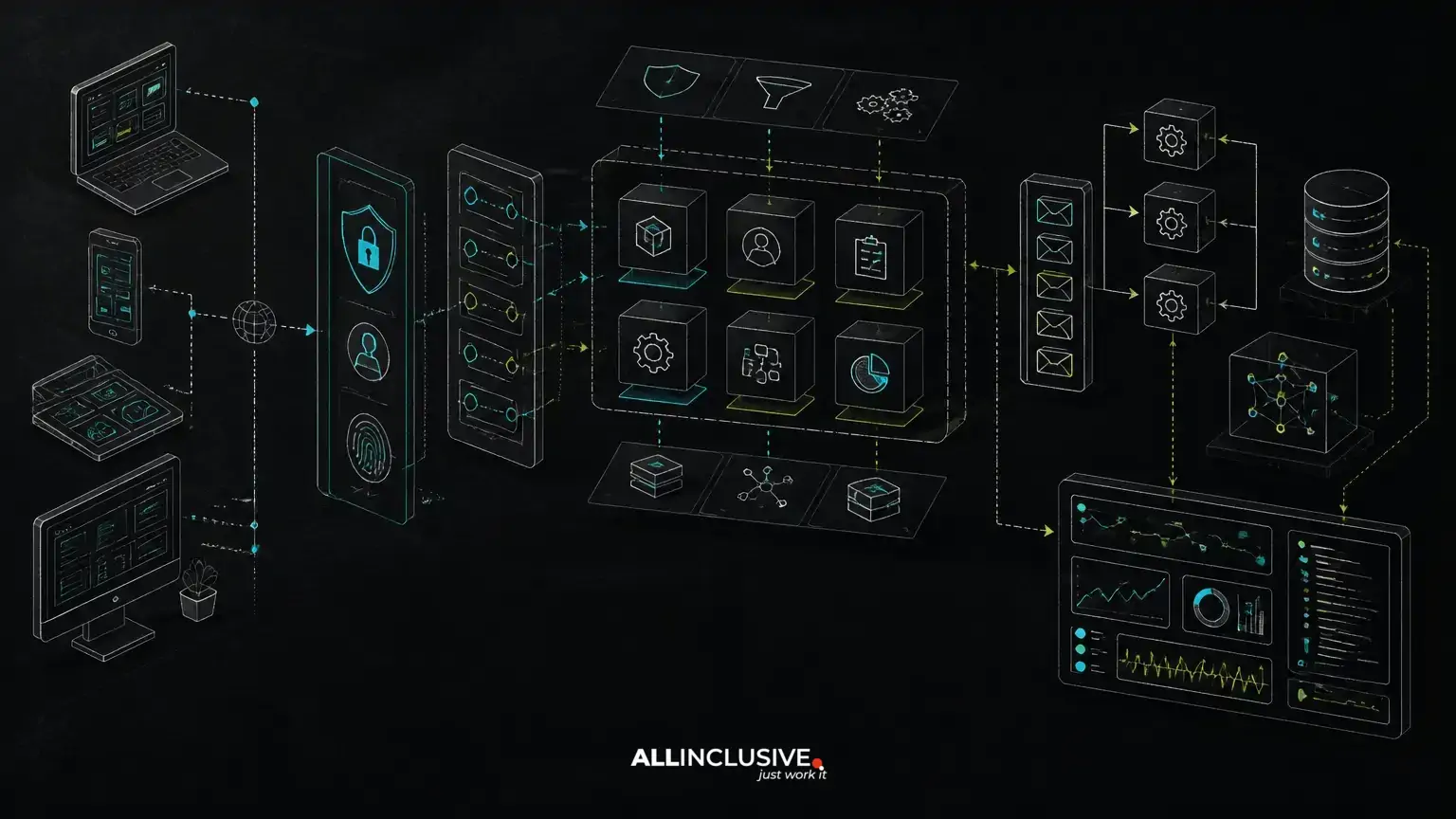
Laravel REST API best practices are less about memorizing controller patterns and more about creating a stable contract around business logic. A production API must authenticate clients, authorize actions, validate input, return predictable errors, evolve without surprising consumers and remain observable under operational pressure.
Laravel provides useful building blocks for these concerns, but the framework does not decide your domain boundaries, data ownership or compatibility policy. Those decisions determine whether an API remains maintainable as a custom application grows.
Start with a clear API contract
Before writing routes, define what each resource represents and which workflows the API must support. A resource should not simply mirror every database table. Exposing persistence details directly can make future schema changes breaking changes for clients.
Document the important parts of the contract:
- Resource names, identifiers and relationships.
- Supported HTTP methods and expected status codes.
- Required, optional and immutable fields.
- Pagination, filtering, sorting and search behavior.
- Authentication requirements and authorization rules.
- Error formats and validation responses.
- Compatibility expectations for existing consumers.
Keep domain and business decisions outside thin transport controllers where possible. A controller can authenticate the request, validate input and delegate to an application service or domain-oriented action. This makes the same rules easier to reuse from queues, scheduled jobs, administration tools or other interfaces.
For broader application architecture considerations, see Laravel development services and engineering guidance.
Use authentication and authorization as separate controls
Authentication answers who is making a request. Authorization answers whether that identity may perform the requested action on the specific resource. Treating them as the same problem is a common source of API vulnerabilities.
Choose an authentication mechanism based on the client types and threat model. A first-party web application, mobile client, partner integration and machine-to-machine worker may need different token handling or credential lifecycles. Avoid placing long-lived secrets in locations where client-side code can expose them unnecessarily.
After authentication, apply authorization at the action and resource level. Policies or equivalent authorization rules should consider ownership, tenant boundaries, account status and workflow state. Checking only whether a user has a general role is often insufficient; an authorized user in one account should not automatically access another account's records.
Protect tenant and object boundaries
For multi-tenant systems, scope queries through the authenticated tenant or account context rather than accepting tenant identifiers as trusted input. Validate that related records belong to the same boundary before creating associations. This prevents insecure direct object references in which a client changes an ID and receives another organization's data.
Keep authorization tests close to the behavior they protect. Test both permitted and denied access, including cross-tenant identifiers, archived records and state transitions such as approving an already cancelled transaction.
Validate input at the API boundary
Request validation should be explicit and separate from persistence. Laravel Form Requests can provide a useful boundary for authorization and field validation, while application services can enforce rules that depend on multiple records or a business workflow.
Validate more than data types. Consider:
- Allowed enum values and state transitions.
- Maximum lengths, file sizes and collection limits.
- Whether referenced records exist within the current tenant.
- Whether the current user may modify each field.
- Whether an operation is idempotent or can be repeated safely.
Do not mass-assign every field received from a client. Define writable attributes deliberately, and separate client-controlled fields from server-owned values such as account IDs, roles, approval timestamps and billing state.
Return consistent success and error responses
Clients should not need endpoint-specific logic to understand common failures. Establish a consistent JSON envelope or problem-details-style structure for validation, authentication, authorization, not-found, conflict and rate-limit responses. The exact shape can vary, but it should remain stable and documented.
Use HTTP status codes to communicate the broad class of result, then include machine-readable details for client behavior. A validation response might identify fields and rules; a conflict response might explain that a state transition is no longer valid. Avoid returning stack traces, SQL details or sensitive exception messages in production.
Separate public messages from internal diagnostics
Log enough context for engineers to investigate a failure without exposing that context to the caller. Correlation or request identifiers can connect an API response to application logs, queue jobs and infrastructure events. Logs should be structured and should avoid tokens, passwords, personal data and payment credentials.
Be cautious with exception handling. A broad handler that converts every failure into a generic response may conceal programming defects and make operational diagnosis harder. Classify expected domain failures separately from unexpected errors, and alert on the latter.
Design predictable pagination, filtering and relationships
Unbounded collection endpoints create both performance and usability problems. Require sensible page limits, establish a default page size and define what happens when clients request an excessive value. For large or frequently changing datasets, cursor-based pagination may provide more stable traversal than page numbers, though it requires a clear ordering strategy.
Filtering and sorting should use an allowlist rather than passing arbitrary column names into query construction. Define supported filters and their semantics. For date ranges, document timezone assumptions and inclusive or exclusive boundaries.
Control relationship loading deliberately. Unrestricted nested resources can create oversized responses and inefficient database access. Support selected expansions or purpose-built representations when needed, and monitor for N+1 queries in resource serialization and related model access.
Version only when the contract changes
API versioning is a compatibility strategy, not a substitute for disciplined design. A new version may be appropriate when a change removes fields, changes meanings, alters authorization behavior or makes existing client assumptions invalid. Additive changes can often be introduced without a new version if clients are expected to ignore unknown fields.
Choose a versioning location—such as a URL segment, header or media type—and apply it consistently. Document the support policy, migration path and deprecation process. A version that exists indefinitely without ownership increases testing and maintenance cost.
Keep version differences at the boundary where possible. Shared domain logic should not be duplicated merely because response representations differ. Version-specific transformers, request objects or application-layer adapters can preserve a common business core while allowing controlled contract changes.
When evaluating API shape, compare REST with alternatives based on client needs and workflow complexity. For laravel rest api best practices, an adjacent technical consideration is explained in GraphQL with Laravel: when it helps and when REST is simpler.
Make write operations safe to retry
Networks fail, clients retry and queue workers can run more than once. For operations such as payments, provisioning or external synchronization, design idempotency deliberately. An idempotency key can associate repeated requests with one recorded operation, provided the server stores and verifies the relevant request state.
Database transactions help keep local changes consistent, but they do not automatically make external calls safe. Avoid holding a database transaction open while waiting on a slow third-party service unless the workflow specifically requires it. Patterns such as an outbox or durable job can help coordinate local state changes with asynchronous integration work.
For long-running work, return a representation of the operation or resource and let clients poll or subscribe according to the product requirement. Queues should have retry policies, failure handling and visibility into permanently failed jobs.
Secure the API beyond login
Authentication is only one part of API security. Apply least privilege to credentials, protect secrets through the deployment environment, enforce HTTPS and limit sensitive administrative operations. Rate limiting can reduce abuse and protect expensive endpoints, but limits should reflect user workflows and trusted integration needs.
Be especially careful with:
- File uploads, including content type, size, storage location and processing.
- Search endpoints that can trigger expensive queries.
- Webhook verification and replay protection.
- Export endpoints containing personal or financial information.
- Mass assignment and over-posting of server-owned fields.
- Detailed error responses in production.
Security controls should be tested as application behavior rather than treated as deployment documentation. Review dependencies and Laravel upgrades through a defined maintenance process; upgrade planning is covered in Laravel upgrade strategy for production applications.
Test contracts, workflows and failure modes
Feature tests should exercise the API through realistic HTTP requests, authentication contexts and database state. Test successful workflows alongside invalid input, unauthorized access, missing resources, duplicate submissions, concurrent changes and external-service failures.
Contract-focused tests are valuable when mobile apps, partner systems or independent frontend teams consume the API. They can detect accidental changes to status codes, field names, nullability and error structures. Keep tests readable enough that product and engineering teams can understand which client promise is being protected.
Run the suite in continuous integration with static analysis and migration checks appropriate to the application. More guidance on release confidence is available in Laravel testing and CI/CD.
Plan observability and deployment before scale arrives
Scaling an API is not only a matter of adding servers. Establish visibility into request latency, error rates, queue depth, database load, cache behavior and third-party dependency failures. Break down measurements by endpoint and operation where that can be done without exposing sensitive data.
Cache only data whose freshness and invalidation rules are understood. Caching an authorization-sensitive or rapidly changing response without a sound key strategy can create correctness and privacy problems. Database indexes should follow measured query patterns, and slow endpoints should be investigated at the query, serialization and external-call levels.
Deployment should include safe migration practices, environment-specific configuration, health checks and a rollback or recovery plan. Schema changes that support multiple application versions are often safer than deploying a database change that requires every client and worker to update simultaneously.
A production review checklist
- Are authentication and resource-level authorization tested separately?
- Are tenant, account and object boundaries enforced server-side?
- Are writable fields, filters, sorts and expansions allowlisted?
- Do errors have stable, documented machine-readable shapes?
- Are retries and duplicate writes safe for important workflows?
- Is pagination bounded and appropriate for the data volume?
- Does the versioning policy identify breaking changes and deprecation ownership?
- Do tests cover denied access, conflicts, external failures and contract changes?
- Can operators trace failures without logging secrets or excessive personal data?
- Are queue, cache, database and deployment concerns included in operational planning?
Strong Laravel REST API design creates a dependable boundary around custom software: clients can evolve with fewer surprises, business rules remain testable and operational failures are easier to diagnose. The right implementation depends on the product's workflows, data model, integrations and risk profile—not on a template or a controller convention alone. For ongoing production support, see support and maintenance for custom software, and explore broader development services when the API is part of a larger application modernization or product build.


