
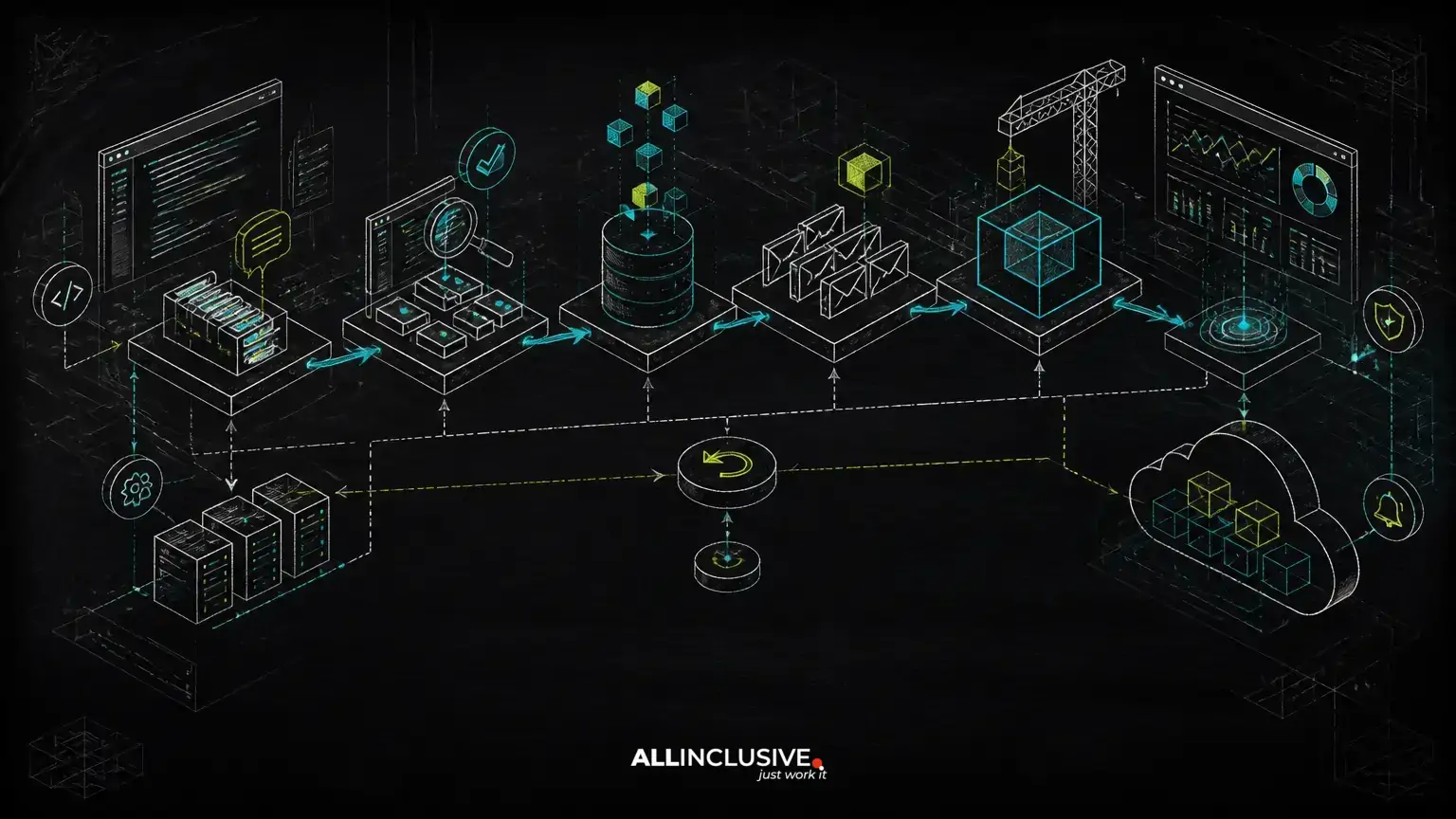
A dependable Laravel release process is more than running a test command before deployment. It connects application design, automated tests, code review, infrastructure, database changes, and rollback decisions so that a team can change production software with evidence rather than assumption.
For a Laravel application with domain logic, Eloquent models, authentication, APIs, queues, caching, or billing workflows, the goal of laravel testing ci cd is not maximum test count. The goal is appropriate confidence at each stage: fast feedback for developers, meaningful verification for pull requests, and controlled release behavior in production.
This article explains how to structure that process, where teams commonly create blind spots, and which decisions deserve explicit ownership.
Start with a release-risk model, not a test-count target
Different parts of a Laravel system fail in different ways. A unit test may be the right tool for pricing rules, while an HTTP test is more useful for an authorization boundary. A queue workflow may require an integration test with controlled dependencies, and a migration needs verification against realistic data volumes or states.
Before choosing CI stages, classify the application’s most consequential risks:
- Business rules: incorrect totals, eligibility decisions, state transitions, or permissions.
- Data integrity: unsafe migrations, incorrect relationships, duplicate records, or partial writes.
- External boundaries: payment providers, email services, storage systems, webhooks, and third-party APIs.
- Asynchronous behavior: queued jobs, retries, scheduled commands, and failure handling.
- Operational behavior: cache invalidation, configuration changes, worker restarts, and deployment sequencing.
This risk map helps prevent two expensive mistakes: testing low-value implementation details while missing critical workflows, and making the CI pipeline so slow that developers bypass it.
Use Laravel’s test layers for different questions
A maintainable test suite usually contains several layers rather than one dominant style. The exact balance depends on the application, but each layer should answer a distinct question.
Unit tests for deterministic domain logic
Unit tests are appropriate for calculations, value objects, policy decisions, parsers, and other logic that can run without the framework or a database. They should be fast and focused. For example, a subscription eligibility service can be tested against trial status, payment state, account limits, and renewal dates without constructing a full HTTP request.
Keeping core business rules testable outside infrastructure also improves maintainability. The code becomes easier to review, reuse, and change when it does not depend unnecessarily on controllers, global state, or a particular database setup.
Feature and HTTP tests for application behavior
Feature tests verify a meaningful slice of the application: a request enters through a route, authentication is applied, authorization is checked, data is persisted, and a response is returned. These tests are valuable for APIs, admin workflows, account management, and other user-visible behavior.
For an API, test more than a successful status code. Verify validation, response structure, authorization boundaries, idempotency where applicable, and the database state that should follow the request. This catches regressions that isolated unit tests cannot see.
Integration tests for infrastructure boundaries
Integration tests are useful where application code depends on a database, queue, cache, filesystem, or external service contract. They should be deliberate about what is real and what is replaced with a fake or test double.
For external providers, a practical approach is often to combine contract-oriented tests with a small number of controlled integration checks. The suite should verify how the application handles the provider’s expected payloads, error responses, signatures, and retry conditions without making every pull request dependent on a live third-party account.
Browser tests for high-value user journeys
End-to-end browser tests are slower and more operationally sensitive, so they should cover a limited set of critical journeys. Examples include account registration, a core transaction, an administrator approval flow, or a billing change that affects access.
Browser tests should not become the only evidence that a workflow works. Lower-level tests should explain business rules and API behavior, while browser coverage confirms that the principal user path is wired together correctly.
Make the test suite deterministic before putting it in CI
CI exposes test-suite weaknesses that may remain hidden on a developer laptop. Flaky tests, shared state, timing assumptions, and environment-specific configuration become release friction when every change depends on them.
Common sources of nondeterminism include:
- Tests that depend on execution order or data left by another test.
- Real network calls to services that are unavailable or variable.
- Time-sensitive assertions using the actual system clock.
- Queue or event behavior that is not explicitly controlled.
- Parallel tests sharing databases, files, ports, or external resources.
- Configuration values that differ between local, CI, staging, and production environments.
Use isolated test data, explicit time control, stable fakes, and clear environment configuration. When a test fails intermittently, treat that as a defect in the delivery system rather than simply rerunning it until it passes. A pipeline that accepts unexplained flakiness teaches the team to distrust failures.
Design CI as a sequence of useful feedback gates
A Laravel CI pipeline should provide the fastest useful signal first and reserve slower checks for later stages. A common structure is:
- Dependency and environment setup: install the intended PHP version and extensions, restore dependencies where safely supported, and establish a known test database or service environment.
- Static quality checks: run formatting checks, static analysis, configuration validation, and other low-cost checks appropriate to the codebase.
- Fast automated tests: run unit and focused feature tests early so common defects are reported quickly.
- Broader integration coverage: exercise database, queue, API, and important application boundaries.
- Build verification: compile frontend assets, validate production-like configuration, and confirm that the deployable artifact can be created.
- Release or deployment approval: deploy only when required checks pass and the change has an appropriate review and ownership path.
The commands and tools may vary by project. The important design principle is that every gate has a reason. A check that produces noisy or redundant output should be improved, moved, or removed rather than allowed to obscure higher-value failures.
Test Laravel workflows that cross queues, events, and databases
Many production defects occur between components rather than inside a single method. A request may create a record, dispatch a job, publish an event, update a cache, and trigger an external notification. Testing only the initial controller response leaves the rest of the workflow unverified.
For these workflows, test explicit state transitions and failure behavior:
- Does the command or request create the expected durable record before dispatching follow-up work?
- Is a job safe to retry without duplicating an action?
- What happens if the external service times out after accepting the request?
- Can a failed job be inspected and replayed safely?
- Does a cache entry become stale after a write, and which operation invalidates it?
- Are authorization decisions enforced again in asynchronous code where needed?
Billing and webhook flows deserve particular care. Test signature or authenticity validation according to the provider’s documented contract, duplicate event handling, out-of-order events, and transitions that should not be reversed accidentally. A successful payment response is not the same as a correctly maintained billing state.
For deployment architecture involving workers and cloud infrastructure, the application test plan should align with operational sequencing. The Laravel AWS deployment guide provides related context for thinking about application processes, workers, and production infrastructure together.
Handle database migrations as release-critical code
A migration can pass all application tests and still create production risk if its data volume, locking behavior, or rollback implications are not understood. Treat schema changes as part of the release design, not as a routine side effect of merging code.
For a potentially disruptive change, consider an expand-and-contract sequence:
- Add a compatible schema element without requiring the new application code immediately.
- Deploy code that can read or write both representations where necessary.
- Backfill or transform existing data in a controlled process.
- Switch reads and writes to the new representation.
- Remove obsolete columns or constraints only after dependent versions are no longer active.
CI can verify that migrations run from a clean database and that the application works against the resulting schema. Staging should add checks for realistic data conditions, while the production plan should document backups, observability, expected duration, and the point at which the change can be halted.
Separate deployment automation from release confidence
CI proves that a defined set of checks passed in a defined environment. It does not prove that every production condition is safe. Deployment automation should therefore include operational safeguards rather than treating a green build as permission to ignore risk.
A production release process may include:
- Immutable or clearly identifiable build artifacts.
- Environment-specific configuration validation without exposing secrets.
- Explicit handling for application cache, route cache, configuration cache, and compiled assets.
- Worker and scheduler coordination so old processes do not continue using incompatible code.
- Health checks that verify meaningful application readiness, not only that a process is running.
- Structured logs, error reporting, and metrics that can be inspected immediately after release.
- A documented rollback or forward-fix decision for application code and database changes.
Rollback is not always a simple reversal. A destructive migration, irreversible external action, or changed billing state may require a forward fix instead. The team should know this before deployment, when the options are still available.
Keep security and authorization inside the test strategy
Security testing should be part of ordinary Laravel delivery rather than a separate activity performed only before launch. Feature tests can verify that unauthenticated users are rejected, authenticated users cannot access another tenant’s records, privileged actions require the correct role, and validation does not permit unintended state changes.
API tests should cover authentication failures, authorization failures, rate or abuse controls where implemented, and sensitive fields that must not appear in responses. Test secrets and production credentials through the CI platform’s secret-management mechanism, never by committing them to the repository or embedding them in test fixtures.
Dependency review and static analysis can identify classes of issues, but they do not replace application-specific authorization tests. A secure release process combines automated checks with code review focused on trust boundaries and data ownership.
Measure the release process by useful signals
Teams do not need a large dashboard to improve CI/CD. A small set of signals can reveal whether the process is helping:
- How long developers wait for the first meaningful failure.
- Which checks fail most often and whether failures are actionable.
- How frequently tests are flaky or rerun without a code change.
- Whether deployment failures are detected before users report them.
- How often emergency changes bypass normal review or verification.
- Whether the team can identify an owner and next action for a failed release.
These signals connect engineering quality to delivery speed and operational ownership. A slower pipeline may be justified for a high-risk release, but its cost should be visible. Conversely, a fast pipeline that omits important workflows can create false confidence.
A practical checklist for Laravel CI/CD adoption
Before calling a release process dependable, review the following questions:
- Are critical domain rules covered independently from controllers and infrastructure?
- Do feature tests verify authentication, authorization, validation, persistence, and response behavior?
- Are queues, retries, webhooks, caching, and external failures tested where they affect business state?
- Can the test suite run repeatedly with isolated data and predictable time?
- Does CI validate both application code and the deployable artifact?
- Are migrations reviewed for compatibility, data volume, locking, and rollback limitations?
- Does deployment coordinate workers, scheduled tasks, caches, configuration, and health checks?
- Can the team distinguish a rollback from a forward fix?
- Are logs and alerts ready before the release begins?
- Does each failed gate have a clear owner and recovery path?
Teams building custom Laravel applications often need to evolve this process alongside the product. A SaaS platform with subscriptions, APIs, background processing, or tenant isolation will usually require more explicit release controls than a small internal application. The right workflow is the one that reflects the system’s actual risk without turning every change into a manual ceremony.
For broader application planning, architecture, and implementation support, see Laravel development services and the wider software development practice. If the application is already in production, support and maintenance can help maintain the test, upgrade, security, and release practices as the codebase changes.
Migration work also benefits from this release discipline. When replacing an older PHP application, the team should use incremental tests and deployment gates to separate stabilization, refactoring, data migration, and new feature delivery. The legacy PHP to Laravel migration guide discusses that distinction in more detail.


