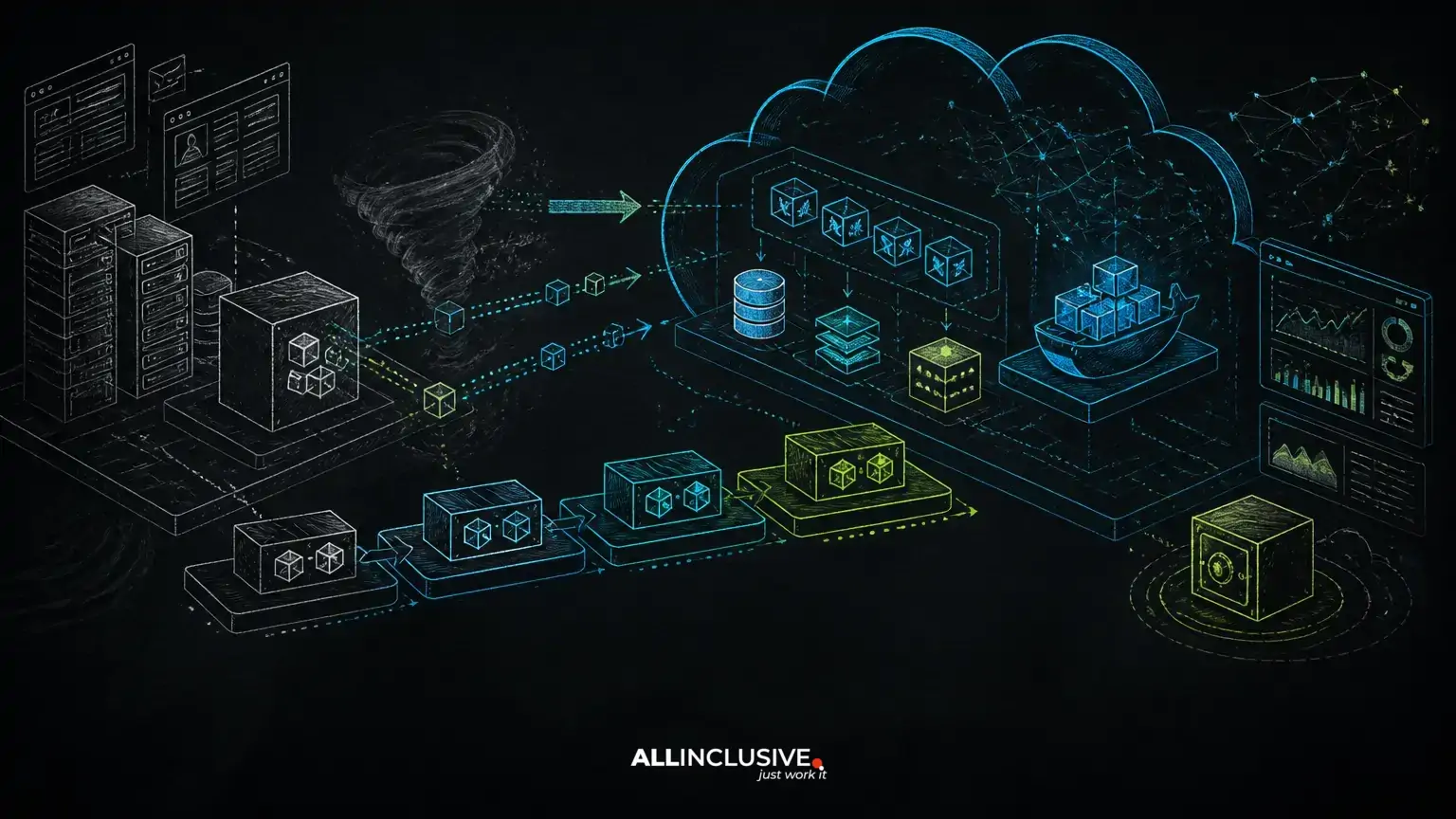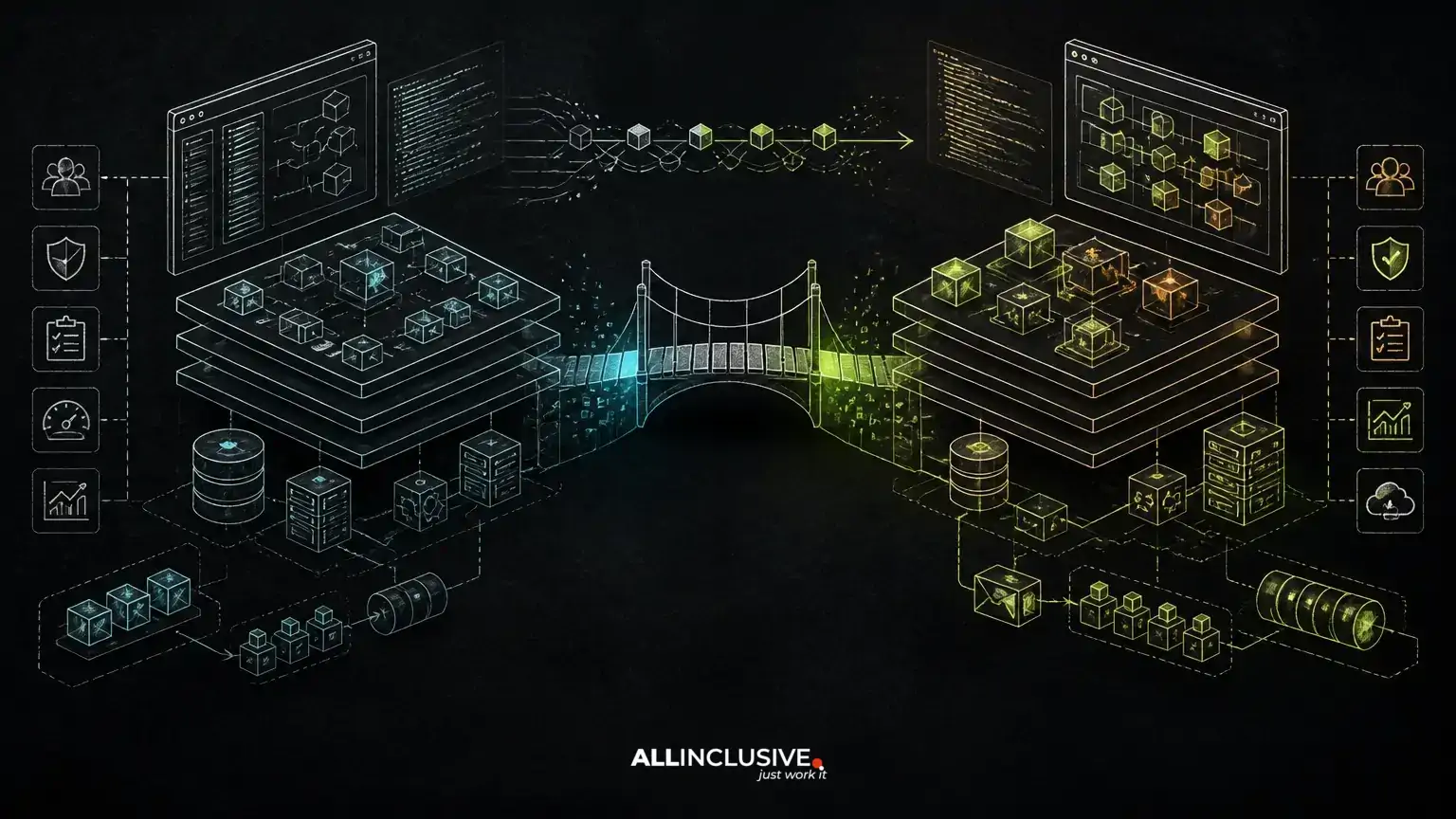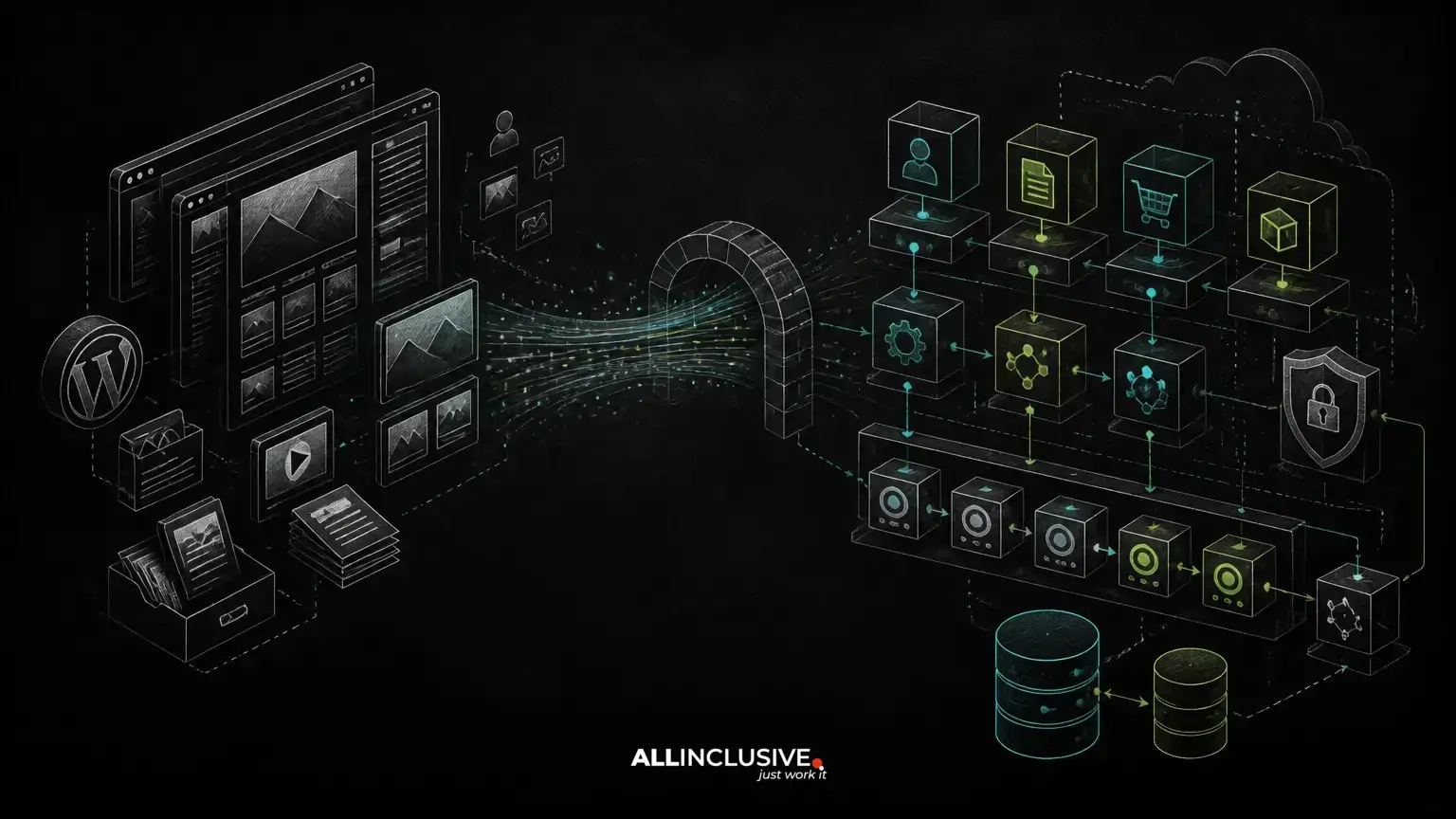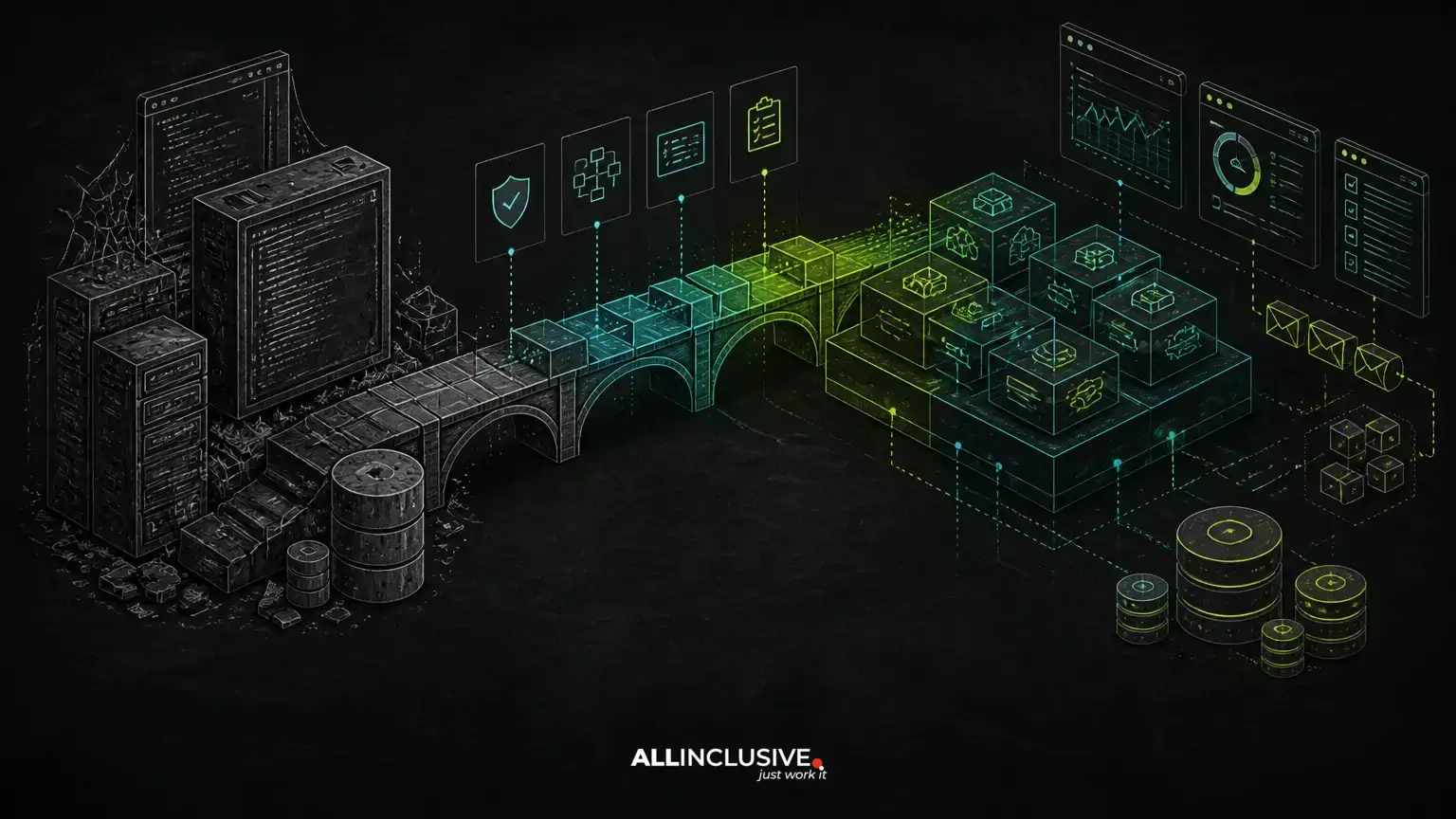
A legacy PHP to Laravel migration is rarely safest when treated as a clean-sheet rewrite. Mature applications contain undocumented business rules, database assumptions, integrations and operational workflows that may not be visible in the code structure. Replacing everything at once can improve architectural consistency, but it also concentrates delivery risk and makes it difficult to distinguish new defects from old behavior.
A safer path is usually to understand the existing system, stabilize its most important risks and migrate capabilities in controlled increments. The target is not simply Laravel code. It is a maintainable production application with clearer domain logic, tested workflows, secure access controls, reliable deployment and a migration plan the business can observe and reverse when necessary.
Start by separating stabilization, refactoring, migration and rebuilding
These activities are related but not interchangeable:
- Stabilize: reduce immediate operational risk, such as unsupported PHP versions, failing jobs, insecure authentication paths, unavailable backups or fragile deployments.
- Refactor: improve the existing PHP code without changing its externally visible behavior.
- Migrate: move a capability or bounded part of the system to Laravel while the remaining application continues to operate.
- Rebuild: replace a system or major subsystem with new product and technical assumptions.
Confusing these categories leads to poor estimates. A team may describe a project as a framework migration when the real scope includes redesigned billing, a new permissions model, a data cleanup effort and a changed user workflow. Those are product and architecture decisions, not automatic consequences of adopting Laravel.
Inventory the legacy PHP application before choosing a migration route
The first technical deliverable should be an application map, not a Laravel folder structure. Document the user journeys and system responsibilities that matter to the business:
- Public and authenticated entry points
- Core workflows and approval states
- Scheduled tasks, command-line scripts and background processing
- Database tables, relationships, triggers and reporting queries
- External APIs, payment providers, email services and file storage
- Authentication, authorization and administrative access
- Deployment steps, environment variables, cron configuration and operational alerts
Trace each important workflow from request to response and from input to persisted state. This often reveals business logic embedded in templates, database queries, global functions or integration callbacks. Those rules should be identified before they are moved into controllers, models or services.
Also record what is unknown. Missing documentation is itself a migration risk. A decision log can distinguish confirmed behavior from assumptions that require product-owner or operations-team validation.
Choose a migration boundary based on business capability
The strongest migration boundaries are usually capabilities rather than technical layers. Moving every model first, or rewriting all controllers before delivering user value, can create a long period in which neither system is easy to operate.
Candidate boundaries might include account administration, a customer-facing dashboard, order processing, billing, a reporting area or an API resource. Select an area with a clear owner, understandable inputs and outputs, and a reasonable way to verify behavior.
A phased approach can use a routing or integration boundary:
- Keep the legacy application responsible for unchanged workflows.
- Introduce Laravel for one defined capability.
- Route selected requests or users to the new implementation.
- Share data through a controlled contract rather than unrestricted cross-application assumptions.
- Observe errors, performance, support tickets and reconciliation results.
- Retire the old path only after the replacement is proven.
This approach does not mean both applications should share every internal class or database query. Shared behavior should be exposed through explicit APIs, queues or carefully designed database contracts. Otherwise, the migration creates a new form of coupling that is difficult to remove later.
Map domain logic before introducing Eloquent models
Eloquent can make database access expressive, but converting every legacy table directly into an active-record model does not automatically produce a sound domain model. Legacy schemas often contain overloaded columns, ambiguous status values, historical exceptions and relationships that were never formally defined.
Before creating models, identify:
- Which records represent business entities versus technical artifacts
- Which fields are authoritative and which are derived
- What each status means and which transitions are valid
- Which actions must be atomic
- Which rules belong to the domain rather than the user interface
- Which data needs normalization, translation or cleanup
Use Laravel models and relationships where they clarify ownership and persistence. Keep complex business decisions in services, actions or domain-oriented components when placing them in a model would make behavior difficult to test. Controllers should coordinate the request, authorization and response; they should not become the new location for every rule previously scattered across legacy PHP.
For data that cannot be changed immediately, an anti-corruption layer or translation service can protect the new code from legacy naming and representation. This lets Laravel use clearer concepts without pretending that the old schema is already clean.
Build a safety net around behavior that must not change
Legacy applications frequently have limited automated coverage. That does not mean migration should proceed without tests. Begin with characterization tests for critical behavior: tests that describe what the system currently does, including awkward but relied-upon edge cases.
Prioritize coverage for:
- Authentication, password reset and account recovery
- Permissions and administrative actions
- Money movement, invoices, subscriptions or usage calculations
- State transitions and approval workflows
- Data imports, exports and scheduled processing
- Integration callbacks and idempotency behavior
- Notifications that users or operations teams depend on
Not every historical behavior deserves preservation. A test should be treated as a documented decision: preserve it, change it intentionally or deprecate it. Product and engineering owners should agree on that distinction before the migration team encodes behavior into the new application.
Laravel feature tests can verify complete HTTP workflows, while unit tests can cover focused business rules. Database tests should use realistic constraints and representative records, particularly when the legacy system has unusual nullability, duplicate data or inconsistent status values.
Rebuild authentication, authorization and security deliberately
Security should not be copied mechanically from legacy PHP. Review the existing session behavior, password handling, reset flows, administrative access, file uploads, input validation, output encoding and secret management. Confirm where authorization decisions are made and whether they are enforced consistently for web requests, APIs, jobs and administrative tools.
Laravel provides conventions and components that can support a stronger design, but framework defaults do not replace threat modeling or application-specific review. Define authorization around actions and resources, not only around hidden interface elements. A user who cannot see a button must also be prevented from invoking the underlying endpoint directly.
For APIs, document authentication, authorization, validation, rate limits, error responses and versioning. For queued work, consider what happens when a job is retried after a partial external operation. Idempotency and auditability are often more important than simply moving the task into a queue.
A dedicated Laravel security audit can help review the target implementation before a major release, especially when the migration changes authentication, payment handling or administrative workflows.
Handle data migration as a controlled product operation
Data migration is not just a set of SQL statements. It is a controlled change to the records that users, support staff, reports and integrations rely on.
Plan for:
- Schema differences and field mappings
- Duplicate, orphaned or invalid legacy records
- Time zones, currency precision and date semantics
- Historical records that must remain readable
- Foreign keys and ordering constraints
- Incremental synchronization while both systems are active
- Reconciliation reports and rollback or correction procedures
Prefer repeatable migration scripts over one-off manual edits. Run them against a representative copy of production data, measure failures explicitly and preserve an audit trail of transformations. If the legacy system remains writable during the transition, define which system owns each field and how conflicts are resolved.
For high-risk workflows, a period of parallel calculation or shadow validation can compare old and new results without immediately changing the user-visible outcome. This is particularly useful for billing, eligibility, inventory and reporting logic.
Move slow work into reliable queues and operations
Legacy PHP applications often perform email delivery, imports, document generation or third-party synchronization during the web request. A Laravel migration is an opportunity to separate user-facing work from background processing, but queues introduce operational responsibilities of their own.
Define retry behavior, failure handling, visibility, deduplication and ownership for each job. A job that can safely run twice is designed differently from one that charges a customer or creates an irreversible external record. Monitor queue latency and failures, and make sure support staff have a documented way to inspect or replay work.
For Laravel-specific queue operations, the guide to Laravel queues and Horizon provides a useful companion to migration planning. The relevant question is not whether a queue is available; it is whether the business process remains correct when work is delayed, retried or partially completed.
Release the migration through observable increments
Deployment design should be part of the migration plan from the first slice. Establish separate environments, repeatable builds, configuration management, database backup procedures and a release checklist. Avoid migrations that require an unplanned sequence of manual production edits.
Use a release strategy appropriate to the risk. Options may include feature flags, internal users first, a limited workflow scope, parallel reads or a short dual-run period. Each increment should have:
- A defined success condition
- Application and infrastructure monitoring
- A support and communication plan
- A rollback or forward-fix decision path
- A record of data changes made during the release
Rollback is not always as simple as redeploying the previous application version. Once a new schema or process has changed data, the safer response may be a compatible forward fix. Design database changes in stages so old and new code can coexist long enough to reduce release risk.
Measure maintainability, not only feature completion
A migration is successful when the organization gains more than a new framework name. Track whether engineers can locate business logic, add tests, diagnose failures and deploy changes with less uncertainty. Review ownership of integrations, documentation quality, dependency updates, error handling and operational runbooks.
Performance should be measured from real workflows rather than assumed from framework selection. Inspect database queries, indexing, caching, queue behavior, payload sizes and external-service latency. The practical Laravel performance guide on Laravel performance optimization can support this work when a migrated capability exposes bottlenecks.
Likewise, ongoing ownership matters after the first release. Planned maintenance should include security updates, dependency review, backups, monitoring, test maintenance and framework upgrade planning. See support and maintenance services for the operational side of keeping a custom application reliable after migration.
When a staged migration is not the right answer
Incremental migration is not universally superior. A rebuild may be more appropriate when the existing application has little recoverable business logic, the data can be cleanly separated, the product requirements are changing substantially or the legacy runtime cannot be operated safely even during transition.
Conversely, a full rewrite is usually difficult to justify when the application contains complex undocumented workflows, many integrations or a large active user base and the proposed replacement has not yet demonstrated behavioral parity. In that situation, a bounded Laravel migration can create evidence before larger commitments are made.
The right decision depends on risk, not preference. Treat the existing PHP application as a source of business knowledge, establish explicit migration boundaries and invest in tests and operational visibility. With that discipline, Laravel becomes a foundation for maintainable custom software rather than a costly rewrite disguised as a framework upgrade. Teams evaluating broader application architecture can also review Laravel development services and the wider custom software development practice for related engineering support.