
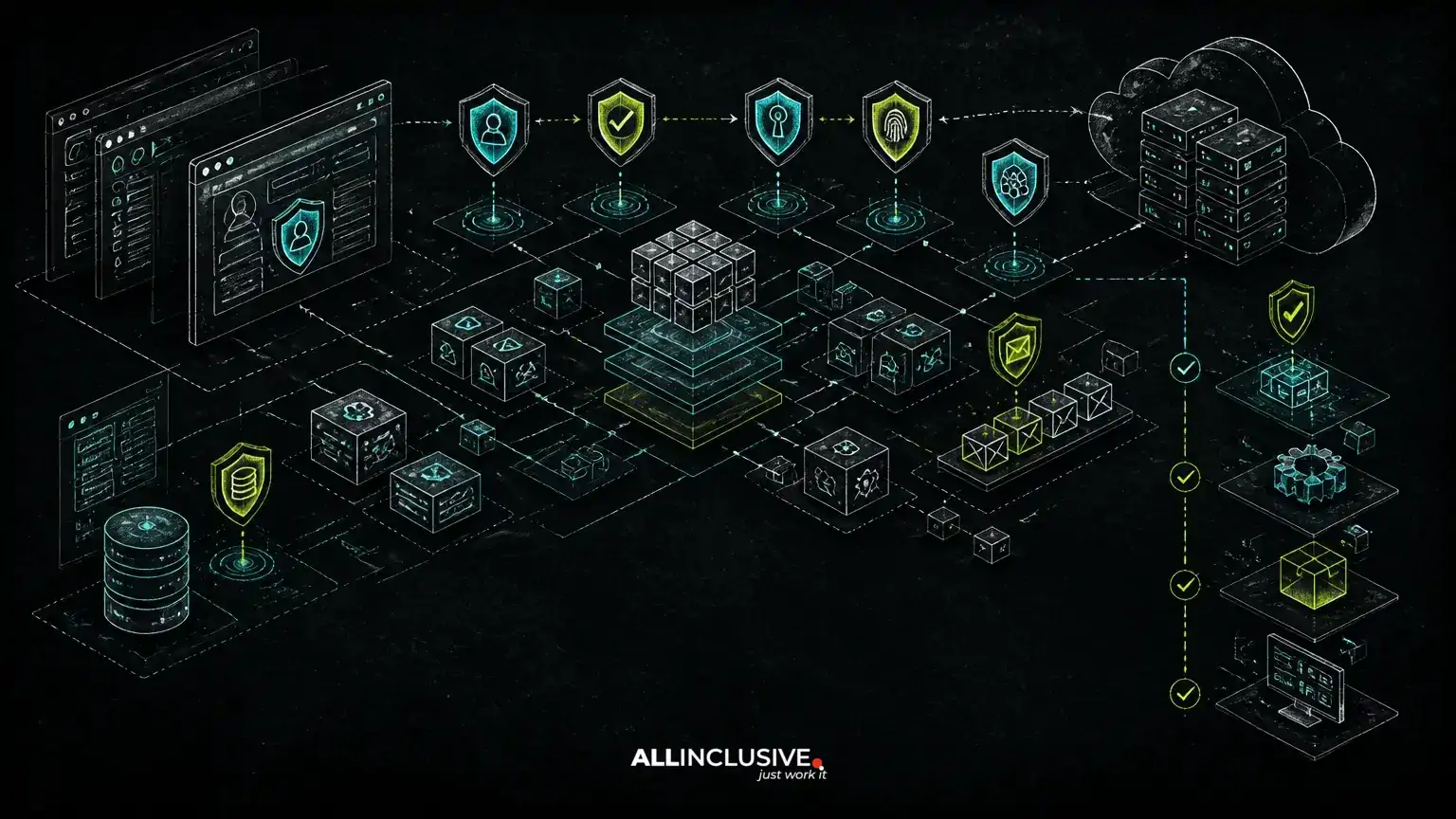
A Laravel security audit before a major release should examine more than package versions and obvious authentication bugs. The review needs to follow real user workflows through controllers, domain logic, Eloquent models, APIs, queues, billing paths, administrative tools and deployment infrastructure. For laravel security audit, an adjacent technical consideration is explained in custom software development.
The most useful audit is risk-based. Start with the application’s sensitive actions and data, identify how those actions are authorized, then test whether unexpected input or an unusual workflow can bypass the intended controls. This approach is more effective than treating Laravel’s conventions as a substitute for application-specific security engineering.
For teams building or maintaining a custom Laravel application, the audit should produce two outcomes: a prioritized remediation list and enough evidence to decide whether the release is ready, needs a limited rollout or should be delayed.
Define the release boundary and threat model
Before reviewing code, document what is changing. A major release may introduce new roles, billing behavior, public endpoints, integrations, data migrations, background jobs or infrastructure changes. Each can alter the attack surface even when the visible feature appears small.
- List new and modified user journeys, including administrative and support workflows.
- Identify sensitive data such as credentials, personal information, payment-related records, internal documents and business rules.
- Record external systems, webhooks, object storage, email providers, queues and scheduled tasks.
- Separate internet-facing, authenticated, staff-only and internal service endpoints.
- Define the consequences of unauthorized access, data disclosure, duplicate processing or destructive actions.
This inventory helps the team spend review time where a defect could create operational, financial or compliance risk. It also prevents a narrow audit that checks only the new screens while overlooking shared models or middleware.
Review authentication and session handling
Authentication confirms who a user is; it does not decide what that user may do. Review both the identity flow and the places where authenticated state is established, renewed and invalidated.
Questions for the audit
- Are login, password reset, email verification and account recovery flows protected against abuse?
- Are session cookies configured appropriately for the deployment environment, including secure transport and cross-site behavior?
- Does logout invalidate the relevant session state, and are sessions rotated after sensitive changes such as login or privilege updates?
- Are administrative accounts subject to stronger controls appropriate to the organization’s risk?
- Do API tokens have limited scope, clear ownership and a practical revocation process?
- Are error messages and recovery responses careful not to disclose whether an account exists?
Test these flows using multiple accounts and realistic sequences. A secure login page can still coexist with an insecure account-linking flow, a weak password reset process or a token that remains usable after it should have been revoked.
Test authorization at the business-action level
Authorization failures are often more damaging than missing validation because a user may be able to perform a legitimate action against the wrong record. Review policies, gates, middleware and service-layer checks together rather than assuming a route-level check covers every path.
For each sensitive action, ask:
- Who may perform it?
- Which tenant, account, project or organization owns the affected record?
- Does the check apply to direct requests, API requests, queued jobs and administrative tools?
- Can a user alter an identifier, route parameter or hidden field to reach another record?
- Is the rule based on current business state, such as invoice status or approval stage?
Test both horizontal access, where one user reaches another user’s data, and vertical access, where a lower-privilege user invokes a staff or administrator action. Authorization should be enforced close to the business operation, not only by hiding a button in the interface.
Inspect request validation and mass assignment boundaries
Validation should reflect business rules, not merely data types. Review form requests, controller validation and service methods for fields that can change ownership, role, status, price, approval state or other security-sensitive attributes.
Mass assignment protection is useful, but it is not a complete authorization strategy. A permitted field can still be dangerous if the current user should not be allowed to change it in a particular context. Prefer explicit input mapping for high-impact operations, and keep user-supplied attributes separate from server-controlled values.
Check how the application handles:
- Unexpected fields and nested arrays.
- File names, MIME types, file size and storage destinations.
- Rich text, URLs, redirects and serialized data.
- Dates, monetary values, quantities and enum-like state transitions.
- Validation performed in the browser but missing on the server.
Stored and reflected output also requires review. Escaping should match the output context, and trusted HTML should be narrowly controlled rather than accepted broadly because it comes from an authenticated user.
Review Eloquent models, queries and data exposure
Laravel’s ORM reduces repetitive database code, but data access still needs deliberate boundaries. Inspect model relationships, scopes, resource transformations and query construction for unintended exposure or access across ownership boundaries.
- Check whether API resources and JSON serialization expose internal identifiers, roles, tokens, audit fields or personal data.
- Review relationship loading for endpoints that could return records outside the requesting user’s scope.
- Use parameter binding or query-builder mechanisms appropriately; do not concatenate untrusted values into SQL or database expressions.
- Confirm that soft-deleted, archived or disabled records cannot be accessed through alternate routes unless intended.
- Review migrations and indexes for sensitive columns, data retention requirements and accidental duplication.
Data modeling is a security concern as well as a performance concern. A clear ownership model makes authorization easier to implement and test. Ambiguous relationships often lead to duplicated checks, inconsistent behavior and difficult incident investigation.
Audit APIs, webhooks and integrations
Public and partner APIs need explicit controls for authentication, authorization, input validation, rate management, response shaping and error handling. Do not assume an internal-looking route is safe simply because it is not linked from the main interface.
For each endpoint, verify the allowed methods, resource ownership rules, pagination limits, filtering behavior and response fields. Check whether identifiers are predictable and whether changing an identifier in a request exposes another customer’s object.
Webhook handlers deserve separate attention. Verify signatures or equivalent authenticity controls where the provider supports them, reject malformed payloads, prevent replay where appropriate and make processing idempotent. A duplicate webhook should not create a second subscription, refund or fulfillment event.
Document external credentials and rotate them through environment or secret-management processes rather than committing them to source control. Integration failures should be observable without placing secrets or sensitive payloads into logs.
Examine queues, scheduled tasks and privileged workers
Background processing changes the security model because work may execute later, under a worker identity and with data captured at dispatch time. Review queued jobs for authorization assumptions that were valid in the original request but may no longer be valid when the job runs.
- Do jobs re-check important ownership, status or permission conditions before destructive actions?
- Are payloads limited to the identifiers and immutable context the worker actually needs?
- Can a job be retried safely without duplicate billing, email, provisioning or state changes?
- Are failed jobs, dead-letter behavior and administrative retry controls protected?
- Do scheduled commands use least privilege and avoid accepting unsafe runtime input?
Operational visibility matters here. A queue that silently accumulates failures can create delayed security and business problems, especially when jobs handle account changes, payments or access provisioning. See the related guide to Laravel queues and Horizon for the operational side of moving slow work out of user requests.
Check secrets, configuration and deployment controls
Review the production configuration path, not only the application repository. Confirm that debug behavior is disabled where appropriate, secrets are supplied through controlled mechanisms and logs do not expose credentials, session data or sensitive request content.
Audit dependency management and deployment permissions. The release process should identify vulnerable or abandoned dependencies, constrain who can deploy, protect production environment settings and provide a tested rollback path. Dependency upgrades should be evaluated for behavior changes as well as security advisories.
Also inspect:
- Web-server and reverse-proxy handling of HTTPS, headers, uploads and request size.
- Container, host and worker permissions.
- Database credentials and network access.
- Storage buckets, downloadable files and signed URLs.
- Backup access, retention and restoration procedures.
- Administrative routes, maintenance commands and deployment hooks.
A secure code change can still be undermined by an exposed backup, overprivileged worker or deployment secret stored in an accessible build artifact.
Use testing to validate security assumptions
Security review should become executable wherever possible. Add feature tests for authentication, authorization, tenant boundaries, sensitive state transitions and API response filtering. Use multiple users, roles and organizations in the test setup rather than testing only a successful administrator path.
Useful negative cases include:
- An authenticated user requesting another organization’s record.
- A lower-privilege user calling an administrative endpoint directly.
- A request containing server-controlled fields such as owner, role or approval state.
- A replayed webhook or retried queued job.
- An expired, revoked or malformed token.
- An oversized upload or unexpected nested input structure.
Automated tests do not replace manual review or specialized security testing, but they prevent known authorization and workflow failures from returning during future refactoring. This is especially important in custom software where business rules change frequently.
Turn findings into release decisions
Record each finding with the affected asset, attack path, business consequence, evidence, owner and remediation status. Prioritize issues that enable account takeover, cross-tenant access, privilege escalation, secret disclosure, unauthorized financial actions or destructive data changes.
Not every finding requires the same release response. A missing authorization check on a billing action should normally block release, while a low-value information disclosure may require a documented mitigation and scheduled fix. The decision should reflect exploitability, exposure, affected data and the availability of compensating controls.
After remediation, retest the complete workflow rather than only the changed line. Then preserve the audit notes, test cases and deployment decisions as part of the application’s maintenance record. Ongoing Laravel support and maintenance can help keep dependency review, upgrades, monitoring and regression testing from becoming a one-time release exercise.
When an audit reveals structural risk
A security audit may expose more than isolated defects. Repeated authorization gaps, unclear ownership relationships, duplicated business rules or untestable controllers indicate maintainability problems that make future releases harder to secure.
In that situation, the right response may be to stabilize the current release, refactor a bounded domain area or plan a broader modernization effort. Performance work can also intersect with security when inefficient queries encourage unsafe caching or bypasses; review the related Laravel performance optimization guide with those trade-offs in mind.
For teams evaluating broader Laravel development work, the audit provides a useful technical baseline: it shows where the application’s domain logic, data model, APIs and deployment process are sound, and where custom engineering is needed before adding more features.
A Laravel security audit is most valuable when it follows the application’s real business actions and produces tests, owners and release criteria. Reviewing authentication alone is not enough. The release should be judged by whether users, workers, integrations and operators can perform only the actions they are meant to perform, with evidence that those boundaries hold under normal and adversarial workflows.


