
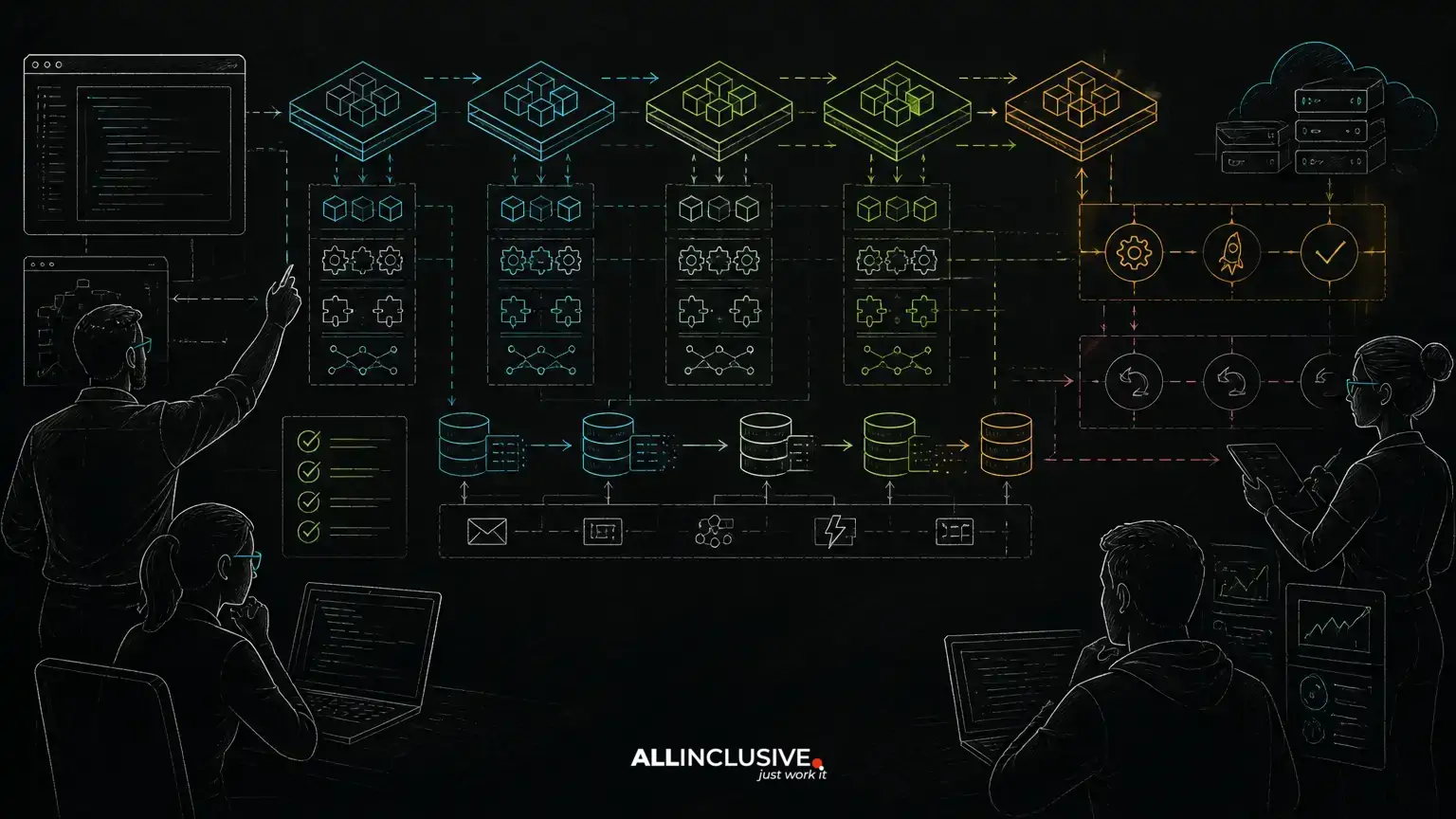
A major Laravel upgrade is not a package update with a larger version number. It is a controlled change to a production application’s framework assumptions, PHP runtime, dependencies, data access patterns, authentication flows, queues, APIs and deployment process. A sound Laravel upgrade strategy treats the work as an engineering project: establish the current state, identify compatibility risks, improve observability, migrate incrementally where possible and define how the team will recover if a release behaves differently in production.
The objective is not simply to reach the newest supported version. The objective is to preserve user workflows and business rules while improving maintainability, security, supportability and the team’s ability to deliver future changes.
Start with an application inventory, not the upgrade command
Before changing framework dependencies, document what the application actually does and how it runs. Laravel applications often accumulate behavior outside controllers and models: scheduled jobs, queue workers, event listeners, service providers, policies, custom middleware, console commands, webhooks, billing integrations and deployment scripts.
Create an inventory that covers:
- Laravel and PHP versions across local, CI and production environments
- Direct and transitive Composer dependencies, including abandoned or locally patched packages
- Authentication, authorization, session, mail, storage, search and payment integrations
- Eloquent models, casts, observers, database constraints, migrations and raw SQL
- Queues, scheduled tasks, workers, Horizon or other operational tooling
- Public APIs, webhooks, frontend build steps and mobile or partner consumers
- Infrastructure assumptions such as extensions, cron entries, process managers and environment variables
This inventory exposes a common source of upgrade failure: the application may appear to be a Laravel project, but its production behavior depends on a wider PHP and infrastructure ecosystem. An upgrade plan that considers only laravel/framework can miss the package, runtime or deployment change that actually breaks the release.
Map the version path and dependency constraints
Major-version upgrades should follow a supported path rather than combining every possible change into one unreviewable pull request. Review the framework’s upgrade guidance for the specific versions involved, then confirm the PHP version required by the target release and by the rest of the dependency graph.
Use Composer inspection and a clean installation to understand constraints before modifying application code. Useful checks include outdated direct dependencies, conflicting version requirements, platform PHP extensions and packages that rely on framework internals. Treat each result as a decision, not an automatic upgrade instruction.
A package that has not been updated may still work, may need a replacement, or may contain application-specific behavior that must be reimplemented. Conversely, upgrading every dependency at once can make failures difficult to attribute. Keep the framework move, PHP runtime move and unrelated feature work separable whenever the product schedule allows.
Separate compatibility work from behavior changes
First make the existing application compatible with the target environment while preserving intended behavior. Avoid folding redesigns, schema rewrites or broad domain refactors into the same change unless they are required for compatibility. This separation makes code review more meaningful and gives the team a clearer rollback point.
After the application runs on the target stack, address follow-up refactoring such as replacing deprecated APIs, simplifying custom framework integrations or improving service boundaries. A major upgrade can reveal maintainability problems, but it should not become an excuse to make unrelated behavior changes without explicit product and engineering review.
Use tests to protect business behavior, not just framework syntax
Framework upgrade testing needs more than a green unit-test suite. The highest-risk failures often occur at boundaries: a login redirect, an authorization policy, a queued billing action, a webhook signature check, an API error response or a database query involving casts and relationships.
Prioritize tests around revenue, access and irreversible actions:
- Registration, login, password recovery, session handling and account deactivation
- Roles, permissions, tenant boundaries and administrative workflows
- Checkout, subscriptions, invoices, refunds and payment webhooks
- Critical Eloquent relationships, scopes, casts and data validation rules
- Queue dispatch, retries, failed jobs and scheduled commands
- Public API authentication, authorization, validation and response contracts
- File uploads, notifications, exports and external service failure handling
Where coverage is weak, add characterization tests before upgrading. These tests record the behavior the product currently relies on, including behavior that may not be elegant. They are valuable because they distinguish an intentional change from an accidental regression.
Also test the deployment shape. A web request may work while a long-running worker still uses old code, stale configuration or incompatible serialized jobs. Validate queue processing, scheduled tasks, cache behavior, storage access and process restarts in an environment that resembles production.
For a broader release process covering automated checks and deployment gates, see Laravel testing and CI/CD practices.
Review Laravel-specific compatibility surfaces
Some upgrade risks appear repeatedly in production Laravel systems, although the exact impact depends on the versions and packages involved.
Container bindings and framework extension points
Custom service providers, macros, middleware, event listeners and container bindings may rely on registration order or internal behavior. Prefer documented extension points, and inspect bootstrapping code carefully. A change that does not produce a syntax error can still alter when a binding is resolved or when configuration becomes available.
Eloquent and database behavior
Review model casts, accessors, mutators, serialization, relationship loading and query scopes. Pay particular attention to code that depends on implicit behavior, raw SQL, database-specific functions or assumptions about null values and date handling. Test production-like data shapes rather than relying only on small fixtures.
Authentication and authorization
Verify guards, providers, password flows, policies, gates, middleware and session behavior. For multi-tenant systems, test that the upgrade cannot broaden access through a changed default, missing scope or incorrectly resolved tenant context. Authorization tests should cover both allowed and denied paths.
Queues, events and serialized payloads
Queued jobs can outlive the deployment that created them. Review job payloads, serialization, retry behavior and compatibility between old and new workers. A staged release may require a period in which workers process jobs created by the previous application version. Avoid changing job contracts without a plan for already-enqueued work.
APIs and external contracts
A framework upgrade should not silently alter an API contract that clients depend on. Compare status codes, validation errors, pagination, date formats, authentication responses and webhook handling. If an API change is necessary, make it explicit through versioning or a documented compatibility layer. See Laravel REST API practices for authentication, errors and versioning.
Plan database changes independently from application deployment
Database migrations deserve their own compatibility plan. A migration that works against a local database may lock a large production table, exceed a deployment window or make rollback impossible.
For schema changes that affect live traffic, use an expand-and-contract approach:
- Expand: add the new column, index or table without removing the old path.
- Dual compatibility: deploy application code that can read the existing structure while beginning to write the new representation when necessary.
- Backfill: migrate existing records in controlled batches, with monitoring and restart-safe jobs.
- Switch: move reads and writes to the new structure after validation.
- Contract: remove obsolete columns or code only after the rollback window and data verification are complete.
This approach may require temporary duplication and additional operational work, but it reduces the chance that an application rollback is blocked by an irreversible schema change. Define ownership for migration monitoring, database backups, verification queries and rollback decisions before release day.
Use staged environments and production-like release checks
A staging environment should exercise the same important integrations and process types as production. It does not need identical scale to be useful, but it should reveal configuration, permissions, queue, storage and deployment differences.
Run a release rehearsal that includes:
- Building from a clean checkout with the target PHP and Composer configuration
- Applying migrations using the same deployment mechanism used in production
- Clearing or rebuilding configuration, route and application caches appropriately
- Restarting workers and verifying that scheduled commands execute once as intended
- Exercising login, core business workflows, APIs, webhooks and administrative actions
- Checking logs, exception reporting, queue failures, response times and database health
Use a small canary, internal users or a controlled traffic segment when the infrastructure supports it. A staged release reduces blast radius and gives the team evidence from real execution paths before broad rollout.
Define rollback limits before the first production deploy
Rollback is not always a matter of redeploying the previous application commit. Once a migration changes data or queued jobs use a new payload, the old version may no longer be safe to run. Document what can be reversed, what requires a forward fix and what data recovery procedure applies.
A practical rollback plan identifies:
- The last known-good application artifact and environment configuration
- Whether database changes are backward compatible
- How workers, scheduled tasks and caches will be handled
- Which metrics, errors or user reports trigger a halt
- Who can approve rollback, pause queues or disable an integration
- How data integrity will be checked after recovery
For some releases, the safest response is a feature flag or traffic switch rather than a database reversal. Make that choice during planning, not while the team is diagnosing a live incident.
Account for security and operational maintenance
Supported framework and PHP versions can improve the maintenance position, but an upgrade does not automatically make an application secure. Review authentication, authorization, dependency advisories, secrets handling, file storage, rate limiting, logging and administrative access as part of the release.
Remove obsolete compatibility workarounds only after confirming why they existed. Update runbooks, environment documentation, local setup instructions, monitoring alerts and incident procedures. A technically successful upgrade can still increase operational cost if the team cannot reproduce the build or understand the new worker and cache behavior.
Ongoing maintenance is part of the upgrade strategy rather than a separate afterthought. A service that monitors dependencies, keeps tests executable and schedules smaller maintenance changes is easier to upgrade than an application that postpones all framework work for years. Allinclusive’s support and maintenance services can be considered when internal teams need additional continuity after release.
When to upgrade, refactor, migrate or rebuild
Not every legacy Laravel application should receive a direct version jump. Upgrade when the domain model, deployment process and testable boundaries remain serviceable and the main problem is framework or dependency age. Refactor when the upgrade exposes tangled code that can be improved incrementally without changing the product’s core architecture.
Consider a migration or partial replacement when a bounded subsystem has a clear interface, persistent operational pain and a strong reason to change its technology or data model. A rebuild is a larger product decision, appropriate only when the existing system’s constraints justify replacing established behavior, data and workflows. It carries more product risk than a compatibility-focused upgrade and should not be selected merely because the current code is difficult to read.
For teams evaluating the broader role of Laravel in custom application engineering, see why Laravel fits custom business web applications. The right approach depends on domain complexity, data criticality, release tolerance, internal ownership and the cost of preserving existing behavior.
A release checklist for a lower-risk Laravel version move
- Confirm the target Laravel and PHP versions and document the supported upgrade path.
- Inventory packages, extensions, integrations, workers, scheduled tasks and deployment assumptions.
- Resolve dependency conflicts and identify packages that need replacement or isolation.
- Add characterization and workflow tests around access, revenue, data and external contracts.
- Review Eloquent behavior, authentication, queues, APIs, events and custom framework extensions.
- Design database migrations for compatibility, backfill safety and rollback limitations.
- Rehearse the deployment from a clean build in a production-like environment.
- Define observability, canary criteria, ownership and stop conditions.
- Prepare rollback or forward-fix procedures for application code, workers and data.
- Update runbooks and schedule post-release verification before closing the upgrade.
A dependable Laravel upgrade strategy is ultimately a risk-management discipline. It protects the product by making hidden dependencies visible, preserving critical behavior through tests, separating reversible from irreversible changes and giving the team a controlled path through deployment. That is the difference between chasing a version number and improving the application’s long-term ownership profile.
For broader custom software planning, architecture and delivery support, visit Allinclusive development services.


