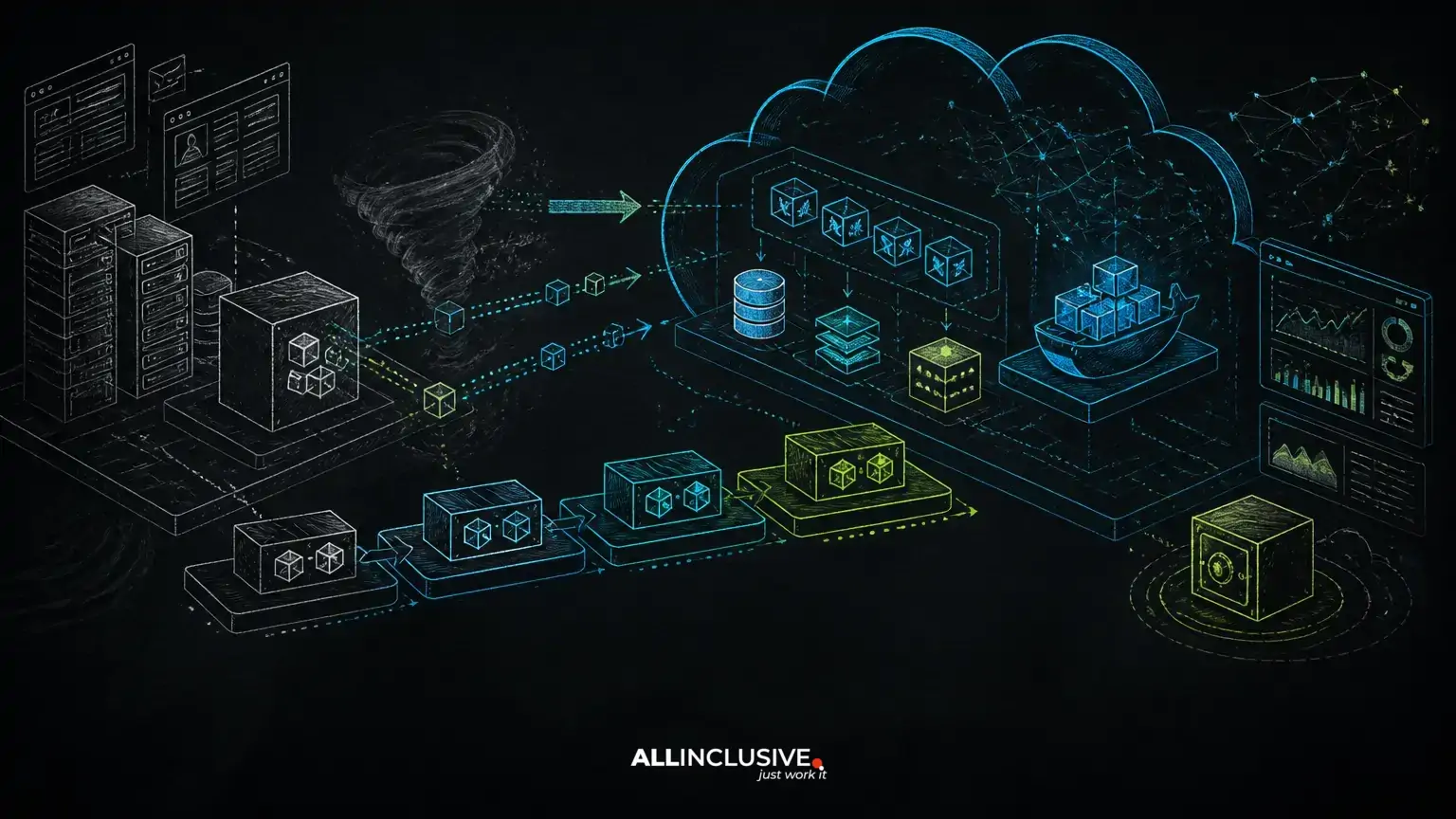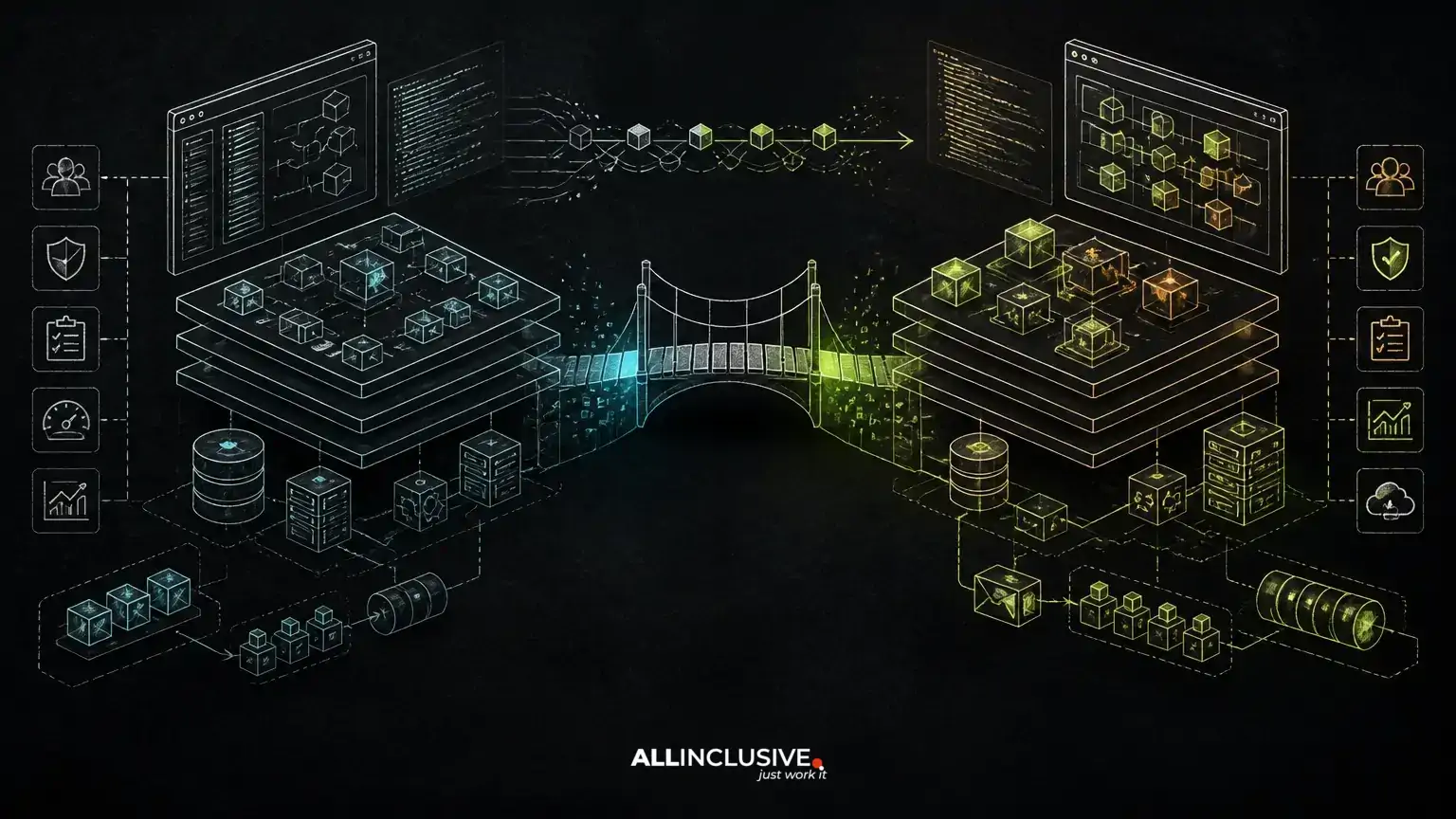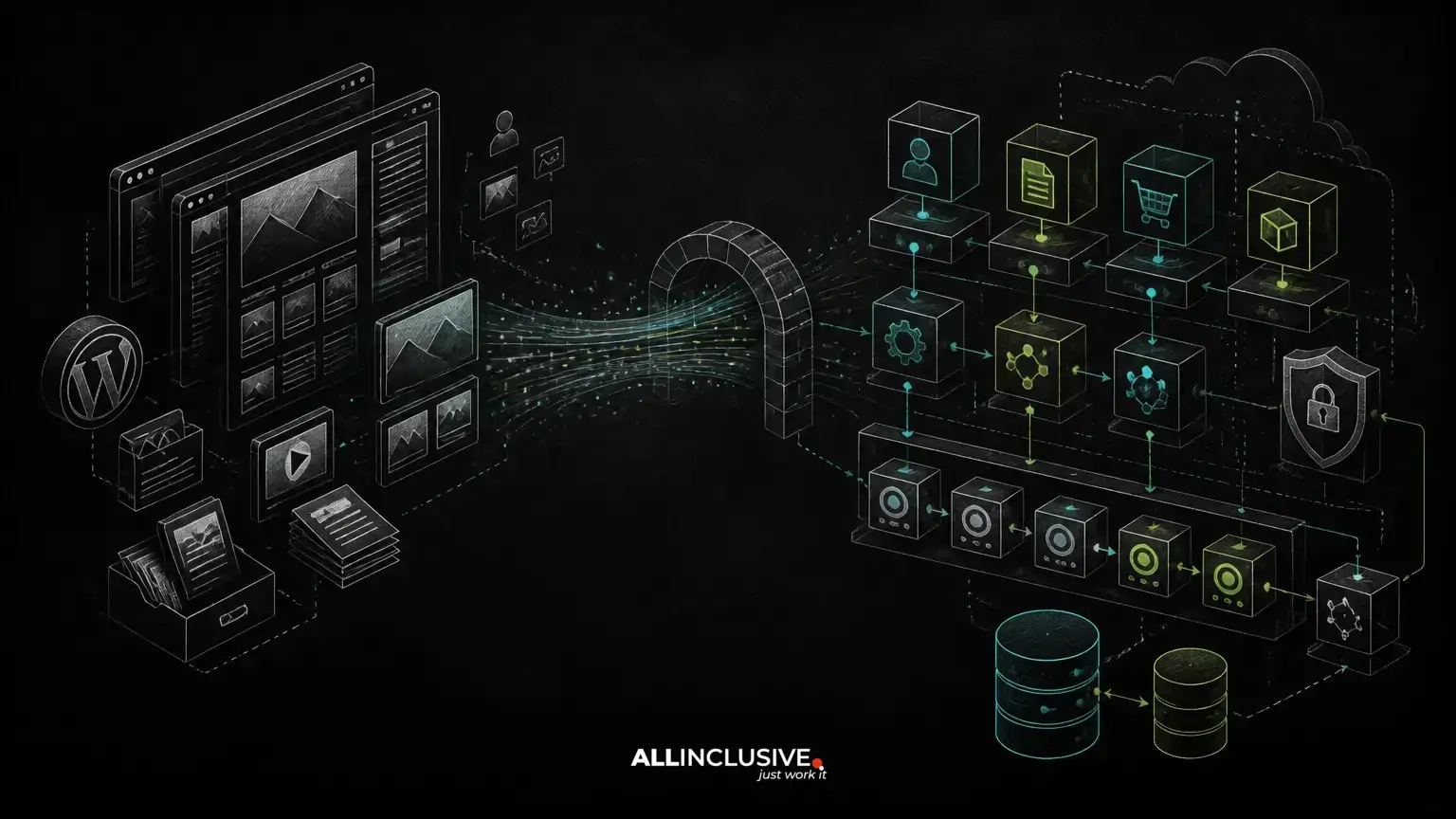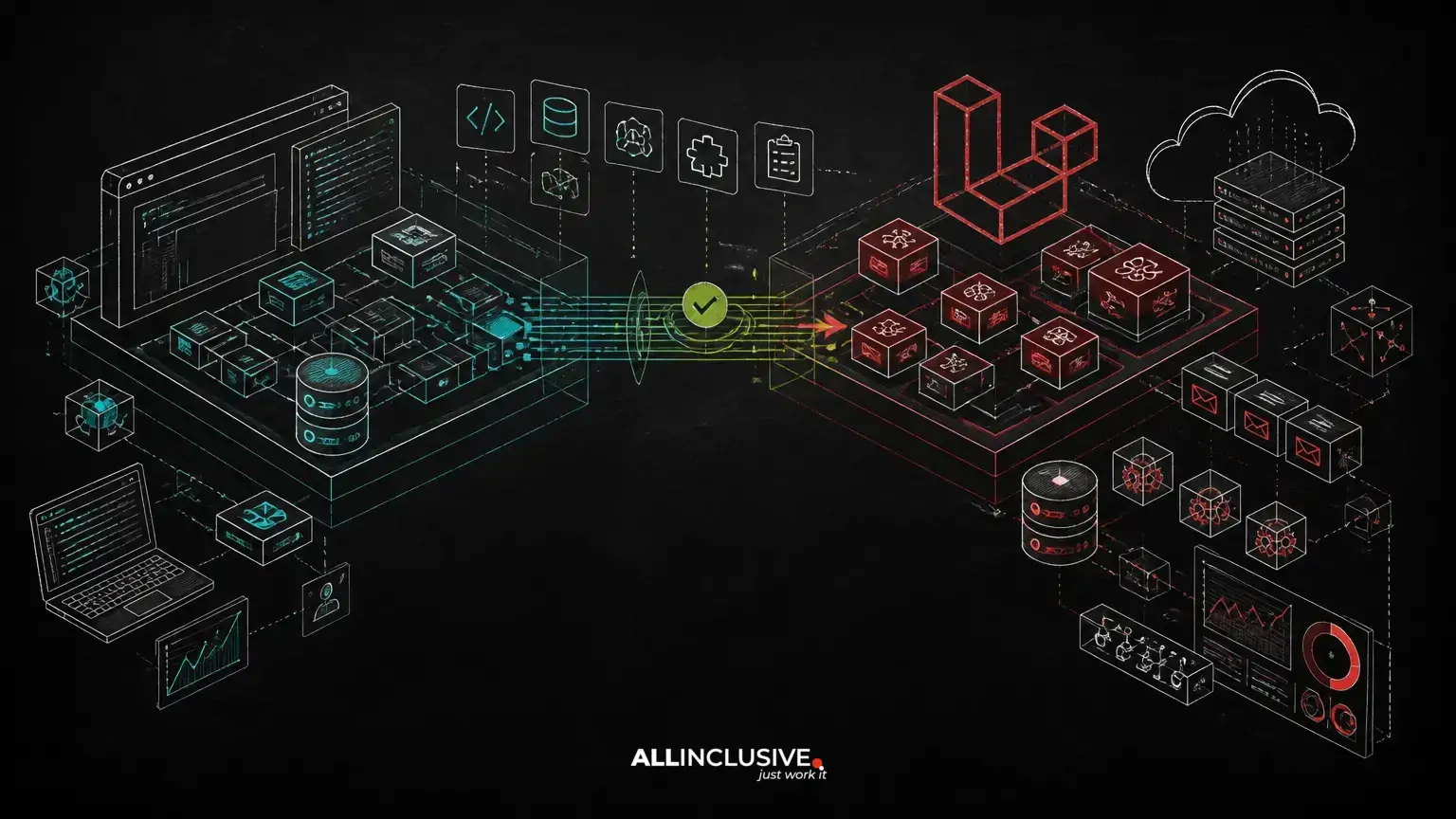
A CodeIgniter to Laravel migration should not begin with a directory-by-directory rewrite. The safer approach is to identify the business capabilities that matter, establish tests and operational baselines, then move functionality in controlled slices. Some parts of a CodeIgniter application—such as domain rules, database records and stable integrations—may deserve preservation. Other parts—such as tightly coupled controllers, inconsistent validation and duplicated authentication logic—may be better redesigned as they move.
The objective is not to make the application look like Laravel. It is to improve maintainability, delivery speed, security and ownership without creating a second unstable system. Laravel provides useful conventions for routing, dependency management, data access, queues, authentication, testing and deployment, but those capabilities only help when they are applied to a clearly understood product.
Start by separating business behavior from CodeIgniter structure
CodeIgniter applications often contain valuable business logic, but that logic may be distributed across controllers, models, helpers, libraries, hooks and view code. Before deciding what to move, create an inventory based on user and business capabilities rather than file locations.
For each capability, document:
- the user workflow or business outcome it supports;
- the data it reads and changes;
- external services, scheduled tasks and webhooks it depends on;
- authorization and validation rules;
- failure behavior and operational dependencies;
- existing tests, monitoring and known defects.
This distinction matters because a CodeIgniter model is not automatically a domain model, and a controller is not necessarily the correct home for a business rule. During migration, preserve the rule and reconsider the framework-specific location.
What to move first in a CodeIgniter to Laravel migration
1. Establish a tested application boundary
Before replacing production routes, define how the application will be observed and verified. Capture important workflows, response behavior, permissions, database side effects and integration outcomes. Characterization tests can document current behavior even when the existing implementation is not ideal.
Prioritize tests for account access, checkout or billing, customer data changes, administrative actions, exports, webhooks and scheduled processes. These tests do not need to approve every historical quirk. They should make intentional behavior changes visible to product and engineering stakeholders.
2. Move data access with a deliberate model design
Laravel's Eloquent can provide a clearer application-level representation of records and relationships, but migration does not require an immediate database redesign. Start by mapping existing tables, keys, nullable fields, timestamps, constraints and high-volume queries.
Use Eloquent where its model and relationship conventions improve clarity. For complex reporting, bulk operations or carefully tuned queries, query builder or explicit SQL may remain appropriate. Avoid changing schema, ORM behavior and business rules in one unreviewable step. A compatible schema can make an incremental cutover easier, while a later migration can address accumulated data-model problems.
3. Move authentication and authorization early, but carefully
Identity flows affect almost every protected capability. Document password handling, session or token behavior, account states, password reset processes, administrator access and any single sign-on integration before implementation.
Laravel can centralize authentication and authorization through established application patterns, but the migration must preserve security properties rather than merely reproduce login screens. Check session invalidation, authorization boundaries, rate limiting, sensitive logging, password reset expiry and ownership of user data. A permission check hidden in an old controller should become an explicit, testable policy or application rule where appropriate.
4. Migrate APIs and integrations by contract
Public APIs, mobile clients, partner integrations and webhooks should be treated as contracts. Record routes, authentication methods, request validation, response shapes, status codes, idempotency behavior and error semantics.
Do not change an API response simply because Laravel encourages a different resource structure. Version or adapt the contract when clients depend on it. For outbound integrations, isolate vendor-specific code behind services or adapters. For inbound webhooks, verify signatures where supported, make processing idempotent and record enough state to investigate retries and failures.
5. Move asynchronous work before it becomes hidden synchronous work
Legacy applications frequently perform email delivery, imports, reports, notifications or third-party calls inside web requests. During migration, identify which operations can be queued and which must remain immediate. Laravel's queue abstractions can make workers and jobs easier to organize, but the design still needs retry rules, timeout handling, duplicate protection and failure visibility.
Moving work to a queue changes user-visible behavior. Product owners should understand whether a screen will show completed results, a pending state or a failure notification. This is an application workflow decision, not only an infrastructure decision.
What to leave alone until the migration proves itself
Stable business rules that are not blocking delivery
Not every old rule needs to be rewritten. If a calculation is correct, covered by tests and not difficult to change, preserve its behavior while moving its execution behind a clearer application boundary. Rewriting stable logic adds risk without necessarily improving the product.
Low-value administrative screens
Internal tools can be important, but they often do not justify first-wave migration effort unless they contain sensitive permissions or critical operations. Move high-risk administrative capabilities when needed, then schedule lower-impact screens after the core path is stable.
Proven integrations with no ownership problem
An existing integration may be awkward internally but reliable externally. If its contract is documented and its failure modes are understood, wrapping it with a Laravel service may be safer than replacing it. Rebuild an integration when its security, reliability, vendor constraints or maintenance burden create a material business problem.
Visual details that do not affect workflow
Recreating every view pixel by pixel can distract from authorization, data integrity and release safety. Preserve essential user workflows and accessibility requirements first. Visual refinement can follow once the migrated capability has reliable behavior and monitoring.
Choose a migration shape that matches operational risk
A phased strangler approach can work when the existing and Laravel applications can coexist behind routing, an edge proxy or a shared authentication strategy. It allows a team to move one capability at a time, but it introduces temporary complexity around sessions, data ownership, background jobs and cross-application navigation.
A modular rewrite may be appropriate when the application has weak boundaries but the team can isolate a complete business capability. A full cutover can be simpler to reason about operationally, yet it concentrates testing, deployment and rollback risk. The right choice depends on release tolerance, team capacity, data coupling and the ability to run both systems safely.
Before selecting an approach, answer:
- Can traffic be routed by capability without confusing users?
- Will both applications write to the same records?
- Which system owns sessions, emails, jobs and webhook processing?
- Can a release be rolled back without losing data?
- What evidence will show that the migrated slice is healthy?
Common failure modes in CodeIgniter to Laravel projects
Rewriting everything before learning the application
A clean Laravel structure does not compensate for undocumented business behavior. Inventory and test critical workflows before deleting old code.
Treating Eloquent as a one-for-one replacement for every model
ORM models, repositories and domain services have different responsibilities. Forcing every rule into an Eloquent model can produce large, difficult-to-test classes. Keep application orchestration and complex business decisions in focused services or domain components.
Changing data contracts during framework conversion
Clients, reports and partner systems may depend on details that are not visible in the browser. Record and test contracts before changing them.
Ignoring deployment and worker behavior
A migration is incomplete if web requests work but queue workers, schedulers, caches, file storage or environment configuration do not. Define deployment sequencing, rollback behavior, logs, health checks and ownership before production cutover.
Postponing security review until the end
New routes, policies, jobs and integrations create new attack surfaces. Review authorization, validation, secrets, file handling, rate limits and sensitive data exposure throughout the migration. A focused Laravel security audit can help organize that review before a major release.
A delivery sequence that keeps the migration manageable
- Discover: map capabilities, dependencies, data ownership and operational constraints.
- Stabilize: fix critical defects, add observability and establish tests around high-value workflows.
- Prepare: define Laravel conventions for configuration, modules, services, validation, authorization and testing.
- Slice: select a capability with meaningful value but manageable coupling.
- Run in parallel where necessary: resolve session, routing, queue and data ownership before exposing the new path broadly.
- Verify: compare business outcomes, error behavior, permissions, performance characteristics and operational signals.
- Retire deliberately: remove obsolete paths only after dependencies, scheduled tasks, integrations and rollback requirements are understood.
Teams planning a broader modernization effort may also benefit from comparing this approach with a legacy PHP to Laravel migration. The technical principles overlap, but CodeIgniter applications often provide more explicit framework conventions and may have different controller, routing and model boundaries. If the product is becoming a larger SaaS or API platform, billing and webhook state deserve separate architecture decisions rather than being treated as ordinary CRUD.
How to judge whether the migration is working
Measure outcomes that matter to the product and operating team, not only the number of files converted. Useful indicators include defect rates in migrated workflows, release rollback frequency, time required to change a business rule, test coverage of critical paths, queue failure visibility, authorization findings and the effort required to onboard engineers.
Performance should be evaluated against real usage patterns and known bottlenecks. Laravel's conventions do not remove the need to inspect database queries, cache behavior, job throughput, external service latency and deployment configuration. A separate Laravel performance optimization review may be appropriate when measurement identifies a bottleneck, but optimization should follow evidence rather than assumptions about the framework.
A well-run migration leaves the organization with clearer ownership of business logic, safer delivery practices and a platform that can evolve. That may mean some CodeIgniter code is replaced, some is wrapped and some is intentionally retained. For teams evaluating implementation options, Laravel development should be considered as production application engineering: domain logic, APIs, data modeling, testing, security and operations—not simply a change of view templates.
Migration work also continues after the first release. Dependency updates, monitoring, incident response and small refactors prevent the new application from recreating the maintenance problems it was meant to solve. Teams that need an ongoing operating model can review support and maintenance as part of the post-migration plan. For broader engineering context, see Allinclusive's development capabilities.