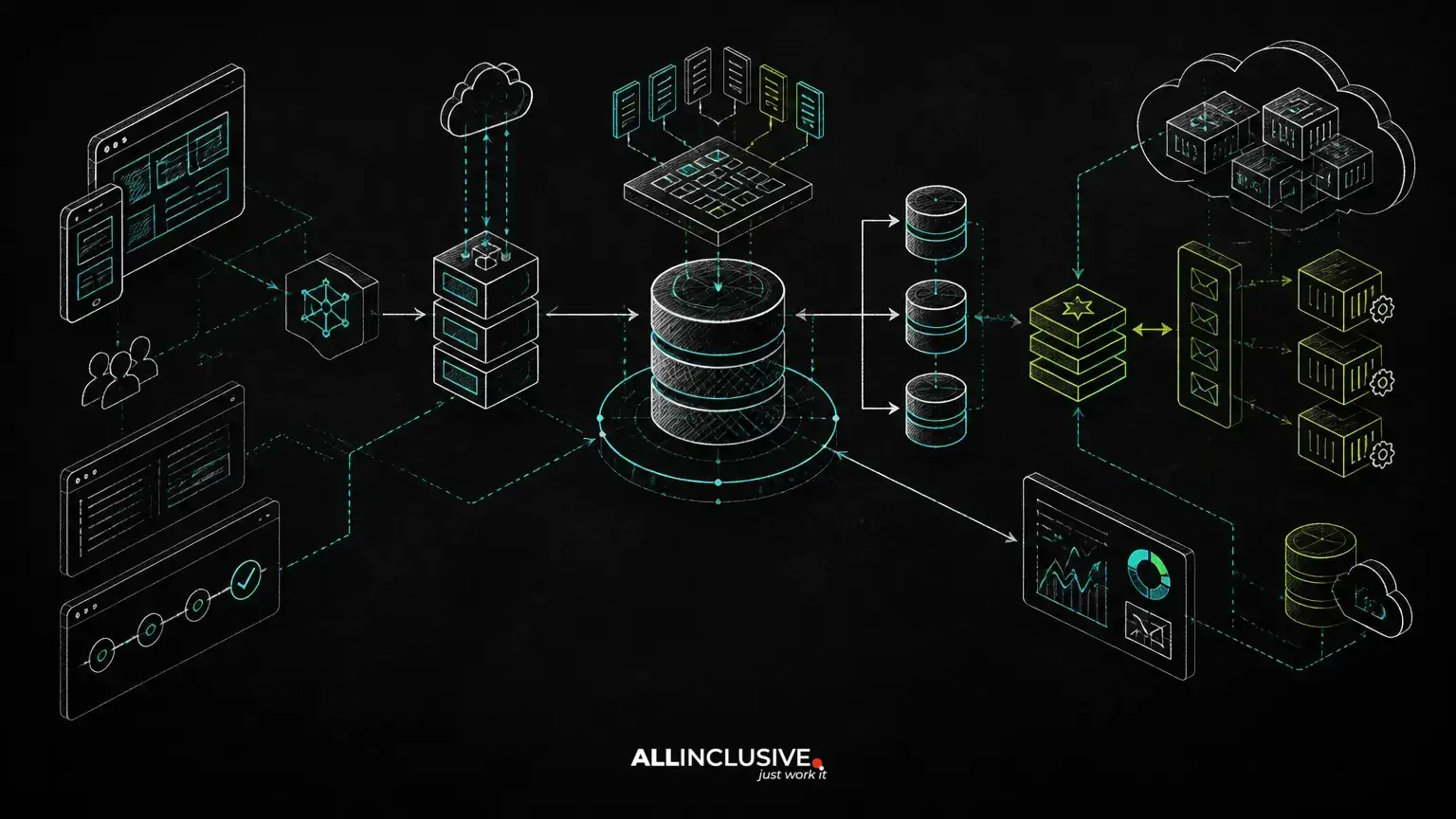
Laravel works well for custom business web applications because it gives engineering teams a coherent foundation for application behavior—not just a way to render pages. The framework provides conventions for routing, data access, authentication, queues, testing and deployment while leaving room for the domain-specific workflows that make a product valuable. When planning laravel for custom web applications, the implementation context in web development is also relevant.
That distinction matters when software must support approvals, billing, customer accounts, internal operations, third-party integrations or multiple user roles. A template-first approach may produce a fast initial interface, but custom business software needs a codebase that can be understood, tested, secured and changed as requirements develop. Laravel can be a strong fit when the team treats it as production application engineering rather than generic website development.
Laravel fits applications where business rules matter
Most business applications are defined by rules that do not exist in a standard content-management template. A quote may require approval before conversion to an order. A subscription may change access based on payment status. A support request may follow different workflows depending on account type, urgency or ownership.
Laravel gives developers a familiar structure for expressing those rules in application code. Controllers can coordinate requests, services or domain-oriented classes can organize important operations, and policies can express authorization decisions. The exact architecture should reflect the product’s complexity; not every application needs an elaborate domain layer. The important principle is to keep business behavior discoverable and separate from presentation concerns.
This improves maintainability. When a requirement changes, engineers can identify the relevant workflow instead of searching through unrelated templates, route handlers or duplicated conditional logic. That reduces the operational risk of making a small change in a system that has grown over time.
Data modeling supports real operational workflows
Custom software usually depends on relationships among users, organizations, records, transactions and events. Laravel’s Eloquent ORM offers an expressive way to work with those relationships while allowing teams to use the underlying database deliberately.
A sound implementation still requires database design. Engineers must choose appropriate keys, constraints, indexes, transaction boundaries and deletion behavior. Eloquent does not remove the need to understand SQL or query performance. It provides a productive application-level model, while migrations and database review preserve control over how information is stored.
For example, an application that manages service requests might model accounts, contacts, requests, assignments, status transitions and audit events separately. That structure is generally more adaptable than storing an entire workflow as loosely structured fields. It also creates clearer options for reporting, permissions and future integrations.
Authentication and authorization can be designed around the product
Business applications rarely have only one category of user. They may include customers, staff, managers, administrators, partners or automated systems. Authentication answers who a user is; authorization determines what that user or system is allowed to do.
Laravel provides established patterns for authentication and authorization, but the product team still needs to define the policy. A role alone may not be sufficient. Access might depend on organization membership, record ownership, region, workflow status or a combination of conditions. Those rules should be represented consistently and tested as part of the application rather than scattered across interface controls.
Security also includes session handling, credential management, validation, output encoding, dependency updates, secret management and safe error reporting. Framework defaults can reduce common implementation mistakes, but they are not a substitute for threat modeling, code review and secure deployment practices.
APIs make Laravel useful beyond a browser interface
Many custom applications serve more than one interface. A browser application may share data with a mobile client, partner portal, internal tool or automation service. Laravel can support JSON APIs with explicit resources, validation, authentication, authorization and error handling.
The API design should follow the product’s ownership and integration needs. Teams need to decide which resources are exposed, how clients authenticate, how errors are represented, whether operations are idempotent and how changes will be versioned or evolved. An API that mirrors internal database tables too closely can make future changes expensive.
For a deeper treatment of endpoint structure, authentication, errors and versioning, see Laravel REST API best practices. If a product needs flexible client-driven queries, GraphQL may be appropriate in selected cases, although REST can be simpler to operate and document for many business systems. The choice should follow client requirements rather than trend preference.
Queues and scheduled work keep user workflows responsive
Business applications often perform work that should not block a user request. Examples include sending notifications, importing records, generating documents, synchronizing an external system and processing uploaded files. Queues allow those tasks to run separately from the immediate request, provided the application handles retries, failures and observability properly.
Asynchronous processing introduces its own design questions. A job may run more than once, an external service may be unavailable, or an operation may complete after the user has moved to another screen. Jobs should therefore be designed with idempotency, timeouts, retry behavior and useful status reporting in mind.
Scheduled tasks can coordinate recurring maintenance and synchronization, but they should not become a hidden collection of business rules. Important workflows need ownership, logging and tests so operations staff can understand what happened when a scheduled process fails.
Billing and integrations require boundaries, not scattered calls
When an application connects to payment providers, accounting platforms, CRM systems or identity services, integration code becomes part of the product’s operational surface. Laravel can organize these connections behind application-specific services or adapters so the rest of the codebase does not depend directly on every vendor’s request format.
Payment and billing logic deserves particular care. A checkout response is not always the final source of truth for subscription status, and external notifications may arrive late, repeatedly or out of order. The application should verify incoming events, record relevant identifiers, reconcile state and provide a path for handling exceptions.
The same principle applies to other integrations: define ownership, validate external data, preserve useful audit information and make failure visible. A clean boundary makes provider changes and testing less disruptive.
Testing turns Laravel’s conventions into delivery confidence
Custom applications change continuously. Without tests, each release becomes a manual investigation into whether a change affected permissions, billing, reporting or another workflow. Laravel supports several useful testing levels, including focused unit tests, feature tests around HTTP behavior and integration tests for important boundaries.
Not every line needs the same test strategy. High-value tests usually cover business rules, authorization policies, state transitions, API contracts and failure handling. A test that verifies a customer cannot access another organization’s records may be more valuable than a large number of shallow interface assertions.
Testing should be connected to a release process. Automated checks can validate code style, run the relevant test suite, inspect dependencies and prevent known failures from reaching deployment. For more detail on release discipline, see Laravel testing and CI/CD.
Performance depends on architecture and operations
Laravel can support substantial application workloads, but performance is not guaranteed by selecting a framework. Response time and capacity depend on database queries, indexes, payload size, caching, external services, infrastructure and traffic patterns.
Common engineering concerns include avoiding unnecessary queries, loading relationships intentionally, paginating large datasets, caching stable or expensive results and moving long-running work to queues. Cache invalidation requires a clear ownership model; stale business data can be more damaging than a slower response.
Observability should accompany optimization. Logs, request context, queue failure records and infrastructure metrics help teams distinguish a slow query from an unavailable dependency or an overloaded worker pool. Measuring the actual bottleneck is safer than adding caching or infrastructure without evidence.
Security and upgrades are ongoing engineering work
A production Laravel application needs a maintenance plan from its first release. Dependencies change, supported versions move forward, infrastructure is updated and security expectations increase. Delaying upgrades can make future changes larger because several breaking changes accumulate together.
Upgrade work should include dependency review, automated tests, framework-change analysis, deployment rehearsal and post-release monitoring. Teams should also review authorization behavior, background jobs, integrations and database migrations rather than assuming an upgrade only affects framework internals. The Laravel upgrade strategy guide covers the planning considerations in more detail.
Security maintenance includes applying relevant updates, protecting secrets, limiting administrative access, reviewing logs and testing failure paths. No framework can guarantee that an application is secure; security is a property of the complete system and its operating practices.
When Laravel is a strong choice for custom software
Laravel is often a sensible choice when a product needs structured server-side business logic, relational data, authenticated users, APIs, background jobs and a team that values conventional PHP development. It can support internal platforms, customer portals, workflow systems, SaaS products and integration-heavy applications.
The decision should still consider the existing team, hosting environment, expected workload, integration requirements and long-term ownership. A different stack may be preferable when a product has specialized real-time, data-processing or organizational constraints. Framework selection is important, but architecture quality, testing and operational discipline usually have a greater effect on the product’s durability.
A practical readiness checklist for Laravel application planning
- Domain model: Can the core business entities, states and rules be described clearly?
- Access model: Are user types, organization boundaries and record-level permissions defined?
- Data design: Are relationships, constraints, indexes and retention requirements understood?
- Integration boundaries: Are external systems isolated behind testable interfaces?
- Async behavior: Which tasks need queues, retries, status tracking or reconciliation?
- Testing: Which business rules and failure paths must block a release if they break?
- Operations: How will deployment, logging, backups, monitoring and upgrades be handled?
For organizations evaluating a broader custom application build, the Laravel development practice provides context on how senior PHP engineering can support these decisions. General software development guidance can also help teams compare architecture and delivery approaches before implementation begins.
Laravel works well for custom web applications when its conventions are used to make domain behavior clear, not to avoid thinking about architecture. A maintainable codebase, explicit security model, tested workflows and disciplined operations are what turn a framework choice into dependable business software.