
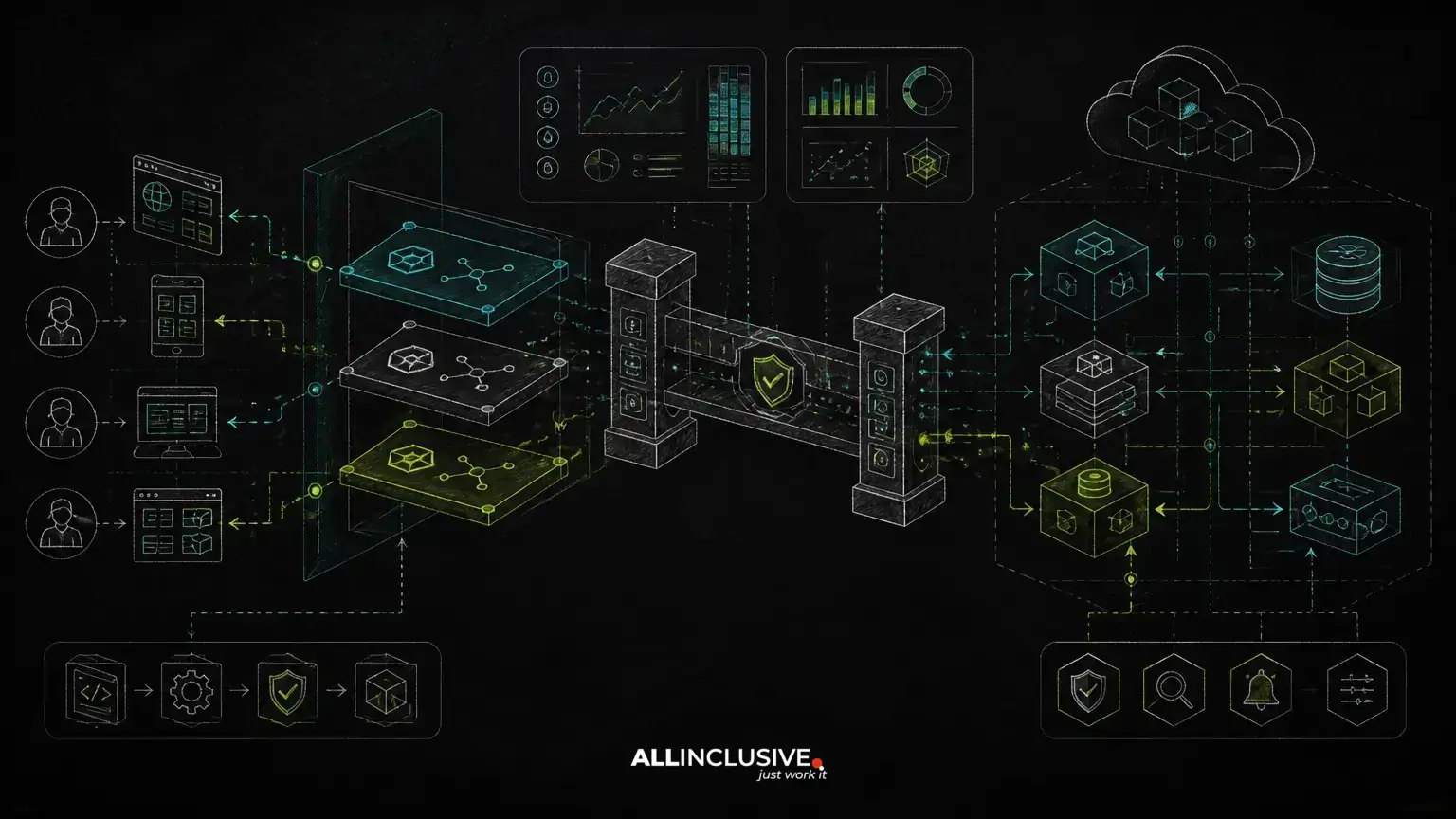
An API versioning strategy defines how a service changes its contract without unexpectedly breaking the applications, partners, automations, and internal teams that depend on it. The right approach is not simply choosing between URL, header, or query-parameter versioning. It includes compatibility rules, ownership, migration paths, validation, deprecation, testing, and operational visibility. When planning api versioning strategy, the implementation context in custom software development is also relevant.
For most teams, the safest default is to make additive changes compatible with existing consumers, introduce a new major version only for intentional breaking changes, and provide a documented migration window. Versioning should be treated as part of integration engineering alongside authentication, idempotency, retries, webhooks, rate limits, and monitoring—not as a naming convention added after development.
This guide explains the main versioning models, how to classify changes, and how Laravel or Python teams can implement a maintainable process.
Start with a contract policy, not a version number
A version identifier cannot protect consumers if the team has no shared definition of a breaking change. Before selecting a URL structure, document the rules that govern the contract.
- Request compatibility: whether existing fields remain accepted and whether new required fields can be introduced.
- Response compatibility: whether fields may be added, removed, renamed, or changed in type.
- Behavioral compatibility: whether the same request can produce materially different business results.
- Error compatibility: whether status codes, error codes, validation formats, and retry guidance remain stable.
- Operational compatibility: whether changes alter rate limits, pagination, timeout expectations, webhook delivery, or authentication requirements.
For example, adding an optional response field is usually less disruptive than removing a field. Changing an integer identifier to a string may break strongly typed clients even if the value appears similar. Changing an endpoint from synchronous processing to eventual completion can also be a contract change because consumers must now handle job states.
Classify API changes before deciding whether to version
Versioning every change creates unnecessary migration work. Versioning too rarely creates hidden breakage. A change review should classify the impact before a release is approved.
Usually compatible changes
- Adding an optional request field with a server-side default.
- Adding a response field without changing existing fields.
- Adding a new endpoint or resource.
- Adding a documented error code while preserving existing error behavior.
- Increasing supported pagination limits only when capacity and rate-limit policies allow it.
Potentially breaking changes
- Removing or renaming a request or response field.
- Changing a field’s data type, format, nullability, or meaning.
- Making an optional request field mandatory.
- Changing default sorting, filtering, pagination, or authorization behavior.
- Changing status codes or error payloads that consumers use for control flow.
- Replacing immediate results with asynchronous processing without a migration design.
The phrase “non-breaking” should be tested against real consumers, not just the server implementation. A response field added to a strict schema may still cause a client failure. Consumer-driven contract tests can expose this class of risk before deployment.
Compare the main API versioning models
There is no universal winner. The best model depends on client diversity, gateway capabilities, caching, documentation, deployment practices, and how much control the provider has over consumers.
URI or path versioning
Path versioning places the version in the resource URL, such as /api/v1/orders and /api/v2/orders. It is visible in logs, browser tools, gateway rules, and documentation. This makes it straightforward for teams to route traffic and measure adoption by version.
The trade-off is that the version becomes part of the public resource address. Teams must maintain routing and documentation for multiple paths, and links or integrations may need explicit updates. Path versioning is often a practical choice for public APIs and larger ecosystems where discoverability matters.
Header versioning
Header versioning keeps the resource path stable and selects a representation through a request header, often using a vendor-specific media type or a custom version header. It can preserve cleaner resource URLs and separate resource identity from representation rules.
However, headers are less visible to casual users and can be harder to inspect in basic tooling. Caches, proxies, API gateways, and documentation systems must correctly vary and record responses based on the version header. This approach works best when infrastructure and client teams understand content negotiation and observability requirements.
Query-parameter versioning
Query parameters, such as ?version=2, are easy to test and expose directly in requests. They can be useful for controlled internal integrations or transitional designs.
They also require careful cache configuration and consistent enforcement. If the parameter is optional, the default behavior must be explicit. Otherwise, clients may silently receive a different contract when the server changes its default version.
Consumer-specific or capability-based evolution
Some APIs avoid broad version identifiers by negotiating capabilities or using separate fields and feature flags. This can reduce duplicated endpoints, but it increases contract complexity. Different consumers may receive different behavior, making support, testing, and incident diagnosis harder.
Capability-based evolution is most appropriate when the variation is narrow and well-defined. It should not become an informal substitute for version governance.
Use additive evolution where it is safe
A durable versioning strategy favors changes that preserve existing behavior. Additive design does not mean “never change.” It means introducing new behavior without forcing every consumer to migrate at the same time.
- Use new fields rather than changing the meaning of existing fields.
- Keep new request fields optional until consumer adoption is confirmed.
- Represent lifecycle states explicitly, especially for queued or asynchronous work.
- Use stable machine-readable error codes alongside human-readable messages.
- Make pagination, filtering, and sorting rules explicit rather than relying on undocumented defaults.
- Preserve identifiers and avoid overloading one field with multiple meanings.
When a business concept genuinely changes, a new field or resource may be clearer than silently repurposing the old one. For example, introducing archived_at may be safer than changing the meaning of an existing active flag when consumers rely on its original semantics.
Design a migration path for breaking versions
Creating v2 is only the start. A migration plan should identify who uses the contract, what must change, how adoption will be measured, and when the old version can be retired.
- Inventory consumers. Include internal services, mobile or web clients, customer integrations, scheduled jobs, webhooks, and undocumented scripts.
- Publish the contract difference. Show changed fields, errors, authentication requirements, examples, and behavior—not only endpoint lists.
- Provide a compatibility window. Keep the old contract available long enough for known consumers to test and release their changes.
- Instrument adoption. Record requests by version, consumer identity, endpoint, error type, and relevant deployment or tenant metadata.
- Communicate deprecation clearly. State the affected version, replacement, migration deadline, support channel, and consequences of remaining on the old version.
- Remove deliberately. Confirm that traffic has migrated or that an explicitly accepted exception exists before retirement.
A deprecation period is not a promise to support an old version forever. It is an operational process that gives consumers a predictable path to change.
Coordinate versioning with authentication, webhooks, and asynchronous work
API contracts extend beyond synchronous JSON responses. A version change may affect OAuth scopes, token claims, webhook payloads, signature verification, retry behavior, and queue processing.
Webhook consumers should know which payload schema they receive and how to handle unknown fields. If a webhook event changes materially, use an explicit event version or a new event type rather than requiring consumers to infer the change from payload shape. Preserve delivery identifiers so consumers can apply idempotency controls when retries occur.
Authentication changes also need migration planning. A new scope or credential requirement can break a client before it reaches the endpoint’s business logic. Similarly, if an API begins returning asynchronous job references, document polling, callback, timeout, and failure semantics. A versioned endpoint without clear state transitions still leaves consumers exposed to ambiguity.
Implement versioning at the right architectural boundary
Versioning logic should be visible and testable without duplicating the entire application. A useful structure separates transport concerns from business capabilities.
- Routing layer: selects the version and applies authentication, request parsing, and rate-limit policies.
- Contract layer: validates version-specific input and serializes version-specific output.
- Application layer: contains shared business operations where semantics are genuinely common.
- Adapter or mapping layer: translates between old and new representations when compatibility is possible.
- Integration layer: manages external calls, queues, retries, idempotency, and reconciliation independently of presentation version.
Laravel teams may implement versioned route groups, request validation objects, resource transformers, policies, and feature tests. Python teams may use separate routers or blueprints, schema models, dependency injection, and contract tests. The framework matters less than keeping version-specific serialization and validation from leaking through core business logic.
When two versions have substantially different business rules, forcing them through one abstraction can be less maintainable than separating application services. Conversely, copying every controller and model for each version creates drift. The correct boundary follows responsibility: share stable domain behavior, isolate genuinely different contracts and workflows.
Test contracts and observe version adoption
Unit tests are useful but insufficient for API evolution. A release should combine several forms of verification:
- Schema tests: confirm request and response shapes, types, required fields, and error formats.
- Consumer contract tests: verify assumptions made by important clients.
- Integration tests: exercise authentication, databases, queues, external services, and webhook delivery.
- Backward-compatibility tests: send representative old-version requests against the release candidate.
- Migration tests: verify that documented v1-to-v2 transformations preserve intended business meaning.
Production observability should distinguish version-related failures from general application errors. Monitor traffic by version and consumer, validation failures, authorization failures, latency, rate-limit responses, queue age, webhook retries, and reconciliation exceptions. These signals help teams find consumers that documentation or a deprecation notice did not reach.
For broader reliability practices, see the guide to API monitoring and observability. Rate-limit changes should also be evaluated as part of the contract because a technically compatible endpoint can still disrupt clients if capacity rules change unexpectedly.
Choose an API versioning strategy using operational criteria
Before standardizing, answer these questions:
- Who controls the consumers: one internal team, several business units, or external organizations?
- How frequently do contracts change, and how costly is coordinated deployment?
- Can gateways, caches, documentation, and monitoring reliably preserve the selected version signal?
- How will the team discover unknown or unofficial consumers?
- What is the deprecation and support policy for old versions?
- Do webhooks, queues, exports, and authentication flows require separate schema versions?
- Can the implementation share business logic without hiding meaningful behavioral differences?
For a small internal API, additive evolution with a clear compatibility policy may be enough. For a public or partner-facing API, explicit versions, published contracts, adoption telemetry, and a managed deprecation process usually reduce operational uncertainty. In either case, the strategy should be recorded in the API documentation and enforced through review and automated tests.
Make version ownership explicit
API versioning is ultimately an ownership problem as much as a technical one. Someone must approve breaking changes, maintain contract documentation, review consumer impact, monitor adoption, and decide when an old version can be retired.
Teams building or modernizing integration-heavy software can treat versioning as part of a broader API development practice, with implementation choices based on the system’s responsibilities rather than framework preference. Custom software is easier to evolve when contracts, failure states, and operational ownership are designed together from the beginning. When existing integrations must remain stable, maintenance and controlled change management are equally important; the support and maintenance process should include contract monitoring and deprecation coordination.


