
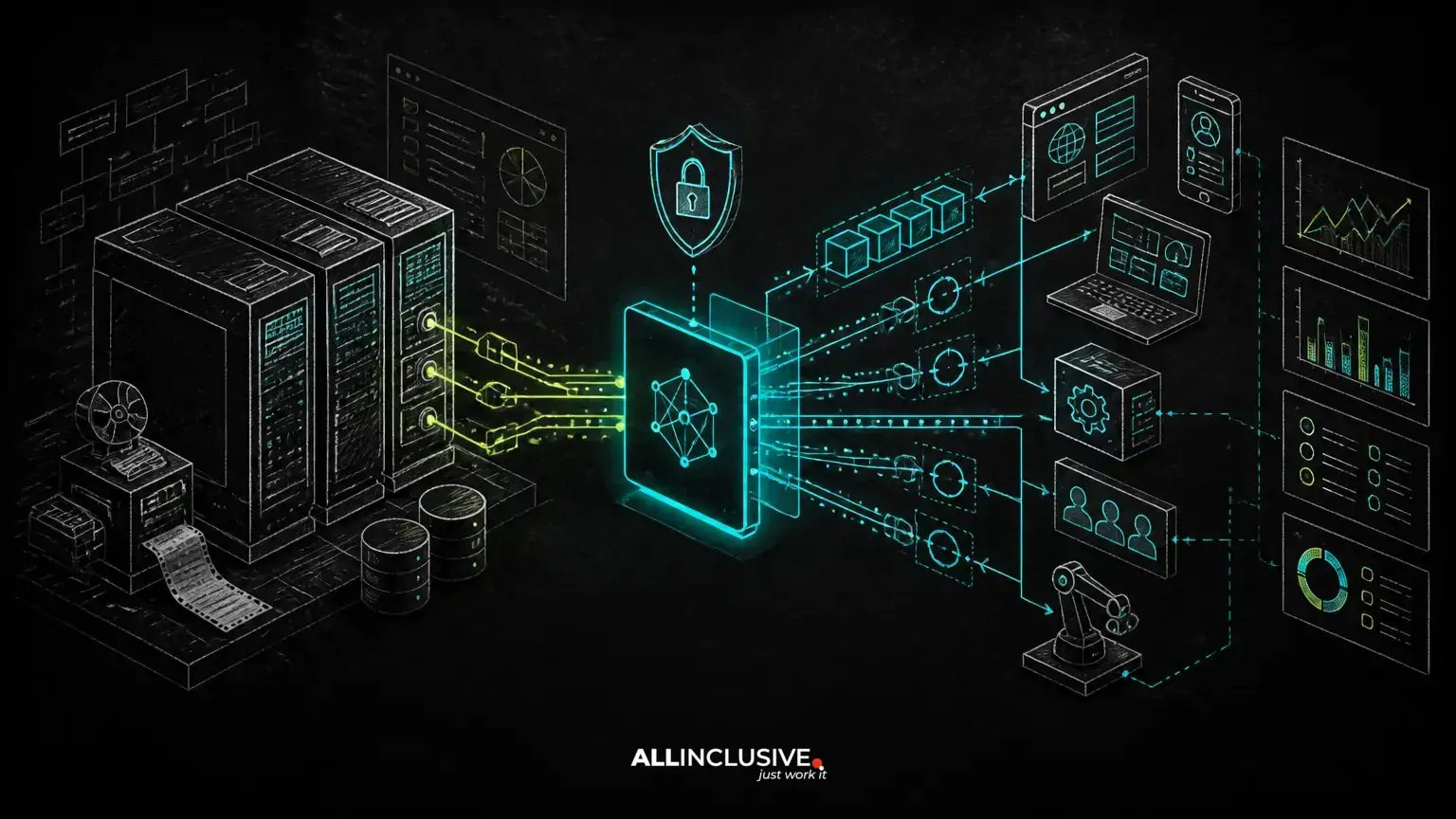
A legacy system API layer exposes carefully defined capabilities from an existing application so newer web, mobile, partner or automation workflows can use them without replacing the core system immediately. The safest approach is usually not to put a thin HTTP wrapper around old code. It is to create a controlled boundary that validates requests, protects authentication, manages failure, records operational evidence and preserves the legacy system’s rules.
This makes modernization incremental. The legacy application remains the system of record where appropriate, while a new integration layer takes responsibility for API contracts, transformation, authorization, retries and observability. Over time, that boundary can support refactoring, migration or selective replacement—but it does not require a full rebuild on day one.
Decide what the API layer should own
Before choosing Laravel, Python or another implementation approach, define the responsibilities of the new layer. A useful boundary commonly owns:
- External contracts: resource names, fields, status codes, validation rules and versioning.
- Authentication and authorization: identifying callers and limiting what each caller can do.
- Transformation: translating modern JSON requests into legacy formats, commands or database operations.
- Reliability controls: timeouts, retries, idempotency, queues and rate limits.
- Operational visibility: structured logs, correlation IDs, metrics, traces and alerts.
- Compatibility decisions: preserving business rules without exposing obsolete internal schemas.
The legacy application should generally retain ownership of its domain rules and data integrity unless the modernization plan explicitly moves that responsibility. Duplicating rules in both systems creates drift: one workflow may calculate a status or price differently from another.
Map the legacy system before designing endpoints
Legacy systems often contain undocumented behavior that is more important than their formal database schema. Start with an inventory of workflows, data ownership and side effects.
- List the business actions that new consumers actually need.
- Identify where each action is implemented: application service, controller, batch job, stored procedure, direct database write or manual process.
- Document required fields, hidden defaults, validation rules and state transitions.
- Record side effects such as emails, inventory changes, invoices, exports or third-party calls.
- Separate read paths from write paths and mark operations that are unsafe to repeat.
- Capture known failure states, including partial completion and unclear outcomes.
This exercise frequently reveals that the first API should expose a small number of business capabilities rather than mirror every legacy table. A resource-oriented REST API can still use domain-specific actions when a simple create, update or delete model would misrepresent the workflow.
Design a stable contract instead of exposing the old schema
An API contract should be understandable and stable even if the underlying system remains difficult to change. Avoid returning legacy column names, internal status codes or database relationships unless they are genuinely part of the external product model.
Define request and response schemas explicitly. Include required and optional fields, nullability, formats, enumerated values, pagination behavior and error structures. Validation should happen at the boundary, but it should not replace the legacy system’s authoritative business validation. The API can reject malformed input early while the domain system still decides whether an order, account or transaction is valid.
Use consistent error responses that distinguish at least these cases:
- Malformed or incomplete input.
- Authentication or authorization failure.
- A valid request for a missing resource.
- A business rule rejection.
- A temporary dependency or infrastructure failure.
- An accepted asynchronous request whose final result is not yet known.
Do not turn every legacy exception into a generic 500 response. A generic response may be appropriate externally when details are sensitive, but internal logs should retain the cause, affected operation and correlation ID.
Protect the boundary with authentication and authorization
Authentication answers who is calling; authorization answers what that caller may do. Treat them as separate design decisions.
For server-to-server integrations, credentials may be managed through signed requests, API keys or OAuth 2.0 client credentials, depending on the consumer and security requirements. For delegated access, OAuth 2.0 scopes can represent permitted actions, but scopes should not be the only authorization check. Resource ownership, tenant boundaries and business roles still need enforcement.
Keep credentials outside source code and logs. Rotate them through an operational process, limit permissions, and define what happens when a credential is revoked. Validate tokens or signatures at the API boundary, then pass a trusted identity and authorization context to the application layer rather than letting downstream code interpret raw headers repeatedly.
For a deeper treatment of delegated and machine-to-machine access, see OAuth 2.0 for API Integrations.
Handle legacy latency and uncertain outcomes explicitly
A modern API request can be fast and predictable only if the legacy operation is also fast and predictable. If it is not, do not conceal that fact with a long HTTP timeout.
For slow imports, report generation, bulk updates and external synchronization, use an asynchronous pattern. The API can validate the request, create an operation record, enqueue work and return an accepted response with an operation identifier. A status endpoint or webhook can communicate progress and final state.
Queues also isolate bursts from fragile legacy components. The worker should enforce timeouts and classify failures as retryable or permanent. A network timeout is not proof that the legacy system did not complete the action. That uncertainty is why write operations need idempotency keys, durable operation records or a reconciliation process.
Idempotency prevents a client retry from creating a duplicate order, payment or submission. The layer should store the key, request identity and resulting outcome for a defined period, then return the original result when the same operation is retried. More design guidance is available in API Idempotency: Preventing Duplicate Payments, Orders and Side Effects.
Build retries, webhooks and reconciliation as one reliability model
Retries are useful only when their conditions are understood. Apply bounded retries with backoff to transient failures, and avoid retrying validation errors, authorization failures or known business rejections. A retry policy should account for the legacy system’s capacity; otherwise, recovery behavior can become a load amplifier.
When the API layer publishes webhooks, make delivery at least observable and repeatable. Record the event, destination, attempt count, response and next retry time. Consumers should be told to verify signatures, tolerate duplicate delivery and process events idempotently. Webhook payloads should identify the event type, resource, version and occurrence time without assuming that delivery order is perfect.
Reconciliation is necessary when systems can disagree. A scheduled or on-demand process can compare authoritative records with integration state, identify missing or conflicting updates and route exceptions for review. This is especially important when the legacy system cannot provide reliable transaction status after a timeout.
Choose Laravel or Python according to the boundary
Laravel is often a practical choice when the API layer belongs near an existing PHP application, needs conventional web application structure, or will share familiar authentication, validation, queue and database patterns. It can reduce the operational distance between the integration layer and a PHP-based domain system.
Python can be a strong fit when the boundary includes specialized integration libraries, data transformation, workflow orchestration or services that already operate in a Python environment. It is also useful when the team wants to separate an integration service from a monolithic PHP application.
Neither framework solves unclear ownership or unreliable legacy behavior. The decision should consider team expertise, deployment model, queue and monitoring standards, required libraries, testability and the expected long-term destination of the capability. A small, well-owned service is preferable to adding a second stack without a clear boundary.
Make observability part of the first endpoint
Uptime alone will not show whether a legacy integration is working. Instrument the request path from the external caller through the API layer and into the legacy operation.
- Use a correlation ID that follows synchronous requests, queued jobs and webhook deliveries.
- Log structured events without exposing credentials or unnecessary personal data.
- Measure request volume, latency, status classes, validation failures, queue age, retry counts and reconciliation exceptions.
- Track dependency failures separately from client errors.
- Alert on symptoms that affect users or operations, not only infrastructure health.
Define the support response for a failed operation before launch. Someone should be able to answer what was requested, whether the legacy system received it, whether a side effect occurred and what action is safe next.
The related guide on API monitoring and observability covers the signals that matter beyond a basic availability check.
Roll out the API layer without creating a second legacy system
Start with a narrow, valuable workflow and a contract that can be tested independently. Use contract tests for request and response behavior, integration tests against representative legacy states, and failure tests for timeouts, duplicate requests and partial completion.
During rollout, consider read-only endpoints before high-risk writes. Use feature flags, restricted consumers or a pilot integration where appropriate. Keep a record of contract changes and introduce explicit versions when a breaking change cannot be avoided. Do not make versioning a substitute for disciplined compatibility; adding optional fields or new endpoints is often safer than changing existing meanings.
As usage grows, review whether the API layer is merely translating calls or beginning to accumulate domain logic. Translation, policy enforcement and orchestration may belong there. Core rules that must be shared across channels should usually remain in a domain service or move deliberately through a refactoring plan.
For a broader discussion of safe contract evolution, see API versioning strategy.
Use the API boundary to stage modernization
An API layer is not automatically a modernization success. It becomes useful when it reduces coupling, makes behavior observable and creates a controlled path for change.
A sensible sequence may be:
- Stabilize: document behavior, add monitoring and protect fragile operations.
- Refactor: extract testable services or adapters behind the API boundary.
- Migrate: move selected data or capabilities while preserving a clear source of truth.
- Rebuild selectively: replace components only when the business value and operational evidence justify it.
This approach supports custom-made software without committing the organization to a disruptive rewrite. It also keeps decisions tied to actual workflow needs, failure patterns and ownership rather than to the age of the technology alone.
If the integration is part of a broader product or platform initiative, explore API development services and the wider development capabilities available for designing, implementing and operating custom systems. Ongoing monitoring, maintenance and incident response should be planned as part of the integration lifecycle; see support and maintenance for that operational concern.


