
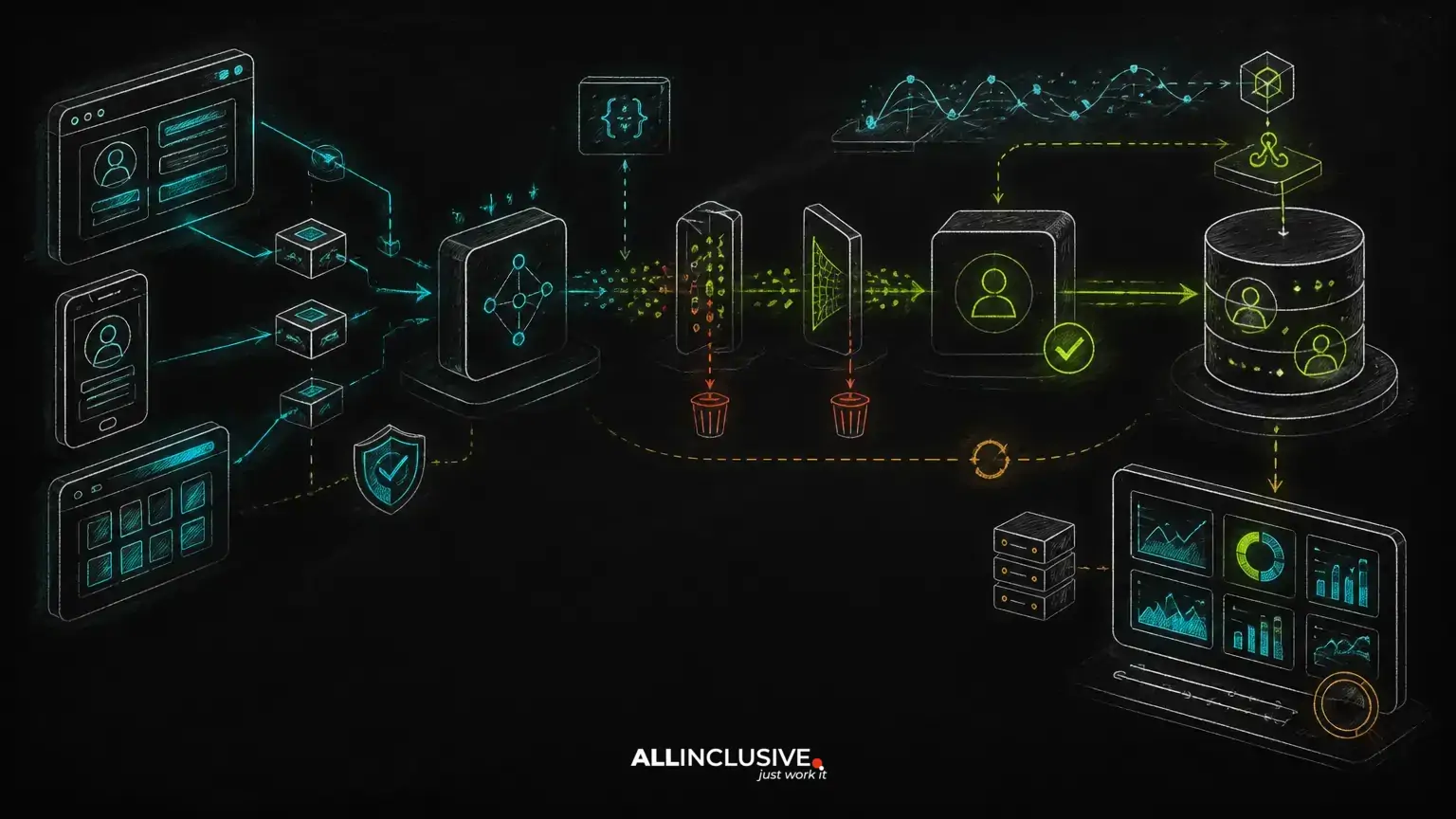
A CRM API integration is reliable when customer data remains understandable and recoverable as records move between systems. That requires more than connecting a form, sales tool or custom application to a CRM endpoint. The integration must define which system owns each field, how records are matched, what happens when delivery fails and how operators detect drift. For crm api integration, an adjacent technical consideration is explained in custom software development.
The most important design principle is to treat synchronization as a distributed-systems problem. APIs can time out, webhooks can arrive more than once, users can edit the same contact in different systems, and vendors can change their contracts. A durable implementation combines explicit data ownership with validation, authenticated transport, idempotent processing, queues, retries, reconciliation and observability.
For broader integration planning, see this third-party API integration strategy. The same failure-oriented thinking applies to CRM connections, but CRM data introduces additional challenges around identity, consent, lifecycle state and conflicting edits.
Start with ownership, identity and synchronization boundaries
Before selecting an SDK or writing a webhook handler, document the systems involved and the direction of each data flow. A typical architecture may include a website, product database, CRM, billing platform and support application. Each may store a customer identifier, email address, company name, status or account owner, but identical-looking fields do not necessarily mean identical business concepts.
Define ownership at the field or domain level. For example, the product database might own authentication and subscription state, while the CRM owns sales pipeline stage and relationship notes. The website may collect a lead, but it should not automatically overwrite a qualified account’s lifecycle stage unless that behavior is intentional.
Identity resolution deserves special attention. Email is useful but not always a durable primary key: addresses can change, shared addresses exist, and a person can belong to multiple organizations. Prefer stable external identifiers where the CRM supports them. Store the CRM record ID in your application, and store your application’s ID in a dedicated CRM field when possible. Matching rules should be explicit, ordered and auditable.
- Use a stable system identifier as the preferred match.
- Use normalized email or domain matching only under defined conditions.
- Do not silently merge records because two names look similar.
- Record whether a link was created automatically, manually or after review.
- Define how deletions, merges and archived records are represented.
Use contracts to control CRM data quality
CRM APIs often expose flexible objects and optional fields, but flexibility at the vendor boundary should not become ambiguity inside your application. Create an internal integration contract that defines accepted inputs, required fields, normalization rules, outbound mappings and permitted state transitions.
Validation should happen before a request reaches the CRM. Check formats, required relationships, enum values and length limits in your own integration layer. Keep vendor-specific field names at the boundary rather than scattering them through controllers, jobs and business logic. This makes a CRM replacement or API version change less disruptive.
Separate transport models from domain models. A CRM contact payload may contain vendor metadata that is irrelevant to your application, while your application may need a concept the CRM represents through several fields. A mapping layer makes these differences visible and testable.
Contract tests can verify that outgoing payloads conform to the expected shape and that representative vendor responses can still be parsed. They do not eliminate the need to monitor production behavior, but they catch accidental mapping changes before deployment.
Choose authentication and permissions deliberately
Authentication is an architectural responsibility, not a configuration detail. Use the CRM’s supported authorization model and request only the scopes required for the integration. OAuth-based connections require secure handling of client credentials, access tokens and refresh behavior. Tokens should be encrypted or stored in an appropriate secrets system, excluded from logs and rotated according to the provider’s capabilities and your risk model.
Keep authorization separate from application identity. A user who submits a lead form does not necessarily need direct CRM credentials in the browser. In most cases, the server-side integration should own the vendor connection and expose only the business operation needed by the application.
For a deeper explanation of token flows and scope decisions, see OAuth 2.0 for API integrations. Also account for revoked access, expired consent, changed scopes and administrator actions. An authentication failure should become a visible integration state with an operator path to repair it, not an endless retry loop.
Combine API writes with webhook-driven updates
Most CRM integrations need both synchronous API calls and asynchronous event processing. A user-facing action may create a lead immediately and return a clear result, while webhook events keep local data informed when a sales representative changes the record in the CRM.
Do not assume that a successful API response means all downstream work is complete. Save the external ID, request correlation ID and relevant version or timestamp, then process secondary actions through a queue when they do not belong on the user’s critical path.
Webhook consumers should be designed as repeatable message processors:
- Verify the webhook signature or equivalent authentication mechanism.
- Validate the event envelope and reject malformed messages safely.
- Persist an event or delivery record before performing nontrivial work.
- Check whether the event has already been processed.
- Apply the update only if its version or ordering rules permit it.
- Acknowledge promptly when processing is safely durable.
Webhook delivery is not the same as guaranteed exactly-once execution. Providers may retry deliveries, deliver events out of order or omit events during an outage. The consumer therefore needs idempotency and a way to rebuild state from the source when necessary.
Prevent duplicate records with idempotency and deterministic matching
Duplicate chaos usually starts when the integration treats every submission as a new CRM object. A browser retry, queue redelivery or user double-click can produce multiple contacts unless the operation has a stable idempotency strategy.
For create-or-update operations, derive an idempotency key from a trusted business event or generate one at the start of the workflow. Store the key, payload fingerprint, result and processing status. A repeated request with the same key should return the recorded result or safely resume processing rather than create another record.
Idempotency does not solve identity matching by itself. Define whether the operation is intended to create a new lead, update a known contact, associate a contact with a company or create a new opportunity. These are different commands and should not be inferred from a loosely shaped payload.
When a match is ambiguous, route it to a review state. A cautious “needs review” result is safer than merging two people or attaching a prospect to the wrong account. The business cost of a duplicate is often visible in reporting, outreach and customer experience long after the API request succeeded.
Design retries around failure types and rate limits
Retries are useful only when the failure is likely to be temporary and the operation is safe to repeat. Network timeouts, connection resets, selected server errors and documented rate-limit responses may be retryable. Invalid fields, missing permissions, revoked authorization and unsupported endpoints generally require correction rather than repetition.
Use bounded exponential backoff with jitter, and honor provider guidance such as retry-after values when available. Set a maximum attempt count or age. After that threshold, move the operation to a dead-letter or manual-review workflow with enough context to diagnose it.
Rate limits should influence queue design and product behavior. A burst of imports may need throttling, batching or scheduled processing rather than thousands of concurrent requests. Separate interactive traffic from bulk synchronization so a backfill does not prevent a salesperson’s new lead from being processed.
For a related treatment of capacity protection and client behavior, see API rate limiting. Rate-limit handling belongs in a shared integration component when several workflows call the same CRM.
Use queues and reconciliation to recover from drift
Queues isolate application requests from vendor latency and make retry behavior explicit. A job can carry the operation type, internal record ID, external ID, idempotency key, attempt count and schema version. Avoid placing sensitive customer data in a queue payload when a reference can be used to load the current, authorized state.
Reconciliation is the recovery mechanism for missed webhooks, partial outages and mapping defects. It should not be treated as an emergency script written after the first incident. Define a scheduled process that compares selected records or aggregates between systems and reports discrepancies.
A reconciliation workflow may:
- Find local records without an external ID.
- Find external records whose stored source identifier is unknown locally.
- Compare fields where each system is authoritative.
- Detect impossible lifecycle transitions or missing relationships.
- Queue safe repairs and flag ambiguous differences for review.
Full bidirectional equality is rarely the right goal. Reconcile the fields and relationships that matter to the business, and make conflict rules explicit. A CRM integration can be healthy even when systems intentionally store different representations of the same customer.
Make errors and observability part of the product design
Integration errors need operational meaning. “CRM sync failed” is not enough for an engineer or operations user to decide what to do next. Classify failures by authentication, validation, authorization, rate limiting, not found, conflict, provider outage and unknown response.
Capture structured logs and metrics without exposing tokens or unnecessary personal data. Useful fields include operation type, internal and external IDs where appropriate, correlation ID, event ID, attempt number, response category, latency and final disposition. Dashboards should distinguish pending, successful, retried, permanently failed and needs-review work.
Alert on conditions that require action: growing queue age, repeated authorization failures, elevated permanent errors, reconciliation drift or a webhook stream that has stopped. Include links to the relevant record and replay or repair procedure where safe.
An operator interface can be more valuable than another automatic retry. It should show what happened, which payload or mapping was involved, whether a retry is safe and who resolved the issue. Avoid building a “retry everything” button without idempotency and authorization safeguards.
Laravel and Python implementation choices
Laravel can be a strong fit when the application already uses PHP and benefits from integrated routing, validation, queues, scheduled tasks, database transactions and application-level authorization. A Laravel integration commonly separates CRM clients, mapping services, webhook controllers, queued jobs and reconciliation commands. The framework should organize responsibilities; it should not hide vendor-specific failure behavior.
Python is often a practical choice when the integration is part of an automation service, data pipeline or broader analytics workflow. Its ecosystem can support asynchronous workers, scheduled reconciliation and transformation-heavy processing, provided the service includes durable job state, clear contracts and production-grade observability.
The decision should follow system boundaries rather than language preference. If the CRM workflow is embedded in an existing Laravel product, adding a separate Python service may introduce deployment, authentication and operational overhead without a clear benefit. If synchronization already belongs to an independent event-processing platform, Python may fit that boundary naturally. Custom software should preserve a coherent ownership model whichever implementation is selected.
Teams planning the application around stable interfaces may also benefit from this overview of API-first architecture. The goal is not to expose every internal model, but to make integration contracts deliberate and maintainable.
A delivery checklist for CRM API integration
- Document system and field ownership before mapping payloads.
- Define stable identity keys, matching rules and ambiguous-match handling.
- Keep vendor payloads behind a dedicated adapter or integration boundary.
- Validate and normalize data before outbound requests.
- Use least-privilege authentication and secure token storage.
- Make create, update, associate and delete operations distinct.
- Implement idempotency for API commands and webhook events.
- Use queues, bounded retries, backoff and rate-limit-aware scheduling.
- Persist failed work with enough context for safe diagnosis.
- Build reconciliation before launch, not after data drift appears.
- Monitor queue age, error classes, webhook health and synchronization gaps.
- Test revoked access, duplicate delivery, out-of-order events, timeouts and vendor schema changes.
A CRM API integration succeeds when the organization can trust both the data and the process that maintains it. That trust comes from explicit ownership, conservative identity matching and recovery paths for ordinary failure. If the integration is part of a larger custom product, web development services can cover the surrounding application architecture, while support and maintenance can help keep credentials, mappings, dependencies and operational procedures current as the connected systems change. When connected systems include an ERP, an ERP integration plan can clarify data ownership, synchronization, and recovery responsibilities.


