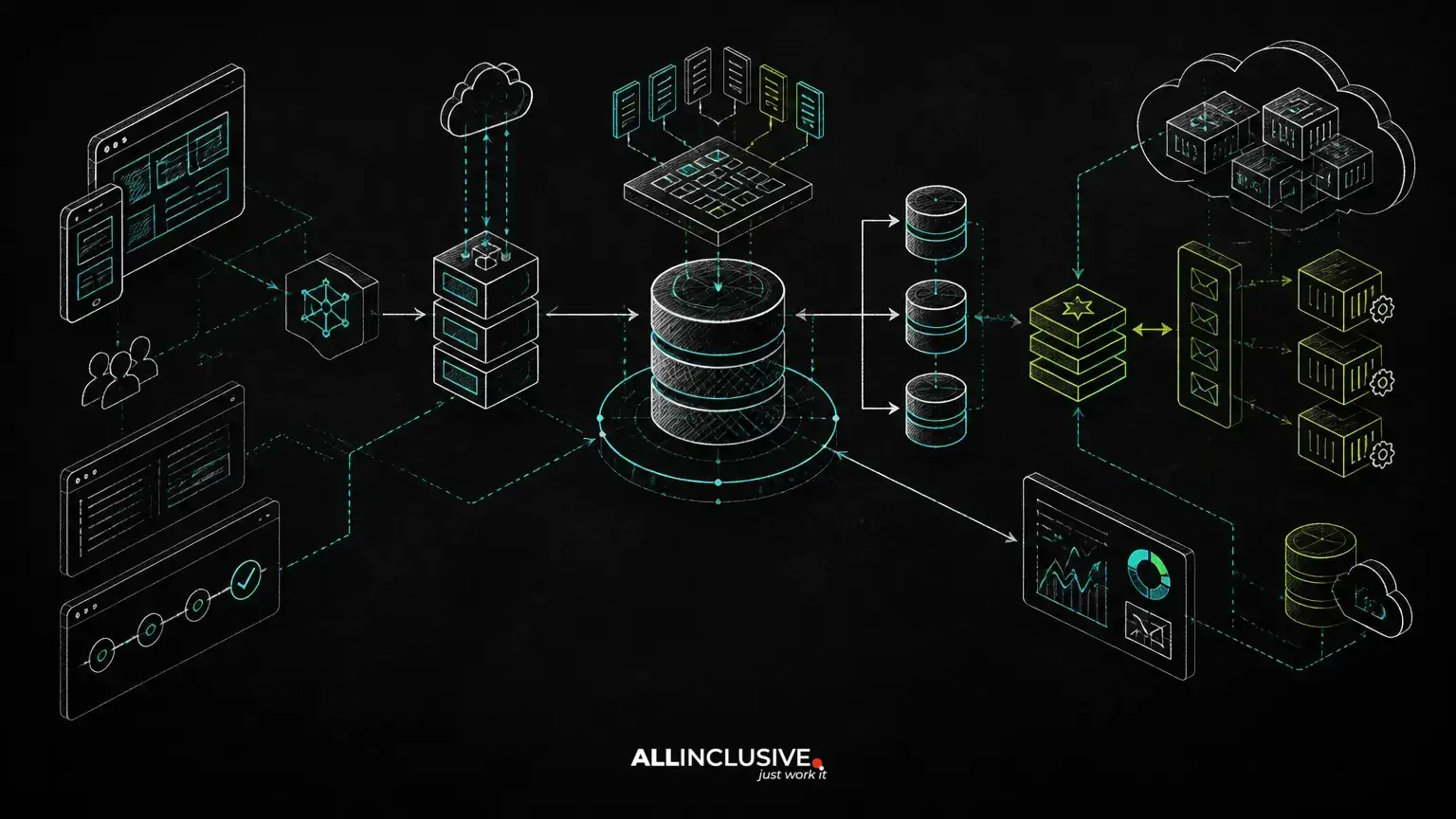
A reliable third-party API integration strategy is not a sequence of successful HTTP requests. It is an operating model for handling timeouts, duplicate events, expired credentials, partial writes, rate limits, schema changes and provider outages without corrupting business workflows.
The strongest integrations define ownership, validate data at boundaries, make retries safe, and provide a way to reconcile local state with the provider. REST endpoints, OAuth, webhooks, queues and background jobs are implementation tools; the strategy is the set of decisions that makes those tools dependable in production.
Start with a contract between systems
Before choosing a client library or writing a service class, document what each system owns. Identify the source of truth for customers, orders, payments, inventory or other shared records. Then define which system may create, update or delete each field and how conflicts are resolved.
A useful integration contract describes:
- The business event or workflow that triggers an API call.
- The request data required, optional and derived by the receiving system.
- Expected response states, including asynchronous processing.
- Whether an operation is safe to repeat.
- How external identifiers map to internal records.
- What happens when a field is missing, rejected or changes type.
- Who owns recovery when the provider or local application fails.
Do not treat provider documentation as a complete application contract. External documentation may describe valid requests but not the operational behavior your product needs, such as duplicate delivery, delayed webhooks or inconsistent error responses. Capture those assumptions in tests, monitoring and internal documentation.
Separate synchronous decisions from asynchronous work
A user-facing request should perform only the external work needed to give the user a meaningful answer. Long-running synchronization, enrichment, exports and webhook processing generally belong in a queue or background worker.
For example, creating an order might synchronously validate the local order and submit a request to a provider. Updating search indexes, importing related records and reconciling the provider’s final status can happen asynchronously. This separation keeps user workflows responsive and gives the integration room to retry without holding an HTTP request open.
Queues do not solve reliability by themselves. A worker still needs a durable job state, an attempt count, a retry policy, an error classification and a way to prevent two workers from applying the same business effect concurrently.
Make authentication and credentials operationally safe
Authentication should be designed as a lifecycle, not a configuration checkbox. API keys, signed requests and OAuth 2.0 each create different responsibilities for storage, rotation, scopes, expiration and revocation. OAuth integrations in particular need explicit handling for token expiry, refresh failures, consent changes and insufficient scopes. See this OAuth 2.0 API authentication guide for the authorization decisions that commonly affect integration design.
Keep secrets out of source control, logs, browser-visible code and exception messages. Store provider credentials in an appropriate secret-management system and limit access to the services that need them. Record which credential or connection was used without recording the secret itself, so operators can investigate failures and rotations.
Plan credential rotation before launch. A deployment that requires manually editing application code or stopping all integration workers creates avoidable operational risk.
Use validation at both sides of the integration boundary
Validate outgoing data before sending it to a provider, but do not assume that a successful response means the data is fully acceptable to your application. Validate responses before persisting them, especially when external values drive financial, entitlement or workflow decisions.
Boundary validation should cover:
- Required fields and permitted formats.
- Identifiers, timestamps, currencies and decimal precision.
- Enumerated status values and unknown future values.
- Pagination metadata and result limits.
- Nested objects that may be absent or partially populated.
- Provider warnings that accompany an otherwise successful response.
Use a translation layer between provider models and internal domain models. Storing a provider’s payload directly throughout the application couples business logic to external naming, status values and schema changes. A translation layer allows the provider adapter to change while the rest of the application continues to use stable internal concepts.
Design idempotency before adding retries
Retries are necessary because networks fail after a request may already have reached the provider. Retrying a non-idempotent operation without protection can create duplicate customers, orders, charges or messages.
For operations that create business effects, use an idempotency key when the provider supports it. Generate the key from a durable internal operation rather than from each HTTP attempt, and persist the relationship between that key, the local record and the provider response. If the provider does not support idempotency, use an internal operation record, a unique constraint or a provider-side lookup strategy where available.
Idempotency must cover the local side too. A webhook handler that updates a record twice may produce an incorrect notification or duplicate downstream job even if the provider delivered the same event intentionally. Store event identifiers or equivalent deduplication data, and make the business update safe to repeat.
Classify errors instead of retrying everything
A useful retry policy distinguishes temporary failures from permanent failures. Network timeouts, connection resets, service-unavailable responses and some rate-limit responses may be retryable. Invalid credentials, insufficient permissions, malformed data and unsupported operations usually require intervention or code changes.
Use bounded retries with backoff and jitter. The delay should increase between attempts, and the integration should eventually move the operation into a visible failed or review state. An unbounded retry loop can consume queue capacity, amplify a provider outage and obscure the original problem.
Record enough context to decide what happens next:
- Operation type and internal record identifier.
- Provider, endpoint and API version.
- Attempt number and timing.
- HTTP status or provider error code.
- Whether the request may have been accepted before the failure.
- Next retry time or terminal failure reason.
Do not expose raw provider errors directly to end users. Translate them into actionable product messages while retaining technical details for operators.
Treat webhooks as untrusted, repeatable input
Webhooks are useful because they reduce polling and can communicate state changes quickly. They are also an external input channel that requires authentication, validation and operational controls.
Verify signatures or another provider-supported authenticity mechanism before processing an event. Check timestamps or replay protections where available. Parse and validate the payload, then acknowledge receipt according to the provider’s expectations. Heavy business work should normally be queued after the event is accepted, rather than performed inside the webhook request.
Expect events to arrive late, out of order or more than once. Use the event identifier for deduplication when available, and compare event timestamps or resource versions before applying state changes. If a “completed” event arrives before a “pending” event, the older event should not move the local record backward without an explicit rule.
Maintain a replayable event record or equivalent audit trail. This supports recovery when a deployment contains a bug, a downstream worker fails or an event is received before the related local record exists.
Build reconciliation instead of trusting one-way sync
Even a well-designed webhook flow can miss events because of misconfiguration, provider downtime, signature failures or local processing errors. Reconciliation is the process of comparing local state with provider state and repairing differences.
A reconciliation job might periodically query records changed since a checkpoint, compare authoritative fields and schedule corrective actions. For larger datasets, use provider-supported cursors, incremental exports or resource-level lookups rather than repeatedly scanning everything.
Define how conflicts are resolved before they occur. Possible rules include provider authority for payment status, local authority for user-facing labels, last-write-wins only when timestamps are trustworthy, or manual review for financially sensitive differences. Silent overwrites create data ownership problems that become expensive to unwind.
Account for rate limits and provider capacity
Rate limits affect architecture, not just request frequency. A burst of queued jobs, a bulk import and normal user traffic may compete for the same provider quota. Centralize throttling where possible, respect provider signals such as retry timing, and prioritize operations by business impact.
Design bulk operations to resume from a checkpoint. Avoid restarting an entire import after one page fails. Cache stable reference data when appropriate, but establish an invalidation or refresh policy so cached values do not become an unexamined source of incorrect decisions. For payment, inventory and entitlement data, caching rules require particular care.
The separate topic of API rate limiting is useful when an integration serves both internal consumers and external clients: protection is needed on both sides of the boundary.
Version contracts and provider changes deliberately
Pin provider API versions when the provider supports versioning, and make the selected version visible in configuration and monitoring. A version pin does not eliminate change; providers may change behavior within a version, deprecate features or introduce new required migration steps.
Keep contract tests for representative requests, responses, error payloads and webhook events. Test unknown fields and unknown enum values defensively so a harmless provider expansion does not crash the integration. For a breaking change, use an adapter or dual-read strategy when the migration requires time, and remove compatibility code after the transition is verified.
API-first architecture can help teams define stable internal boundaries, but an external integration still needs provider-specific translation and recovery rules. The distinction is covered in this API-first architecture overview.
Make failures visible to operators and product teams
Observability should answer three questions: what failed, which business record is affected, and what action is available. Logs should include correlation IDs, operation IDs, provider request identifiers when safe to store, status codes and duration. They should exclude access tokens, payment credentials and unnecessary personal data.
Metrics can track request volume, latency, error classes, retry counts, queue age, webhook backlog, reconciliation differences and authentication failures. Alerts should focus on actionable conditions, such as a growing failed-operation queue or a sudden increase in rejected payloads, rather than every individual transient timeout.
Give support and operations staff a controlled way to inspect an integration operation, retry it when safe, mark it for review or trigger reconciliation. A “retry” button without idempotency and permission controls can create more damage than the original failure.
Choose Laravel or Python by responsibility
Laravel is often a practical choice when the integration belongs inside a PHP application that already owns authentication, domain workflows, database transactions and queue infrastructure. Service classes, jobs, scheduled tasks, validation and application-level policies can keep the integration close to the business process without scattering provider calls through controllers.
Python may be a better fit for data-heavy synchronization, specialized transformation, independent workers, machine-learning pipelines or an existing Python platform. It can also be appropriate when the integration is an autonomous service with its own deployment and operational boundary.
The important decision is not language preference alone. Define the system boundary, failure ownership, deployment model, data volume and team expertise. A small, well-tested adapter inside an existing application may be more maintainable than a separate service; a high-volume or independently scaled workflow may justify isolation.
A production-readiness checklist for third-party integrations
- Data ownership and conflict rules are documented.
- Outgoing requests and incoming responses are validated.
- Credentials have scoped storage, rotation and failure handling.
- Non-idempotent operations have duplicate protection.
- Retries are bounded, classified and observable.
- Webhooks are authenticated, deduplicated and replayable.
- Queue jobs can resume without restarting whole workflows.
- Rate limits are respected across workers and user traffic.
- Reconciliation can detect and repair missed or inconsistent state.
- Provider versions, contract tests and migration ownership are defined.
- Operators can inspect failures without exposing secrets or sensitive data.
Reliable integrations are custom software components, not disposable glue code. When the architecture reflects failure modes from the beginning, teams can add provider capabilities without making every business workflow dependent on an unexamined external response. For broader product engineering and implementation considerations, see Allinclusive development services, and review support and maintenance planning for the operational work that continues after launch.