
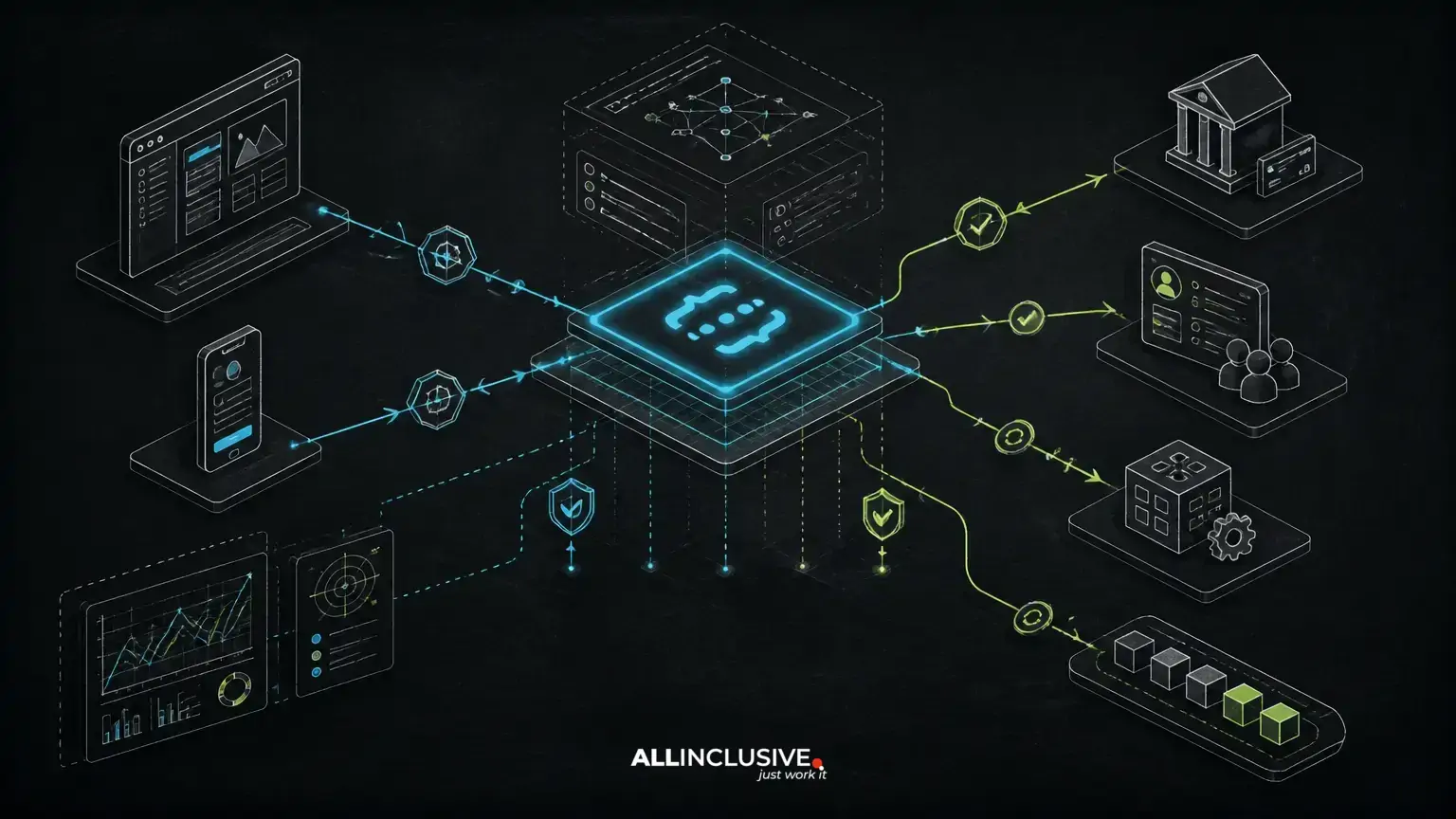
API-first architecture means treating an API contract as a primary product and engineering boundary, rather than exposing endpoints only after an application has been built. The approach can help product teams move faster when multiple clients, integrations or teams depend on the same capabilities. It can also create unnecessary work when a small internal application has one user interface, limited integration needs and no realistic reuse path. A related decision for api first architecture is covered in custom software development.
The important question is not whether every product should be API-first. It is whether defining stable interfaces early will reduce coordination, integration and change-management risk. A useful API-first design covers more than routes and JSON fields. It includes validation, authentication, authorization, error states, idempotency, retries, webhooks, rate limits, versioning and observability.
What API-first architecture changes in product development
In a conventional implementation-first project, a team may build screens, database logic and business rules before deciding how external clients will interact with the system. An API is then added around the existing behavior. This can work for a contained product, but the resulting interface often reflects internal tables or controller methods rather than stable business capabilities.
With an API-first approach, the team defines the consumer-facing contract before or alongside core implementation. That contract can be reviewed by product, frontend, backend, integration and security stakeholders. The implementation may change behind it, while the agreed behavior remains understandable to its consumers.
- Frontend independence: web and mobile teams can work against an agreed interface without waiting for every backend detail.
- Integration clarity: partners and internal systems know what data, authentication and error behavior to expect.
- Change control: breaking changes become visible design decisions rather than accidental side effects.
- Testability: contract validation and automated integration tests can be planned before all features are complete.
API-first does not require microservices. A modular monolith can expose carefully designed APIs while keeping deployment and operational complexity under control. The architectural decision is about interface ownership and contract discipline, not about splitting an application into many services.
When API-first is likely to improve delivery speed
API-first architecture is most useful when the cost of coordination is significant. Several conditions make the approach particularly valuable.
Multiple clients consume the same business capabilities
If a product will support a browser application, mobile application, partner portal or internal operations tool, a shared API can separate client workflows from core business rules. Each client can shape the presentation without duplicating important validation or transaction logic.
External integrations are part of the product, not an afterthought
Products that connect to payment providers, CRMs, ERPs, identity platforms or data services need explicit integration boundaries. An API-first design makes ownership, data mapping and failure behavior easier to review before implementation begins. For broader integration planning, see this third-party API integration strategy.
Several teams need parallel delivery
A documented contract can let frontend, backend and integration engineers plan work in parallel. This benefit depends on more than publishing an OpenAPI document. Teams also need examples, validation rules, authentication expectations, error semantics and a process for resolving contract changes.
The product will become a platform or embedded capability
If customers, partners or other company systems may consume the product, designing interfaces deliberately from the beginning can avoid expensive retrofitting. The team should still resist exposing every internal operation. A public or partner API should represent stable business capabilities, not database access.
When API-first can slow a team down
API-first architecture adds design and governance work. That work is justified only when it reduces a larger risk.
- Small, single-client applications: a private application with one tightly coupled interface may not need a formal external contract.
- Unclear product behavior: prematurely freezing a contract can make experimentation harder. Early prototypes may need deliberately temporary interfaces.
- Low integration demand: if no external consumers or second client are likely, extensive versioning and developer-portal work may be unnecessary.
- Unowned contracts: documentation that no team maintains becomes misleading. API-first fails when design artifacts are separated from implementation and release processes.
A pragmatic approach is to apply stronger contract discipline at the boundaries that carry the most business risk. Internal modules can remain simpler, while payment, identity, customer-data and partner interfaces receive more formal design and testing.
What a production-ready API contract should define
A useful contract explains how a consumer can succeed, recover and respond when something goes wrong. At minimum, define the following.
Resources, actions and representations
Use names and operations that reflect business capabilities. Document required fields, optional fields, formats, relationships and pagination behavior. Avoid leaking storage details that may constrain future implementation changes.
Validation and error states
Validation should distinguish malformed requests from valid requests that violate business rules. Error responses should provide a stable machine-readable code, a safe human-readable message and enough context for support and logging. Do not expose stack traces, secrets or sensitive internal data.
Authentication and authorization
Authentication establishes who or what is calling. Authorization determines what that identity may do. Define token handling, scopes or permissions, expiration behavior and access to tenant or account data. OAuth-based integrations require careful decisions about consent, token storage and refresh behavior; the OAuth 2.0 API authentication guide covers those concerns in more detail.
Idempotency and duplicate protection
Network failures can leave a client unsure whether a write succeeded. For operations such as creating a payment, order or subscription, an idempotency key can allow a safe retry without creating a second result. The contract should explain which operations support idempotency, how long keys remain valid and what happens when the same key is reused with different input.
Rate limits and resource behavior
Document limits where consumers need to adapt their behavior. Responses should communicate when a client is being throttled and, where appropriate, when it may retry. Rate limiting is both an operational safeguard and a product decision: limits should account for legitimate workflows rather than simply blocking unexpected traffic.
Designing reliable asynchronous integrations
Not every operation should remain synchronous. Long-running work, third-party calls and bursty workloads may be better handled through queues or background workers. The API can accept a request, return an operation identifier and provide a way to inspect status or receive a webhook.
Webhooks introduce their own contract. Define event names, payload versions, delivery attempts, signature verification, timestamp handling and replay behavior. Recipients should acknowledge quickly and process events asynchronously when work may take time. Senders should retry transient failures with bounded backoff, while avoiding infinite delivery loops.
Neither side should assume that messages arrive once, in order or without delay. Consumers need deduplication and, where ordering matters, a strategy for detecting gaps or stale events. A reconciliation process is also important for high-value workflows. It can compare the system of record with the integration partner and repair missed or inconsistent state.
For transaction-heavy workflows, payment integrations are a useful example of why synchronous success responses are not enough. This payment gateway integration architecture guide examines webhooks, transaction state and reconciliation.
Laravel and Python choices should follow responsibility
Laravel can be a strong fit when the product benefits from a cohesive PHP application with routing, request validation, authentication, queues, scheduled tasks and database-backed business workflows in one ecosystem. It is often practical for teams building a modular monolith or a conventional web product with a well-defined API boundary.
Python may be preferable when the API is closely connected to data processing, automation, scientific workloads or machine-learning services. Python frameworks can support focused service boundaries, asynchronous workflows and integration-heavy processing, but the team still needs to make deliberate choices about validation, background jobs, persistence and deployment.
Neither language makes an API reliable by itself. Reliability comes from explicit contracts, bounded retries, safe replay behavior, structured logs, monitoring and clear ownership. A Laravel application may need a separate worker and reconciliation process; a Python service may need equally disciplined authentication and contract management.
Operational requirements that prevent silent integration failure
API design is incomplete until the team can operate and troubleshoot it. Track request identifiers across services so a user action, queued job and partner call can be connected. Record structured events for authentication failures, validation errors, rate limiting, retries, webhook delivery and reconciliation outcomes.
Metrics should help answer practical questions: Which endpoints fail? Which consumers are affected? Are retries succeeding or multiplying load? How long do queued operations remain pending? Are webhook deliveries delayed or repeatedly rejected? Alerts should focus on actionable conditions rather than every individual transient error.
Define ownership for the API contract, production incidents, credentials, third-party dependencies and deprecation decisions. A support and maintenance process can help keep integrations, dependencies and operational documentation aligned after launch; see support and maintenance for custom software.
A decision checklist for adopting API-first architecture
- Identify every current and probable consumer: web, mobile, internal operations, partners and external customers.
- List business capabilities that must remain stable even if the user interface or internal implementation changes.
- Classify operations by failure impact and decide where idempotency, queues or reconciliation are required.
- Define authentication, authorization, validation and error behavior before implementation.
- Choose synchronous or asynchronous interaction based on user workflow, processing time and dependency reliability.
- Set a versioning and deprecation policy that matches the expected consumer population.
- Specify logs, metrics, traces, alerts and ownership before the first production integration.
- Reassess whether a modular monolith is sufficient before introducing distributed services.
For teams evaluating implementation options or planning a custom product, API development services can support contract design, integration architecture and production delivery. The right outcome is not the largest API surface. It is a stable, observable boundary that reduces coordination cost without hiding complexity or shifting failure onto users.


