Pairing Python with React or Next.js is a strong option when a web product needs more than browser interactions and database forms. Python can provide the production backend for business rules, APIs, background processing, data workflows and AI features, while React or Next.js can support a responsive product interface and, where useful, server-rendered or statically generated pages.
The important decision is not whether these technologies can work together. They can. The architectural question is where responsibilities belong, how the frontend communicates with Python, and how the system remains testable and operable as the product grows. A clean design usually treats the frontend and backend as separate applications with explicit contracts rather than as one loosely connected codebase.
What a Python, React and Next.js stack actually contains
React is a UI library used to build component-based interfaces. Next.js is a React framework that can add routing, rendering strategies, build tooling and server-side capabilities. Python typically supplies the application backend through Django, FastAPI or another established framework.
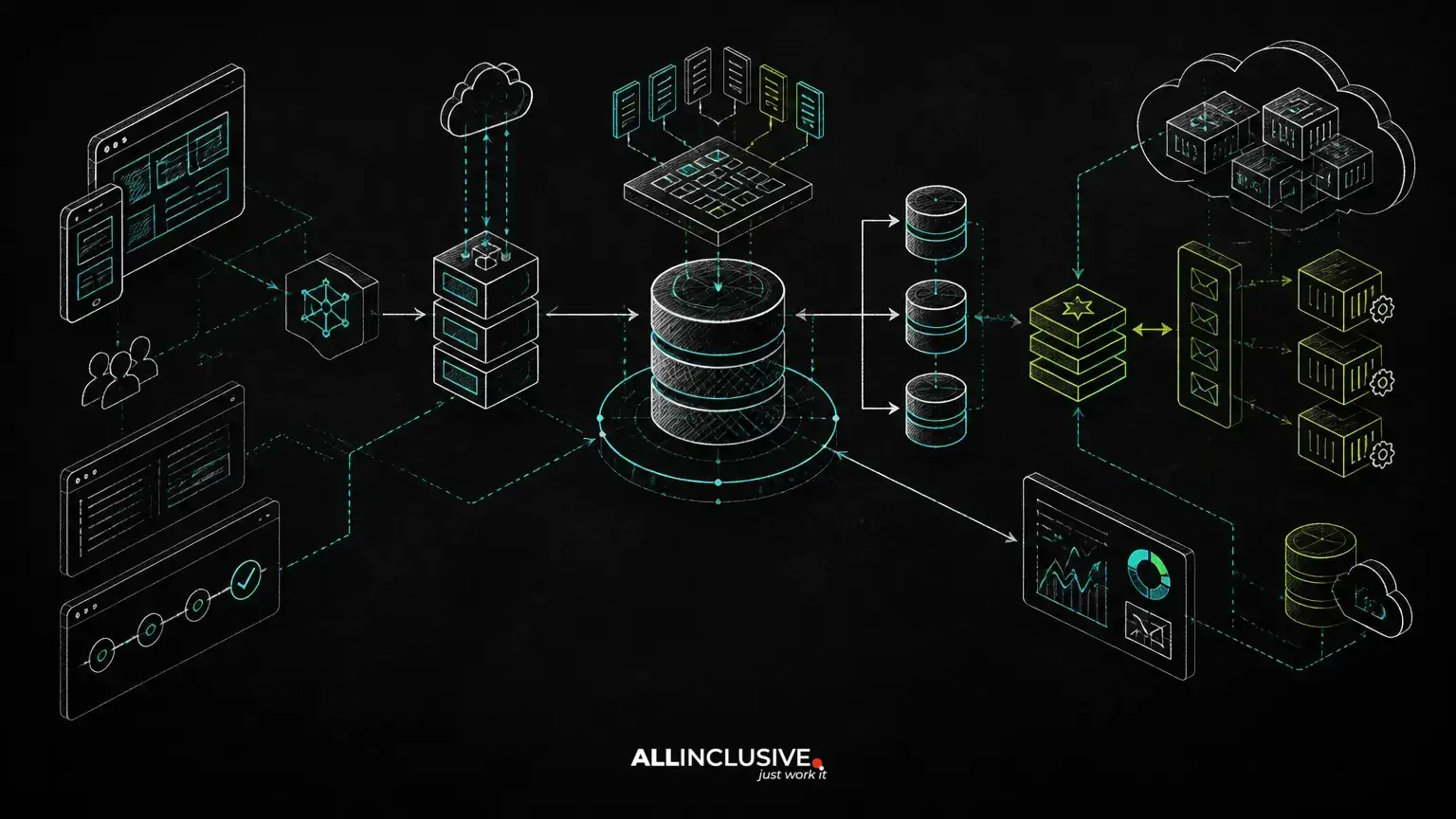
A common production arrangement looks like this:
- React or Next.js: product screens, forms, navigation, client-side state and user-facing workflows.
- Python API: authentication, authorization, business rules, validation, transactional operations and integration endpoints.
- Database: durable product data, with ownership and access patterns defined by the backend.
- Workers and queues: email, file processing, imports, notifications, reports, model calls and other work that should not delay a user request.
- Operational services: logging, metrics, error tracking, secrets management, backups and deployment infrastructure.
Next.js can also handle selected server-side concerns, but that does not remove the need to define ownership. If Python is the system of record for business rules and data, duplicating those rules in Next.js can create inconsistent behavior and more difficult testing.
Choosing FastAPI or Django for the Python backend
FastAPI is often a good fit for API-centered products where explicit request models, asynchronous integration points and a focused service boundary are valuable. It works well when the team wants a relatively lean backend and is prepared to assemble the surrounding pieces—such as database access, administration, background processing and authentication—deliberately.
Django is often useful when the product benefits from a mature application framework, integrated conventions, an administrative interface, established authentication options and a broad ecosystem. A Django backend can expose APIs for React or Next.js while retaining server-side tools that help internal operators manage the product.
The choice should follow product constraints rather than framework fashion:
- Choose based on the domain model, administrative needs and team experience.
- Evaluate how authentication, authorization, migrations, testing and background jobs will be implemented.
- Consider whether the product is primarily an API platform, an operations-heavy business application or a data-intensive workflow.
- Prefer a framework the team can operate consistently over a theoretically minimal stack.
For a deeper API discussion, see Python REST API best practices for validation, errors, authentication and versioning.
Define the boundary between Next.js and Python
The most important design work happens at the application boundary. The frontend should know what it needs to render and what actions a user can take. The Python backend should own rules that affect data integrity, permissions, billing, workflow state and external side effects.
For example, a frontend may submit a request to create a report. It should not decide whether the requesting user is allowed to access the underlying records, calculate the final billing state or directly coordinate several external systems. Those responsibilities belong in the backend or in a worker controlled by it.
Use explicit contracts for this boundary. Define request and response shapes, error conventions, pagination behavior, date and currency formats, authentication expectations and versioning rules. OpenAPI-based documentation or generated client types can reduce drift, but generated types do not replace integration tests and careful review.
There are several viable communication patterns:
- REST APIs: a practical default for resource-oriented workflows and integrations.
- GraphQL: potentially useful when clients need flexible read shapes, provided authorization and query complexity are controlled.
- Backend-for-frontend endpoints: useful when the web interface needs compositions that should not be exposed as general-purpose domain APIs.
- Events or jobs: appropriate for asynchronous work, notifications and processes that do not need to complete during the request.
Do not let the frontend become a second business layer. Presentation logic belongs in React or Next.js; domain decisions should have one authoritative implementation.
When Next.js server features should and should not be used
Next.js can support server-rendered pages, static output and server-side data access. These capabilities can be valuable for public content, initial page delivery and interfaces that benefit from server-side composition. They also introduce another place where data access and business logic might appear.
A useful separation is to keep Python as the domain backend and use Next.js server features for presentation-oriented concerns. For example, Next.js might assemble page data from the Python API, handle route-level rendering or manage a web-specific session boundary, while Python remains responsible for permissions and mutations.
Directly connecting Next.js server code to the same database as Django or FastAPI can be tempting, but it weakens ownership and can bypass backend validation, audit rules and transaction boundaries. It may be appropriate in a deliberately designed architecture, but it should not become an accidental shortcut.
Background jobs are part of the full-stack design
Many web products become unreliable when every operation is handled inside the HTTP request. Imports, exports, document generation, image processing, email delivery, scheduled synchronization and AI model calls can take too long or fail independently of the user’s request.
A Python worker system can move these operations into queues. The API accepts and validates the request, records the intended work, and returns a status the frontend can display. A worker then performs the task and updates its state. The interface can poll, subscribe to updates or let users return to the task later.
Production job design should address:
- Idempotency, so retries do not duplicate charges, messages or records.
- Timeouts and retry policies that distinguish temporary failures from permanent ones.
- Dead-letter or failure handling for jobs that need human review.
- Progress and status states that are meaningful to users.
- Traceability between the original user action, API request and worker execution.
For AI-enabled workflows, this separation is especially important. Model calls can have variable latency and may require evaluation, moderation, fallback behavior and cost controls. The AI development guide provides related context on turning AI behavior into an operable product capability.
Design data workflows without hiding them in the UI
React can make complex workflows feel simple, but a polished interface does not make a workflow reliable. Data validation, state transitions and consistency rules must remain enforceable on the backend.
For a multi-step process, model the important states explicitly. A document might move from uploaded to scanning, processed, needs review and approved. The frontend can display those states, but Python should control which transitions are valid and record who or what caused them.
For data-heavy products, separate transactional operations from analytical or batch processing where appropriate. A request that updates a customer record may need a short database transaction. A monthly aggregation or external data synchronization may belong in a scheduled worker with its own monitoring and reconciliation process.
Testing a split frontend and Python backend
Testing should reflect the boundary between applications. Unit tests can cover domain rules and UI components, but they are not enough to detect contract drift.
- Backend tests: validate permissions, domain rules, transactions, serialization, failure behavior and job handling.
- Frontend tests: cover component behavior, form validation, loading states, error display and important user workflows.
- Contract tests: verify that the API responses and requests match the assumptions made by the frontend.
- End-to-end tests: exercise a small number of high-value workflows through a deployed-like environment.
- Operational tests: confirm migrations, worker startup, scheduled jobs, backups and recovery procedures.
Test failure states deliberately. A product that only works when the API is fast, the queue is empty and every third-party integration responds successfully is not production-ready.
Deployment and observability for the combined stack
A Python and React or Next.js system may have separate build and deployment pipelines, even when it is delivered as one product. This makes ownership clearer but requires disciplined configuration.
Define how environments provide API URLs, authentication settings, database credentials, queue configuration and third-party secrets. Keep secrets out of frontend bundles and distinguish public configuration from server-only configuration. Coordinate frontend releases with API compatibility so that an older client does not fail immediately after a backend deployment.
Observability should connect the user action to backend work. Useful signals include request duration, error rates, queue depth, job age, failed integrations, database health and frontend errors. Correlation IDs or equivalent tracing context can help teams follow a request across the browser, API and worker.
Deployment choices should also account for operational ownership. A technically elegant architecture can become expensive to maintain if no one owns incident response, dependency updates, schema changes and rollback procedures. Custom software development should include that operating model, not only the initial feature build.
Common failure modes in Python React Next.js projects
Duplicated business rules
When validation and workflow rules are independently implemented in React, Next.js and Python, the product eventually produces contradictory outcomes. Keep authoritative rules in the backend and treat frontend checks as usability improvements, not security controls.
One oversized API request
Returning every related record in one response can simplify an early screen but creates slow queries, unstable payloads and difficult permissions. Design endpoints around real workflows, pagination and predictable expansion.
Queueing work without a user-visible state
Moving work to a background job solves request latency but can create confusion if users cannot see whether the task was accepted, running, completed or failed. Treat job status as part of the product model.
Using shared database access as a shortcut
Allowing multiple applications to write directly to the same tables can bypass domain rules and make migrations risky. Establish ownership before optimizing for fewer API calls.
Ignoring deployment compatibility
Independent frontend and backend releases require compatible contracts. Add deprecation windows, feature flags or versioned behavior when a change cannot be rolled out atomically.
When this architecture is a good fit
Python with React or Next.js is a sensible choice when the product needs a rich web interface alongside substantial backend work: workflow automation, integrations, reporting, data processing, subscription operations or AI-assisted features. It is also useful when an organization already has Python expertise or existing Python services that should remain part of the product.
A different architecture may be simpler when the application is mostly static content, a small administrative tool or a conventional server-rendered system with limited client-side interaction. The right stack depends on the product’s workflow, team capabilities and operating constraints—not on using the largest number of technologies.
For organizations assessing a Python product, the next step is to map user workflows to API boundaries, domain ownership, asynchronous work and operational responsibilities. That exercise usually reveals whether React, Next.js, Django, FastAPI or a hybrid arrangement will reduce risk rather than merely add technology.
Teams maintaining an existing mixed stack may also benefit from Laravel and Python hybrid architecture guidance, particularly when a full rewrite would interrupt a functioning product. Related planning considerations are covered in Python application maintenance and Python backends for SaaS products.