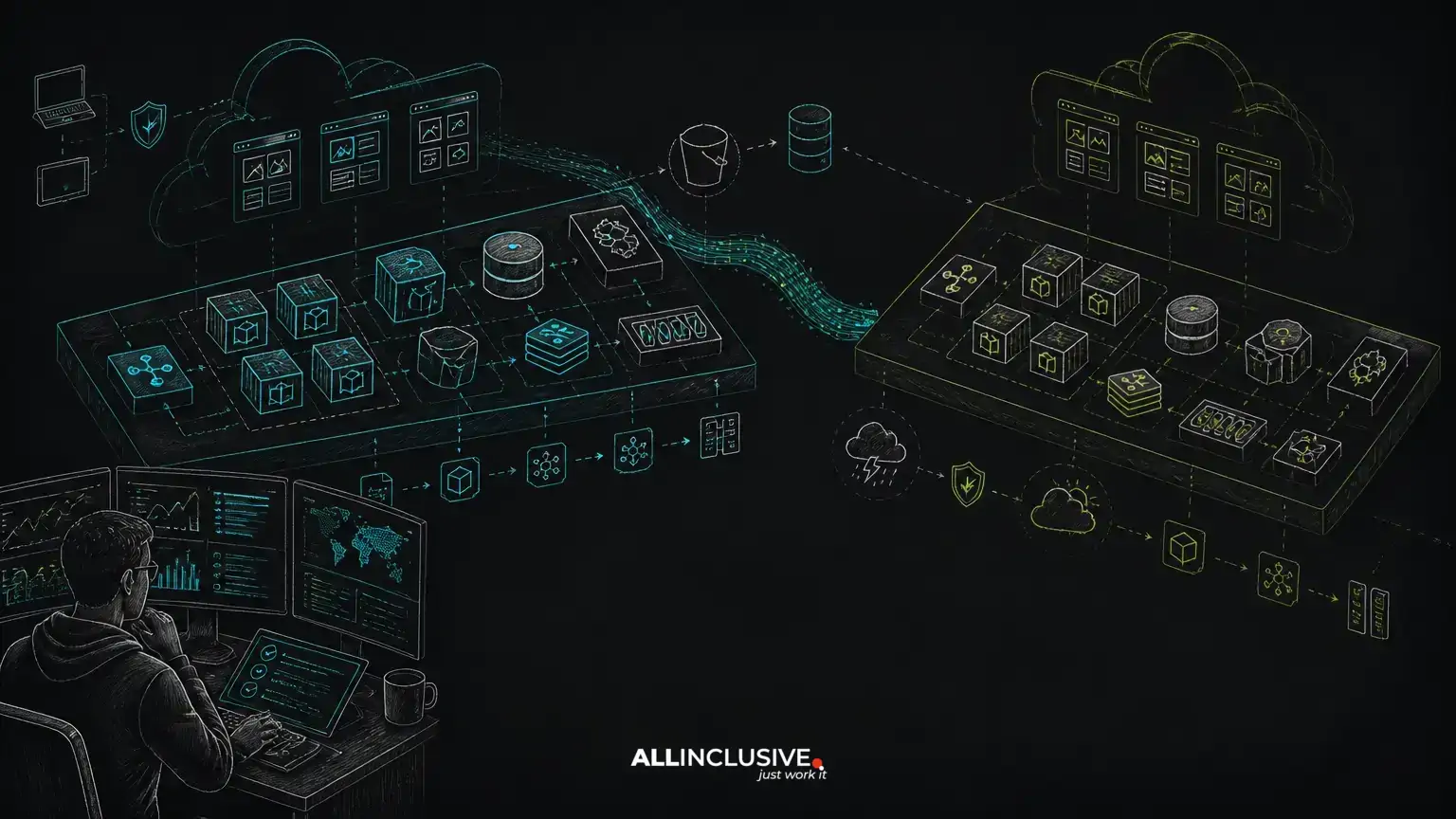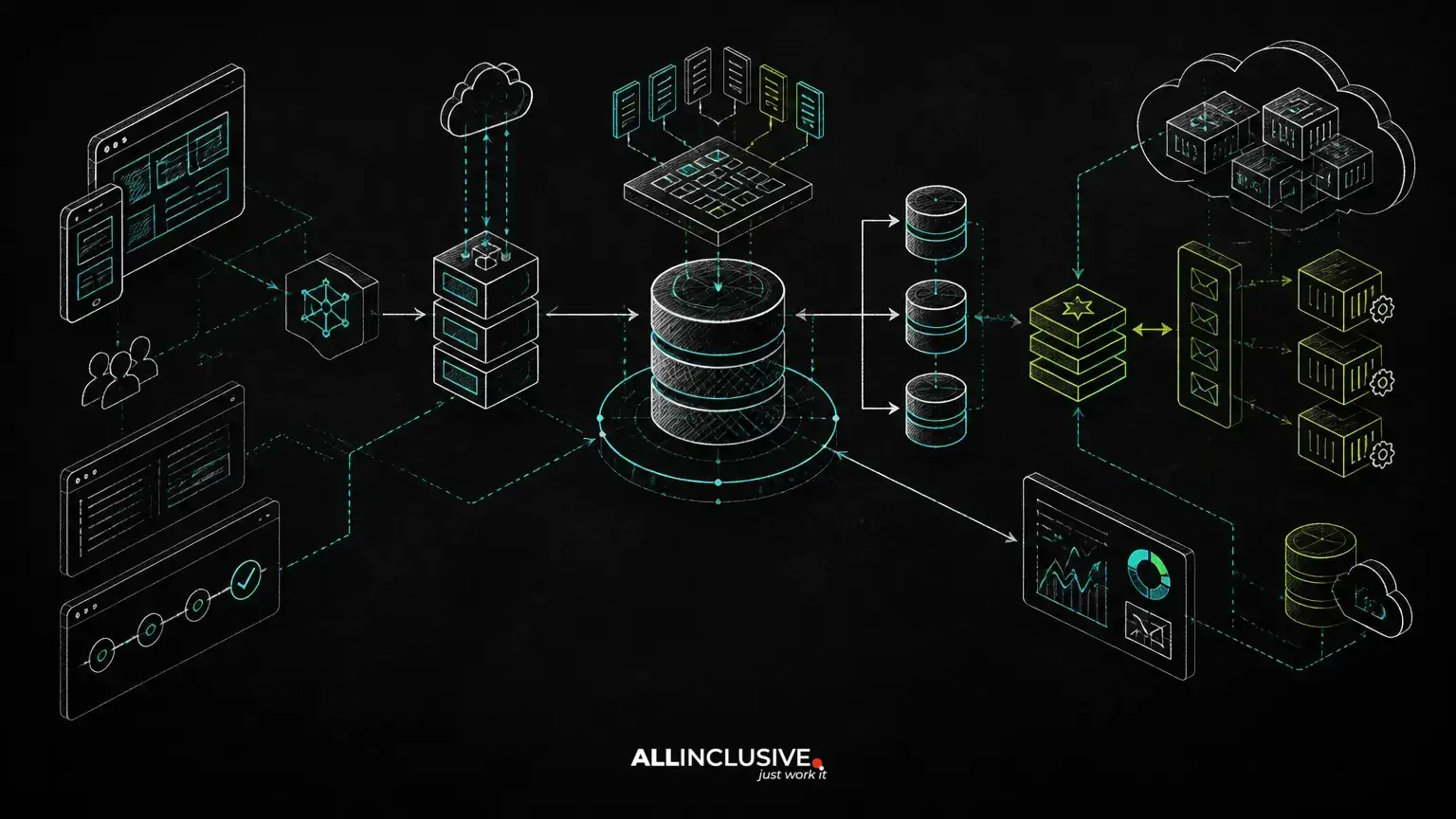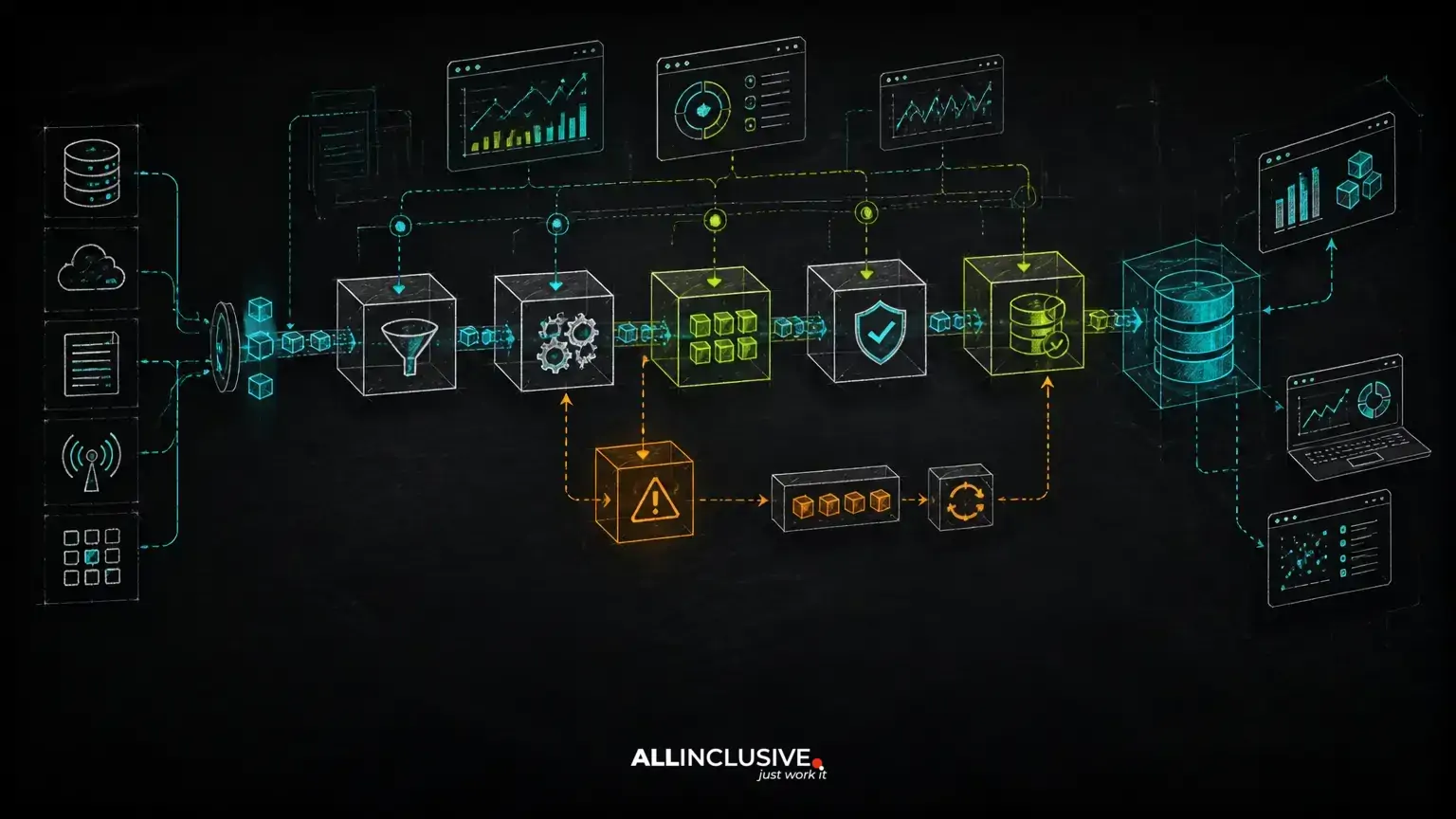
Reliable ETL is less about moving data once than about recovering when the source is slow, a record is malformed, a destination rejects a batch, or a deployment interrupts processing. A sound python etl architecture treats failure, replay and operational ownership as first-class design concerns.
Python is well suited to production data workflows because it can combine API clients, database access, validation, transformation logic, background workers and observability in one ecosystem. The important distinction is between a script that succeeds on a developer laptop and a pipeline that can be rerun safely, inspected by an operator and extended without creating data ambiguity.
This article presents a practical architecture for Python ETL systems, including component boundaries, idempotency, retries, checkpoints, data quality controls and deployment decisions. For broader context on building production software with Python, see Python development services.
Start with the failure model, not the Python package list
Before selecting libraries or deployment tools, define what can fail and what the business expects afterward. An ETL pipeline may depend on third-party APIs, file transfers, operational databases, warehouses, queues and scheduled triggers. Each dependency has different timeout, consistency and retry behavior.
Useful questions include:
- Can the source change between extraction attempts?
- How will the pipeline identify the same source record on a replay?
- Is partial loading acceptable, or must a business batch be atomic?
- How long can data be delayed before users or downstream systems are affected?
- Who receives an alert, and what information do they need to repair the issue?
The answers determine whether the workflow needs row-level checkpoints, batch-level transactions, a dead-letter path, manual approval or a full backfill mechanism. “Retry on error” is not a complete recovery strategy if the retry can duplicate rows or overwrite newer data.
A durable Python ETL architecture separates control flow from data work
A maintainable pipeline usually has distinct stages, even when several stages run in the same service:
- Trigger and orchestration: starts a run, supplies parameters and records the run identity.
- Extraction: reads from APIs, files, databases or event streams and preserves source context.
- Validation and normalization: checks schema, types, required fields and business constraints.
- Transformation: applies deterministic business rules while preserving traceability to source data.
- Loading: writes to a warehouse, operational database, search index or downstream API.
- Audit and observability: records counts, durations, errors, checkpoints and outcomes.
These boundaries reduce operational confusion. If a load fails, operators can determine whether extraction must be repeated or whether the transformed data can be loaded again. They also make testing more precise: transformation rules can be tested without contacting a source system, while integration tests can focus on adapters and persistence behavior.
Keep source adapters replaceable
Source-specific code should handle authentication, pagination, rate limits, response parsing and source-side cursors. It should return a stable internal representation rather than leaking vendor response formats throughout the pipeline.
For example, an API adapter might emit records containing a source system name, source identifier, extraction timestamp, payload version and raw payload reference. This metadata supports debugging and future reprocessing when transformation rules change.
Make transformations deterministic where possible
A transformation should produce the same result for the same input and configuration. Avoid hiding network calls, current-time lookups or mutable global state inside transformation functions. When external enrichment is necessary, isolate it as an explicit stage with its own timeout, cache or retry policy.
Design idempotency before adding retries
Retries are useful only when repeating a unit of work is safe. Idempotency means that processing the same logical input more than once produces the intended final state rather than duplicate or conflicting data.
Common techniques include:
- Use a stable natural key or source identifier for upserts.
- Store an ingestion or batch identifier with every loaded record.
- Write to staging tables before promoting validated data.
- Use database constraints to reject duplicate logical records.
- Track the source cursor or file version associated with each successful checkpoint.
Idempotency must cover the destination side effect, not only the Python function. A function can be repeatable while an external API call, email, payment operation or database insert is not. For non-idempotent destinations, use an outbox or command ledger that records the intended operation and its completion state.
Use checkpoints and replayable units of work
A large, all-or-nothing job is difficult to recover. Break processing into units that are small enough to retry and large enough to avoid excessive orchestration overhead. The right unit may be a file, API page, date partition, tenant, table partition or range of source identifiers.
Each unit should have a durable status such as pending, running, succeeded, failed or quarantined. Store the attempt count, timestamps, error category and checkpoint details. A worker can then resume unfinished units without reprocessing the entire dataset.
Do not mark a unit successful merely because extraction finished. The success state should reflect the business boundary you care about—for example, that the transformed records were committed and reconciliation checks passed.
Apply retries selectively and classify failures
Transient failures include connection resets, temporary rate limits and short-lived service unavailability. These may justify bounded retries with exponential backoff and jitter. Permanent failures—such as invalid credentials, incompatible schemas or a rejected business rule—usually require an alert or quarantine path instead.
Useful failure categories include:
- Transient infrastructure: retry within a defined limit.
- Source throttling: honor provider guidance and reduce request pressure.
- Malformed input: isolate the record or batch and preserve evidence.
- Destination constraint: stop or quarantine according to data integrity requirements.
- Code or configuration error: fail clearly and avoid repeated automated attempts.
Retry policies should be visible in configuration and logs. An unbounded retry loop can conceal a broken pipeline, consume resources and delay later work.
Validate data at multiple boundaries
Validation is most effective when it happens close to the boundary where invalid data enters or changes meaning. Schema validation can check types and required fields; domain validation can check rules such as allowed states, valid date ranges or referential relationships.
Separate invalid data from system failure. A record with an invalid currency code is not the same problem as a database timeout. Route data-quality failures to a quarantine store containing the original payload, validation errors, source metadata and pipeline version. This gives data owners a way to correct or review records without losing the evidence needed for diagnosis.
At the batch level, add reconciliation checks such as source-to-target counts, aggregate totals, uniqueness checks and expected partition coverage. These controls catch silent omissions that row-level validation cannot detect.
Choose execution patterns that match workload behavior
A scheduled command may be adequate for a small, predictable workflow with limited recovery requirements. As volume or dependency complexity grows, background workers and queues provide better isolation between orchestration and processing.
A common production pattern is:
- A scheduler creates a run and divides it into work units.
- A queue distributes units to workers.
- Workers execute extraction, transformation and loading for each unit.
- A metadata store tracks state, attempts and checkpoints.
- Monitoring reports run health and sends actionable alerts.
FastAPI or Django can expose administrative endpoints, run-status views and controlled reprocessing actions, while workers handle long-running data work outside the request lifecycle. The web layer should not be responsible for holding an HTTP request open while a full ETL job executes.
When a Laravel or PHP application already owns business workflows, Python can operate as a specialized data service rather than requiring a wholesale rewrite. A queue, API or shared durable store can establish a clear boundary between the application and the ETL system. Another decision connected with python etl architecture is covered in Laravel and Python hybrid architecture.
Make observability part of the pipeline contract
Logs alone are rarely enough for ETL operations. Record structured events with a run ID, work-unit ID, source, destination, pipeline version, record counts, duration and outcome. Avoid placing sensitive payloads or credentials in logs.
Track metrics that answer operational questions:
- How many units are queued, running, succeeded or failed?
- How long do extraction, transformation and loading take?
- How many records were accepted, rejected, skipped or duplicated?
- How old is the newest successfully loaded data?
- Are retries increasing for a particular source or destination?
Alerts should describe impact and next action, not merely announce that a process exited with a nonzero status. A useful alert identifies the affected pipeline, failed unit, error category, last successful checkpoint and link to relevant run details.
Test recovery paths, not only transformation logic
Unit tests are valuable for transformations, parsers and validation rules, but production confidence also requires integration and failure-injection tests. Test interrupted loads, repeated messages, expired credentials, malformed pages, destination timeouts and schema changes.
Use representative fixtures without copying sensitive production data. Verify that rerunning a failed unit does not create duplicates, that quarantined records remain traceable and that a partially completed run can resume from its intended checkpoint. For API-facing components, the Python REST API best practices guide covers related concerns around validation, errors and versioning.
Deploy with ownership and change control in mind
Package the pipeline reproducibly and keep configuration separate from code. Define database migrations, dependency updates, secret handling and rollback procedures as part of deployment rather than as operational afterthoughts.
Version transformation logic and record the version used for each run. This matters when a business rule changes and historical data must be backfilled. A backfill should be an explicit workflow with a defined scope, throttling plan, reconciliation checks and communication about downstream effects—not an accidental consequence of rerunning a production job.
For teams building custom software, the best architecture is the one that matches data criticality and operational capacity. A modest pipeline can remain simple if it has durable run metadata, safe reruns and clear alerts. A high-volume or business-critical system may need queues, partitioned processing, staging layers and controlled replay. Complexity should buy a specific recovery or ownership capability.
Questions to resolve before production
- What is the unique identity of a source record?
- What can be safely retried, and what requires manual review?
- Where are raw inputs retained for replay?
- What is the smallest useful checkpoint?
- How are schema and business-rule changes versioned?
- What data-quality thresholds stop a load?
- Can operators rerun one failed unit without restarting the entire pipeline?
- Which metrics show freshness, completeness and failure concentration?
- Who owns the pipeline when a source or destination changes?
A Python ETL architecture becomes production-ready when recovery is designed into its data model, execution model and operating procedures. Python can provide the implementation flexibility, but reliability comes from explicit boundaries, durable state, safe side effects, tested failure paths and clear human ownership. Those principles apply whether the pipeline supports analytics, operational synchronization, automation or an AI backend; broader integration and application context is available through AI development services and web development services.
For teams evaluating architecture, implementation or modernization options, explore custom software development to connect the pipeline design with the rest of the product and operational environment.