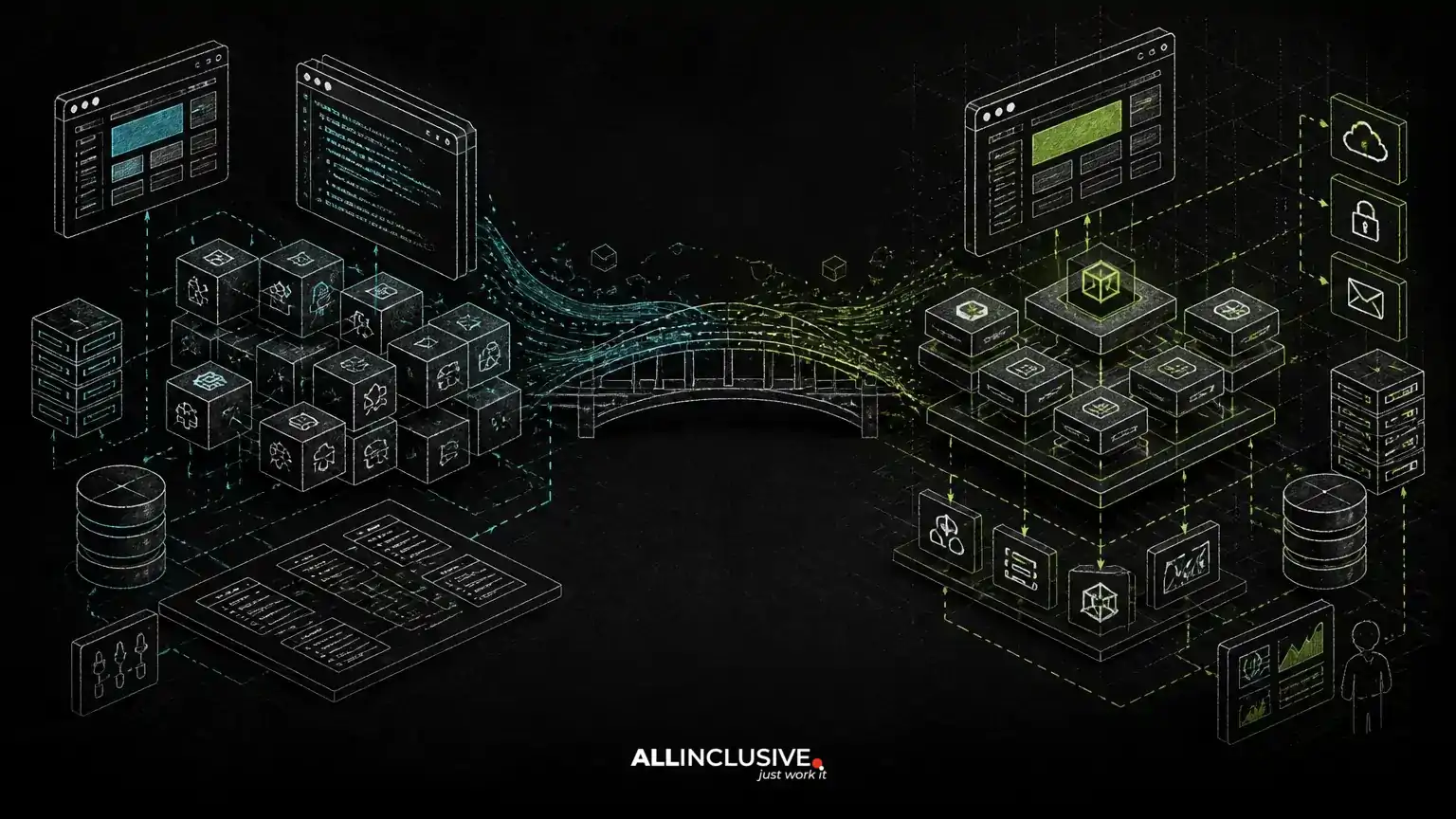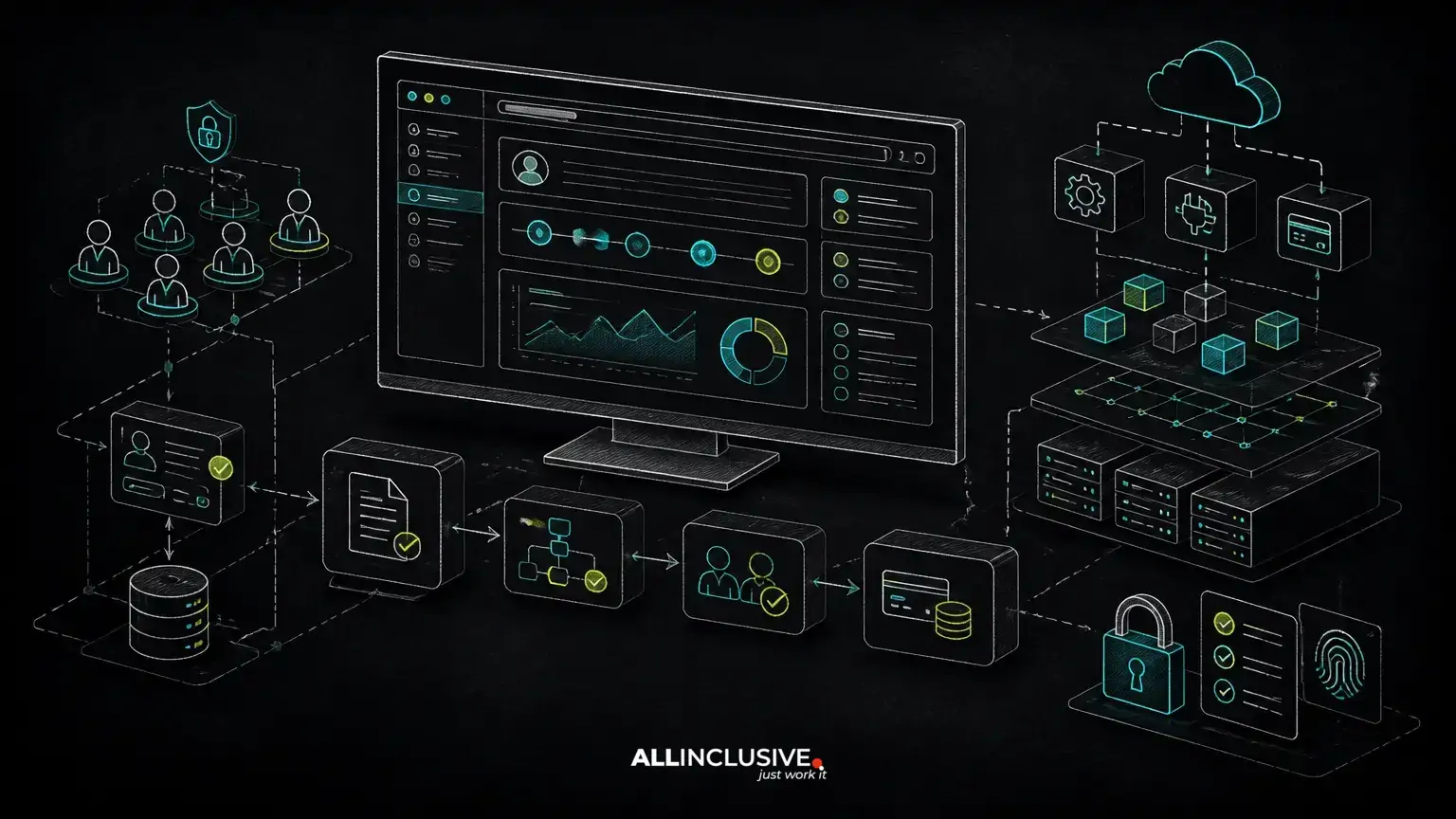
If a Laravel application already handles authentication, business workflows and customer-facing web experiences well, replacing the entire stack with Python is rarely the only path to modernization. A laravel python hybrid architecture can preserve the stable parts of a PHP system while introducing Python where it provides a stronger fit for data processing, automation, machine learning or specialized backend services.
The right design is not “Laravel for the old system and Python for everything new.” It is a deliberate division of responsibilities, with explicit service boundaries, reliable data exchange, observable background work and clear ownership. Rewriting the whole stack may be justified in some cases, but a hybrid approach can reduce migration risk and deliver new capabilities sooner when the existing Laravel application remains valuable. The laravel python hybrid architecture workflow also connects to the guidance in python performance optimization.
When a Laravel application is a good candidate for hybrid architecture
Hybrid architecture is most useful when the current Laravel system is operationally important but a new capability does not fit naturally inside the existing application. Common examples include:
- AI inference or retrieval workflows that require Python libraries and model-serving patterns.
- Data transformations, document processing or ETL jobs that are easier to maintain with Python tooling.
- Optimization, forecasting or scientific computations that need a Python-based ecosystem.
- Long-running automation that should not compete with Laravel’s web request lifecycle.
- A new internal or partner API that can be developed independently without changing the core application.
The case is weaker when the proposed Python service would simply duplicate Laravel logic, introduce a second database for convenience or add network calls to a workflow that needs strong transactional consistency. A second runtime creates operational work. It should solve a meaningful architectural problem rather than reflect technology preference.
Assign responsibilities by business boundary, not programming language
A stable hybrid system starts with ownership. Laravel and Python should each own coherent capabilities instead of splitting one business process across arbitrary technical layers.
Laravel as the system of engagement
Laravel often remains responsible for the browser-facing application, user sessions, permissions, administrative workflows, billing integrations and transactional business rules. It may also act as the primary system of record for entities such as accounts, orders, subscriptions or workflow states.
Keeping these responsibilities in Laravel avoids forcing users and operational teams to cross service boundaries for routine actions. It also prevents a Python service from becoming a second implementation of authorization, tenant rules or core domain logic.
Python as a specialized production backend
Python can own capabilities that benefit from its backend, data and AI ecosystem. A FastAPI service may expose a focused HTTP API for inference or document analysis. Django may be appropriate when the Python component needs a substantial domain model, administrative workflows or a broader application surface. A worker-oriented Python service may be better when the primary requirement is asynchronous processing rather than interactive requests.
Python should be treated as production software: versioned, tested, monitored, secured and deployed through the same engineering discipline applied to the Laravel application. It is not merely a scripting escape hatch.
Choose the integration pattern according to consistency requirements
The most important boundary question is how the two systems exchange work and state. There is no universally correct integration pattern.
Synchronous APIs for immediate decisions
Use an HTTP API when Laravel needs a bounded response during a user workflow. For example, Laravel might send a document identifier and selected processing options to a Python service, then receive a classification or validation result.
The contract should define authentication, request validation, response schemas, error categories, timeouts and compatibility rules. A synchronous call should not hide an unbounded model operation or a multi-minute data job behind a browser request.
FastAPI can be a practical choice for a focused Python API because it supports explicit request and response models. The architectural benefit comes from the contract and operational controls, not from the framework name alone.
Queues and events for long-running work
Use a queue when processing may take substantial time, can be retried or does not need to block the user. Laravel can create a job record and publish a message containing a stable identifier. A Python worker consumes the message, performs the work and records a result or emits a completion event.
Design asynchronous work for at-least-once delivery. Workers should be idempotent where possible, messages should have correlation identifiers, and retry policies should distinguish transient failures from invalid input. A dead-letter or failed-job workflow is essential; otherwise, repeated failures can remain invisible until users report missing results.
Shared databases require restraint
Sharing one database can simplify an early integration, but direct cross-service writes create hidden coupling. If both applications can modify the same tables, ownership becomes unclear and schema changes become riskier.
A safer model is to assign each important entity a system of record. Other services consume an API, event or deliberately published read model. If a shared database is unavoidable, document table ownership, permitted operations, migration coordination and consistency expectations.
Use a workflow that separates user state from processing state
AI and data features often fail when a technical job is treated as a single request. A more resilient design represents the workflow explicitly.
- Laravel validates the user’s permissions and input.
- Laravel creates a processing record with a pending status.
- A message is published with the record identifier and required version information.
- The Python service retrieves authorized inputs, performs the work and stores output in an appropriate location.
- The result is validated and associated with the processing record.
- Laravel exposes status, errors and completed output to the user or downstream workflow.
This approach gives product teams a visible state model: pending, running, completed, failed or cancelled. It also supports retries and operational review without pretending that an asynchronous process is instantaneous.
Design the data boundary before building the Python service
Data movement is often the most expensive part of a hybrid architecture. Before implementation, specify which service owns each data type, where files are stored, how sensitive values are handled and how long derived artifacts are retained.
Prefer passing identifiers and controlled references instead of copying large payloads through multiple APIs. For documents, object storage can hold the source and generated artifacts while services exchange metadata and signed, time-limited access references. For structured data, define schemas and version them as requirements change.
AI workflows need additional distinctions. Store model and prompt configuration where it can be audited, separate raw inputs from generated output, and record evaluation or review status when results influence business decisions. A prototype that returns plausible text is not automatically a production feature.
Teams planning a broader AI component can use the principles described in Python AI backend architecture to structure APIs, queues, model operations and evaluation concerns.
Make failure behavior part of the contract
A hybrid system adds network and process failure modes that do not exist inside a single application. The design should answer practical questions before production release:
- What happens when the Python service is unavailable?
- How long does Laravel wait for a synchronous response?
- Can the same job be safely delivered twice?
- Which errors are retryable, and who reviews permanent failures?
- How does a user distinguish pending work from failed work?
- What happens when a deployment changes a request or event schema?
Use timeouts, bounded retries and circuit-breaking or equivalent protection where appropriate. Avoid retrying invalid input or authorization failures. Preserve correlation IDs across Laravel requests, queue messages and Python logs so engineers can trace one user action through both systems.
Testing should cover the boundary, not only each codebase
Unit tests remain valuable inside both applications, but they cannot verify whether the systems agree. Add contract tests for API schemas and event payloads, integration tests for authentication and data access, and workflow tests that exercise success, timeout, duplicate delivery and permanent failure paths.
Test compatibility during deployment. A producer should not immediately send a payload that an older consumer cannot parse unless rollout order and version support make that safe. Backward-compatible fields, explicit schema versions and staged releases reduce coordination risk.
For Python services that generate classifications, summaries or recommendations, test more than HTTP status codes. Define expected behavior for representative inputs, unsafe or incomplete data, confidence handling and human-review paths. Monitor quality separately from infrastructure health.
Operate Laravel and Python as one product system
Separate deployments do not mean separate operational standards. Both runtimes need documented ownership, environment configuration, secrets management, dependency updates, alerting and rollback procedures.
At minimum, monitor:
- API latency, error rates and timeout rates.
- Queue depth, job age, retry counts and dead-letter volume.
- Processing success rates by workflow and input type.
- Database, object-storage and external-provider failures.
- Resource consumption and capacity constraints in Python workers.
- Business-level outcomes, such as completed workflows rather than only HTTP responses.
Deployment strategy should reflect coupling. Independently deployable services are useful only when contracts are stable and rollback behavior is understood. If every release requires simultaneous changes in Laravel, Python and the database, the architecture may have separated code without reducing coordination.
When a full rewrite is more defensible
A rewrite may be worth evaluating when the current Laravel application prevents essential product changes, has deeply inconsistent domain rules, cannot meet required operational constraints or is so difficult to test that every modification carries disproportionate risk. Even then, “rewrite” should be treated as a sequence of bounded migrations rather than a single replacement event.
Stabilizing the existing application, extracting one capability, or introducing a façade can provide evidence before a larger commitment. A hybrid architecture is not automatically safer: poor boundaries can create distributed complexity, duplicated logic and unclear ownership. The decision should compare the cost of continued change in Laravel with the cost of operating and eventually replacing additional services.
A decision checklist for Laravel and Python coexistence
Before approving a hybrid component, confirm that the team can answer these questions:
- What business capability will Python own?
- Why is a separate runtime preferable to implementing the capability in Laravel?
- Which system owns the source data and the resulting state?
- Is the interaction synchronous, asynchronous or both?
- What are the timeout, retry, idempotency and cancellation rules?
- How will API and event schemas evolve?
- Who supports the service after launch?
- How will quality, security, cost and business outcomes be measured?
When the answers are concrete, Laravel and Python can complement one another without forcing a disruptive rewrite. Laravel can continue to provide a dependable product and workflow layer, while Python supplies focused production capabilities for automation, data and AI. For broader decisions about building or modernizing a custom application, see custom software development guidance and the related web development services overview.