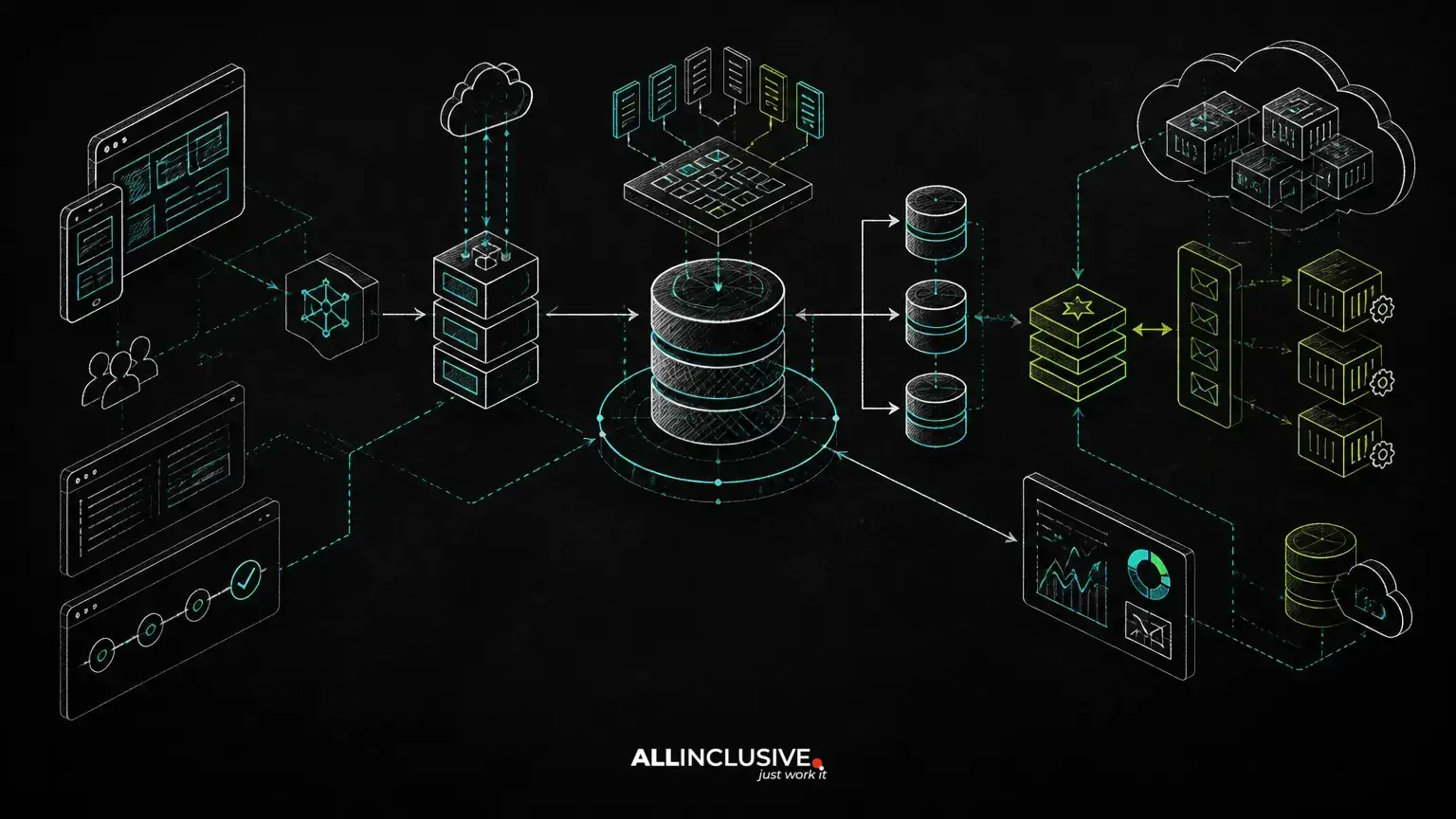
Production AI features need more than a model call behind an HTTP endpoint. A reliable Python AI backend architecture separates user-facing APIs from long-running work, isolates model providers, validates inputs and outputs, records operational evidence, and evaluates behavior before releases reach users.
FastAPI is often a strong fit for focused, typed APIs and AI services, while Django can be appropriate when the product needs an established application framework, administration workflows, authentication or a larger relational domain. Either can support production systems when the surrounding boundaries are designed deliberately. Python can also coexist with an existing Laravel or PHP application rather than forcing a full rewrite.
This article explains the main architectural decisions for AI-backed products: API contracts, queues, model adapters, data workflows, evaluation, observability and deployment.
Start with the user workflow, not the model
An AI feature should first be defined as a product workflow. A support assistant may retrieve account information, draft a response and request human approval. A document-processing feature may accept a file, extract structured fields, flag uncertainty and expose a review queue. These workflows have different latency, privacy and reliability requirements even if both use a language model.
Map each step before selecting components:
- Request: What does the user submit, and what validation is required?
- Decision: Is the response synchronous, or can the system process it asynchronously?
- Data: Which records, documents or external systems are needed?
- Review: Where does a person approve, correct or reject the result?
- Outcome: What durable state changes after successful processing?
This prevents a common failure mode: treating an uncertain, multi-step workflow as a single chat completion. The model becomes difficult to test, retry and govern because business logic, data access and presentation are intertwined.
Separate the API layer from AI execution
The API should translate product requests into explicit application commands. It should authenticate the caller, validate the payload, enforce authorization, create a job or request record, and return a predictable response. It should not contain every prompt, database query and provider-specific option.
For short operations with a well-defined latency budget, a synchronous endpoint can be appropriate. For document ingestion, batch classification, retrieval-heavy responses or external actions, an asynchronous job is usually safer. The API can return a job identifier and expose status through polling, webhooks or a product-specific activity view.
A useful service boundary
- Transport layer: HTTP routes, authentication, request validation and response schemas.
- Application layer: Workflow orchestration, permissions and business rules.
- AI integration layer: Model adapters, prompt construction, tool calls and structured-output handling.
- Data layer: Relational records, object storage, search indexes and audit events.
- Worker layer: Queue consumers for jobs that may be slow, retried or rate-limited.
This structure gives product teams a stable application contract even when a model provider, prompt strategy or retrieval implementation changes. It also makes ownership clearer: API failures, job failures and model-quality failures can be diagnosed separately.
Use queues for work that should not block a request
Background jobs are not simply a scaling technique. They are a reliability boundary. A queue allows the system to acknowledge work, retry transient failures, limit concurrency and record job state independently of a browser or API connection.
A typical AI job lifecycle includes queued, running, succeeded, failed and, where appropriate, cancelled or needs review. Store enough metadata to explain what happened without exposing sensitive prompt content unnecessarily: workflow version, input reference, model adapter, attempt count, timestamps and error category.
Retries need careful design. Network timeouts and temporary provider errors may be retryable; invalid input, permission failures and deterministic schema violations usually are not. Every job that can change external state should be idempotent, using an operation key or durable state check to avoid duplicate emails, payments, tickets or database updates.
Queue architecture also requires operational controls. Set timeouts, define a dead-letter or failed-job path, limit worker concurrency, and make stuck jobs visible. A queue that hides failures is only postponing the incident.
Keep model providers behind explicit adapters
Model calls should be treated as infrastructure dependencies, not scattered utility functions. An adapter can expose a narrow internal interface such as classify, extract, summarize or generate response. The adapter owns provider request formatting, authentication, timeout handling, response normalization and provider-specific error mapping.
Application code should receive a typed result rather than a raw provider response. For extraction, that may be a validated object with confidence indicators and source references. For generation, it may include the response, citations or retrieved record identifiers, safety metadata and usage information where available.
Do not assume that structured output eliminates validation. Validate model responses against application schemas, constrain allowed values, reject missing required fields and define what happens when parsing fails. A failed validation should become a visible workflow state, not an unexamined fallback string.
Design for model change without promising interchangeability
Different models can vary in instruction following, context handling, latency, cost, tool behavior and output consistency. An adapter reduces coupling, but it does not make models drop-in equivalents. Maintain workflow-specific evaluation cases and record the model configuration used for each result.
Version prompts, parsing rules, retrieval settings and model selections together. A change to any of these can alter product behavior. Treat the combination as a deployable configuration with review and rollback options.
Build data and retrieval workflows as first-class components
AI quality often depends more on data preparation and retrieval boundaries than on the final generation call. Ingestion should identify source documents, normalize content, preserve metadata and make updates repeatable. If content is chunked or indexed, retain links back to the original source and relevant permissions.
For transactional systems, do not give a model unrestricted access to database tables. Expose narrowly scoped application functions that enforce authorization and return only the fields required for the workflow. For retrieval-augmented generation, filter candidate records by tenant, user permissions and document status before they reach the model.
Python ETL services can support ingestion and transformation, but they need production controls: checkpointing, deduplication, restartability, schema validation and observable failure states. The same principles apply whether the pipeline runs on a schedule, responds to an upload or consumes events. When planning python ai backend architecture, the implementation context in Python ETL architecture for recoverable pipelines is also relevant.
Make evaluation part of the release process
Traditional unit tests can verify that a function returns the expected result for a known input. They cannot fully determine whether a generated answer is useful, grounded or appropriately cautious. AI features need layered evaluation.
- Contract tests: Confirm schemas, permissions, error handling and provider-adapter behavior.
- Deterministic workflow tests: Verify routing, retries, idempotency and state transitions.
- Curated evaluation sets: Use representative inputs with expected properties, such as required fields, source attribution or refusal conditions.
- Regression checks: Compare a proposed configuration with a baseline before release.
- Human review: Inspect ambiguous or high-impact cases that automated checks cannot judge reliably.
Define failure criteria before implementation. An evaluation may check factual grounding, extraction accuracy, correct tool selection, refusal behavior, formatting or escalation to a person. Avoid reducing quality to a single score when different failure types have different business consequences.
Prototype behavior can be exploratory: prompts may be edited manually and results reviewed informally. Production behavior needs versioned inputs, repeatable test runs, traceable configurations and a clear response when evaluation results regress.
Add observability without collecting unnecessary sensitive data
AI operations require visibility across the complete workflow. Capture request identifiers, job identifiers, workflow versions, latency, retry counts, queue wait time, provider error categories and final state. Trace the relationship between an API request, background job, retrieval operation and model call.
Logging full prompts and responses may create privacy, security and retention risks. Prefer redacted metadata, content hashes, sampled traces or separately controlled payload storage. Define access and retention policies before production traffic accumulates.
Monitor both system health and product behavior. A service can have normal CPU and memory while returning poorly grounded answers because an index is stale or a prompt version changed. Product-level signals may include escalation rates, correction frequency, invalid structured outputs and review outcomes.
Choose deployment boundaries that match ownership
A small AI feature may start as one Python application with a worker and a database. That can be a sensible deployment unit if the code has clear internal boundaries. Splitting every capability into separate services too early adds networking, deployment and observability overhead.
Separate services when there is a concrete reason: independent scaling, incompatible runtime needs, stronger isolation, distinct ownership or a workload that must be operated separately. A Python service can sit beside a Laravel or PHP product, exposing an internal API or consuming events. This approach can add AI and data capabilities while preserving stable customer-facing workflows.
Deployment design should include secrets management, environment separation, migrations, health checks, worker lifecycle handling, rollback procedures and capacity limits. Model-provider outages should produce controlled product behavior, such as a retryable status or human-review route, rather than an unhandled application error.
Teams evaluating a broader custom system can review the Allinclusive development approach alongside the specific AI capabilities described in AI development services.
Architecture review checklist for a Python AI backend
- Is the user workflow documented independently of the model prompt?
- Are synchronous and asynchronous operations deliberately separated?
- Does every long-running job have durable state, timeouts and retry rules?
- Are model providers accessed through versioned adapters?
- Are model outputs validated before they affect business state?
- Are retrieval and tool calls constrained by authorization?
- Can ingestion restart without duplicating or corrupting data?
- Do evaluation cases represent real inputs and important failure modes?
- Can operators trace a result without exposing unnecessary sensitive content?
- Can the system degrade safely when a provider, queue or index is unavailable?
Python is effective for AI backends because it brings mature web frameworks, background processing, data tooling and model-integration options into one engineering environment. The production advantage does not come from Python alone. It comes from boundaries that make uncertain model behavior observable, testable and replaceable while keeping business workflows under application control.
For API-specific decisions around validation, errors, authentication and versioning, see these Python REST API best practices. If performance becomes a concern, measure the API, queue, database, retrieval and provider layers separately before optimizing; the guidance in Python performance optimization can help structure that investigation.