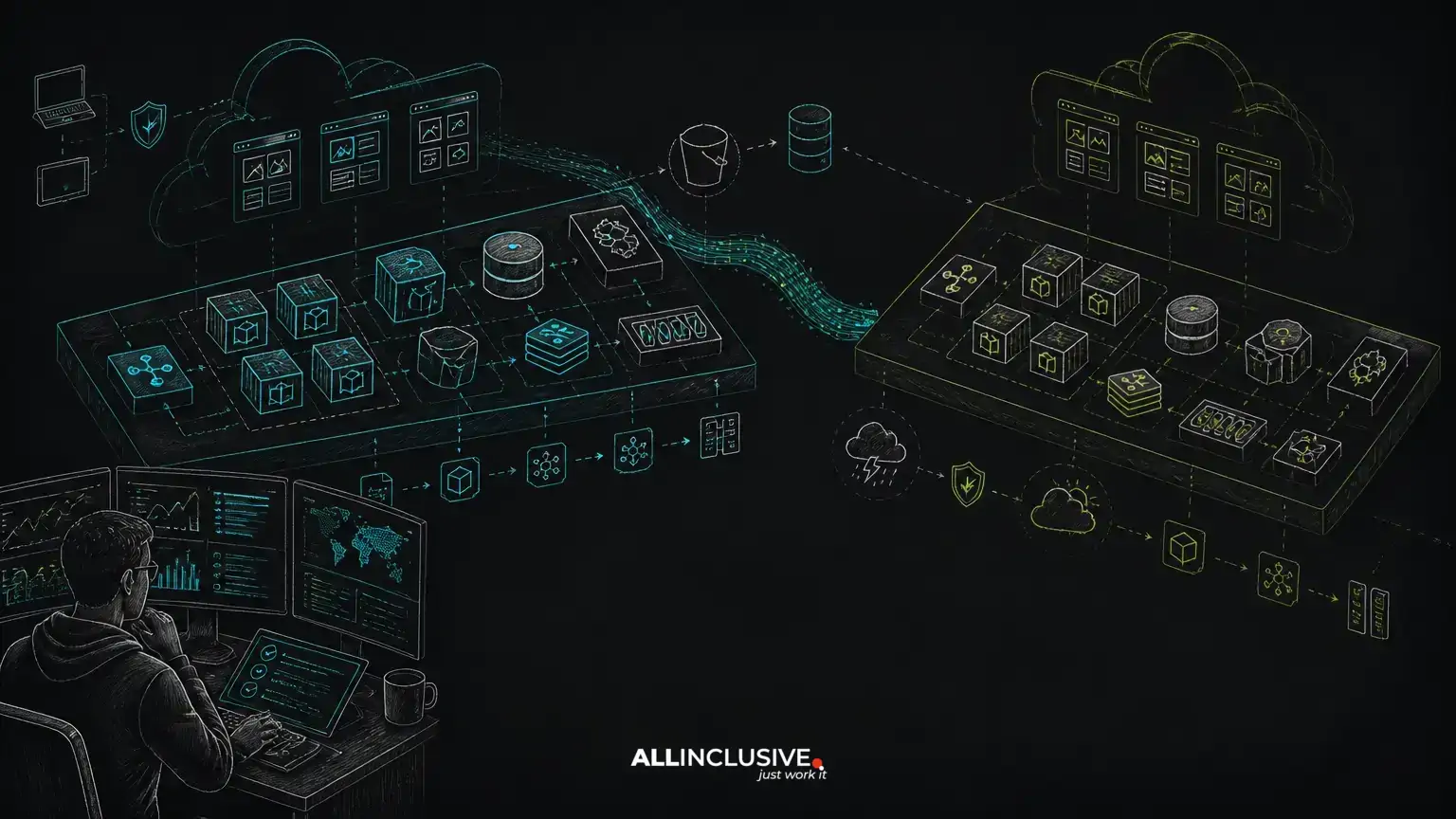
A sound AWS architecture for Laravel is less about selecting the largest available service and more about giving each workload a clear operational boundary. A typical production application may need web request handling, scheduled jobs, queue workers, relational data, caching, file storage, deployments, monitoring and recovery. Those concerns should be separated where doing so improves reliability and ownership, but not split into microservices simply because the application runs in the cloud. For teams evaluating aws architecture for laravel, this implementation detail is expanded in web development services.
For many custom Laravel applications, a modular monolith with managed AWS infrastructure is a strong starting point. The application can remain one deployable codebase while web traffic, queue processing, scheduled commands, data storage and observability are designed as distinct operational concerns. That approach can scale incrementally and keeps transaction boundaries, debugging and team ownership simpler.
Start with the Laravel workload, not the AWS product list
Before choosing services, map the application’s workloads and their failure characteristics:
- Web requests: authenticated pages, APIs, admin workflows and public content.
- Asynchronous work: email, imports, exports, document processing, notifications and integrations.
- Scheduled work: recurring commands, cleanup, reconciliation and reporting.
- State: relational records, sessions, cache entries, uploaded files and generated artifacts.
- Operational signals: logs, metrics, traces, alerts, deployment status and audit events.
This inventory affects architecture more than the Laravel version or the number of expected servers. A request-heavy application, a data-import platform and an AI-assisted workflow may all use Laravel, but they place different demands on compute, queues, database connections and storage.
Teams building or modernizing custom software can use custom web development services to align the application’s domain model and delivery plan with its operating environment rather than treating infrastructure as a late-stage deployment task.
A practical baseline architecture for Laravel on AWS
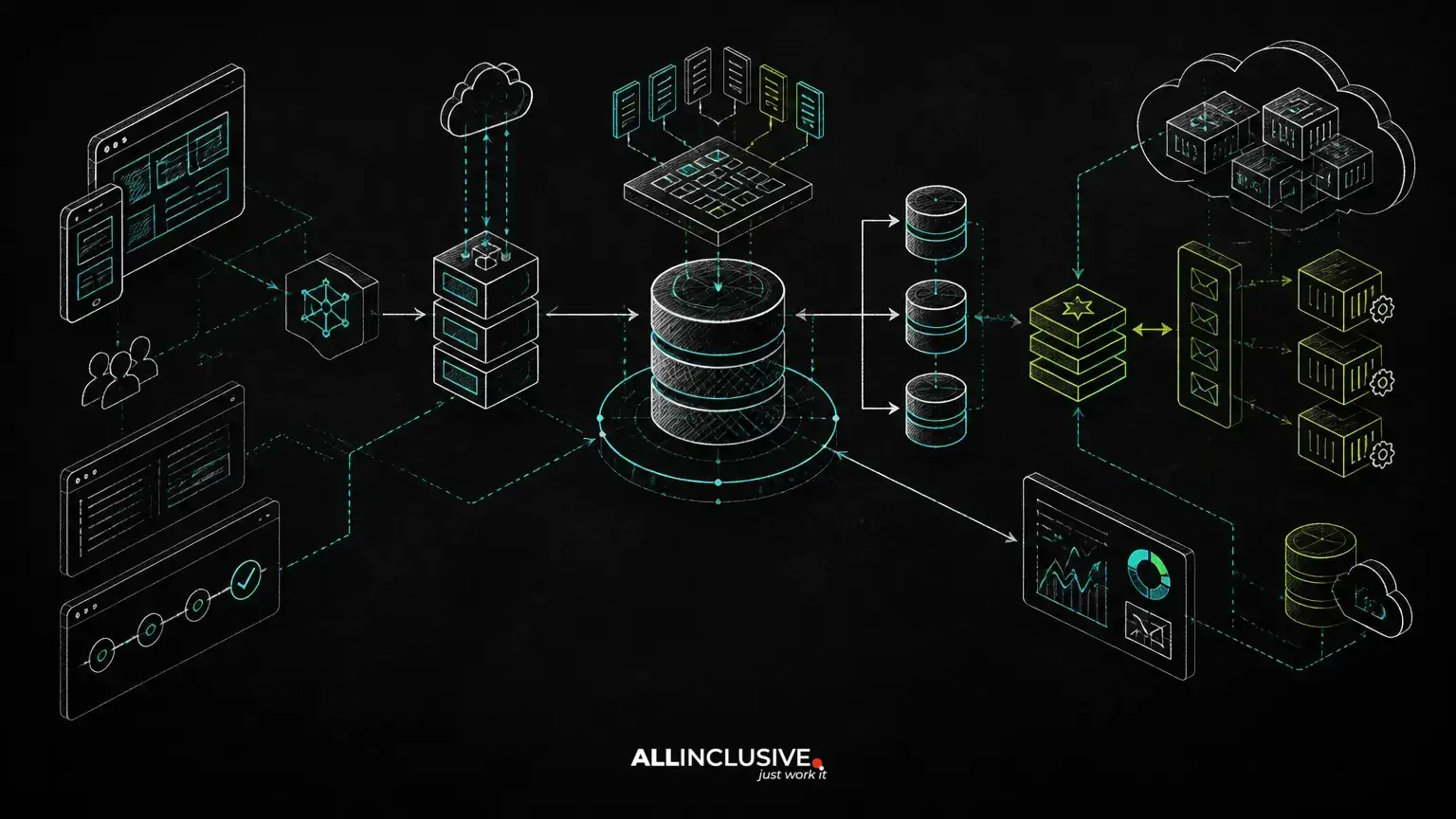
A common baseline uses a load balancer in front of stateless Laravel application containers, a managed relational database, managed Redis-compatible infrastructure for transient state, object storage for files, and a queue service or Redis-backed queue for asynchronous processing. A container registry and deployment pipeline complete the delivery path.
The exact AWS services may vary. Containers can run on a managed container platform or on virtual machines, while a relational database can be operated through a managed database service. The important design properties are more stable than the product names:
- Web instances or tasks can be replaced without losing user state.
- Database credentials and application secrets are not embedded in images or source code.
- Queue workers can scale independently from web traffic.
- User uploads and generated files do not depend on local container storage.
- Deployments, health checks and rollback procedures are repeatable.
Compute: keep Laravel web traffic stateless
Laravel web traffic is usually a good fit for horizontally scalable application containers. The load balancer distributes requests across healthy tasks or instances, while the application image contains the code and its runtime dependencies.
Statelessness requires deliberate configuration. Sessions should be stored in a shared store when requests can reach different application tasks. Cache data should not rely on a local filesystem. Uploaded files should go to object storage, and temporary local files should be treated as disposable. If the application writes important state to a container’s local disk, a replacement task can turn an infrastructure event into data loss or a broken user workflow.
Container images should be built once and promoted through environments rather than rebuilt differently for staging and production. A typical image includes the PHP runtime, required extensions, Composer dependencies and application code. Environment-specific configuration should be injected at runtime through a controlled secrets and configuration mechanism.
Autoscaling should respond to useful signals, such as request load, latency or task utilization, rather than serving as a substitute for capacity planning. Long-running work should not occupy web processes when it can be moved to a queue.
Database design: protect the relational core
Laravel applications commonly depend on a relational database for transactional integrity. A managed database reduces the amount of routine infrastructure administration, but it does not remove application-level database responsibilities.
Design around the following concerns:
- Connection limits: each application task and worker process can consume connections. Scaling compute without planning connection capacity can overload the database.
- Indexes and query shape: application growth often exposes unindexed filters, inefficient relationship loading and reports that compete with transactional traffic.
- Migration safety: schema changes should be compatible with the deployment sequence, especially when old and new application versions may briefly coexist.
- Backups and restore testing: a backup policy is incomplete until the team knows how to restore data and validate the result.
- Read scaling: replicas may help specific read-heavy workloads, but they introduce consistency and routing considerations. They are not a universal fix for slow queries.
Database changes should be reviewed as production-risk changes, not merely as code changes. A migration that locks a large table or changes an indexed column can affect user workflows even if the application deployment itself is technically successful.
Redis, cache and session state: separate speed from truth
Redis is useful in Laravel architectures for cache entries, sessions, rate-limiting data and queue backends. Its role should be explicit. Cache data is disposable acceleration; relational data is usually the system of record. Treating cached values as authoritative creates recovery and consistency problems.
Cache design should specify:
- Which keys can expire and for how long.
- How stale values are invalidated after writes.
- What happens when Redis is unavailable.
- Whether sessions can tolerate eviction or require a more durable configuration.
- How memory pressure and connection saturation will be detected.
Do not put large, unbounded payloads into cache simply because the store is fast. For files, reports and other sizable artifacts, object storage is usually a more appropriate boundary. For critical workflows, design a fallback or failure message rather than allowing a cache outage to produce silent data corruption.
Queues and workers: move variable work out of requests
Laravel queues are central to a responsive application when work is slow, bursty or failure-prone. Email delivery, third-party API calls, imports, exports, media processing and notifications often belong in background jobs rather than synchronous HTTP requests.
Separate worker capacity from web capacity. A sudden import should increase worker demand without forcing the application to add unnecessary web servers. Worker processes also need their own deployment, timeout and memory policies.
Reliable queue design includes:
- Jobs that are safe to retry or explicitly protected against duplicate effects.
- Timeouts that reflect the actual external operation.
- Backoff behavior for temporary failures.
- A failed-job workflow with investigation and replay controls.
- Visibility into queue depth, job age, processing duration and failure rate.
- Graceful worker shutdown during deployments.
Retries are not a substitute for idempotency. If a job charges a payment method, creates a customer record or sends an external command, the application needs a strategy for preventing or reconciling duplicate effects.
Object storage: make files independent of application servers
Uploaded documents, images, exports and generated reports should generally live in object storage rather than on the local disk of a Laravel task. This allows application capacity to change without moving files between servers and supports independent lifecycle, access-control and retention policies.
The application should store metadata in the database and treat the object key as a reference, not as the file’s entire business meaning. Access can be handled through application authorization and time-limited URLs where appropriate. File validation, malware scanning, size limits and content-type handling remain application responsibilities.
Storage lifecycle rules can reduce operational clutter, but they should reflect business retention requirements. Automatically deleting temporary exports is useful only when the product does not promise that users can retrieve them indefinitely.
Docker and CI/CD: make infrastructure changes repeatable
Docker provides a consistent packaging boundary for Laravel, PHP extensions, web servers and worker processes. It does not automatically make an application production-ready. Images still need dependency controls, vulnerability review, non-root execution where practical, health checks and a clear process model.
A useful CI/CD pipeline should validate more than whether the code compiles. It can include automated tests, static analysis, dependency checks, container image creation, migration review and deployment verification. The release process should distinguish application rollout from potentially risky data changes.
For deployments that must avoid interruption, use a strategy that keeps a healthy version serving traffic while the new version is prepared and checked. Pay attention to queue workers, scheduled commands, long-running requests and database compatibility; replacing web containers alone does not make the whole release zero-downtime.
See Docker for Laravel and Python for a related multi-service development perspective, and CI/CD for web applications for the release path from pull request to production.
Observability: monitor user impact and system causes
Logs, metrics and traces answer different questions. Logs describe events, metrics reveal trends and thresholds, and traces help connect a user request across application code, database calls and external services.
At minimum, monitor:
- Request latency, error rates and response status by route or operation.
- Database latency, connection use, slow queries and storage capacity.
- Redis memory, connections, evictions and command latency.
- Queue depth, oldest job age, retries and failed jobs.
- Container restarts, resource saturation and deployment health.
- Backup completion and restore-test results.
Alerts should correspond to an owner and an action. An alert that cannot lead to investigation, mitigation or escalation becomes background noise. Correlation IDs and structured logs are particularly valuable when a customer workflow crosses the web tier, queue workers, database and third-party APIs.
Load testing, failure planning and recovery
Load testing should represent real workflows, not just repeated requests to a lightweight health endpoint. Test authenticated paths, database-heavy pages, file uploads, queue-producing actions and the concurrency patterns the product expects.
Use the results to identify bottlenecks and capacity limits, but do not treat one test as a permanent guarantee. Application code, database contents, dependencies and traffic mix change over time.
Recovery planning should cover more than restoring a database snapshot. Document how the team will rebuild application compute, retrieve secrets, restore data, reprocess queued work, recover files and communicate service status. Define recovery objectives in business terms: which data may be lost, how long a workflow can be unavailable, and which functions must return first.
Teams responsible for ongoing reliability may also benefit from a defined support and maintenance plan covering monitoring, dependency updates, incident response and recovery exercises.
When this architecture should evolve
A modular Laravel application does not need to become a distributed system on a calendar schedule. Consider separating a component when it has a distinct scaling profile, deployment cadence, security boundary, failure mode or ownership model. A CPU-intensive document processor may deserve independent workers; a stable public API may need a separate scaling policy; a highly isolated domain may justify a service boundary.
Extracting services introduces operational costs: network failure, distributed tracing, deployment coordination, data ownership questions and more complicated local development. Make the boundary earn its complexity.
For a broader view of capacity planning, compare this design with scalable web architecture patterns. A phased infrastructure plan is usually easier to operate than a premature collection of services, especially for a product team still learning its workload.
A production-readiness checklist for Laravel on AWS
- Web tasks are stateless and can be replaced safely.
- Sessions, cache, queues, files and relational records have explicit storage roles.
- Database connections, indexes, migrations and restore procedures are reviewed.
- Workers have independent capacity, retries, timeouts and failed-job handling.
- Secrets are managed outside source code and container images.
- CI/CD includes tests, deployment health checks and rollback procedures.
- Logs, metrics and traces identify both technical causes and affected workflows.
- Load tests exercise realistic application behavior.
- Backups are monitored, and restores are tested.
- Architecture changes are driven by workload and ownership needs rather than service-count targets.