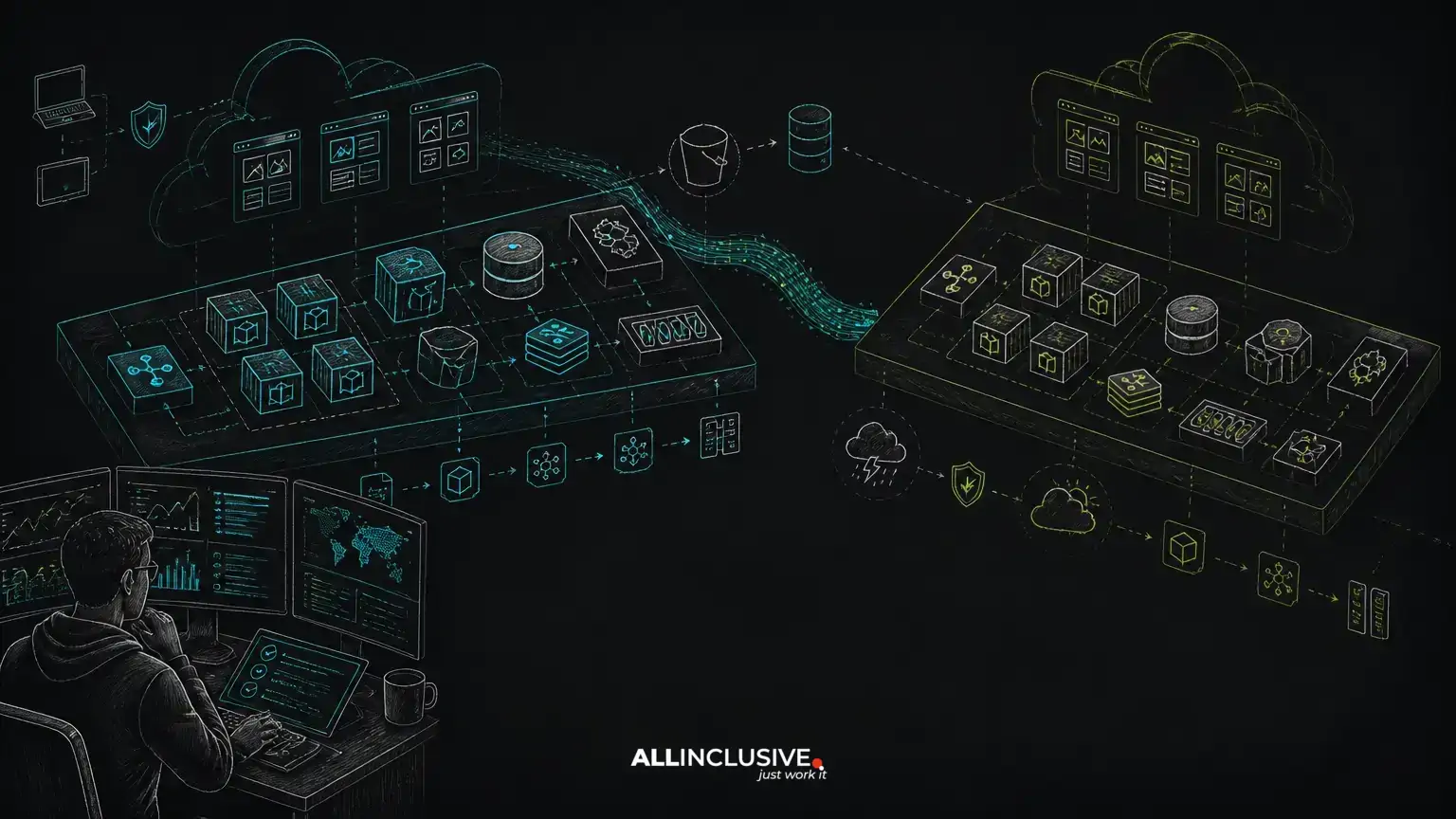
Docker gives Laravel and Python teams a consistent way to run application code, databases, queues and supporting services across developer machines, CI and cloud environments. A useful docker laravel python setup is not simply a collection of containers, however. It should make local development predictable while preserving a clear path to testing, deployment, observability and recovery.
The strongest design is usually a multi-service application with explicit ownership boundaries, not a microservice architecture created for its own sake. Laravel may handle the primary web application, while Python supports data processing, automation, machine learning or a specialized API. Both services can share infrastructure such as PostgreSQL, Redis and object storage while remaining independently testable and deployable where that separation provides value.
What the Docker setup should accomplish
A development environment should answer several practical questions:
- Can a new developer start the application with documented commands?
- Do Laravel and Python use versions close to those in CI and production?
- Can web requests, scheduled work and queue workers be tested separately?
- Are databases and caches treated as replaceable infrastructure rather than hidden local dependencies?
- Can failures be reproduced from logs and service health information?
- Does the architecture support a controlled move to AWS or another cloud platform?
Docker helps with consistency, but it does not automatically provide secure configuration, reliable data management or production resilience. Those concerns still require deliberate architecture.
A sensible multi-service layout for Laravel and Python
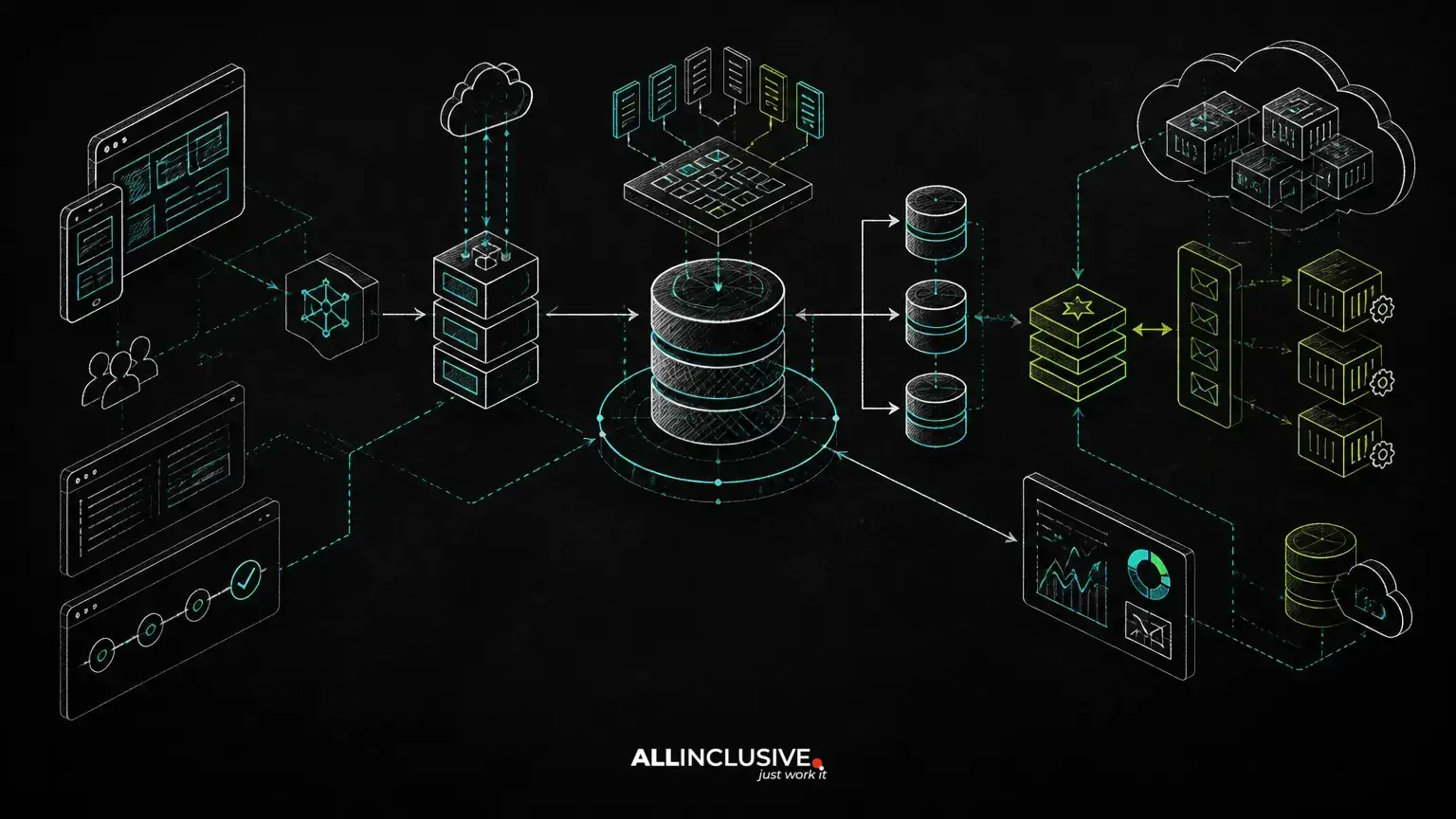
A common starting point is a repository with separate application directories and one orchestration definition for local development:
- Laravel application: HTTP requests, authentication, business workflows and administrative interfaces.
- Python service: background processing, data transformation, forecasting, document processing or a focused API.
- Database: PostgreSQL or another relational database selected for the application’s data model and operational requirements.
- Redis: transient caching, queue coordination, rate limiting or short-lived state where appropriate.
- Worker services: Laravel queue workers and Python consumers running independently from web processes.
- Reverse proxy or local gateway: optional routing layer for browser requests and service-to-service access.
These services can run on one developer workstation while using separate images and process definitions. In production, they may be deployed as containers on ECS, Kubernetes, managed container platforms or virtual machines, depending on team capability and operational needs.
The important distinction is between process separation and business-service separation. Running a Laravel web process, a queue worker and a scheduler in separate containers improves lifecycle control. It does not mean the application must be split into many independently owned microservices.
Design the Dockerfiles around runtime responsibility
Laravel and Python images should be built for the process they run. A web image, a queue-worker image and a scheduled-task image may share a base layer, but their commands and health expectations differ.
For Laravel, the image commonly needs PHP, Composer dependencies, required extensions and a web-serving process. Depending on the deployment model, the container may run PHP-FPM behind a web server or use another supported application-serving arrangement. Queue workers should use a command suited to the project’s queue configuration rather than sharing the web process.
For Python, the image should install dependencies from a locked or otherwise reproducible dependency definition, copy only the required application files and start the correct API, worker or job process. Separating development dependencies from production dependencies helps reduce image size and limits the runtime attack surface.
Multi-stage builds are useful when compilation tools are needed only during dependency installation or asset generation. They can keep production images smaller, but they add build complexity and should be introduced when the benefit is clear.
Keep configuration outside the image
Environment-specific values should not be baked into images. Database credentials, application keys, cloud credentials and external service endpoints belong in local environment configuration for development and in an appropriate secret-management system for deployed environments.
Configuration should also be validated at startup. A missing queue connection or invalid database URL is easier to diagnose when the service fails clearly during initialization than when it produces partial failures after receiving traffic.
Use Compose for local orchestration, not as a production assumption
A Compose-based setup can describe application services, networks, volumes, health checks and dependency relationships in a form that developers can understand. It is particularly useful for starting Laravel, Python, PostgreSQL and Redis together.
Dependency ordering should not be confused with readiness. A database container being started does not guarantee that it is accepting connections, and Redis being reachable does not guarantee that application initialization has completed. Health checks and application-level retry behavior are more reliable than assuming startup order is sufficient.
Persistent local data should be handled deliberately. A named database volume is convenient for development, while a disposable database is valuable for repeatable tests. Developers should have documented commands for both preserving data and resetting it. Without that distinction, local state can hide migration problems or make failures difficult to reproduce.
Connect Laravel and Python without creating hidden coupling
There are several valid integration patterns:
- Synchronous HTTP: Laravel calls a Python API when it needs an immediate response. Use timeouts, bounded retries and clear error handling.
- Asynchronous jobs: Laravel places work on a queue and Python consumes or processes it. This is often better for long-running or failure-prone operations.
- Shared database tables: convenient in limited cases, but risky when both services become responsible for the same schema and business rules.
- Object storage and events: useful for documents, generated files and workflows where the payload is too large or too slow for a synchronous request.
Define ownership before implementing the connection. If Laravel owns the customer workflow and Python owns a processing task, the interface should describe inputs, outputs, status and failure states. Avoid allowing either service to modify the other’s internal tables casually.
For AI or data-processing features, distinguish a prototype from a production workflow. Production requirements may include model or prompt versioning, input validation, cost controls, human review, timeout handling and the ability to replay or quarantine failed jobs.
Redis, queues and database behavior need operational boundaries
Redis can support several different responsibilities, but those responsibilities should be named and monitored separately. Cache entries are disposable; queue messages represent work; rate-limit state has different expiration and correctness requirements. Treating all Redis data as interchangeable makes incident diagnosis harder.
Queue workers need explicit policies for retries, visibility timeouts, idempotency and dead-letter handling. A job that charges a payment, sends an email or updates an external system should be safe to retry or should record enough state to prevent duplicate effects.
Database migrations should run as a controlled release step rather than being an incidental side effect of every container startup. For larger applications, backward-compatible schema changes are safer: add new fields before using them, deploy code that supports both versions when necessary, then remove obsolete structures in a later release.
For a deeper treatment of recovery behavior, see queue architecture for web applications. Redis decisions also deserve their own review because caching can improve response time while introducing stale-data and invalidation risks; see this Redis caching strategy guide.
Make the container setup consistent with CI and AWS deployment
CI should build the same meaningful artifacts that deployment uses. A practical pipeline can:
- Install or restore dependencies using reproducible definitions.
- Run Laravel and Python unit and integration tests.
- Build container images and scan them according to the organization’s security process.
- Start dependent services for integration testing where required.
- Publish versioned images rather than relying on mutable tags.
- Deploy to a controlled environment and run smoke checks.
On AWS, the target may be a managed container service, a Kubernetes platform or a simpler virtual-machine arrangement. The choice should reflect traffic patterns, team operating experience, compliance requirements and the number of services that genuinely need independent scaling.
Keep runtime concerns outside application containers where managed services provide a better operational boundary. A managed relational database, managed cache, object storage and centralized logging can reduce maintenance work. They do not eliminate responsibility for access control, backups, retention, failover testing or cost monitoring.
The related guide on CI/CD pipelines for web applications covers how release automation connects testing, artifact management and deployment controls.
Build observability into both services
Container logs should be structured enough to answer what happened, where it happened and which request or job was involved. Include correlation identifiers when a request crosses Laravel, a queue and Python. Avoid logging credentials, tokens or sensitive payloads merely because containers make collection easy.
Metrics should cover service health and business-relevant behavior, such as request latency, error counts, queue depth, job age, database connection saturation and cache failures. Traces can show where time is spent across Laravel, Python and external dependencies, particularly when a user request starts asynchronous work.
Health endpoints should distinguish basic process availability from meaningful dependency readiness. A service that returns a healthy response while it cannot reach its database may cause a deployment system to route traffic into a failure state.
For a fuller operating model, see web application observability: logs, metrics and traces.
Plan deployment, rollback and recovery before production
Zero-downtime deployment is not achieved by running containers alone. It depends on capacity, health checks, connection draining, compatible migrations, asset handling and a rollback strategy. A release should be reversible when the new application image fails, while database changes may require a forward-fix plan if they are not safely reversible.
Backups should cover the database and other important state, including object storage where appropriate. Define retention, encryption, access controls and restoration ownership. A backup that has never been restored is an assumption, not a recovery plan.
Disaster recovery also includes rebuilding images, recreating infrastructure, restoring secrets and re-establishing external integrations. Document recovery objectives in terms the business understands, then test the procedures at a level appropriate to the application’s risk.
For deployment-specific patterns, review zero-downtime deployment for Laravel and Python applications.
A practical readiness checklist
- Laravel and Python use documented, reproducible runtime versions.
- Web, worker and scheduled processes have separate commands and scaling policies.
- Local Compose services have health checks and clear reset instructions.
- Secrets remain outside images and repositories.
- Service interfaces define timeouts, retries and ownership.
- Queue jobs are idempotent or otherwise protected against duplicate effects.
- Database migrations are tested as part of the release process.
- CI builds and tests the artifacts intended for deployment.
- Logs, metrics and traces identify cross-service failures.
- Backups, rollback steps and restoration procedures are documented.
Docker is most valuable when it turns operational assumptions into explicit, testable configuration. For a custom application, that may mean Laravel remains the main product surface while Python provides a focused processing capability, with shared infrastructure managed intentionally rather than hidden inside developer machines. The result is a setup that can evolve toward cloud scale without forcing unnecessary architectural complexity. Teams planning that kind of system can review Allinclusive’s development capabilities and the available support and maintenance approach when ongoing ownership is part of the delivery plan.