
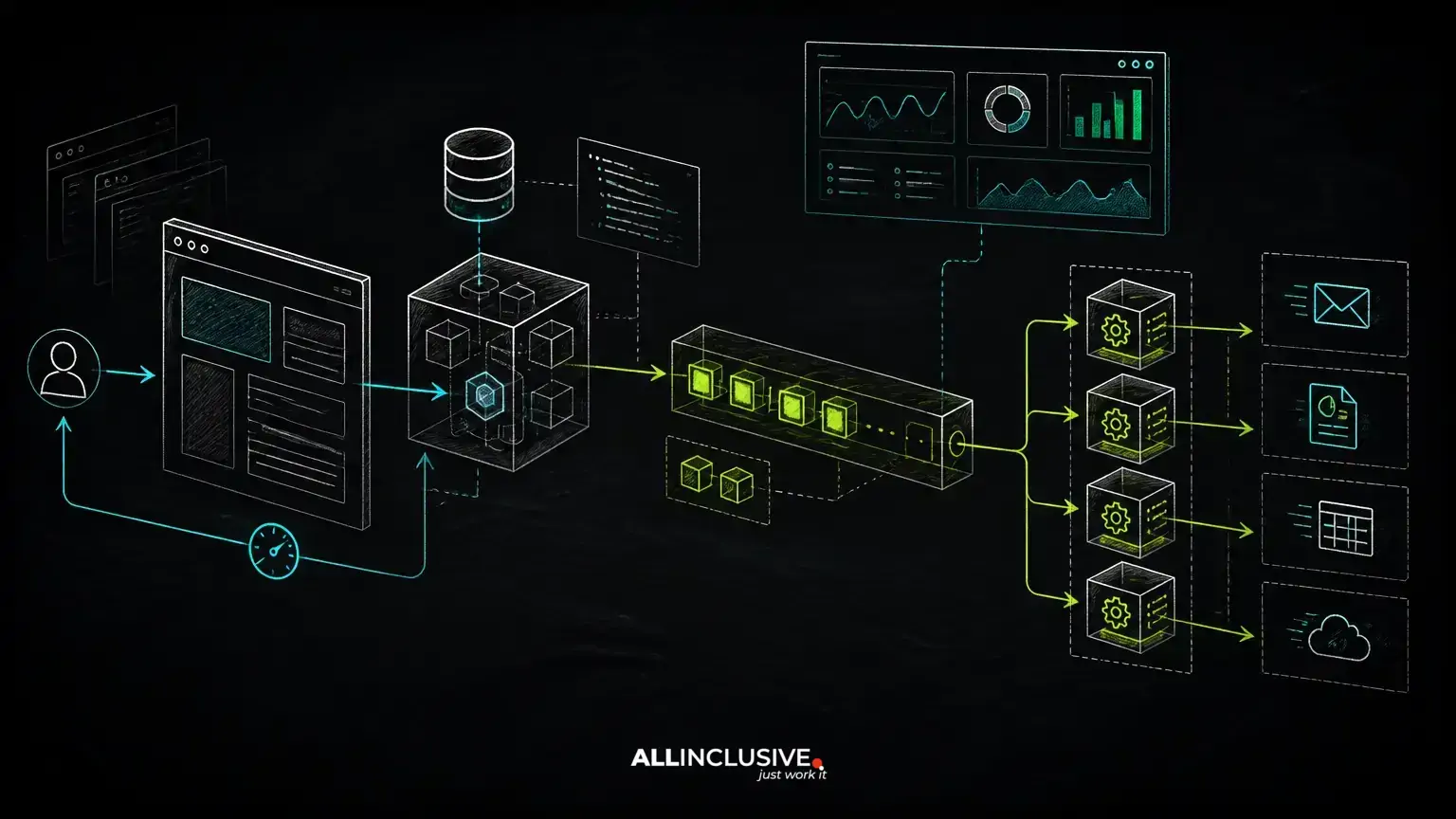
When a Laravel request sends an email, imports a large file, calls a third-party API, or generates a report synchronously, the user waits for every step to finish. That increases response time and makes the request vulnerable to timeouts, transient failures, and provider outages. When planning laravel horizon queues, the implementation context in custom software development is also relevant.
Laravel queues move this work into background jobs. Horizon provides an operational view and configuration layer for Redis-backed workers, helping a team observe throughput, failures, wait time, and worker behavior. Used together, they create a boundary between the user workflow and work that does not need to complete before the response is returned.
This is not simply a performance toggle. Queue design affects data consistency, retries, deployment, scaling, testing, and support. The right architecture starts by deciding which work belongs in the request and which work can be completed asynchronously.
What Laravel queues change in the request lifecycle
A synchronous request performs application work before returning a response:
- The user submits an action.
- Laravel validates input and runs business logic.
- The application performs slow or external work.
- The server returns a response only after that work completes.
With a queue, the request performs the minimum work needed to accept the action, creates a job, and dispatches it to a queue backend. A worker later retrieves the job and executes it.
For example, a report request might create a report record with a pending status, dispatch a report-generation job, and immediately return a page showing that processing has started. The worker creates the file, stores it, and updates the record to completed or failed.
The user experience improves because the request is no longer coupled to report generation. The application also gains a clear place to apply retries, logging, alerts, and operational controls.
Which Laravel work belongs in a queue?
Good queue candidates are tasks that are slow, unpredictable, externally dependent, or unnecessary for the immediate response. Common examples include:
- Sending transactional or bulk email after a state change.
- Processing uploads, images, documents, or data imports.
- Calling payment, CRM, messaging, or other third-party APIs when the user does not need an immediate result.
- Generating exports, invoices, reports, or other files.
- Rebuilding search indexes or synchronizing integration data.
- Running scheduled maintenance, notifications, or recurring business workflows.
Not every operation should be asynchronous. Authentication decisions, authorization checks, inventory rules, payment confirmation requirements, and other logic needed to determine the immediate response generally remain in the request. Moving them to a queue can create an incorrect or confusing user experience.
A useful question is: Does the user need this result before the application can safely respond? If the answer is no, a job may be appropriate. If the answer is yes, keep the critical decision synchronous and queue only the follow-up work.
Design jobs around business actions, not controller code
A queue job should represent a meaningful application action, such as GenerateMonthlyStatement, ImportCustomerRecords, or SyncSubscriptionStatus. This is easier to reason about than a generic job that contains a large block of unrelated controller logic.
Controllers should validate the request, authorize the action, persist the necessary state, and dispatch the job. The job should then load the current data it needs, perform its work, and record the outcome.
Passing a complete Eloquent model into a job can be convenient, but it also creates lifecycle questions. By the time the worker runs, the record may have changed or been deleted. In many workflows, passing a model identifier and reloading the record inside the job makes the job's behavior more explicit. The job can then decide whether a missing or changed record should be skipped, retried, or treated as a failure.
Jobs should also be designed to be idempotent. An idempotent job can run more than once without creating duplicate business effects. For example, a synchronization job can use an external reference and an upsert strategy rather than blindly inserting a new record each time.
Why retries require deliberate failure handling
Queues improve resilience, but retries can amplify mistakes if they are not designed carefully. A worker may retry because of a temporary network error, a provider rate limit, a database interruption, or an application exception. A retry is useful only when the underlying failure might resolve.
For each job, define:
- Which exceptions are likely to be temporary.
- How many attempts are reasonable.
- How long to wait between attempts.
- Whether the job should be released, marked failed, or ignored.
- What operational action should occur after the final failure.
Backoff intervals can prevent a failing integration from receiving immediate repeated requests. A maximum execution time can prevent one stuck job from occupying a worker indefinitely. A failure handler can record enough context for support staff to investigate without exposing sensitive data.
Retries do not replace idempotency. If a job charges a customer, sends a message, or updates an external system, the application needs a strategy for determining whether the operation already happened. Depending on the integration, that may involve an idempotency key, a durable operation record, or a reconciliation process.
Where Laravel Horizon fits
Horizon is intended for Laravel applications using Redis queues. It provides a dashboard and configuration approach for monitoring queue activity and managing worker processes. Teams can use it to inspect recent jobs, failed jobs, throughput, runtime, and wait behavior, subject to their deployment and version configuration.
Horizon is not a replacement for a process supervisor, deployment strategy, application logs, or infrastructure monitoring. Workers still need to be started, kept alive, restarted during deployments when appropriate, and sized for the workload. Redis also becomes an operational dependency that requires sensible access controls, persistence decisions, capacity planning, and monitoring.
A production setup should make queue health visible outside the dashboard as well. Useful signals include growing queue depth, increasing wait time, repeated failures, exhausted retries, worker restarts, and unusual job duration. These indicators connect background processing to business impact: delayed customer emails, late reports, stale integration data, or orders waiting for fulfillment workflows.
Separate workloads by priority and behavior
One queue is rarely sufficient for a mature application. A password reset email, a large data export, and a slow third-party synchronization have different urgency and resource profiles.
Separate queues can help protect important workflows from noisy or expensive jobs. For example, an application might use distinct queues for high-priority notifications, ordinary application work, and long-running imports. Worker processes can then be assigned to those queues according to business priority and available capacity.
This separation should reflect real workload behavior rather than create needless operational complexity. A small application may need only a simple default queue. As volume and workload diversity grow, queue boundaries can become a useful scaling and isolation mechanism.
Transactions, events, and the dispatch timing problem
Queue dispatching interacts with database transactions. If a job starts before a transaction commits, the worker may not see the expected record or may observe an incomplete state. This is especially important when a model event or application service dispatches a job immediately after writing related records.
Teams should choose an explicit approach: dispatch after the relevant transaction commits, or design the job to tolerate records that are not yet visible. The first option is often easier to reason about for jobs that depend on committed data.
Events can help keep domain logic organized, but they should not hide important side effects. A product team should be able to trace the path from a user action to a dispatched job, the job's state changes, and its failure handling. Clear naming, structured logs, and durable status fields are often more valuable than a deeply abstract event chain.
Testing queued Laravel workflows
Queue tests should cover both dispatch decisions and job behavior. A controller or application-service test can verify that the expected job was dispatched with the appropriate data. A job test can exercise business rules without requiring a real worker for every test run.
Integration tests are important for boundaries such as database transactions, file storage, external APIs, and serialization. They can reveal issues that a mocked queue will not, including missing relationships, stale model state, unexpected payload size, and assumptions about committed data.
Test failure paths deliberately. Verify that an invalid record is handled safely, transient provider errors can retry, permanent errors become visible, and repeated execution does not duplicate the business outcome. For user-facing workflows, test the status transitions that communicate whether work is pending, complete, or failed.
Deployment and maintenance concerns
Queue workers are long-running processes, so deployment needs more care than replacing short-lived web requests. Code changes, configuration changes, and job payload changes must be coordinated with worker restarts and backward compatibility.
A job already stored in a queue may have been created by an older application release. Removing a class, changing required constructor arguments, or changing the expected data shape can cause failures during deployment. Durable jobs should therefore use stable identifiers and tolerate reasonable version transitions where possible.
Operational ownership also matters. Someone should know how to inspect failed jobs, retry or discard them safely, pause processing, increase worker capacity, and diagnose a growing backlog. This is part of application maintenance, not an optional add-on. For broader operational guidance, see Laravel support and maintenance services.
Common queue mistakes in Laravel applications
- Queueing everything: Excessive asynchrony makes workflows harder to understand and can hide failures that users need to see immediately.
- Passing oversized or sensitive payloads: Jobs should contain the minimum durable data required to perform the work.
- Assuming one retry solves every failure: Permanent validation, authorization, or data errors need a different path.
- Ignoring duplicate execution: Retries, manual reprocessing, and worker interruptions make idempotency essential.
- Monitoring only failed jobs: A queue can be unhealthy while jobs technically succeed but wait too long.
- Testing only with a fake queue: This can miss transaction, serialization, storage, and integration defects.
- Mixing high-priority and long-running work: Large jobs can delay time-sensitive notifications and user workflows.
When a queue architecture needs deeper redesign
If queue problems continue after basic configuration, the issue may be in the application model rather than the worker count. Repeated failures can indicate unclear domain boundaries, non-idempotent integration logic, oversized transactions, or a missing state machine for a multi-step workflow.
Performance work should examine database queries, serialization, external calls, locking, and job granularity together. Our Laravel performance optimization guide covers a broader bottleneck-by-bottleneck approach. Queue code also intersects with authorization, secrets, payload handling, and auditability; a release-focused Laravel security audit can help identify risks beyond response time.
For custom SaaS products, APIs, billing systems, and integration-heavy Laravel applications, queue architecture should be designed alongside the domain model and deployment process. Laravel development is most effective when background work is treated as part of the product's operational design, not as a last-minute fix for slow endpoints.
A practical review checklist for Laravel Horizon queues
- Is the queued work genuinely safe to complete after the request returns?
- Does the job have a clear business name and a bounded responsibility?
- Can the job run twice without duplicating its business effect?
- Are transaction boundaries and dispatch timing explicit?
- Are retries, backoff, timeouts, and final failure handling defined?
- Are high-priority and long-running workloads separated where necessary?
- Can operators see queue depth, wait time, runtime, and failures?
- Will existing queued jobs survive a deployment or schema change?
- Do tests cover successful, repeated, delayed, and failed execution?
Laravel queues and Horizon provide the building blocks for moving slow work out of the user request, but reliable background processing depends on application design around those tools. The strongest implementations connect jobs to explicit business states, protect critical workflows with sensible priorities, make retries safe, and give operators enough visibility to act before delays become user-facing problems.


