
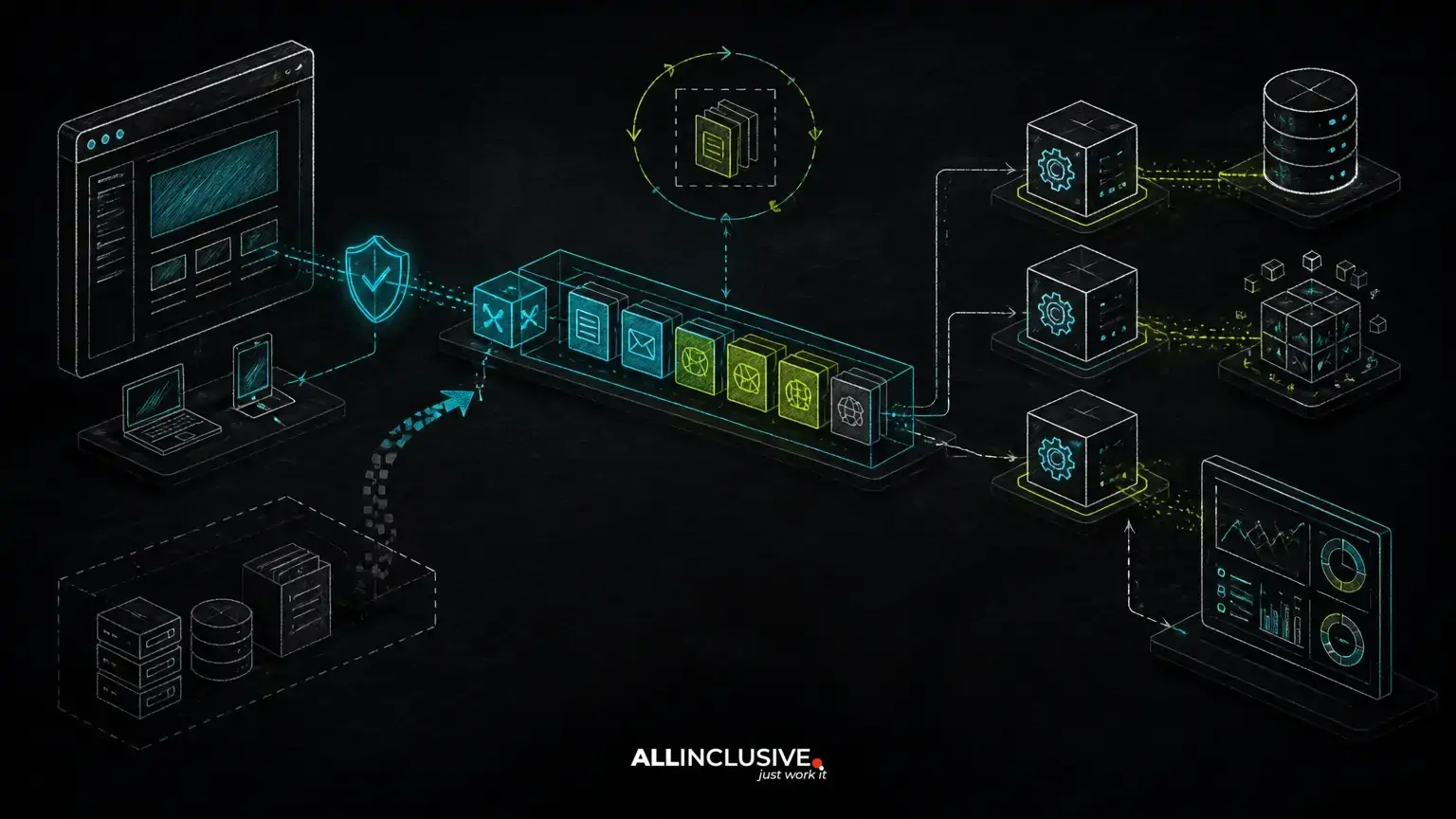
PHP background jobs and queues let an application move slow, failure-prone or resource-intensive work outside the user request. Instead of making a customer wait while a system sends email, imports data, generates a document or calls an external API, the application records a job and a worker processes it asynchronously.
The pattern is useful, but adding a queue does not automatically make a system reliable. A production design must define what happens when a worker stops, a database transaction rolls back, an API times out, a job runs twice or the queue grows faster than workers can drain it. Those decisions matter especially in custom PHP systems, where business rules may be distributed across older controllers, scheduled scripts, database procedures and third-party integrations.
This article explains the architecture behind reliable queues, the failure modes to plan for and how to decide whether an existing PHP application should be stabilized, refactored, upgraded, migrated to Laravel or rebuilt.
When PHP background jobs and queues are useful
A background job is a unit of work that can be processed outside the request that initiated it. A queue provides durable or semi-durable handoff between the producer, which creates the job, and a worker, which executes it.
Common candidates include:
- Sending transactional or batch email after a business event
- Generating reports, invoices, exports or media derivatives
- Importing and validating files from customers or partners
- Synchronizing records with external systems
- Recalculating search indexes, summaries or derived data
- Processing webhooks and other inbound events
- Running scheduled maintenance that would exceed a web request timeout
Queueing is less appropriate when a user must receive a definitive result immediately, when the operation is too small to justify operational complexity or when the work cannot safely be retried. In those cases, a synchronous transaction may be easier to understand and operate.
The core architecture: producer, queue and worker
A typical PHP queue workflow has three parts. The application creates a job containing a small payload. A queue backend stores that job until it is claimed. A worker retrieves the job, performs the work and acknowledges successful completion.
The queue backend might use a relational database, Redis or a dedicated messaging service. Each option has trade-offs. A database-backed queue can be convenient for an existing custom application and may reduce infrastructure changes, but high job volume can compete with application queries. Redis can provide fast queue operations, although durability, memory management and operational ownership must be considered. A managed messaging service can reduce infrastructure maintenance while introducing provider-specific configuration, cost and delivery semantics.
The job payload should normally contain identifiers and intent rather than a large snapshot of application state. For example, a job might contain an order ID and the requested operation, then load current data when it runs. That approach keeps messages smaller, but it also requires explicit rules for what should happen if the order changes or is deleted before processing.
Workers need a controlled lifecycle. They should receive configuration from the deployment environment, limit memory and execution time, log meaningful context and shut down cleanly when a process manager or deployment system requests termination. The exact process manager depends on the hosting environment; the important design requirement is that workers are supervised rather than treated as permanent unmanaged shell processes.
Delivery semantics: assume a job can run more than once
Many queue systems provide at-least-once delivery: a job is normally delivered, but it may be delivered again if the worker loses its connection, times out or crashes after completing part of the work. Designing as though every job runs exactly once is a common source of duplicate payments, repeated notifications and inconsistent records.
Idempotency means that repeating the same job does not create an unintended additional effect. A PHP job that creates an invoice might use a unique business key, such as an order and invoice type, and check that key before inserting. A synchronization job might store the external event ID and ignore an event already processed. A notification job might record a delivery state before or after sending, depending on the required failure behavior.
Idempotency is not a single generic code snippet. It depends on the business operation and its database constraints. Unique indexes, state transitions and carefully scoped transactions are often more reliable than an application-level “check, then insert” sequence that can race under concurrency.
Retries, timeouts and failure classification
Retries are valuable for temporary failures such as a short network interruption, rate limiting or a briefly unavailable dependency. They are harmful when applied to permanent failures such as invalid input, revoked credentials or a business rule that will never succeed without correction.
A reliable job design classifies failures:
- Transient failures: retry with a bounded policy and backoff.
- Permanent failures: mark the job failed and preserve enough information for investigation.
- Business exceptions: record a defined application state rather than repeatedly retrying.
- Unknown failures: retry conservatively, alert when thresholds are exceeded and inspect the underlying cause.
Retry policies should include a maximum attempt count, a delay strategy and a destination for exhausted jobs, often called a failed-job store or dead-letter queue. Backoff reduces pressure on a failing dependency. Jitter can prevent many workers from retrying simultaneously after the same outage.
Timeouts need to exist at more than one layer. An HTTP client timeout, a worker execution limit and a queue visibility or lease timeout solve different problems. If the worker limit is shorter than the time required for a legitimate operation, jobs may be interrupted unnecessarily. If the lease is too short, another worker may claim a still-running job and execute it concurrently.
Database transactions and the job handoff problem
A subtle failure occurs when an application changes database state and queues a job in the same request. If the job becomes visible before the transaction commits, a worker may read data that does not yet exist. If the transaction rolls back after the message is published, the worker may process an event for a change that never happened.
One solution is to publish only after the transaction commits, where the chosen queue integration supports that lifecycle. Another is the transactional outbox pattern: write the business change and an outgoing event to an outbox table in one transaction, then use a separate publisher process to deliver outbox entries to the queue. The publisher can safely retry because the outbox records provide durable handoff and status tracking.
The outbox pattern adds tables, monitoring and cleanup work, but it can be justified when losing an event would create a serious business inconsistency. For simpler workflows, an after-commit dispatch mechanism may be sufficient. The decision should be based on the consequence of missed or duplicated work, not on a preference for a particular framework.
Keeping workers safe and observable
A queue is an operational system, not only a programming abstraction. Teams should be able to answer which jobs are waiting, how long jobs have been waiting, which jobs are failing, how many attempts have occurred and whether a particular business record is affected.
Useful signals include queue depth, oldest-job age, processing duration, success and failure counts, retry counts and worker availability. Logs should include a job identifier, job type, relevant business identifier and correlation or request identifier when available. Sensitive data should not be copied into logs merely because it is present in the job payload.
Workers should also protect dependencies. Concurrency limits, rate limits and separate queues can prevent a large import from delaying urgent customer notifications. A job that calls an external service should use bounded request timeouts, validate responses and avoid assuming that a successful HTTP response means the business operation completed correctly.
Security controls remain important in asynchronous code. Treat job payloads as untrusted input, authorize actions at execution time when permissions or records can change and protect secrets through the deployment environment or a suitable secret-management process. A queue containing personal or financial data may require access controls, encryption and retention rules consistent with the application’s broader security requirements. A PHP security audit can help identify risks that are easy to miss when queue workers run outside normal web request paths.
Choosing a queue backend in a custom PHP application
The right backend depends on workload, existing infrastructure and operational ownership.
- Database queues: often a pragmatic starting point for moderate workloads and legacy systems already centered on a relational database. They require careful indexing, cleanup and contention analysis.
- Redis-based queues: useful when low-latency queue operations and existing Redis expertise are available. Memory limits, persistence and failure recovery should be explicit.
- Managed messaging services: attractive when the team wants less queue infrastructure to operate or needs integration with a wider cloud architecture. Delivery guarantees, visibility timeouts and provider coupling must be reviewed.
Do not select a backend solely because it is popular in a framework tutorial. Examine job volume, payload size, ordering requirements, delay support, failure handling, observability, deployment model and recovery procedures. Existing caching infrastructure may inform the choice, but cache requirements and queue durability requirements are different; the guidance in Redis caching for PHP applications is relevant when Redis is being considered for both purposes.
Modernizing queues in legacy PHP systems
Legacy modernization should begin with behavior discovery, not a wholesale replacement of the application. Before introducing workers, map the business workflow: where data is written, which scripts perform side effects, which integrations are called, and which users or downstream systems depend on the timing.
Different situations call for different interventions:
- Stabilize: add logging, timeouts, supervision, failed-job handling and operational runbooks without changing business logic.
- Refactor: isolate side effects behind services, make job boundaries explicit and add tests around important workflows.
- Upgrade: move the PHP runtime or dependencies to supported versions after checking compatibility, extension behavior and deployment assumptions. A phased PHP 8 upgrade plan can reduce unrelated changes during queue work.
- Migrate: move selected components to Laravel or another framework when its queue, dependency-injection, testing and operational conventions solve a documented problem.
- Rebuild: replace a bounded subsystem when its design, data model or security constraints make incremental change more expensive and risky than a controlled replacement.
Laravel can be a strong choice when a team wants established application conventions and queue integrations, but migration is not automatically justified by the presence of background work. A custom PHP application may benefit more from a narrow worker service, a database outbox or improved process supervision while preserving stable business logic.
During modernization, keep compatibility boundaries visible. Do not move a job into a new framework while leaving hidden duplicate processing in an old cron script. Run old and new paths side by side only with clear ownership, reconciliation checks and a defined removal plan. The broader principles in legacy PHP modernization help separate safe stabilization from larger architectural change.
A production-readiness checklist for PHP queues
- Define whether each job is synchronous, asynchronous or scheduled, and document why.
- Keep payloads small, versionable and free of unnecessary sensitive data.
- Make side effects idempotent using business keys and database constraints where appropriate.
- Set timeouts for external calls, workers and queue leases.
- Classify failures and use bounded retries with backoff.
- Preserve failed jobs with actionable error context and a controlled replay process.
- Ensure database changes and job publication cannot create invalid intermediate states.
- Separate queues or concurrency limits for workloads with different urgency or resource needs.
- Monitor queue depth, oldest-job age, processing duration, retries and failures.
- Test duplicate delivery, worker termination, dependency timeouts, malformed payloads and deployment interruption.
- Document who owns the queue, how it is drained during incidents and how records are reconciled.
Designing the workflow before choosing the framework
Reliable PHP background jobs come from explicit business and operational rules: what may run later, what must happen once, what can be retried, how state is reconciled and who responds when processing stops. A framework can reduce implementation effort, but it cannot decide those rules for the business.
For a new custom application, define job contracts, failure states and observability before selecting the queue backend. For an established system, start with the highest-risk workflow and preserve proven business behavior while isolating one asynchronous boundary at a time. The right modernization path may be a stabilization effort, a targeted refactor, a PHP upgrade, a justified Laravel migration or a bounded rebuild—not necessarily a wholesale rewrite.
When queue architecture intersects with broader application changes, custom software development can provide the engineering discipline to evaluate dependencies, database behavior, security and delivery risk together. Ongoing operational ownership also matters; queue workers, failed jobs and external integrations need maintenance after launch, not only during implementation. See support and maintenance for custom software for that continuing responsibility.


