
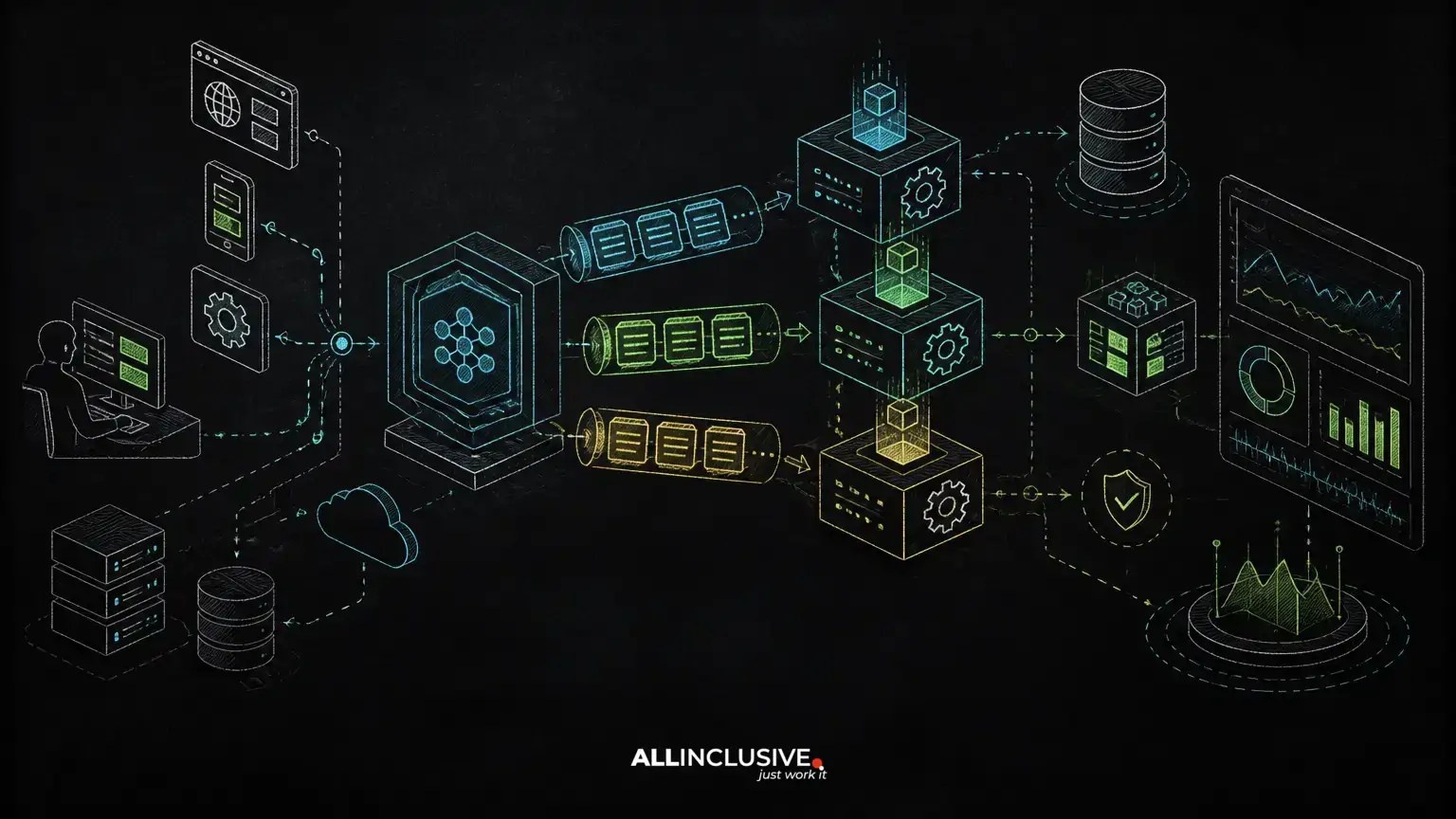
Celery background jobs let a Python application move slow, failure-prone or scheduled work out of the request path. That can improve user workflows, but only when tasks are designed for retries, duplicate delivery, partial failure and operational visibility. Celery is not a substitute for architecture: it is a task-processing layer that must be paired with clear ownership, durable state and appropriate monitoring.
This guide explains the patterns that make Celery useful in FastAPI and Django systems, including task boundaries, broker and result-backend choices, retry behavior, idempotency, queue design and deployment. For broader architectural decisions, see our Python development services and the wider software development practice. Teams working on celery background jobs may also need the implementation guidance in python react nextjs full stack.
When Celery background jobs are the right tool
A background task is appropriate when work does not need to finish before the user receives an HTTP response or when the work must run on a schedule. Common examples include:
- Sending email, notifications or webhooks after a business event.
- Generating reports, exports, documents or media files.
- Processing uploaded files or importing data from external systems.
- Running recurring reconciliation, cleanup or synchronization jobs.
- Executing data and AI workflows that may take longer than an API request should remain open.
Celery is less suitable for a small amount of local, in-process work where durability, distribution and operational controls are unnecessary. It also should not conceal a workflow that needs explicit state transitions, human approval or long-running orchestration. In those cases, a database-backed workflow model or a specialized orchestration approach may be clearer.
Understand the Celery execution model before designing tasks
A typical Celery deployment includes a Python application that publishes messages, a message broker, one or more workers and, optionally, a result backend. The broker transports task messages. Workers consume and execute them. The result backend stores task results or states when the application needs to inspect them.
These components solve different problems. A broker is not automatically a business database, and a result backend is not a replacement for durable domain state. For example, an invoice-processing task should not rely only on a transient task result to record whether an invoice was paid. The payment or invoice record belongs in the system of record, while Celery coordinates the work around it.
Redis and RabbitMQ are common infrastructure choices, but the correct option depends on delivery requirements, operational expertise, hosting constraints and existing platform standards. Treat broker durability, access control, backups and failure recovery as production concerns rather than default configuration details.
Design small tasks around business actions
A reliable task usually represents one meaningful, observable action rather than an entire application workflow hidden inside a single function. A task might “generate monthly account export” or “synchronize customer record,” while the code it calls is organized into testable application services.
Pass stable identifiers instead of large serialized objects whenever possible. A task can receive an order ID, reload the current record, validate its state and perform the action. This keeps messages smaller and reduces the chance that a task acts on stale data.
Task functions should also have an explicit contract:
- Which identifiers and parameters are required?
- What state must exist before execution?
- Which errors are retryable?
- What changes are committed if execution stops partway through?
- How can an operator safely replay or cancel the work?
This discipline is especially important in custom software that combines API requests, scheduled jobs, third-party services and data processing. A task boundary should make the workflow easier to reason about, not merely move code into another process.
Make retries safe with idempotency
Celery can retry tasks, and messages may be delivered again after worker or network failures. As a result, task code should assume that the same logical operation can run more than once. Idempotency means repeating the operation produces the intended final state rather than duplicate side effects.
Useful techniques include storing a business operation ID, enforcing a database uniqueness constraint, checking current status before applying a transition and using provider-supported idempotency keys for external APIs. For an email task, the application might record a notification event before sending and use a stable event identifier. For an import, it might use a source-system record ID and version to prevent duplicate creation.
Do not treat a broad exception handler as a reliability strategy. Classify failures instead:
- Transient failures: network timeouts, temporary service unavailability or rate limiting may justify a retry.
- Permanent failures: invalid input, missing permissions or a malformed document usually require correction rather than repeated attempts.
- Unknown failures: capture enough context for investigation and apply a bounded retry policy.
Use exponential backoff and a maximum retry limit appropriate to the operation. A retrying task should not create an unbounded stream of duplicate requests or delay detection of a real defect.
Separate queues by workload and operational priority
One shared queue can be adequate for a small system, but mixed workloads create contention. A large report-generation task can occupy worker capacity while short notification tasks wait. Separate queues by workload characteristics when priority, resource usage or failure behavior differs.
Typical categories include high-priority user-facing follow-up work, ordinary application tasks, scheduled maintenance and CPU- or memory-intensive processing. Workers can then be deployed with different concurrency and resource settings. This is often more predictable than increasing the number of workers indiscriminately.
Queue design should follow business consequences. Ask which jobs affect a user-visible workflow, which can wait, which need specialized dependencies and which can consume significant memory or CPU. Document those decisions so operations teams understand why a queue exists and what service level it supports.
Keep database transactions and task publication consistent
A common race condition occurs when an application publishes a task before its database transaction commits. The worker may start immediately, fail to find the record or observe incomplete state. Publishing only after the transaction succeeds avoids that inconsistency.
Framework integrations can help schedule task publication after a successful transaction, but the principle remains architectural: the worker should consume a committed business event or record. For more demanding workflows, an outbox pattern can store an event in the same database transaction as the business change. A separate publisher then sends pending outbox records to the broker and marks them as dispatched.
The outbox approach adds implementation and operational work, but it provides a clearer recovery path when the database commit succeeds and broker publication does not. Choose it when losing an event would create material business risk.
Use task state for operations, not as the whole domain model
Task states such as pending, started, successful or failed are useful for dashboards and support workflows. They are not always sufficient to represent a business process. A document-generation workflow may need states such as requested, validating, rendering, awaiting review, published and expired, each with different permissions and transitions.
Store business state in a durable domain model and associate task IDs or execution records with it. This makes the workflow queryable even if task-result retention changes. It also allows a replacement worker or administrative tool to understand what remains to be done without depending on an old result payload.
Build observability into every Celery job
Background processing is invisible to the user unless the application exposes useful status and the team can inspect failures. At minimum, record:
- A correlation or operation ID connecting the initiating request to the task.
- The task name, queue, arguments or safe argument summary and execution timestamps.
- Attempt count, duration and outcome.
- Relevant domain identifiers and external provider references.
- Exception details without exposing secrets or sensitive payloads.
Monitor queue depth, task age, failure rate, retry volume and worker health. Alerts should distinguish a brief spike from a queue that is continuously growing. Logs, metrics and traces should use consistent identifiers so an engineer can follow a request from API entry through database changes and downstream work.
Do not put passwords, access tokens or unnecessary personal data into task arguments or logs. Background infrastructure expands the number of systems that may retain message content, which makes data minimization part of application security.
Plan deployment and worker lifecycle deliberately
Celery workers are application processes with their own release, scaling and shutdown behavior. Deployments should account for tasks already in progress, messages waiting in queues and code compatibility between publishers and workers during a rollout.
Use graceful shutdown procedures where supported by the deployment environment, and avoid removing infrastructure before queued work has been drained or safely preserved. Keep task payloads compatible across the transition between application versions. If a task schema must change, use versioned payloads or a staged migration rather than assuming all workers update simultaneously.
CPU-bound Python work may require process-based worker capacity or a separate processing service, while I/O-heavy work has different concurrency needs. Measure resource behavior in the actual deployment environment instead of selecting worker settings from a generic example.
Test failure modes, not just the happy path
Unit tests should cover task logic independently from the worker runtime. Integration tests should verify broker interaction, database transaction boundaries, serialization and external-service behavior. Failure testing should include:
- A worker stopping during execution.
- A broker or external provider becoming temporarily unavailable.
- Duplicate task delivery.
- Malformed or expired task arguments.
- A task exceeding its expected runtime.
- A deployment occurring while messages are queued.
For external services, use controlled test doubles or sandbox environments and verify that retry behavior does not violate provider limits. For data and AI pipelines, test partial completion and safe resumption; a failed downstream step should not require repeating an expensive upstream operation unless that is intentional.
Celery patterns for FastAPI, Django and hybrid systems
FastAPI applications commonly use Celery for document processing, notifications, integrations and data workflows while keeping request handlers focused on validation and response delivery. Django applications can use the same separation, with attention to transaction boundaries and model state.
In a broader product architecture, Celery does not require every component to be Python. A Laravel or PHP application can publish work through a shared broker or invoke a Python service when the workflow benefits from Python libraries for data processing or AI. The boundary should be explicit: define message schemas, ownership, authentication, retries and observability rather than treating the queue as an informal integration.
For a related architectural comparison, see Laravel and Python hybrid architecture. Teams building AI-enabled workflows may also benefit from the production considerations in AI development.
A production checklist for Celery background jobs
- Define the business action and its durable source of truth.
- Pass stable identifiers and keep payloads small and versionable.
- Classify errors before adding retries.
- Make side effects idempotent and enforce uniqueness where appropriate.
- Publish work only after required database changes commit.
- Separate queues when priority or resource behavior differs.
- Set bounded retries, time limits and sensible backoff.
- Track correlation IDs, task outcomes, duration and queue health.
- Protect task messages and logs from sensitive data exposure.
- Test duplicate delivery, worker loss, deployment and dependency failure.
- Document replay, cancellation and dead-letter or recovery procedures.
Celery becomes dependable when it is treated as part of a production system rather than as a decorator added to slow code. Clear task contracts, durable business state, idempotent side effects and operational visibility allow Python teams to process background work without turning retries and queues into hidden sources of risk. For product teams evaluating a new backend or an existing workflow, the right design starts with the business consequence of delay or failure, then selects the queue, worker and deployment model that can support it.


