Python web application security is not a single library choice or a final penetration test. It is a review of how the application validates input, enforces authorization, protects secrets, handles background work, exposes APIs, manages dependencies and responds to operational signals. For teams evaluating python web application security, this implementation detail is expanded in ai development.
For a FastAPI or Django system, the most useful security review follows the path of a real request: from the public edge through routing, authentication, business rules, databases, queues and third-party services. That approach catches failures that framework defaults cannot prevent, especially authorization mistakes and unsafe assumptions between services.
This checklist is designed for production Python backends supporting SaaS products, automation, data workflows or AI features. It can be used during architecture review, before launch, after a major feature release or while stabilizing an inherited codebase.
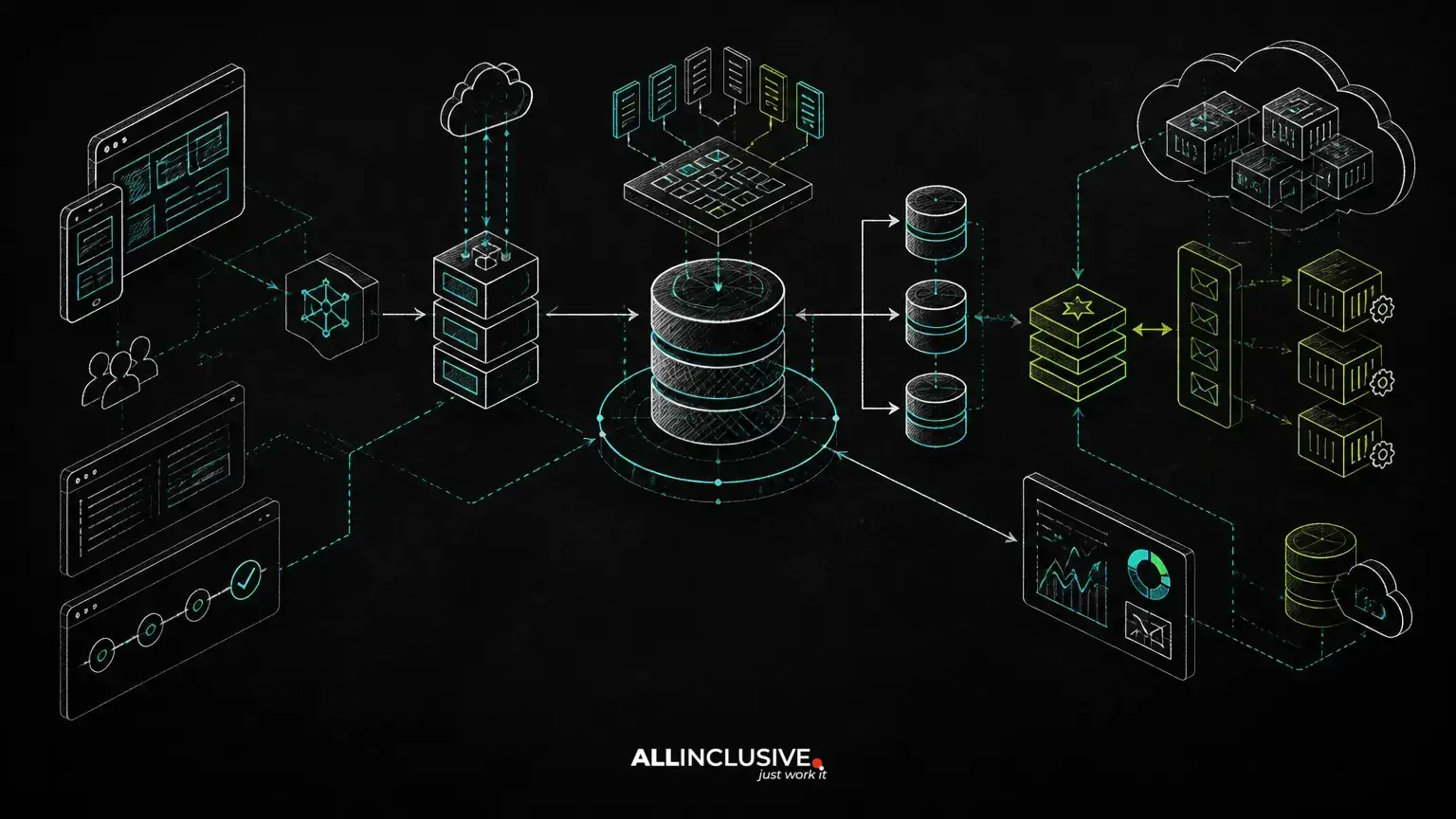
Start with an application and threat boundary map
Before reviewing individual controls, document what the application protects and where trust changes. Identify public endpoints, administrative interfaces, internal APIs, worker processes, scheduled jobs, databases, object storage, model providers and observability systems.
For each component, record:
- Which users, services or jobs can invoke it.
- What sensitive data it can read, create, change or delete.
- Whether it is reachable from the public internet, a private network or only the application runtime.
- Which identity and authorization decision controls access.
- What happens when the dependency is unavailable or returns malformed data.
This map makes security ownership explicit. A web endpoint may be protected correctly while a queue consumer accepts an untrusted payload without applying the same business authorization rules. Similarly, an internal service is not automatically safe if credentials, network paths or tenant identifiers can be manipulated.
Review Django or FastAPI configuration before application code
Framework configuration establishes important defaults, but it should be reviewed as application code rather than treated as a security guarantee. Check production settings for debug behavior, trusted hosts, allowed origins, cookie attributes, secure transport and error responses.
For Django, review settings related to host validation, CSRF protection, session cookies, password hashing, security middleware and deployment configuration. For FastAPI, review the ASGI server and reverse proxy arrangement, CORS configuration, authentication dependencies, request parsing and exception handlers. FastAPI does not automatically define your complete authorization model, and API documentation endpoints may need separate exposure decisions.
Across both frameworks, verify that:
- Debug traces, stack details and local development credentials cannot appear in production responses.
- HTTPS is enforced at the correct edge, with proxy headers handled deliberately.
- Cross-origin access allows only the origins and credentials required by the product.
- Security headers are supplied by the edge or application where appropriate.
- Health and readiness endpoints reveal operational status without exposing secrets or detailed infrastructure information.
Separate authentication from authorization
Authentication answers who is making a request. Authorization answers whether that identity may perform this specific action on this specific resource. Many serious web vulnerabilities occur after authentication succeeds but authorization is applied too broadly.
Review every sensitive operation for an explicit authorization decision. Test the following cases:
- A user requests another user’s record by changing an identifier.
- A member attempts an administrator action.
- A user from one tenant submits a valid identifier belonging to another tenant.
- A disabled, suspended or deleted account calls an existing session or token.
- A background job continues after the initiating user loses access.
Do not rely on a client-supplied tenant ID, role field or ownership flag. Derive access scope from the authenticated identity and enforce it in the service or repository boundary. For complex products, central policy functions or domain services can reduce inconsistent checks across route handlers.
Token design also deserves a lifecycle review. Define expiration, revocation behavior, refresh-token storage, key rotation, audience and issuer validation, and the consequences of leaked credentials. Avoid placing sensitive business data in tokens merely because it is convenient for the frontend.
Validate input at boundaries and encode output by context
Python’s flexible data model does not remove the need for strict boundary validation. API schemas should define required fields, types, formats, length limits, collection limits and acceptable enumerations. Validation should happen before business logic, database queries or queue publication.
For FastAPI, typed request models can provide a clear validation boundary, but the surrounding service still needs limits and business rules. For Django, forms, serializers and model validation serve different purposes; database constraints remain necessary for invariants that must hold under concurrent writes.
Review input handling for:
- Unexpected fields that could alter privileged behavior.
- Large bodies, deeply nested JSON and oversized file uploads.
- URLs, redirects, hostnames and webhook destinations supplied by users.
- Search, sort and filter parameters interpolated into queries or expressions.
- Template, HTML, Markdown, shell, path and spreadsheet output contexts.
Parameterized database access is essential, but it does not make every dynamic query safe. Validate identifiers used for sorting or selecting database objects against an allowlist. Escape or sanitize output according to its destination rather than applying one generic transformation everywhere.
Protect files, URLs and outbound integrations
File uploads and server-side HTTP requests are common sources of overlooked risk. Store uploads outside executable paths, generate application-owned names, enforce size and type limits, and inspect content according to the risk of the workflow. Do not assume a filename or MIME type describes the actual content.
Any feature that fetches a user-provided URL should be reviewed for server-side request forgery. Restrict schemes, resolve and validate destinations, control redirects, block access to sensitive network ranges where appropriate, and set timeouts. Apply the same discipline to document processors, image tools, webhooks and AI retrieval connectors.
Third-party integrations need explicit failure behavior. Verify signatures on inbound webhooks, prevent replay where the provider supports it, limit retries, redact credentials from logs and avoid treating external response fields as trusted authorization input.
Make background jobs part of the security boundary
Queues and workers often receive less scrutiny than HTTP routes even though they may perform high-impact actions. Treat every job payload as untrusted input. Include only the identifiers and data required to perform the task, validate them on consumption, and re-check authorization when the job executes.
Define idempotency for operations such as billing actions, notifications, imports and record updates. A retry should not duplicate an irreversible effect. Set queue visibility, retry and dead-letter behavior deliberately, and ensure sensitive payloads are not retained longer than necessary.
For automation and AI backends, isolate tools that can send messages, modify records, execute code or access private data. A model-generated instruction, retrieved document or external response should not automatically become an authorized command. Require explicit policy checks before consequential actions.
Control secrets, dependencies and supply-chain exposure
Keep secrets out of source code, committed configuration and ordinary application logs. Use an appropriate secret-management mechanism, restrict access by workload, rotate credentials and document which service owns each secret. Review error reporting and debugging tools for accidental disclosure of tokens, authorization headers or personal data.
Dependency security is broader than checking for known vulnerabilities. Pin or constrain dependency versions, review transitive packages, remove unused libraries, protect build credentials and make dependency updates reproducible. Separate development tools from production images where practical. A vulnerability scanner is useful, but its results still require ownership, prioritization and remediation testing.
Also review the Python runtime, base image, operating-system packages, native extensions and deployment artifacts. Security decisions should cover the complete release path, not only the requirements.txt file.
Design data protection around retention and access
Classify data before choosing storage and logging behavior. Personal information, credentials, payment-related data, customer documents, prompts, model outputs and internal business records may require different retention and access rules.
Check encryption in transit and at rest, database permissions, backup access, object-storage policies and administrative tooling. Use separate credentials and privileges for migrations, application reads, reporting and maintenance tasks where the operating model justifies it.
Logging should support investigation without becoming a second data leak. Define redaction rules for request bodies, headers, tokens, prompts and uploaded content. Set retention periods and access controls for logs, traces and error events. If an AI workflow handles customer material, include provider access, retention and data-transfer behavior in the same review.
Test security properties, not only happy paths
Security testing should combine automated checks with targeted review. Unit tests can verify policy functions and validation rules. Integration tests can exercise authentication, tenant isolation, database constraints, webhook verification and queue behavior. End-to-end tests can confirm that real user workflows cannot cross authorization boundaries.
Useful negative cases include:
- Missing, expired, malformed and incorrectly scoped credentials.
- Requests using another tenant’s identifiers.
- Unexpected JSON fields and invalid type combinations.
- Oversized requests, repeated retries and duplicate messages.
- Malformed webhook signatures and replayed events.
- Dependency timeouts, partial failures and worker restarts.
Run static analysis, dependency checks and secret scanning in the delivery pipeline, then review the output rather than treating a green build as proof of security. Periodic penetration testing can add value, particularly for public applications and major changes, but it should complement continuous engineering controls.
Make deployment and observability support response
A secure design can still fail operationally if deployment permissions are broad or incidents cannot be investigated. Separate build, release and runtime access where feasible. Use least-privilege service accounts, protected production configuration and a rollback approach that does not depend on ad hoc shell access.
Monitor authentication failures, authorization denials, unusual volume, queue anomalies, administrative actions, outbound integration errors and unexpected data access. Alerts should be actionable and should avoid exposing sensitive payloads. Maintain an incident process covering credential rotation, session invalidation, evidence preservation, customer communication and recovery.
Observability is part of security ownership: teams need enough context to determine what happened, which records were affected and whether a control actually contained the event.
Use the checklist during architecture and delivery reviews
- Map assets and trust boundaries. Include routes, workers, integrations, data stores and operational tools.
- Review framework and edge configuration. Verify production behavior for errors, cookies, origins, transport and headers.
- Trace authorization through business workflows. Test object ownership, tenant isolation and privileged actions.
- Constrain all external input. Cover API bodies, files, URLs, webhooks, queue messages and model-generated content.
- Limit access and retention. Apply least privilege to users, services, secrets, databases, logs and backups.
- Test failure and replay behavior. Check retries, duplicate events, timeouts, partial writes and worker restarts.
- Connect findings to owners. Record severity, affected assets, remediation steps and verification criteria.
Security review works best when it is part of the product delivery system rather than a launch-day inspection. A custom Python backend can support APIs, automation, data processing and AI features effectively, but its security depends on the boundaries and operating practices around the framework. Teams evaluating architecture can also review Python development capabilities, explore custom software development, or compare related guidance on Python REST API best practices and Python backend architecture for AI features.