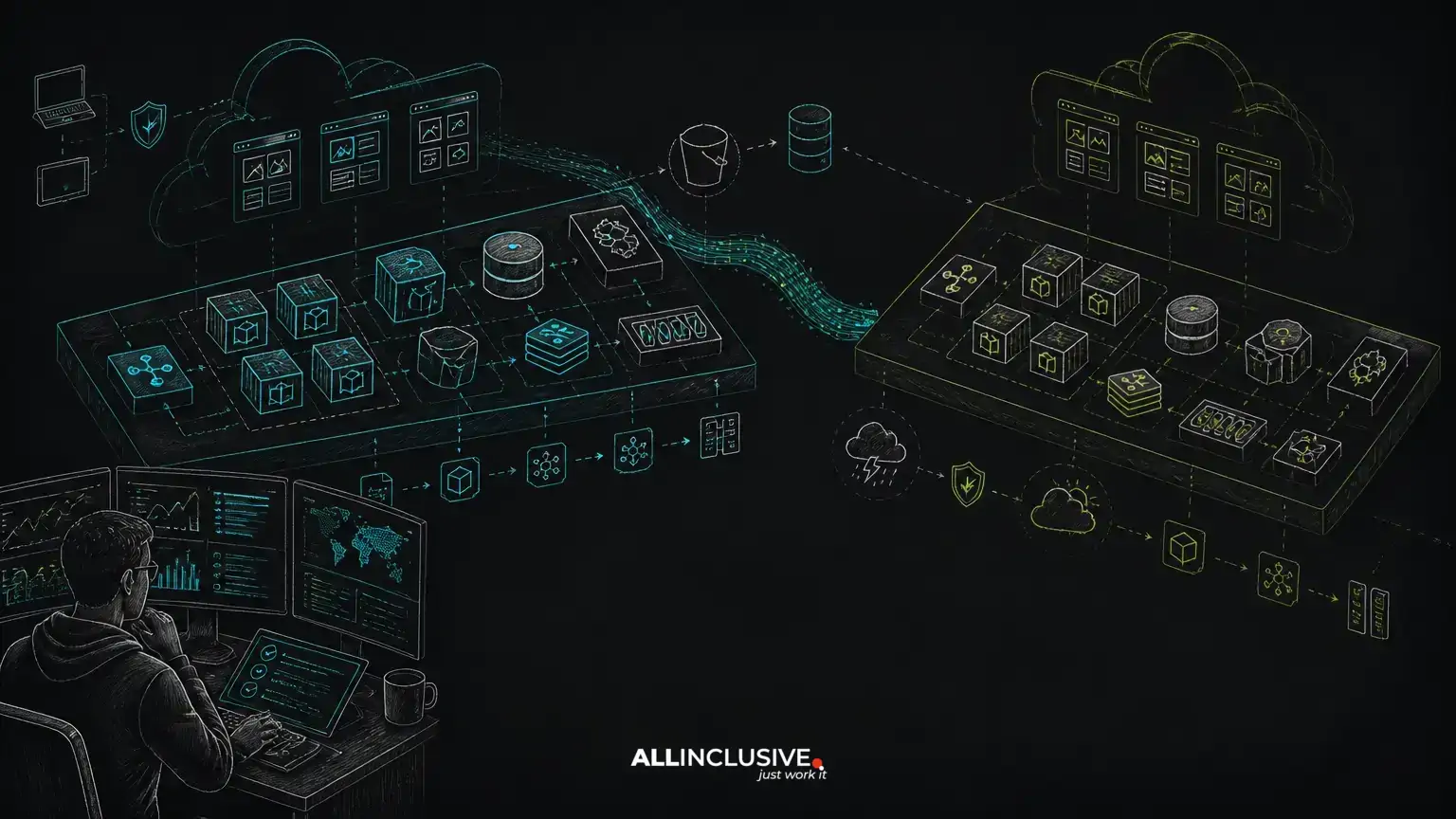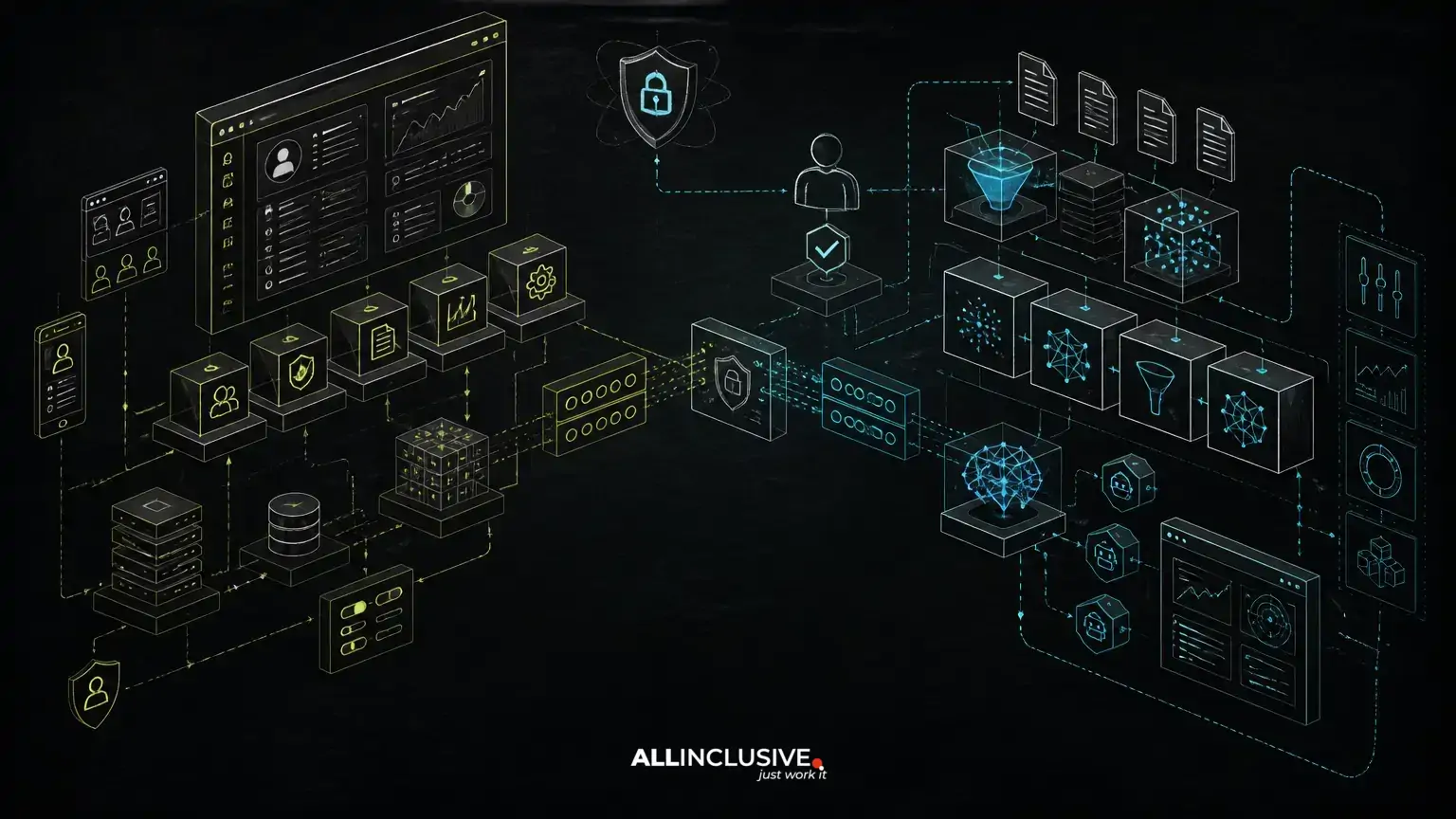
Laravel and Python are often a strong combination for AI products because they solve different parts of the system well. Laravel can own authentication, billing, permissions, business workflows, administration and the user-facing application. Python can own model orchestration, document processing, retrieval, evaluation and other AI-specific workloads.
The important decision is not whether Laravel or Python is the “AI framework.” It is how to define reliable boundaries between product logic and probabilistic model behavior. A practical laravel python ai architecture keeps business rules explicit, treats models as replaceable dependencies, and gives the team enough observability to understand quality, latency, cost and failure modes in production.
Why split Laravel application logic from Python AI workloads?
AI features usually sit inside established product workflows. A customer may upload a document, ask a question, approve a recommendation or trigger an action. Those steps involve permissions, audit history, notifications, transactions and user experience concerns that are not specific to machine learning. Laravel is well suited to coordinating these deterministic application responsibilities.
Python becomes valuable when the product needs model pipelines, embeddings, document parsing, retrieval experiments, evaluation tooling, data preparation or specialized inference libraries. Keeping those concerns in a dedicated service can make the system easier to evolve, provided the integration contract is clear.
This split can support:
- Independent change: AI engineers can adjust retrieval or model routing without rewriting billing, accounts or core workflows.
- Clear ownership: application developers own product state, while AI engineers own model behavior and quality measurement.
- Controlled risk: model output does not automatically become a database mutation or external action.
- Scalable operations: asynchronous Python workers can handle long-running ingestion or generation jobs separately from web requests.
The split is not automatically better. Two services introduce network calls, deployment coordination, authentication, tracing and additional operational work. A small feature may be safer as a single application initially. The boundary should follow real workload, ownership and reliability needs rather than technology fashion.
A reference architecture for Laravel and Python AI products
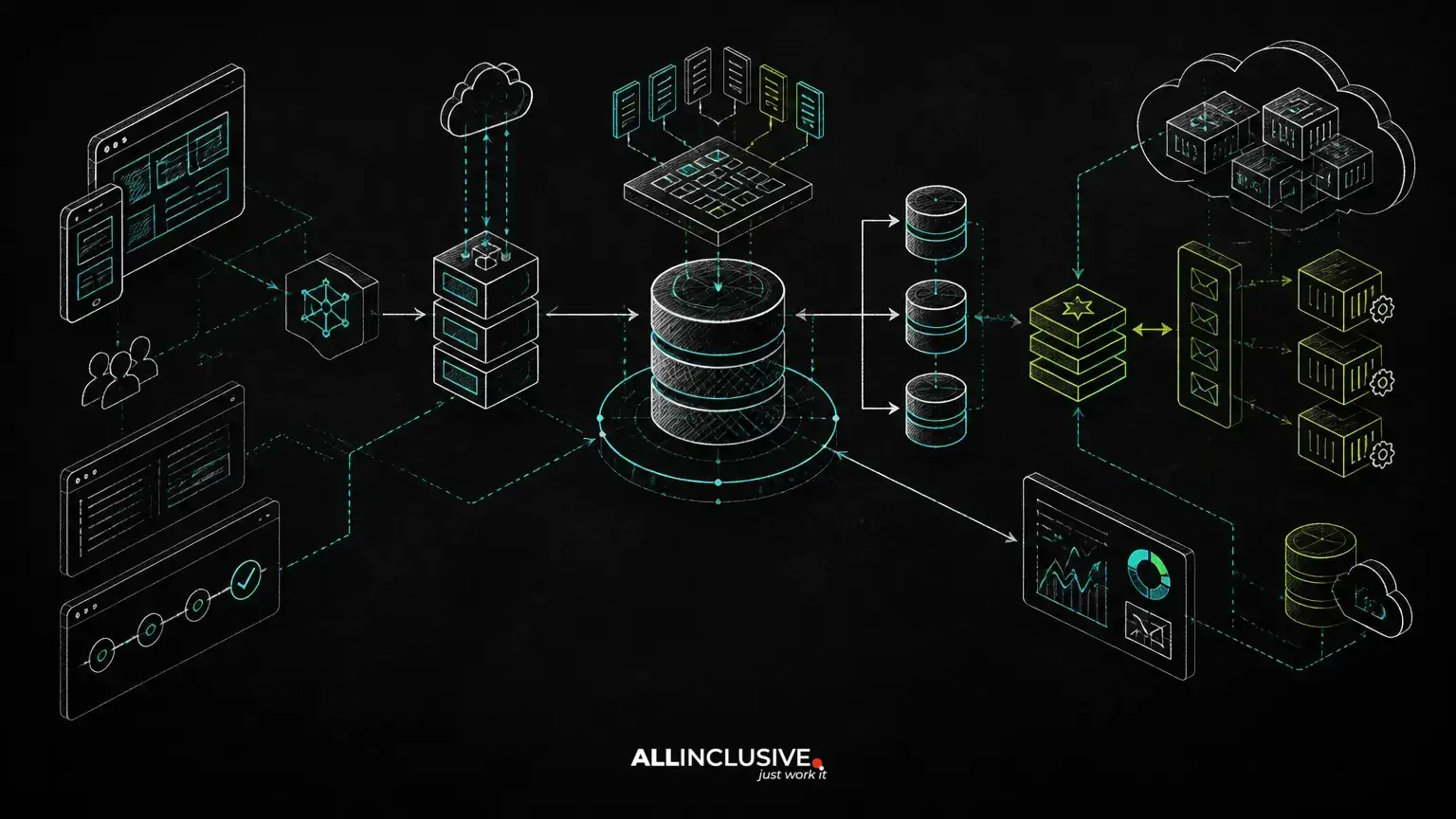
A common design uses Laravel as the system of record and Python as an AI capability service.
- Laravel web and API layer: handles identity, tenant context, authorization, product workflows, request validation, billing and user-facing responses.
- Job and event layer: carries tasks such as document ingestion, embedding generation, evaluation runs and long-running agent work.
- Python AI service: manages model providers, prompt or task orchestration, retrieval, reranking, tool policies and structured outputs.
- Data stores: separate transactional records from document, vector, cache and telemetry data where appropriate.
- Observability layer: records request IDs, model calls, retrieval results, latency, token or usage data, errors and evaluation signals.
Laravel should generally remain the authority for facts such as whether a user can access a document, whether an action is approved and whether an account is active. The Python service should receive the minimum context required to perform its task and should not infer authorization from prompt instructions.
Synchronous requests versus asynchronous jobs
Short, interactive operations may use a synchronous API call: Laravel sends a request to Python, Python returns a structured result, and Laravel renders it. This works when the operation has a predictable time limit and the user benefits from an immediate response.
Document ingestion, large retrieval indexes, batch classification, agent workflows and human review queues are better represented as jobs. Laravel can create a job record and publish a task. Python processes it, stores artifacts or emits a result event, and Laravel updates the product workflow. Users receive status rather than an unreliable request timeout.
Define the service contract around tasks, not model vendors
A weak integration exposes provider-specific details throughout the Laravel codebase. A stronger contract describes a business capability. For example, Laravel might request “answer this authorized knowledge question with citations” rather than directly constructing a provider-specific chat request.
Useful contract fields can include:
- tenant, user and authorization context;
- task type and input references;
- response schema and validation requirements;
- correlation and idempotency identifiers;
- requested quality, latency or cost profile;
- allowed tools and data sources;
- status, warnings, citations and refusal reasons.
Results should be structured whenever the application must act on them. A validated JSON response is easier to review and test than free-form text containing hidden assumptions. Laravel should validate the result again before changing business state, sending a message or invoking an external integration.
Contracts also reduce lock-in. The Python layer can support different model providers or local models behind an internal interface while Laravel continues to depend on stable product semantics. This does not eliminate provider-specific behavior, but it limits where that behavior must be managed.
Where RAG, embeddings and reranking belong
Retrieval-augmented generation is usually a Python-owned workload because it combines document preparation, chunking, embeddings, filtering, ranking and prompt assembly. However, retrieval must respect application permissions. A vector similarity result is not proof that a user is allowed to see the underlying content.
A safer flow is:
- Laravel authenticates the user and identifies the tenant or account scope.
- Python receives a constrained retrieval request, not unrestricted database access.
- Retrieval applies tenant, document, role or policy filters before context is assembled.
- Optional reranking improves the ordering of candidate passages.
- The model generates an answer from the permitted context.
- The response includes source references and confidence or review signals where the product supports them.
- Laravel applies presentation and workflow rules before showing or storing the result.
Embedding pipelines should be treated as data pipelines, not one-time setup scripts. Content changes, deleted permissions, parser errors and embedding-model changes can make an index stale. Track source version, ingestion status, access scope and deletion behavior so that the retrieval layer can be reconciled with the transactional system.
For deeper retrieval design considerations, see RAG development patterns for search, retrieval, reranking and citations.
Agents need stronger boundaries than chat features
An agent that can call tools is a workflow engine with probabilistic decision-making. It should not receive broad access to Laravel internals or production credentials. Define an explicit tool registry with narrow inputs, authorization checks, timeouts, rate limits and audit records.
For example, an agent may request “find open invoices for this authorized account,” while Laravel performs the actual query and applies account permissions. If the agent wants to issue a refund, Laravel can require a separate approval state or human confirmation rather than executing the request immediately.
Useful controls include:
- allowlisted tools and arguments;
- read-only defaults for early releases;
- maximum steps, time and spending limits;
- idempotency for actions that can be retried;
- human approval for financial, legal, account or external communication actions;
- complete records of tool requests, results and approvals.
This approach lets the product benefit from agent workflows without allowing a prompt or model error to bypass application controls. For tool interoperability and controlled business actions, see MCP server development and safe AI tool connections.
Production requirements beyond the prototype
A prototype often measures success by whether a model produces an impressive answer. A production feature must also answer whether the result is authorized, repeatable enough, explainable to its users, affordable to operate and safe to fail.
Evaluation and regression testing
Create a representative evaluation set before changing prompts, retrieval settings or models. It can include expected answers, required citations, refusal cases, permission boundaries and examples of ambiguous input. Automated checks may assess structured-output validity, citation coverage, retrieval relevance or prohibited content. Human review remains useful for nuanced quality and business suitability.
Run evaluations against the proposed change and a baseline. A faster or cheaper model is not an improvement if it increases unsupported answers or review workload. Store evaluation inputs and configuration versions so results can be interpreted later.
Observability and incident diagnosis
Log enough information to investigate quality without exposing unnecessary sensitive content. Correlate the Laravel request, Python task, retrieval operation, model call and final workflow decision. Useful signals include latency by stage, queue age, model and prompt version, token or usage data, tool failures, fallback frequency and user or reviewer feedback.
Tracing should make it possible to distinguish a slow database query from slow retrieval, provider latency or an oversized prompt. AI-specific monitoring should also identify empty retrieval results, malformed outputs, citation failures and repeated retries. When planning laravel python ai architecture, the implementation context in AI observability for logging, tracing, cost and quality monitoring is also relevant.
Privacy and data handling
Decide which data may be sent to external model providers, how long prompts and outputs are retained, and whether sensitive fields require masking or exclusion. Keep secrets in the appropriate service boundary, use encrypted transport, and limit service-to-service credentials. Tenant isolation must apply to source documents, vector records, caches, logs and evaluation datasets.
Privacy requirements can affect architecture. A product may need provider controls, a private deployment, selective redaction, a local model for certain tasks or a human review process that avoids exposing sensitive content to unnecessary systems. These are product and compliance decisions, not merely configuration details.
Failure modes to design before launch
- Python is unavailable: Laravel returns a useful pending or degraded state rather than failing the entire application.
- The model times out: enforce deadlines, cancel work where possible and offer retry or human review.
- Output is invalid: validate the schema, record the failure and avoid applying side effects.
- Retrieval returns no useful context: distinguish “no evidence found” from a confident answer.
- A provider has an outage or policy change: use carefully tested fallbacks and communicate reduced capability.
- A job is delivered twice: make ingestion and actions idempotent.
- Permissions change after indexing: apply current authorization at retrieval or serving time and support deletion propagation.
- Costs grow unexpectedly: set usage budgets, monitor expensive paths and route simple tasks to simpler models when quality permits.
Fallbacks should preserve correctness. Returning stale or uncited information may be worse than asking the user to retry or assigning the task to a reviewer.
When a single Laravel application is enough
Not every AI feature needs a separate Python service. Keeping a feature inside Laravel may be reasonable when it uses a straightforward provider API, has limited data processing, needs no specialized Python libraries and is owned by one team. A single deployment can reduce network failure modes and simplify local development.
Introduce Python when the AI workload has distinct scaling characteristics, substantial ingestion or evaluation pipelines, specialized libraries, multiple model providers, independent ownership or operational requirements that would complicate the Laravel application. The decision should be revisited as the product gains real workload data.
For broader application architecture and custom software delivery considerations, explore Allinclusive development services and Python development capabilities for AI and data-intensive systems. Laravel should remain the product’s workflow authority, while Python should earn its place by isolating genuinely AI-specific complexity.
A delivery checklist for Laravel and Python AI architecture
- Identify which system owns each business fact and permission decision.
- Define a versioned, structured contract between Laravel and Python.
- Choose synchronous calls only for bounded interactive work.
- Use jobs for ingestion, batch work, long-running agents and human review.
- Apply authorization before retrieval results become model context.
- Validate model outputs before they affect product state.
- Build evaluation cases for quality, refusal, citations and permissions.
- Trace requests across Laravel, queues, Python, retrieval and model providers.
- Set privacy, retention, budget, timeout and fallback policies before launch.
- Make tool actions narrow, auditable and approval-aware.
The strongest Laravel and Python AI products are not defined by having two languages. They are defined by disciplined ownership: Laravel protects product integrity, Python manages AI-specific complexity, and the integration makes uncertainty visible instead of hiding it. That division gives teams room to improve models and workflows without turning every model change into a product-wide risk.