
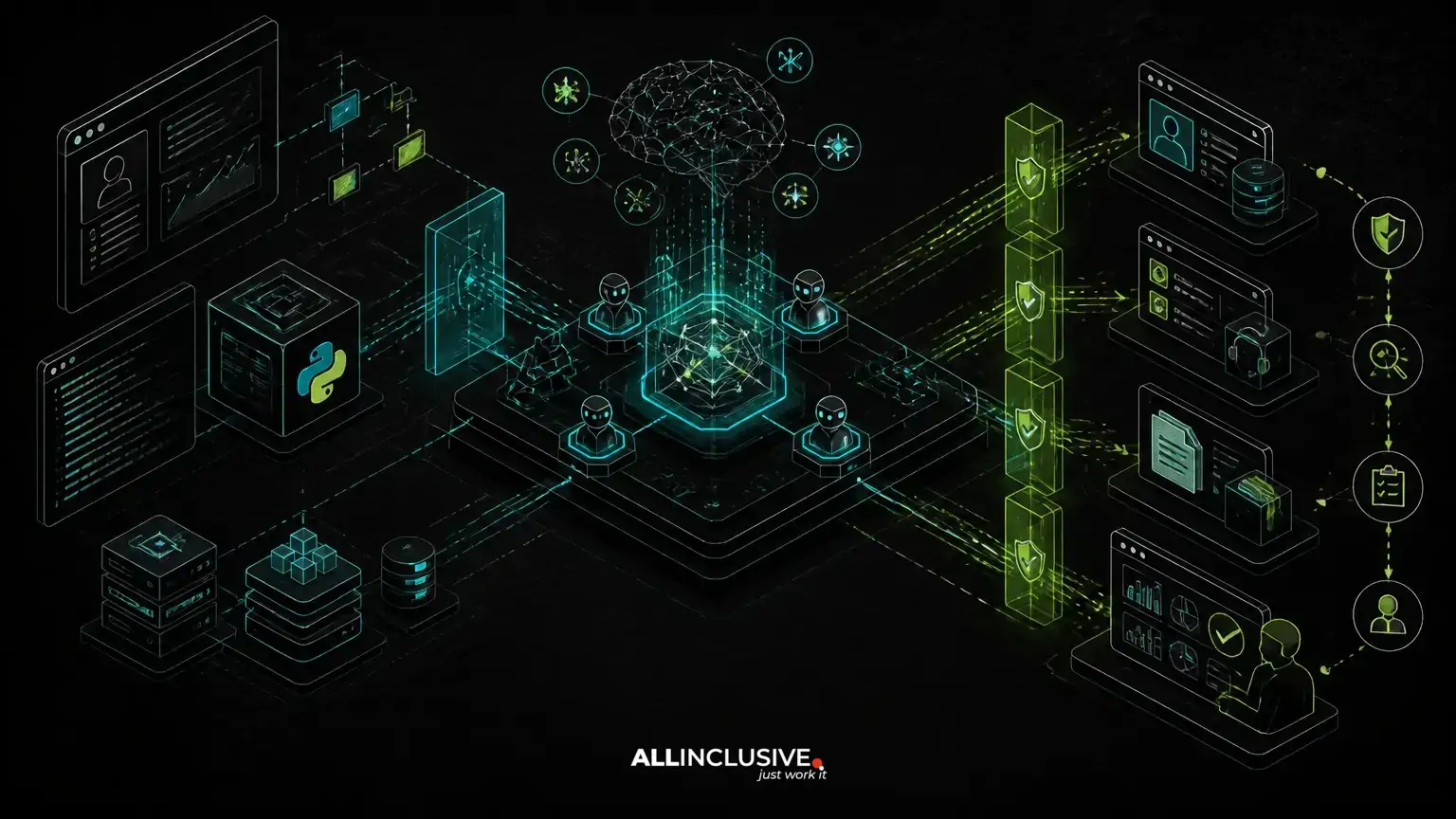
MCP server development is the process of building a controlled integration layer that lets AI applications discover and use business tools, data sources and workflows. Instead of giving an agent unrestricted access to an application or database, an MCP server exposes narrowly defined capabilities with explicit inputs, authorization checks and operational logging.
That distinction matters when an agent needs to search a knowledge base, inspect a customer record, create a draft, open a support ticket or request an approval. A prototype may call a function successfully. A production system must also determine who is allowed to call it, what data can be returned, how actions are validated, how failures are handled and when a human must review the result.
MCP is therefore best treated as an application-integration and governance problem, not merely a protocol implementation exercise. The surrounding architecture may include a Python AI service, a Laravel application, existing REST APIs, retrieval pipelines, model routing, evaluation tooling and human approval workflows.
What an MCP server does in an AI application
An MCP server presents tools, resources or prompts that an MCP-compatible client can use. The client is typically part of an AI application or agent runtime. The server then translates an approved request into an operation against a business system.
A useful mental model is:
- Model: proposes a tool call based on the conversation and available context.
- Agent runtime: decides whether the proposed call fits the workflow and policy.
- MCP client: communicates with the selected server.
- MCP server: validates the request and exposes a bounded business capability.
- Business system: performs the underlying search, read, calculation or write operation.
- Review and monitoring layer: records the decision, result, latency, cost and any required human approval.
The MCP server should not be considered a replacement for application authorization, domain logic or audit controls. It should enforce those controls or delegate to systems that already own them. A tool called refund_order must not rely on the model to decide whether a refund is permitted.
Where MCP fits in a production architecture
A common architecture separates product workflows from AI-specific orchestration. Laravel or another application layer can own users, tenants, billing, workflow state and established business rules. Python can own model integration, retrieval, embeddings, agent orchestration and evaluation services. MCP servers can sit at the boundary between the agent runtime and selected business capabilities.
For example, a customer-support assistant might use:
- A Laravel application for authenticated agents, ticket workflows and customer permissions.
- A Python service for conversation orchestration, model routing and retrieval.
- An MCP server exposing tools such as search_tickets, get_customer_context and draft_reply.
- A separate approval path for actions such as sending a message, changing account status or issuing a credit.
- Centralized tracing for model calls, retrieval steps, tool calls and downstream API requests.
This split is not mandatory. A smaller product may implement the MCP server in the same language as its main application. The important decision is ownership: each tool should have a clear system of record, a clear authorization source and a clear operational owner.
Teams building the surrounding application can use the broader software development guidance from Allinclusive to evaluate integration boundaries, maintainability and delivery scope before adding agent capabilities.
Design tools around business actions, not database access
The quality of an MCP integration depends heavily on the shape of its tools. Exposing a raw SQL interface or an unrestricted API client gives the model too much responsibility and makes policy enforcement difficult. Prefer tools that represent bounded business actions or focused queries.
For example, a safer interface might expose find_open_invoices with tenant and date constraints rather than run_query. A tool for account changes might accept a specific request, return a proposed change and require a separate confirmation step before execution.
Characteristics of maintainable MCP tools
- Specific purpose: the tool does one understandable job.
- Typed inputs: required fields, formats, ranges and enumerated values are explicit.
- Constrained scope: tenant, user, region and record boundaries are applied server-side.
- Predictable output: responses contain structured fields rather than large unbounded documents.
- Idempotency where possible: retries do not unintentionally duplicate a write.
- Clear failure states: authorization, validation, availability and business-rule errors are distinguishable.
- Stable ownership: changes to the underlying business system have an accountable owner.
Tool descriptions also deserve engineering attention. They should explain when a tool is appropriate, what it cannot do and whether it reads, drafts or changes data. Vague descriptions increase the chance of inappropriate tool selection by the agent.
Permission design for MCP server development
Permissioning is one of the most important differences between a demonstration and a production agent. Authentication identifies the caller; authorization determines whether the requested operation is allowed in context.
Useful controls may include:
- Tenant and organization isolation.
- Role and permission checks from the primary application.
- Record-level access filters.
- Read-only and write-capable tool separation.
- Approval requirements for financial, legal, privacy-sensitive or externally visible actions.
- Rate limits and quotas by user, tenant, tool and workflow.
- Short-lived credentials and narrowly scoped downstream tokens.
Do not treat model instructions as a security boundary. Prompt injection can cause an agent to request an action that appears plausible but violates policy. The MCP server and the systems it calls must validate authorization independently of the model's reasoning.
Data minimization is equally important. A tool should return only the fields needed for the task. Sensitive values can be redacted, masked or replaced with references. Access to customer data, internal documents and regulated information should be covered by the same privacy policies that apply to non-AI application features. For related considerations, see AI security and privacy practices for LLM applications.
Combining MCP tools with RAG and retrieval
MCP tools and retrieval-augmented generation solve related but different problems. RAG retrieves relevant content for the model to cite or summarize. An MCP tool performs a defined operation against a live system or controlled resource.
A knowledge assistant might retrieve policy documents through a search pipeline using embeddings, metadata filters and reranking. It may then use an MCP tool to check the current status of a case in a ticketing platform. The retrieved policy explains what should happen; the tool provides current operational data. Keeping these paths distinct improves traceability and reduces the temptation to place every business operation inside a vector index.
Tool responses should be compact and useful to the next reasoning step. Returning an entire customer history can increase latency, token usage and privacy exposure. Return identifiers, relevant fields, timestamps and source references where possible. Teams working on retrieval-heavy systems can compare this approach with the architecture patterns described in RAG development for search, reranking and citations.
Human review for consequential actions
Not every tool call requires manual approval. Read-only searches and low-risk drafting may be suitable for automatic execution when access controls and monitoring are in place. Actions that alter records, contact external parties, move money, disclose sensitive information or create contractual commitments should usually have stronger controls.
A practical approval flow can separate three stages:
- Proposal: the agent prepares a structured action and explains the supporting context.
- Validation: the application checks permissions, business rules, required fields and policy conditions.
- Execution: an authorized user or an approved policy allows the MCP server to perform the action.
The approval record should capture what was proposed, what data supported it, who approved it, what was executed and whether the downstream system confirmed success. This creates a defensible operational trail without asking a human to re-evaluate every harmless retrieval request.
Testing MCP integrations before production
Unit tests should cover input validation, authorization, tenant isolation, output schemas and error mapping. Integration tests should exercise the real or contract-compatible downstream interfaces, including timeouts, partial failures, expired credentials and duplicate requests.
AI-specific evaluation is also necessary. Test whether the agent selects the right tool, supplies valid arguments, declines unauthorized requests and recovers appropriately when a tool fails. Include adversarial cases such as prompt injection in retrieved documents, conflicting records, ambiguous user requests and attempts to access another tenant's data.
Useful evaluation dimensions include:
- Tool-selection accuracy for representative workflows.
- Argument correctness and validation failure rates.
- Unauthorized-action refusal.
- Grounding of tool-based answers in returned data.
- Recovery behavior after timeouts or malformed responses.
- Human-review routing for high-impact actions.
- Regression performance after changing prompts, models or tool schemas.
Keep deterministic application tests separate from probabilistic model evaluations. The first proves that a tool enforces its contract. The second measures whether an AI workflow reliably chooses and uses that tool.
Observability, latency and operating cost
An agent trace should connect the user request to model calls, retrieved context, selected tools, authorization decisions, downstream requests and the final response. Without that chain, a team may see that an answer was wrong without knowing whether the cause was retrieval, model reasoning, an incorrect tool argument or stale business data.
At minimum, record timestamps, correlation IDs, tool names, validation outcomes, response sizes, error categories and approval decisions. Protect sensitive payloads through redaction, access controls and appropriate retention policies. Logging every raw prompt and tool response may create a privacy risk of its own.
Latency and cost can grow quickly when an agent makes multiple model calls and tools in sequence. Control this with bounded tool loops, timeouts, result limits, caching for safe reads, model routing and explicit budgets. A fast path for common read-only requests can coexist with a slower path for complex research or approval workflows. Another decision connected with mcp server development is covered in AI observability and monitoring for quality, cost and tracing.
Common MCP implementation mistakes
- Exposing broad administrative tools: a single powerful tool is convenient to build but difficult to secure and evaluate.
- Trusting the model with authorization: instructions cannot replace server-side permission checks.
- Returning excessive context: large responses increase cost, latency and data exposure.
- Skipping idempotency: retries can duplicate writes or send repeated external messages.
- Ignoring downstream failure modes: an agent needs explicit handling for timeouts, stale data and unavailable services.
- Logging without a privacy plan: traces can contain the same sensitive information the system is designed to protect.
- Launching without evaluation: a successful demo does not establish reliable tool selection or safe behavior.
When custom MCP server development is justified
Custom development is most valuable when an organization needs its agent to work across proprietary systems, complex permissions or domain-specific workflows. It allows the team to shape tools around existing ownership boundaries rather than forcing business processes into generic connectors.
A custom implementation may be appropriate when the project requires tenant isolation, approval queues, audit evidence, private deployment, custom retrieval, legacy system integration or coordinated Laravel and Python services. A smaller use case may instead be served by an existing connector, provided it supports the required authentication, data boundaries, logging and failure handling.
Before implementation, document the business actions the agent should support, the data it may access, the systems of record, approval thresholds, failure behavior and measurable quality criteria. That design work determines whether MCP adds useful control or merely creates another integration layer.
MCP server development succeeds when it makes AI capabilities easier to govern, test and evolve. Treat the server as a carefully bounded part of the product architecture: one that exposes useful business actions, preserves application ownership, limits data access and makes every consequential operation observable and reviewable.


