
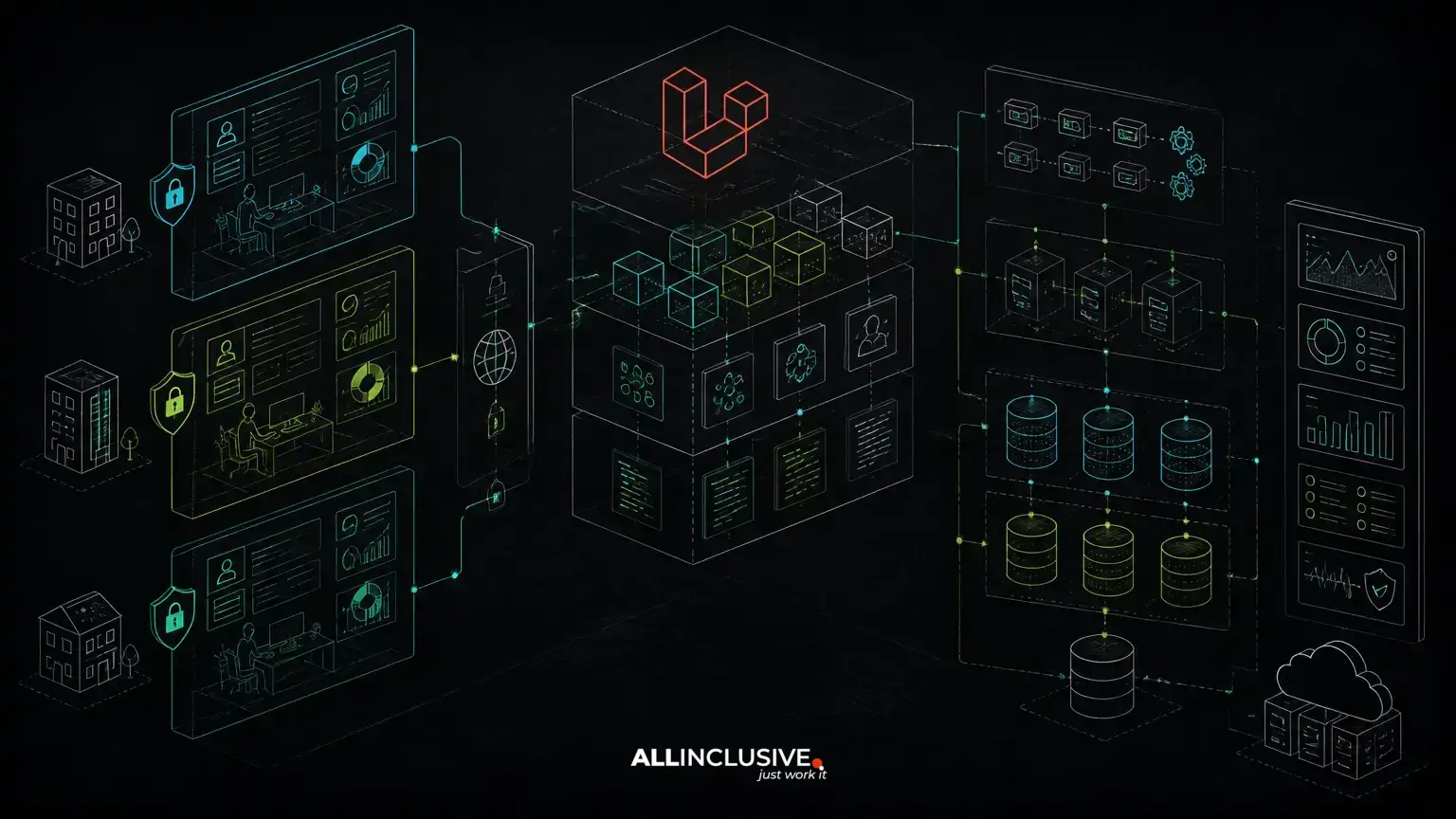
Laravel multi-tenancy is an architectural choice for building one application that serves multiple organizations while keeping each organization’s users, records and workflows appropriately separated. The key decision is not simply whether to add a tenant_id column. A production design must define how tenants are identified, how data access is constrained, how background jobs and files retain tenant context, and how the system is operated as the customer base grows. The laravel multi tenancy workflow also connects to the guidance in custom software development.
For many SaaS products, the most maintainable starting point is a shared application with tenant-scoped data in one database. More demanding isolation, compliance or operational requirements may justify separate schemas or databases. Laravel can support each model, but the application’s domain boundaries, Eloquent conventions, authentication flow, deployment process and testing strategy must be designed together. The laravel multi tenancy workflow also connects to the guidance in laravel for custom web applications.
What Laravel multi-tenancy needs to solve
A tenant is usually an organization, account or workspace that owns a set of users and business records. A request may contain a tenant identifier through a subdomain, custom domain, authenticated membership, URL segment or API credential. The application then uses that context to determine which records the user may access.
That creates several related responsibilities:
- Tenant resolution: identify the organization associated with a request, command or queued job.
- Authorization: confirm that the authenticated user belongs to the tenant and has the required role or permission.
- Data isolation: ensure queries, writes, exports and administrative tools stay within the intended tenant boundary.
- Operational isolation: prevent caches, files, queues, notifications and scheduled tasks from mixing tenant data.
- Lifecycle management: provision, suspend, migrate, archive and delete tenants safely.
These concerns are broader than routing. A tenancy implementation that protects ordinary web requests but loses context in a queue worker can still expose data or process the wrong organization’s records.
Choosing a Laravel tenancy database model
Shared database with tenant-scoped rows
In the shared-database model, tenant-owned tables include a tenant key such as tenant_id. Queries are scoped to that key, usually through explicit repository logic, model scopes, policies or a carefully designed application-wide mechanism.
This approach generally has the lowest infrastructure overhead. Migrations run against one database, reporting across tenants is comparatively straightforward, and a new tenant does not require a new database. It is often appropriate for early and mid-stage SaaS products with consistent data structures and ordinary isolation requirements.
The trade-off is that isolation depends heavily on application correctness. Every relevant query, relationship, import, export and administrative action must respect the tenant boundary. A forgotten condition can become a serious security defect. Shared indexes and large tables can also require careful query planning as tenant volume and record counts increase.
Separate schemas
With separate schemas, tenants share a database server but their data is placed into distinct schemas or equivalent namespaces. This can create a stronger structural boundary than a shared table while retaining some centralized infrastructure.
Schema-based tenancy adds operational complexity. Migrations must be applied consistently across many schemas, connection behavior must be verified across environments, and reporting across tenants becomes less direct. It may be useful when an organization needs more separation than row-level scoping but does not need fully independent database instances.
Separate databases
In a database-per-tenant model, each organization receives its own database or database instance. This can support stronger isolation, tenant-specific backups and differentiated operational policies. It may also simplify certain customer-specific restore or retention procedures.
The cost is operational multiplication. Provisioning, credentials, migrations, monitoring, backups, connection management and disaster recovery all become more involved. Application code must reliably select the correct connection for every request and background process. This model should be chosen because its isolation or lifecycle benefits are necessary, not because separate databases automatically make an application secure.
Modeling tenants and memberships in Eloquent
A typical domain separates the tenant from the user. A user may belong to one organization in a simple product, but a many-to-many membership model is more flexible for products where users work across multiple organizations.
Common entities include:
- Tenant: the organization or workspace that owns business data.
- User: the person authenticating to the application.
- Membership: the relationship between a user and tenant, including role or status.
- Tenant-owned records: invoices, projects, tickets, documents or other domain entities linked to a tenant.
For shared tables, tenant ownership should be represented consistently and enforced at the domain boundary. A model scope can help express common filtering, but it should not be treated as the only security control. Policies and authorization checks still need to verify that the current user can act on the resolved tenant and target record.
Relationships also deserve scrutiny. A tenant-scoped project may have tasks, comments and files. If a relationship can be reached through an unscoped query, an attacker may be able to substitute an identifier from another tenant. Prefer access paths that begin with the authorized tenant or otherwise prove ownership through policy checks.
Resolving tenant context safely
Tenant resolution should happen early in the request lifecycle and produce an explicit context object or equivalent application state. Common signals include a verified custom domain, a subdomain mapped to a tenant, an authenticated membership, or a tenant identifier in an API credential.
Do not trust a tenant ID supplied by the browser or client without verifying the user’s membership. A URL such as /tenants/42/projects/9 is only a locator; it is not proof that the current user may access tenant 42 or project 9.
For web applications, middleware can resolve the tenant and reject requests that use an unknown or inactive organization. For APIs, tokens or claims may identify an account, but authorization must still be enforced against current membership and status. Custom domains also require careful handling of DNS, certificate provisioning, local development and fallback behavior.
Keep tenant context explicit in service methods where practical. Hidden global state can make code convenient in one request and difficult to reason about in commands, tests and workers. The right balance depends on the application, but the rule is consistent: developers should be able to see how a piece of work becomes tenant-scoped.
Preventing cross-tenant failures beyond HTTP requests
Queues and scheduled work
Queued jobs must carry enough information to restore tenant context when they execute later. A job that stores only a record ID may be ambiguous if the worker does not know which tenant owns it, and a long-running worker may retain state unintentionally if context is not reset between jobs.
Scheduled commands should iterate tenants deliberately rather than relying on whichever tenant happened to be resolved by a preceding request. For each unit of work, load the tenant, establish its connection or scope, perform the operation, and clear the context afterward.
Cache keys and files
Cache keys should include a stable tenant identifier whenever the value is tenant-specific. The same principle applies to filesystem paths, object-storage prefixes, temporary exports and generated reports. A generic key such as settings can produce incorrect behavior if multiple organizations share a cache.
Notifications, webhooks and integrations
Outbound emails, webhook payloads and third-party credentials need tenant-aware ownership. Integrations should not retrieve credentials from a global configuration record when each organization has its own connection. Webhook processing should authenticate the sender, resolve the intended tenant and make retries idempotent.
Authentication, authorization and tenant administration
Authentication answers who the user is. Multi-tenancy additionally requires an answer to which tenant the user is acting within and what that user may do there.
Role systems should be designed around business capabilities rather than only generic labels. An organization administrator may manage billing but not export sensitive records; a project manager may edit projects but not invite users. Policies should evaluate both the user’s membership and the target resource’s tenant ownership.
Tenant-switching workflows need particular care. When a user changes organization, invalidate or refresh tenant-specific session state, recalculate permissions, and ensure subsequent requests cannot reuse stale identifiers. API clients should make the active tenant explicit where ambiguity is possible.
Testing tenant isolation as a release requirement
Multi-tenancy should be tested as a security and correctness property, not only as a feature. Useful tests include:
- Requests cannot read, update or delete another tenant’s records by changing an identifier.
- Relationships and nested resources preserve tenant ownership.
- Users with no membership cannot access a tenant, even if they know its domain or ID.
- Tenant-specific cache entries do not collide.
- Queued jobs execute against the tenant that dispatched them.
- Exports, notifications and webhooks use the correct tenant configuration.
- Administrative and support tools have explicit cross-tenant permissions and audit trails.
- Tenant provisioning and deactivation are safe to retry.
Factories should create multiple tenants and deliberately create similarly shaped records in each. Negative tests are especially valuable: attempt to access a record from the wrong organization and confirm that the application denies it rather than returning an empty result by accident.
A reliable CI process can make these checks routine. For broader Laravel testing and release practices, see Laravel testing and CI/CD.
Operational trade-offs as tenant counts grow
Database architecture affects more than isolation. Shared databases simplify migrations and centralized reporting, but noisy tenants may compete for resources. Separate databases improve control over backups and capacity, but increase connection, migration and observability work.
Ask operational questions before selecting a model:
- Will every tenant use the same schema and release cadence?
- Do customers require isolated backups, retention or restoration?
- Will the product need cross-tenant reporting?
- Can the team monitor and migrate many databases reliably?
- Are there contractual or regulatory requirements that affect isolation?
- How will large imports, exports or background jobs be rate-limited?
There is no universal best architecture. A shared model may be the most maintainable choice when the team can enforce row-level boundaries and the product has uniform operational needs. Separate databases may be justified when tenant-specific recovery, isolation or scaling requirements outweigh the added administration.
Designing for maintainable Laravel SaaS code
A maintainable implementation keeps tenancy rules close to the domain rather than scattering ad hoc conditions throughout controllers. Services, policies, query objects and well-defined repositories can make ownership rules easier to review. Database constraints, indexes and foreign keys should support the intended model where the chosen database engine allows it.
Document the tenant lifecycle: creation, onboarding, plan changes, suspension, data export, deletion and restoration. Billing events should be idempotent and associated with the correct tenant. Deployment procedures should specify how schema changes, queued jobs and long-running workers are coordinated during releases.
Laravel is often a strong fit for custom SaaS products because it provides a productive foundation for domain logic, authentication, queues, APIs and testing while leaving architecture decisions to the engineering team. Explore broader Laravel development services when the application needs custom business workflows rather than a template-first implementation.
Multi-tenancy also creates an ongoing ownership requirement. Monitoring, dependency upgrades, security reviews, database maintenance and incident procedures should account for tenant context. A planned support and maintenance process helps keep the architecture reliable after the initial launch.
When to revisit the tenancy model
A product may begin with shared tables and later need stronger separation, but migration is not automatic. Before changing models, map every tenant-owned table, relationship, cache, file, queue, integration and reporting workflow. Decide whether the transition will be gradual, whether old and new models must coexist temporarily, and how rollback will work.
Revisit the design when tenant-specific performance requirements diverge, customer contracts require distinct recovery controls, reporting becomes difficult to manage, or operational incidents reveal that the current boundary is too dependent on application discipline. A measured migration is usually safer than introducing database complexity without a clear requirement.
The central design principle is straightforward: tenant isolation must be consistent across data, execution and operations. Choose the simplest Laravel architecture that meets the product’s security and lifecycle requirements, then make its assumptions visible through domain code, constraints, tests and deployment procedures.


