
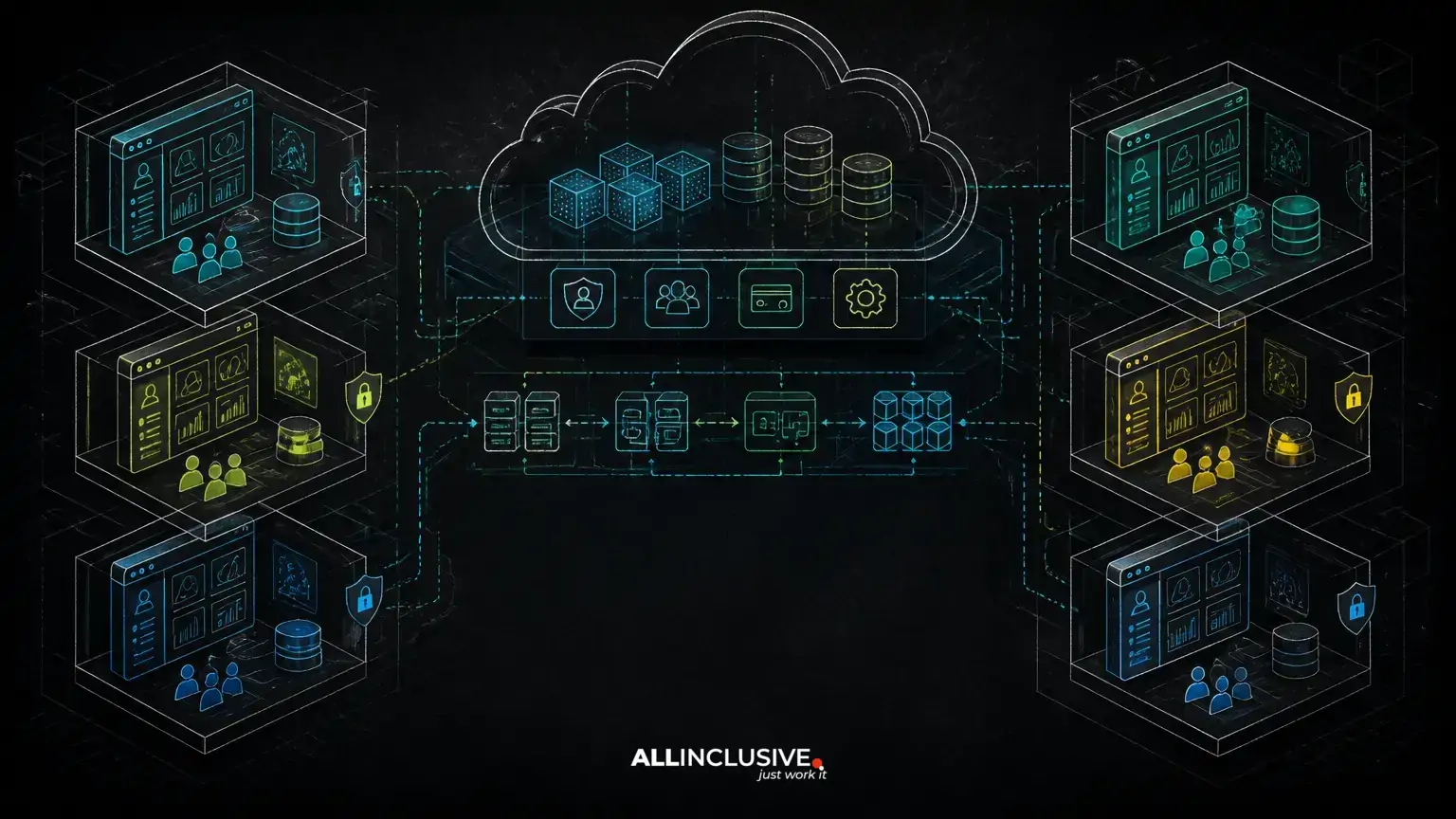
Multi-tenant SaaS architecture lets one product serve multiple customer organizations while sharing some application infrastructure. The difficult part is not adding a tenant identifier to a table. It is defining how data, permissions, billing, integrations, operations and support behave when customers share a platform but must remain operationally independent. For multi-tenant saas architecture, an adjacent technical consideration is explained in web development services.
A reliable design starts with the business workflow. Each tenant should have a clear boundary, every request should be evaluated in that context, and commercial rules should be represented separately from authorization rules. The architecture must also leave room for tenant-specific configuration, controlled exceptions and future growth without turning the codebase into a collection of customer-specific conditions.
What multi-tenant SaaS architecture actually means
In a multi-tenant system, a tenant is usually an organization, account or workspace that owns users, records and configuration. The application may share compute, deployment pipelines, queues and database infrastructure across tenants, but tenant-owned data must be accessed only through an intentional tenant context.
This differs from a single-customer application deployed repeatedly for different customers. Separate deployments can simplify isolation, but they increase operational overhead and may complicate upgrades, observability and shared feature delivery. Multi-tenancy centralizes more of the platform, so the design must be explicit about isolation and failure boundaries.
Common tenant models include:
- Shared database, shared schema: tenant-owned rows share tables and include a tenant key. This is efficient, but every query path must enforce tenant scope.
- Shared database, separate schemas: tenants are separated by database schema. This can provide stronger boundaries, although migrations and provisioning become more involved.
- Separate database per tenant: each tenant has an independent database. This supports stronger isolation and selective residency or backup policies, at the cost of more provisioning and operational work.
There is no universal best choice. The decision depends on regulatory obligations, customer requirements, expected tenant count, data volume, operational maturity and the consequences of a tenant-level failure.
Design tenant isolation as a system-wide invariant
Tenant isolation should not depend on developers remembering to add a filter in every controller. It should be treated as an invariant enforced across the application, data access layer, background jobs, exports, search indexes, caches, files and administrative tools.
A typical request flow identifies the tenant from an authenticated organization membership, a trusted subdomain or another controlled mapping. The application then establishes a tenant context before business logic runs. Repository methods, query builders or service-layer policies use that context when retrieving or modifying tenant-owned records.
Useful safeguards include:
- Require tenant scope for tenant-owned queries rather than making it optional.
- Validate that a user belongs to the requested tenant before loading tenant resources.
- Use database constraints and foreign keys to preserve relationships within the correct tenant boundary.
- Include tenant identity in queue payloads, cache keys, audit events and file paths.
- Test cross-tenant access attempts as deliberately as normal workflows.
- Review reporting, support impersonation and bulk administration separately because these paths often bypass ordinary request assumptions.
Shared-schema systems can be appropriate for many products, but they demand disciplined query patterns and strong automated testing. A missed tenant condition in an export or background job can be more serious than a visible application error because the system may appear to work while returning the wrong organization’s data.
Separate authentication, tenant membership and authorization
Authentication answers who a person is. Tenant membership answers which organizations they can access. Authorization answers what they can do within a selected organization. Treating these as one concept produces confusing permission models and makes future requirements harder to implement.
A user may belong to several tenants with different roles. For example, the same person could be an administrator in one organization, a reviewer in another and a read-only external collaborator in a third. The role belongs to the membership or relationship, not necessarily to the global user record.
Permission design should reflect business actions rather than only interface screens. A system may need permissions such as approve invoices, invite users, manage integrations, export records or change billing details. These capabilities can then be grouped into roles that match how the organization operates.
For a deeper treatment of permission modeling, see role-based access control for web apps. In a multi-tenant product, also consider whether permissions apply to all tenant records or only a region, department, project or account owned by that tenant.
Keep billing boundaries distinct from application roles
Billing and authorization interact, but they should not be collapsed into one model. A user’s role determines what the user may do. A subscription or contract determines what the tenant has purchased or is entitled to use.
That distinction matters when a plan limits seats, storage, workflow volume, automation runs or access to particular modules. The application should represent entitlement checks explicitly rather than scattering plan-name comparisons throughout the codebase.
A durable billing design usually accounts for:
- Tenant ownership of the subscription or commercial account.
- Plan, contract or entitlement records with effective dates.
- Usage measurement and the events that produce billable quantities.
- Invoices, payment status and reconciliation states.
- Grace periods, failed payments, cancellation and reactivation.
- Manual adjustments or negotiated enterprise terms.
Payment-provider events should be processed as external inputs, not treated as unquestionable synchronous truth. Webhook handlers need verification, idempotency and a way to reconcile delayed or repeated events. The application should also define what happens when payment status is uncertain. Immediate destructive access removal can disrupt legitimate workflows, while indefinite access without commercial controls creates a different operational problem.
Model tenant configuration without creating a forked product
Customers often need differences in branding, approval steps, notification rules, fields or integrations. The safest approach is to identify which variations are genuine product configuration and which are requests for a separate product behavior.
Configuration can be represented through structured settings, feature entitlements, workflow definitions or policy records. It should be validated, versioned where necessary and observable in support tooling. Avoid placing unstructured customer-specific logic in scattered conditionals such as “if this tenant, then do something else.” Those exceptions increase testing cost and make upgrades unpredictable.
Feature flags can help release functionality gradually, but they are not a substitute for authorization or billing checks. A flag should have an owner, a reason for existence and a removal or review path. For high-value enterprise differences, a separate module or extension boundary may be more maintainable than increasingly complex tenant configuration.
Choose data architecture around workflow and failure boundaries
Tenant-owned transactional data is only one part of the system. Files, search indexes, analytics data, audit logs and third-party synchronization records also need ownership and retention rules.
For shared databases, indexing should reflect common access patterns, often beginning with tenant identity followed by the fields used for filtering or ordering. This is not a universal indexing formula; real queries and data distribution should guide the design. Large or unusually active tenants may require partitioning, archival, separate workloads or a different storage strategy.
Consider failure boundaries as well as capacity. If one tenant generates a large import, expensive report or queue backlog, can that work delay other customers? Queue priorities, per-tenant limits, concurrency controls and workload isolation can reduce noisy-neighbor risk.
Backups and restoration require special planning. A full platform restore may be straightforward, while restoring one tenant without overwriting others is more complex. Define whether the product needs tenant-level export, deletion, retention, legal hold and recovery procedures before these become urgent customer commitments.
Build integrations and background jobs with tenant context
Many SaaS workflows run outside the web request: sending notifications, importing data, synchronizing records, generating documents and processing AI-assisted tasks. Every asynchronous job should carry enough context to identify the tenant, authorization assumptions and relevant record scope.
Jobs should be idempotent where possible. If a message is retried, the system should not create duplicate invoices, notifications or external records. External identifiers should be stored with the tenant relationship, and integration credentials should be encrypted and scoped to the tenant that authorized them.
Observability also needs tenant awareness without exposing sensitive customer data in logs. Operational events should identify the tenant and workflow, while payload logging should be minimized and access-controlled. Support tools should make it possible to investigate a tenant issue without granting broad, untracked access to unrelated customer data.
Plan for scale before shared infrastructure becomes a constraint
Scalability is not only a matter of adding servers. Multi-tenant systems scale across tenants, users, records, workflows and uneven usage patterns. A small number of high-volume tenants can affect the experience of many smaller ones.
Useful design questions include:
- Which operations are synchronous, and which should be queued?
- What are the largest expected imports, reports or file operations?
- Can expensive work be rate-limited or scheduled per tenant?
- Which tables, indexes and queries will grow fastest?
- What metrics reveal a tenant-specific bottleneck?
- Can a large tenant move to isolated infrastructure later without a full rewrite?
Application performance work should be based on measured query behavior, queue latency, resource utilization and workflow requirements. The web app scalability checklist can help structure that review. Designing an extraction path for exceptional tenants is often more valuable than prematurely deploying every tenant separately.
Use a workflow-first build and validation sequence
Before implementation, map the workflows that define tenant boundaries: onboarding, invitation, role changes, subscription changes, imports, approvals, exports, offboarding and support access. For each workflow, identify the actor, tenant context, records affected, authorization decision, external systems and failure recovery.
A practical delivery sequence is:
- Define tenant ownership and membership rules.
- Model core business records and their tenant relationships.
- Implement authorization around business actions.
- Establish billing and entitlement boundaries.
- Add asynchronous processing with explicit tenant context.
- Test isolation, retries, exports, deletion and administrative access.
- Measure workload behavior before optimizing or changing the tenancy model.
This approach keeps architecture connected to real operations instead of designing an abstract tenancy layer that does not match how customers use the product. It also makes build-versus-buy decisions clearer: identity, payments, email delivery and observability may be integrated services, while tenant-specific workflows and domain rules are often where product differentiation and ownership matter most.
When custom multi-tenancy is the right investment
A custom-made SaaS product is justified when the workflow, data model or commercial model does not fit a generic platform without costly workarounds. It can provide ownership of source code, control over integrations and the ability to evolve the product around actual customer operations.
That does not mean every subsystem must be built from scratch. A sensible architecture evaluates managed infrastructure and specialized services while keeping core domain logic, authorization decisions and tenant boundaries understandable and testable. PHP and Laravel can be suitable for workflow-heavy web products when their conventions support the team and operating model; Python or another stack may be preferable for particular data, automation or service requirements. The choice should follow the product workflow, not a technology checklist.
For broader planning and implementation support, explore custom software and web development. After launch, ongoing monitoring, dependency updates, security review and operational improvements are part of maintaining a trustworthy multi-tenant platform; the support and maintenance service provides a relevant next step.
Pre-launch checks for a multi-tenant SaaS product
- Can every tenant-owned record be traced to an explicit tenant boundary?
- Are tenant context and membership verified before authorization?
- Do exports, files, caches, search indexes and jobs preserve tenant scope?
- Are roles separate from plans, entitlements and payment status?
- Are webhook processing and asynchronous jobs idempotent?
- Can administrators and support staff access data only through audited paths?
- Have noisy-neighbor scenarios and high-volume tenants been tested?
- Are backup, deletion, export and tenant-level recovery requirements defined?
- Can configuration evolve without creating unreviewed tenant-specific branches?
- Does the architecture preserve a practical path to isolate exceptional tenants later?
Multi-tenant SaaS architecture is ultimately a product and operations decision as much as a database decision. Strong isolation, explicit membership, separate billing concepts and workflow-led implementation create a platform that can grow without losing control of customer data or business rules.


