Gemini API integration is most valuable when a business workflow needs more than text generation. Multimodal models can help software interpret documents, images, audio and text, then connect that understanding to controlled application actions. The difficult part is not sending a prompt. It is designing a reliable boundary between the model, company data, business rules and users.
A production implementation should therefore treat Gemini as one component in a broader system. A Python service may handle model interaction, retrieval and evaluation, while Laravel or another application layer owns authentication, workflow state, permissions, billing and user-facing operations. This separation makes the AI capability easier to test, replace, monitor and govern.
This article explains where Gemini can fit in business software, which architecture patterns are useful, and what must be addressed before a prototype becomes a dependable product feature. For broader delivery context, see AI development and the wider software development hub.
Where Gemini API integration fits in a business workflow
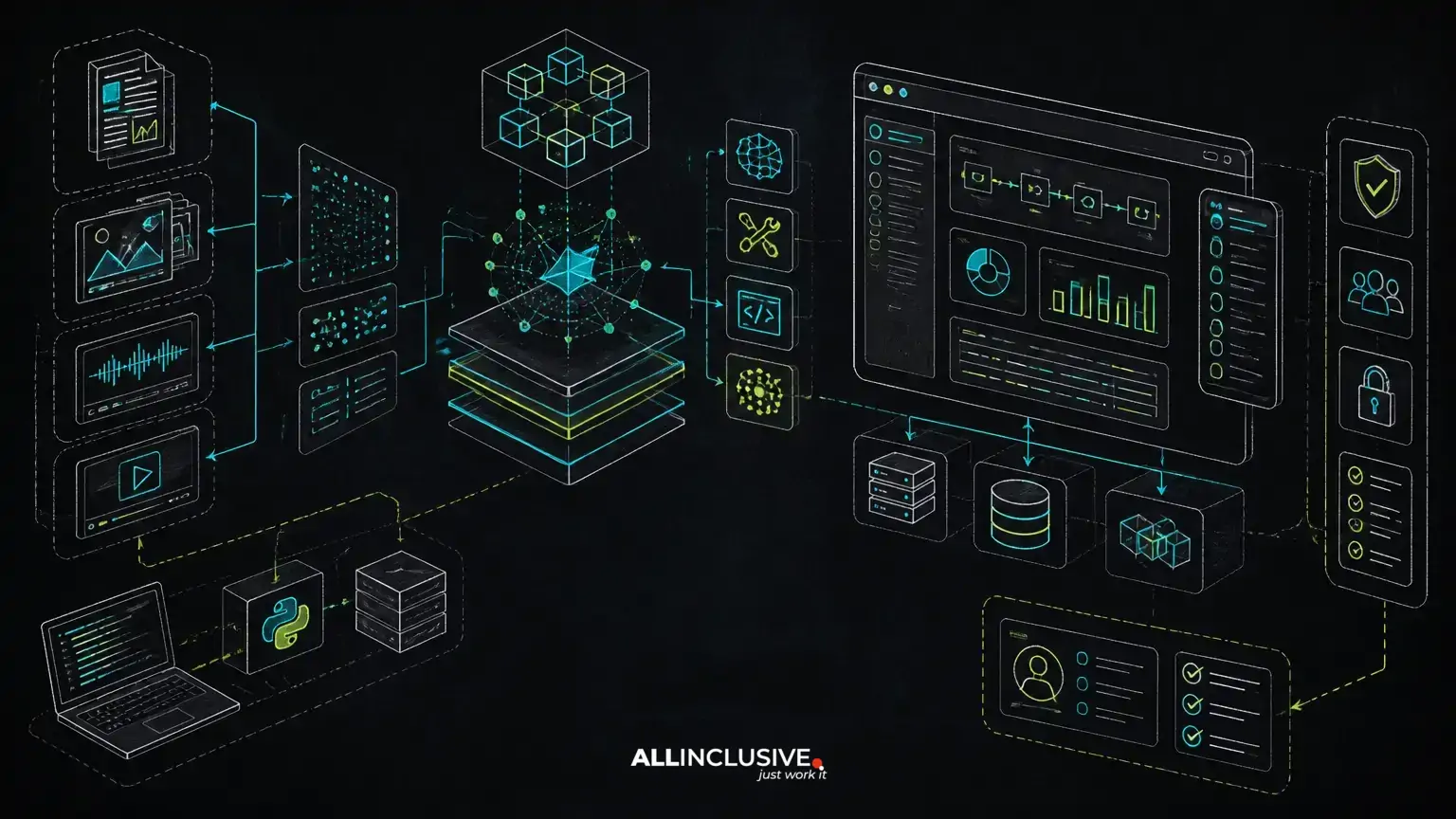
Gemini is a reasonable candidate when the workflow involves unstructured or multimodal inputs and the output can be reviewed, validated or constrained by application logic. Typical examples include:
- Document understanding: extracting fields from invoices, contracts, applications or inspection records.
- Knowledge assistance: answering questions against approved internal documents through retrieval-augmented generation.
- Content transformation: summarizing, classifying, translating or restructuring customer-provided material.
- Image and media analysis: interpreting visual evidence, screenshots or recorded inputs where the business process requires a preliminary assessment.
- Workflow assistance: preparing a draft response, routing a case or recommending the next action without granting the model unrestricted authority.
The model should not silently become the system of record. It can propose an interpretation or action, but the surrounding application should decide what is accepted, persisted and exposed to other users.
A reference architecture for Gemini API integration
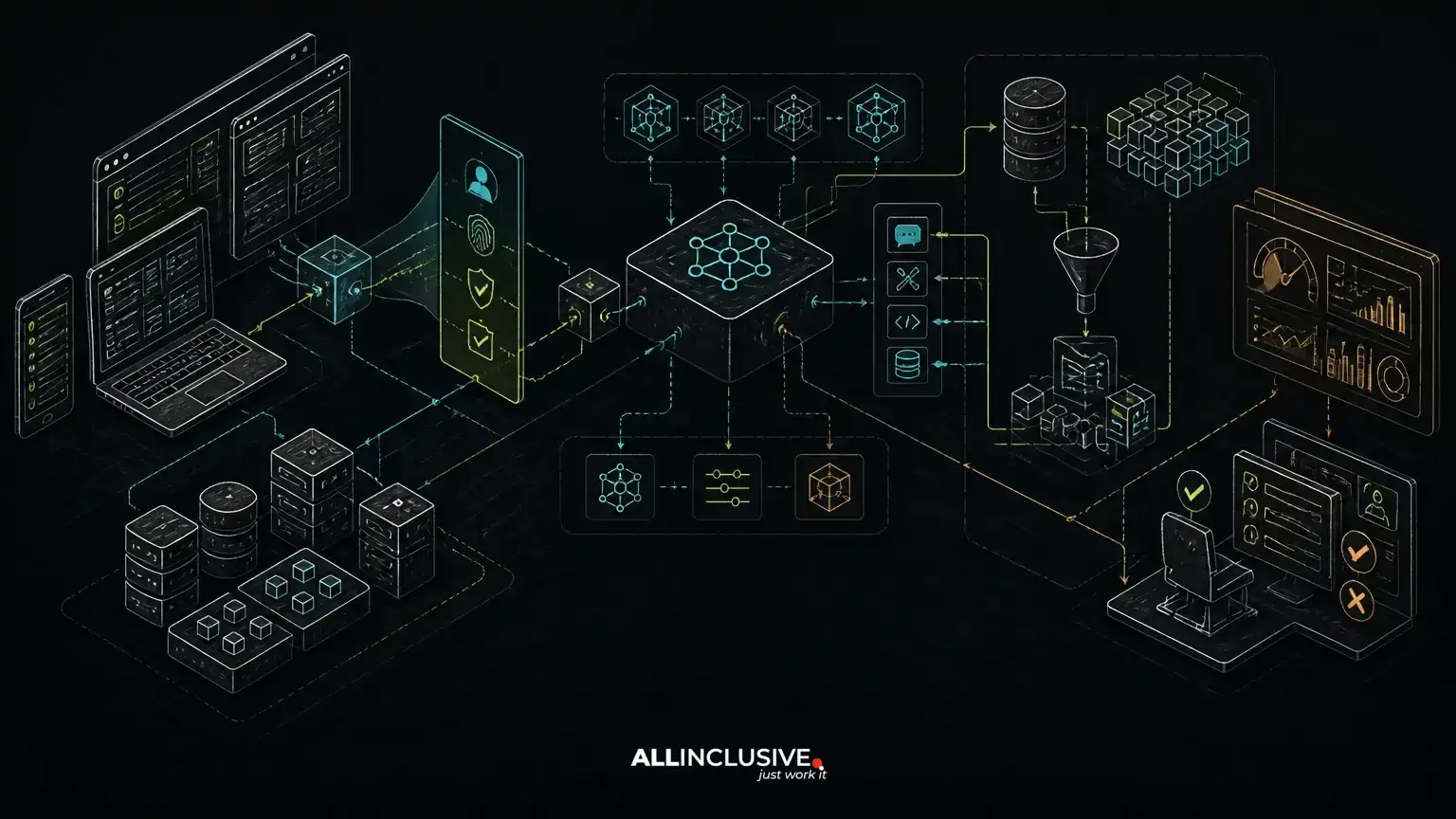
A maintainable design usually separates the product layer from the AI orchestration layer. The exact deployment can vary, but the responsibilities are easier to reason about when they are explicit.
Application and workflow layer
Laravel, PHP or another application framework can manage user accounts, tenant boundaries, permissions, workflow state, queues, notifications and audit records. It should validate who is allowed to request an AI operation and which data may be included in that request.
AI orchestration layer
A Python service can prepare prompts, normalize inputs, call Gemini, execute retrieval, apply structured-output validation and coordinate retries or fallbacks. Keeping this layer separate is useful when AI dependencies change faster than the core product or when data-processing libraries are primarily available in Python.
Data and retrieval layer
For knowledge-grounded answers, the system can ingest approved source material, split it into meaningful passages, create embeddings, retrieve candidates and optionally rerank them before building the model context. Retrieval is not a guarantee of correctness: the application still needs source attribution, access filtering and answer evaluation.
Observability and review layer
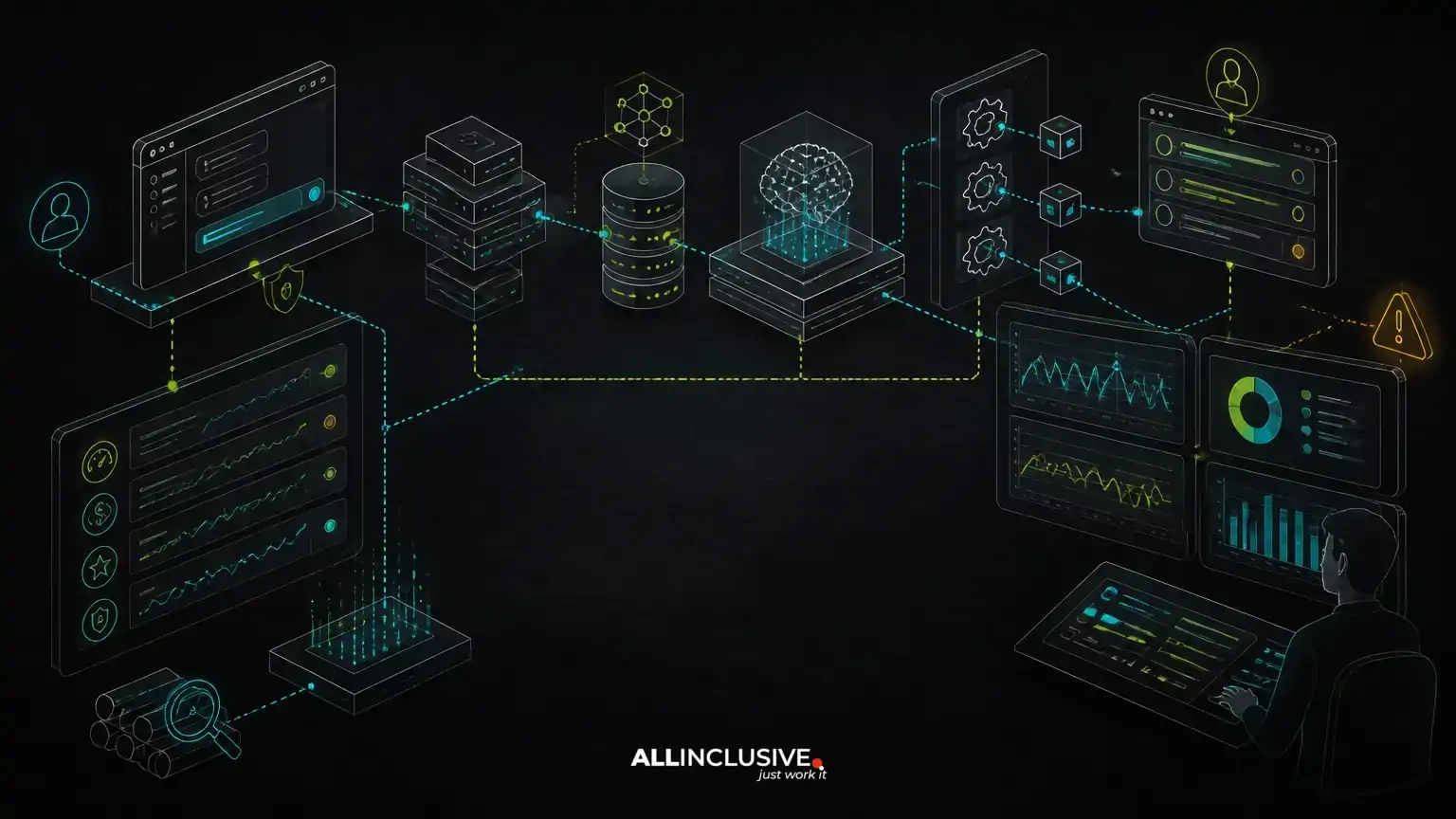
Every meaningful AI operation should have enough metadata to investigate failures. Useful records can include model and prompt version, request type, latency, token or usage data when available, retrieved document identifiers, validation results, escalation status and the final human decision. Sensitive content should not be logged by default.
This architecture is closely related to the concerns covered in LLM integration architecture, particularly the separation of model calls from product-critical business logic.
Use structured outputs and explicit business contracts
Free-form text is convenient for a demo but difficult to operate safely. If Gemini is expected to produce data for an application, define a response contract. For example, a document-review operation might require:
- a classification selected from an allowed set;
- normalized fields with explicit null behavior;
- confidence or review signals that are treated as indicators, not proof;
- source references or page locations where applicable;
- a list of missing, contradictory or uncertain information; and
- a recommended next step that cannot directly bypass authorization.
The service should validate the returned structure before it reaches the domain layer. Invalid output can be retried with a narrower instruction, routed to a fallback model, placed in a review queue or rejected with a visible operational status. Do not let malformed model output write directly to financial, legal, identity or permission-sensitive records.
RAG for private business knowledge
Retrieval-augmented generation is often a better fit than attempting to place an entire knowledge base into a prompt. A typical pipeline indexes authorized content, retrieves relevant passages for a question and supplies only those passages to Gemini.
The quality of this pipeline depends on more than the model. Chunk boundaries, metadata, document freshness, query rewriting, filtering and reranking all affect what the model sees. A technically fluent answer can still be wrong if retrieval selects an outdated policy or content from another tenant.
Permission checks should happen before context assembly, not only after the answer is generated. Store ownership, document status, tenant identity and access rules as retrieval metadata. When the system cannot find sufficient evidence, it should state that limitation or route the request for review rather than inventing a confident response.
Tool use and agents need narrower boundaries than chat
Connecting Gemini to tools can make an assistant useful inside a real workflow. Tools might search a CRM, calculate an eligibility result, create a draft ticket or retrieve an order status. The model should select from a limited set of typed operations, while the application validates arguments and authorization.
Agentic behavior becomes risky when the system can chain actions indefinitely or treat a model-generated instruction as permission. Set explicit limits for tool count, execution time, data scope and action type. Separate read operations from writes, require confirmation for consequential actions and make each tool call auditable.
A practical pattern is to let the model prepare an action proposal while a deterministic service decides whether it is permitted. Human approval may be required for refunds, account changes, external communications, regulated decisions or any operation with material customer impact.
Multimodal input changes the testing problem
Text-only tests do not adequately represent a multimodal feature. Inputs can vary by image quality, document layout, handwriting, language, audio clarity, compression and missing pages. A document extraction system should be tested against representative variations, not only clean examples selected by the development team.
Evaluation cases should include correct, ambiguous and adversarial inputs. Measure the fields that matter to the workflow, such as extraction accuracy, citation validity, refusal behavior, routing decisions and reviewer agreement. Also test whether the system exposes uncertainty when evidence is incomplete.
Evaluation should continue after launch. Model updates, prompt changes, retrieval modifications and source-document changes can alter behavior. The principles in AI evaluation frameworks are relevant here: maintain a versioned test set, define acceptance criteria and investigate regressions before releasing changes broadly.
Latency, cost and reliability require deliberate controls
AI requests can be slower and less predictable than ordinary application queries. A user-facing workflow may need streaming, asynchronous processing, a progress state or a queue rather than a request that waits indefinitely.
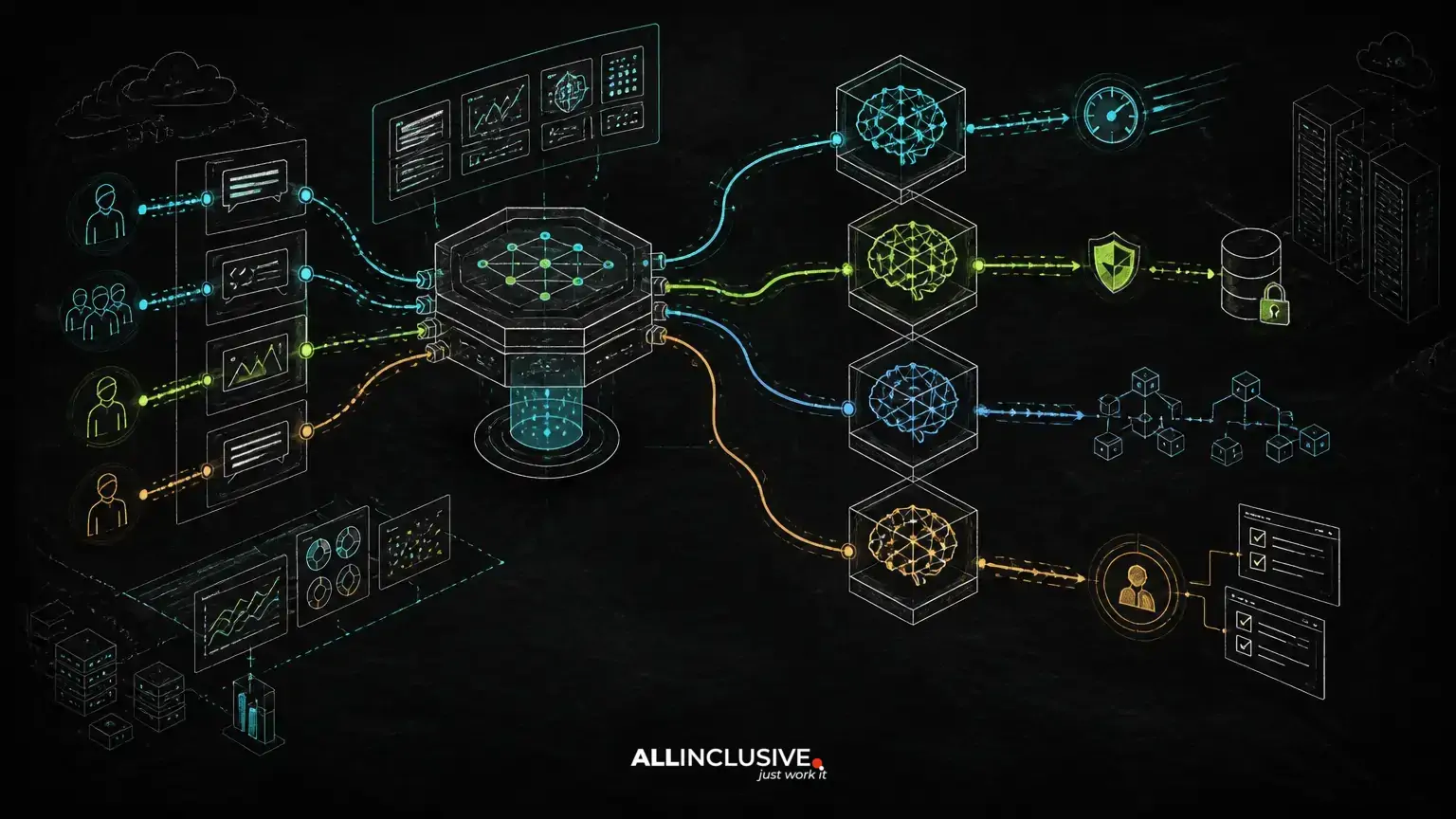
Cost management starts with scope. Limit unnecessary context, avoid repeatedly sending the same large files, cache safe intermediate results and select models according to task complexity. Routing a simple classification or extraction step to a smaller suitable model may be preferable to using the most capable model for every operation. A multi-model strategy is discussed in multi-model AI routing.
Reliability controls should include bounded retries, timeouts, idempotency keys and clear failure states. A fallback can be another model, a rules-based path, a delayed review queue or a request for more information. The right fallback depends on the business consequence of an incorrect or unavailable response.
Privacy, permissions and data retention
Before sending business data to an external model API, document what data is transmitted, why it is needed, how it is retained and who can access the resulting records. Remove unnecessary personal data, redact secrets and avoid including an entire customer record when only a few fields are relevant.
Multi-tenant products require tenant-aware retrieval, logs and caches. A shared embedding index or prompt cache must not allow one customer’s information to appear in another customer’s context. Access controls should be enforced by the application and tested as part of the AI evaluation suite.
Privacy is also a product-design issue. Give users a clear indication when content is AI-generated or awaiting review, provide correction paths and preserve the source evidence needed to investigate an incorrect result.
Common Gemini integration failure modes
- Prototype code becomes production code: a controller calls the model directly with no queue, validation, audit trail or retry policy.
- Retrieval is added without authorization: relevant content is found, but the system has no reliable tenant or role filtering.
- Confidence is treated as truth: a model score is used as a business decision without calibration or human review.
- Prompt changes are untracked: behavior changes cannot be explained because prompts, model choices and test results were not versioned.
- Logs contain sensitive prompts: debugging data creates a new privacy and access-control problem.
- Agents receive excessive authority: a useful assistant can make irreversible changes without confirmation or deterministic validation.
A production readiness checklist
Before releasing a Gemini-powered feature, confirm that the team can answer these questions:
- What exact user or business problem does the model solve?
- Which inputs are permitted, and what sensitive data is removed?
- What response schema and validation rules apply?
- How are retrieval results filtered by tenant, role and document status?
- What happens when the model is unavailable, uncertain or structurally invalid?
- Which actions require deterministic rules or human approval?
- How are latency, usage, errors, reviews and model changes monitored?
- What evaluation set represents real and difficult inputs?
- Who owns prompts, model configuration, source data and incident response?
Choosing the right implementation boundary
Gemini API integration works best when it is designed around a specific workflow rather than added as a general-purpose chat box. The product application should own identity, permissions, records and business consequences. The AI layer should own model interaction, context preparation, structured interpretation and evaluation. Human reviewers should remain part of the design wherever ambiguity or impact makes automation unsafe.
For teams building or extending a custom product, the appropriate architecture may combine a Laravel or PHP application with Python-based AI services, queues, retrieval infrastructure and a review interface. The technology choices matter, but clear ownership boundaries matter more: they determine whether the feature can be tested, governed and changed without destabilizing the rest of the software.