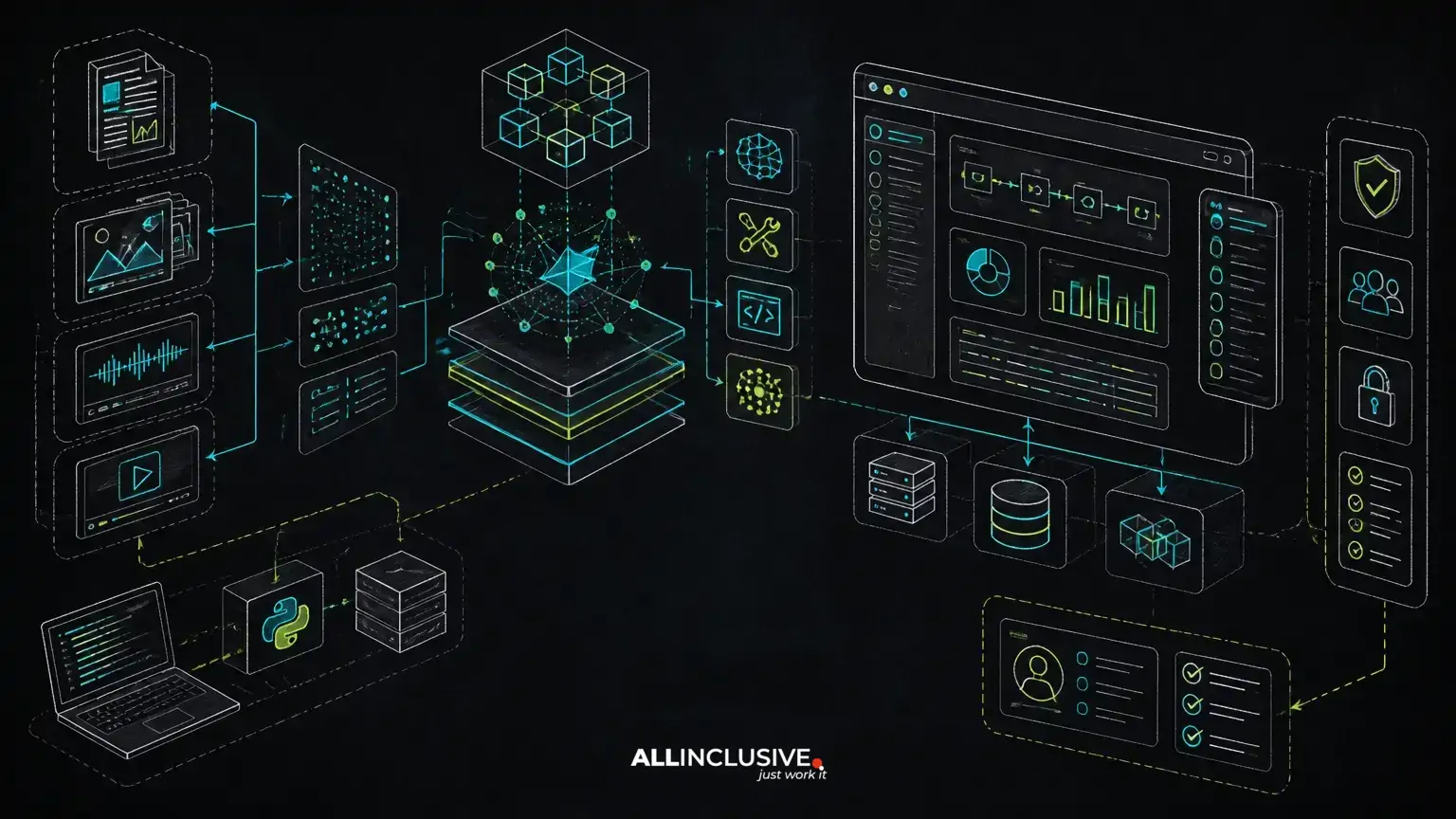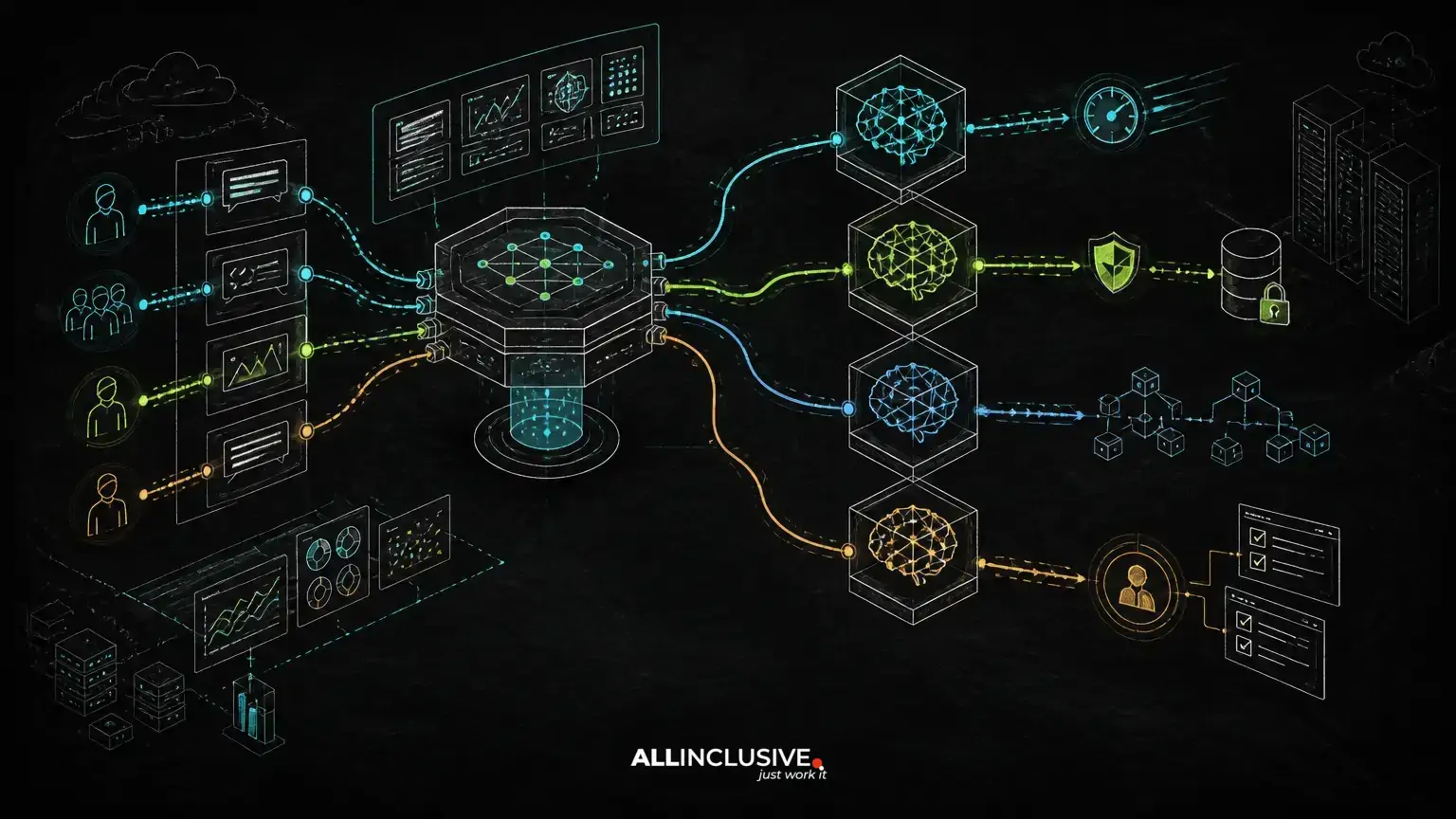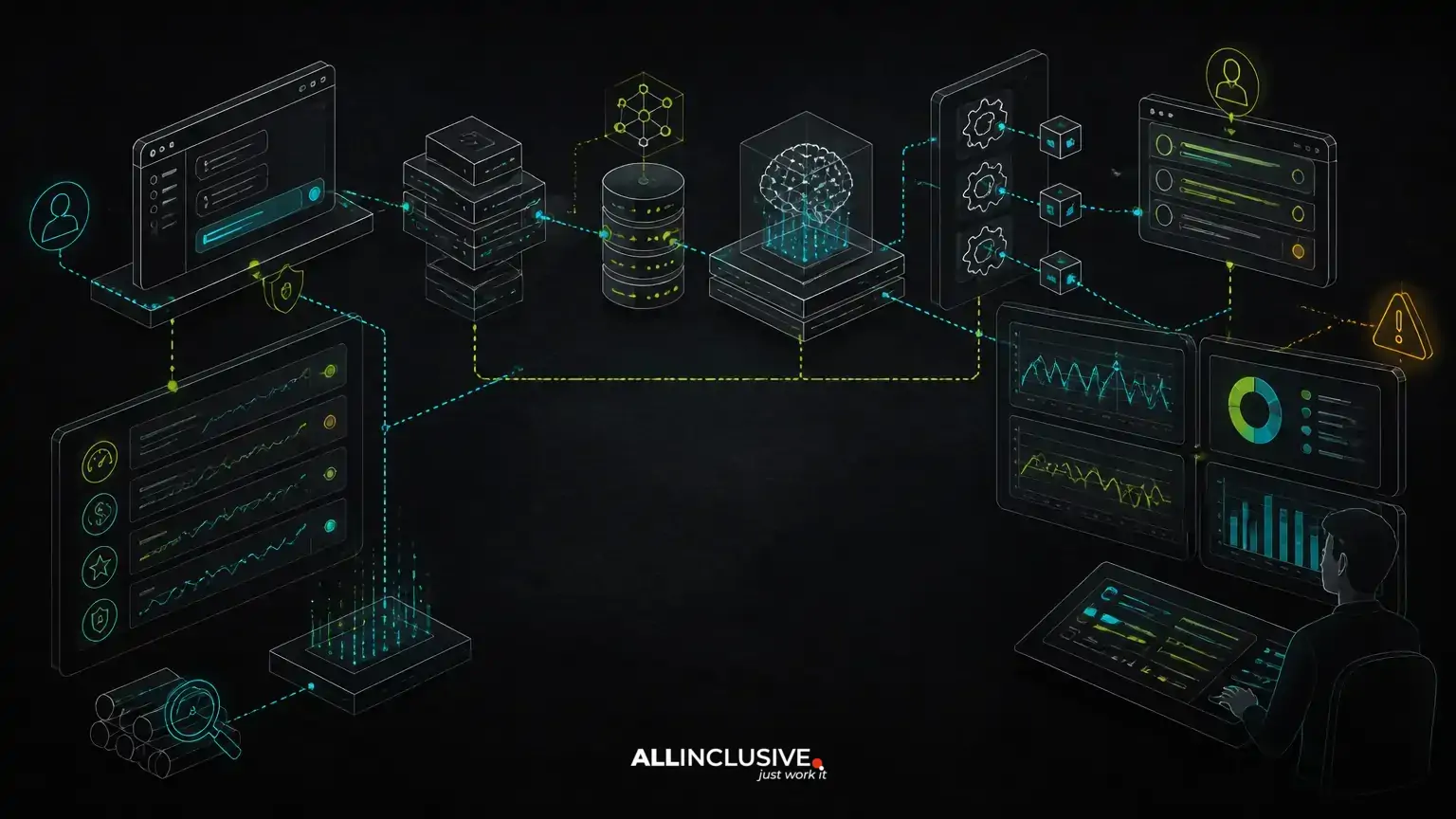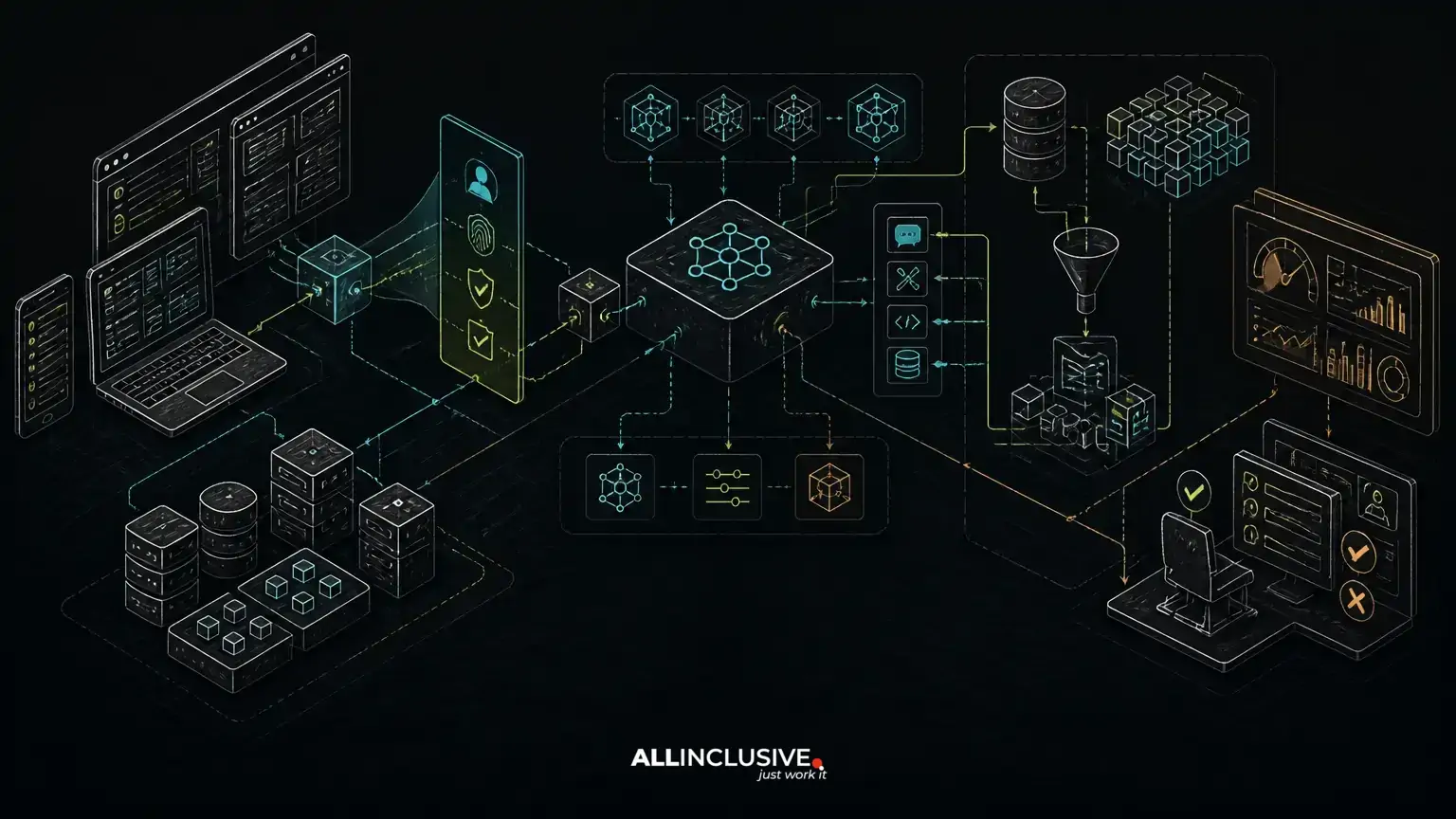
An LLM integration architecture should treat the model as one component in a larger software system, not as the application itself. The safest design keeps business rules, permissions, data access, auditability and user workflows under your application’s control while giving the model narrowly defined capabilities.
For an existing product, that often means adding an AI service behind an explicit boundary. A Laravel or other application layer can continue to own authentication, billing, workflow state and user-facing actions, while Python services handle retrieval, document processing, model calls and evaluation. The exact division depends on the product, but the principle is consistent: separate probabilistic model behavior from deterministic product responsibilities.
This approach makes AI easier to test, replace, monitor and restrict. It also reduces the risk that a prompt, model response or retrieved document can bypass the controls already protecting the application.
Start with the product workflow, not the model
Before selecting a model, define the user task and the acceptable outcome. “Add an AI assistant” is too broad to guide architecture. A useful specification identifies the input, expected output, permitted actions, data sources, approval points and failure response.
For example, a support feature might allow a user to ask about account documentation, retrieve relevant passages, draft an answer and cite its sources. It may not change an account, issue a refund or expose another customer’s records without a separate authorization path.
Classify the feature by risk:
- Assistive: summarizes, drafts or recommends while a person makes the final decision.
- Constrained automation: performs a narrow action when validation and authorization checks pass.
- High-impact automation: influences financial, legal, employment, health or access decisions and requires stronger controls, review and documentation.
The risk classification affects model choice, retrieval boundaries, human review, logging, testing and rollout strategy. It is more useful than choosing an architecture based only on whether a model supports tools or a large context window.
A reference architecture for production LLM integration
A practical architecture usually contains several distinct layers:
- Application layer: authenticates the user, validates requests, enforces permissions and records business state.
- AI orchestration layer: selects prompts, models, retrieval steps and tools for a specific use case.
- Knowledge and retrieval layer: indexes approved content, applies metadata filters and returns relevant evidence.
- Model gateway: centralizes provider calls, timeouts, retries, routing, redaction and usage tracking.
- Validation and review layer: checks structured outputs, applies business rules and routes uncertain cases to people.
- Observability layer: records traces, latency, token usage, retrieval quality, errors and user feedback without unnecessarily storing sensitive content.
The application should not trust a model-generated instruction simply because it is formatted as JSON. A schema validator can confirm structure, but business logic must still verify that the requested action is allowed and that referenced records belong to the current user or organization.
In a Laravel and Python arrangement, Laravel might expose the product endpoint and dispatch an AI job. Python could coordinate document parsing, embeddings, retrieval and model calls. Communication between the services should use authenticated service-to-service requests, explicit contracts and idempotent job handling. Keeping the boundary clear prevents AI-specific dependencies from spreading through the core application.
Decide whether the feature needs RAG, tools or an agent
These patterns solve different problems and should not be treated as interchangeable.
Retrieval-augmented generation
RAG retrieves relevant content before generating an answer. It is appropriate when the model needs access to internal, changing or domain-specific information that should not be placed permanently in model training data.
A dependable RAG pipeline includes ingestion, cleaning, chunking, metadata, embeddings, retrieval, optional reranking and citation or evidence handling. Access filters must be applied during retrieval, not after the model has already seen the content. If users belong to different tenants, tenant identity should be part of the retrieval policy and data model.
Embeddings can help find semantically related content, but vector similarity alone is not a complete relevance strategy. Keyword or metadata filters may be necessary for exact identifiers, dates, product versions and permissions. Reranking can improve ordering when the initial candidate set is broad, but it adds latency and cost.
Tool calling
Tools let a model request a defined operation, such as searching an approved knowledge base or preparing a draft. The tool implementation—not the model—should enforce authentication, authorization, input validation, rate limits and side-effect controls.
Separate read tools from write tools. A read operation may return account information after authorization. A write operation should normally require stricter validation, an idempotency key and, where appropriate, explicit user or staff approval.
Agents
Agents can select tools and execute multi-step plans, but their flexibility increases operational risk. Use them when the task genuinely benefits from iterative planning and tool selection. For predictable workflows, a fixed orchestration graph is often easier to evaluate, debug and govern.
Limit agent loops by step count, time, budget and tool scope. Record every tool request and result. Define what happens when the agent cannot complete a step rather than allowing it to continue indefinitely or invent a substitute.
Keep model behavior behind a controlled gateway
A model gateway creates one integration point for provider-specific behavior. It can normalize request and response formats, apply timeouts, track usage, redact selected fields and support controlled model routing.
Routing decisions may depend on task complexity, required modalities, latency targets, data handling requirements or availability. A smaller model may handle classification or extraction, while a more capable model handles difficult synthesis. Routing should be based on measured quality for the actual task, not on general reputation.
Build fallbacks around user impact rather than assuming another model will behave identically. A fallback might return a cited search result, save a draft for later processing, use a deterministic template or ask the user to retry. Silent degradation can be worse than a clear failure because users may not know that quality or functionality has changed.
Design privacy and permissions before prompts
Privacy controls belong in the data flow, not only in prompt wording. Identify which fields may leave the application, which may be retained, and which must be masked or excluded. Consider personal information, confidential business records, credentials, financial data and content subject to contractual or regulatory restrictions.
Use least-privilege access for retrieval indexes and tools. A model should receive only the context required for the current task. Do not rely on the model to ignore unauthorized text once it has been included in a prompt.
Logging requires the same discipline. Store enough information to investigate failures, such as request identifiers, model configuration, retrieval references, validation outcomes and latency. Avoid retaining raw prompts and responses by default when they contain sensitive customer content. Establish retention and deletion behavior that matches the product’s obligations.
Make output validation and human review explicit
LLMs produce plausible text, not guaranteed truth. Production systems should define what can be accepted automatically and what requires review.
For structured tasks, request a constrained schema where supported, then validate it in application code. Check required fields, allowed values, numerical ranges, references and consistency with source records. For generated text, use evidence requirements, prohibited-claim checks or a review queue where appropriate.
Human review should be designed as a workflow rather than a generic warning. A reviewer needs the original request, generated result, relevant sources, proposed action, reason for escalation and the ability to edit, approve, reject or request regeneration. Capture the decision so it can improve future evaluations and product design.
Set clear escalation conditions, such as missing evidence, conflicting sources, low retrieval confidence, sensitive topics, high-value transactions or attempted actions outside the tool’s permitted scope.
Evaluate the complete system, not just the prompt
Evaluation should cover the model, retrieval pipeline, tools and surrounding application behavior. Build a representative test set from real task categories, edge cases and known failure modes, with sensitive data handled appropriately.
Measure dimensions that matter to the workflow:
- Answer correctness and completeness.
- Grounding in approved sources.
- Retrieval relevance and permission isolation.
- Structured-output validity.
- Tool selection and argument correctness.
- Refusal and escalation behavior.
- Latency, failure rate and cost per task.
Use deterministic checks where possible and model-based grading carefully, with human review for important samples. Version prompts, retrieval settings, model choices and evaluation data so changes can be compared. A prompt update that improves helpfulness but increases unsupported claims should not ship without an explicit decision.
For a deeper treatment of measurement, see AI evaluation frameworks. Provider-specific design also deserves separate consideration; for example, Claude API integration patterns may differ from the requirements of other model APIs.
Plan observability around operational questions
AI observability should answer why a response was produced, where time was spent and which component failed. Useful traces can include application request ID, user or tenant scope, retrieval query, selected documents or document identifiers, model route, tool calls, validation result and human-review outcome.
Monitor latency by stage rather than only measuring the end-to-end request. Retrieval, reranking, model generation, tool execution and queue delays require different remedies. Track usage and cost by feature, tenant or workflow where contractually and operationally appropriate.
Protect observability data as carefully as production data. Redaction, access controls, sampling and retention rules are part of the architecture. A detailed trace that creates a second sensitive-data store may solve a debugging problem while creating a larger privacy risk.
Roll out incrementally and preserve a non-AI path
Start with a narrow workflow and a reversible release. Feature flags, shadow evaluation, limited cohorts and asynchronous processing can reduce exposure while quality is assessed. Keep a deterministic or human-operated path available when the model is unavailable, uncertain or outside its approved scope.
Before launch, review the integration against this checklist:
- Is the user task and risk level explicit?
- Are authentication, tenant boundaries and tool permissions enforced outside the model?
- Does retrieval filter content before it reaches the prompt?
- Are outputs validated against business rules?
- Are side-effecting actions separately authorized and idempotent?
- Are timeouts, retries, budgets and fallbacks defined?
- Can the team trace failures without excessive sensitive-data retention?
- Does an evaluation set cover normal, adversarial and ambiguous cases?
- Is human review available for defined escalation conditions?
Adding AI safely is an architecture and product-operations problem, not merely an API integration exercise. Teams planning a broader AI initiative can review AI development services alongside the surrounding software development guidance. For teams building the orchestration or data-processing layer in Python, the Python development capability may fit the service boundary; the existing web application can remain focused on its established workflows and controls.