
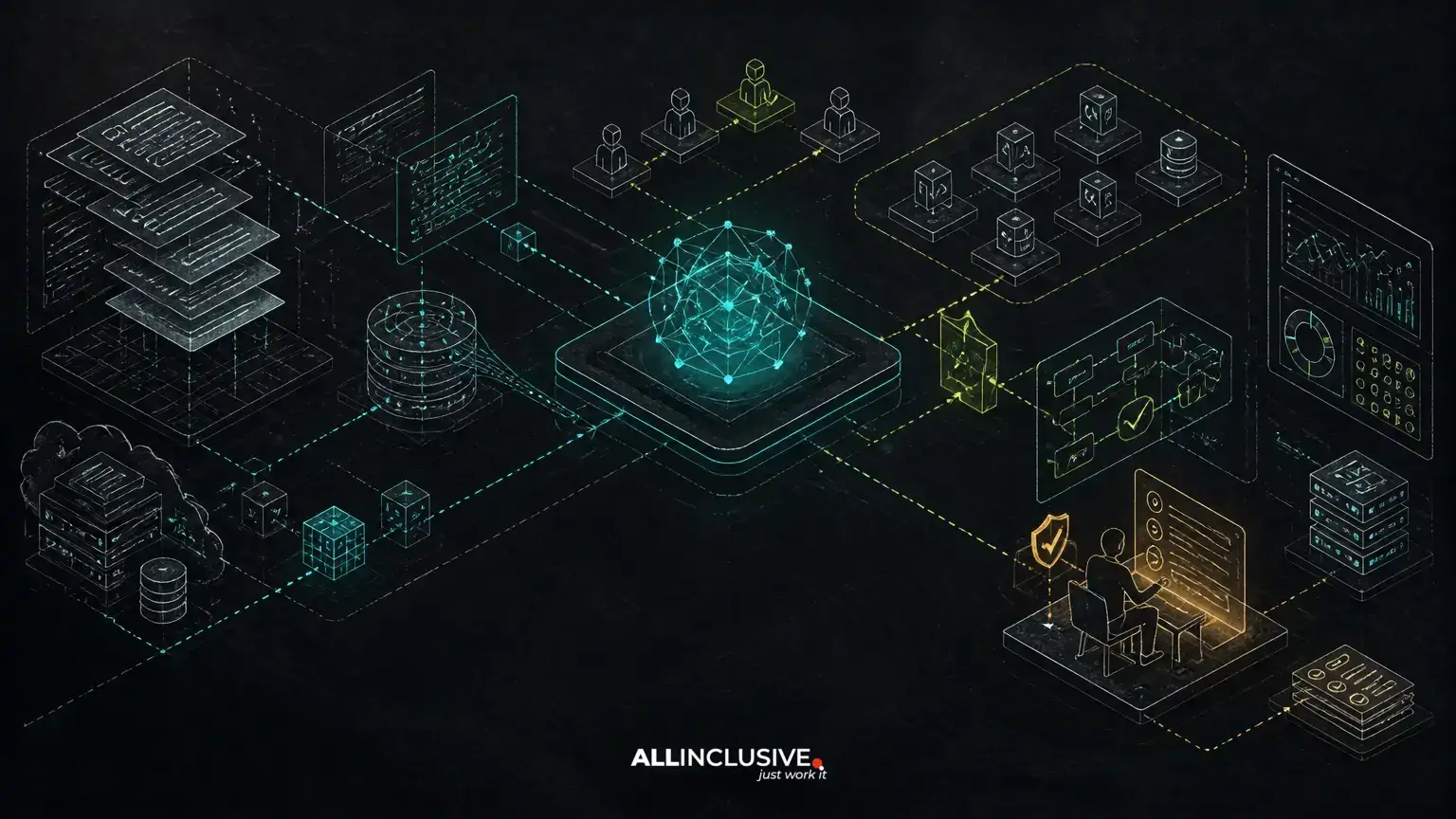
Claude API integration is most useful when the model is treated as one component in a controlled software system—not as an autonomous replacement for application logic. A reliable implementation separates model requests from business rules, retrieves only the information needed for each task, exposes narrowly scoped tools, records decisions for evaluation, and routes consequential actions through permissions or human review.
That distinction matters whether Claude is summarizing documents, answering questions over internal knowledge, drafting customer responses or coordinating workflow steps. The API call may be straightforward; production reliability depends on everything around it: context assembly, validation, retries, privacy controls, cost limits, observability and fallback behavior.
What a production Claude API integration should contain
A maintainable integration normally has several explicit layers:
- Application layer: owns users, workflows, permissions, records and user-facing state.
- AI orchestration layer: selects prompts, models, tools, retrieval strategies and response schemas.
- Knowledge layer: handles document ingestion, chunking, embeddings, retrieval and access filtering where RAG is required.
- Validation layer: checks structured output, citations, tool arguments and policy constraints.
- Operations layer: records latency, token usage, errors, traces, feedback and evaluation results.
For an existing product, the application layer might be Laravel or another web framework while Python owns document processing, retrieval or more complex orchestration. That division is not mandatory, but it can keep AI-specific dependencies and experimentation separate from core product workflows. The broader software development practice should still define ownership, deployment boundaries and support responsibilities before implementation begins.
Designing long-context requests without sending everything
Long context can reduce the need for aggressive summarization, but it does not eliminate the need for context engineering. Passing every available document, conversation turn and database field increases processing cost, latency and the chance that relevant instructions become difficult to distinguish from background material.
A stronger design treats context as a budgeted resource:
- Identify the task and the minimum evidence needed to complete it.
- Retrieve candidate records using metadata, permissions and semantic search.
- Rerank or filter the candidates for relevance, freshness and source quality.
- Place instructions, user intent, evidence and output requirements in clearly separated sections.
- Remove duplicate, stale or irrelevant material before the API request.
- Require citations, source identifiers or uncertainty signals when the workflow needs auditability.
Conversation history also needs management. A system can retain recent turns, summarize older turns, and preserve durable facts in structured application storage rather than relying on the model to remember them indefinitely. Summaries should be treated as derived data: they can be versioned, regenerated and checked against source records.
When RAG is preferable to a larger prompt
Retrieval-augmented generation is generally a better fit than indiscriminately expanding the prompt when the knowledge base is large, frequently updated or permission-sensitive. Retrieval allows the application to select evidence at request time and apply tenant, role, document and retention rules before content reaches the model.
Embeddings help find semantically related content, while metadata filters handle conditions such as customer account, document status or publication date. Reranking can improve ordering when a broad initial search returns several plausible results. None of these techniques guarantees a correct answer, so the final workflow should still distinguish retrieved evidence from the model's interpretation and provide a route for correction.
Using Claude tools for controlled workflow automation
Tool use is valuable when Claude needs current application data or must propose an action. A tool should be a deliberately designed application operation, not a general-purpose gateway to a database or shell.
Useful tool definitions specify:
- the action and its intended business purpose;
- strict input types and validation rules;
- the records or scope the tool may access;
- whether the operation is read-only, reversible or consequential;
- the user or service identity under which it executes;
- the result shape returned to the model;
- logging and approval requirements.
For example, a model may be allowed to look up an invoice, draft a reply or assemble a support case. Sending a payment, changing account access or issuing a contractual message should normally require stronger authorization and, in many products, explicit human approval.
Keep business rules outside the model
Claude can select a tool or explain a recommendation, but the application must enforce eligibility, authorization, transaction limits and state transitions. A prompt instruction such as “only refund within policy” is not a substitute for server-side policy code.
Idempotency is equally important. Tool calls may be retried after timeouts or duplicated during orchestration. Mutation tools should use idempotency keys, transaction checks and clear status handling so a repeated request does not create a second charge, ticket or notification.
Python and Laravel boundaries in a Claude integration
Many business systems already use Laravel or another PHP application framework for authentication, administration, queues and transactional workflows. Python may be a better home for ingestion pipelines, evaluation jobs, retrieval experiments or specialized data processing. The right boundary is the one that minimizes operational ambiguity.
One workable pattern is:
- Laravel receives the user request and applies product permissions.
- A queue publishes an AI job with a stable workflow identifier.
- Python performs retrieval, orchestration or document analysis through an internal service.
- The AI service returns structured results, source references and status metadata.
- Laravel stores the result, presents it for review and executes approved business actions.
This approach introduces service coordination, deployment and monitoring work, so it should not be adopted merely because Python is associated with AI. For smaller features, a single application can be simpler. For larger systems, a clear service contract can prevent model experimentation from destabilizing core product behavior. Teams evaluating broader Python development options should define the interface, queue semantics and ownership before splitting workloads.
Structured output, validation and fallback behavior
Free-form text is suitable for some user-facing drafts, but automation usually needs a predictable result. Ask the model for a constrained structure appropriate to the task—for example, a classification, extracted fields, recommended next step, evidence references and confidence or review status.
Validation should occur after the API response and before downstream use. Check required fields, allowed enum values, date and currency formats, referenced record identifiers and consistency with the current application state. A valid JSON response can still contain an unsafe or unsupported recommendation.
Design explicit failure paths:
- retry transient transport failures with bounded backoff;
- avoid blindly retrying validation or policy failures;
- fall back to a smaller or alternative model only when quality requirements permit;
- return a review-needed state when evidence is missing or conflicting;
- preserve the original request and response for diagnosis, subject to privacy policy;
- allow the user to continue manually when automation is unavailable.
Fallbacks should be tested as product behavior, not added only after an outage. Users need to know whether they are receiving a completed action, a draft, an estimate or an unresolved exception.
Privacy, permissions and data handling
Claude API integration should begin with a data-flow inventory. Identify which fields enter prompts, which are stored in logs, which may appear in traces and which are retained by supporting services such as vector databases or queues.
Common controls include field minimization, redaction of unnecessary identifiers, tenant-aware retrieval filters, encryption in transit and at rest, restricted operational access, retention limits and separate handling for sensitive content. The model must not become an authorization boundary: permissions should be checked before retrieval and again before a tool executes a mutation.
Prompt injection is another application security concern. Retrieved documents and user messages should be treated as untrusted input. They may contain instructions that attempt to override system behavior or induce unauthorized tool calls. Tool permissions, output validation and approval gates remain necessary even when the prompt appears carefully written.
Evaluating quality before workflow automation
Evaluation should use representative, versioned examples rather than informal impressions from a few successful conversations. Build a test set that includes ordinary cases, ambiguous requests, missing evidence, conflicting documents, adversarial inputs and permission boundaries.
Measure the dimensions that matter for the workflow:
- factual consistency with approved sources;
- retrieval relevance and citation accuracy;
- classification or extraction correctness;
- tool-selection and argument validity;
- refusal or escalation behavior;
- format compliance;
- latency and token consumption;
- human correction frequency.
Automated graders can help compare versions, but they should not be the sole authority for high-impact use cases. Human review is particularly important when the output affects legal commitments, financial decisions, access control, medical information or customer eligibility. See the related guide to AI evaluation frameworks for a broader testing perspective.
Observability for Claude API operations
Application logs should make an AI request explainable without exposing more data than necessary. Record a correlation ID, workflow type, model configuration, prompt or template version, retrieval identifiers, tool calls, validation outcome, latency, token usage and final status. Redact or hash sensitive content according to the system's retention policy.
Useful operational signals include rising validation failures, empty retrieval results, repeated tool retries, increased review rates, latency by workflow and cost by tenant or feature. Trace data can connect the original user action to queue jobs, retrieval calls, model requests and tool execution. This makes it easier to distinguish a model-quality problem from a database, permissions or network failure.
Configuration should be versioned. Changes to prompts, retrieval settings, tool schemas or model selection can alter behavior even when application code has not changed. A controlled release process and regression evaluations reduce the risk of silently changing a customer-facing workflow.
When Claude API integration is ready for production
Before moving beyond a prototype, confirm that the feature has a defined owner, a documented data flow and a measurable success criterion. The implementation should also answer:
- What happens when the model is unavailable, slow or uncertain?
- Which actions are drafts, recommendations or committed transactions?
- Where are permissions enforced?
- Can the team reproduce a problematic result safely?
- How are prompts, tools, retrieval indexes and evaluations versioned?
- What is the human review path and who owns exceptions?
- How will token usage, infrastructure cost and latency be monitored?
For teams considering multiple providers or model classes, model routing can separate fast, low-risk tasks from complex reasoning or multimodal workloads. The decision should be based on evaluated quality, operational fit, privacy requirements and total workflow cost rather than model branding alone. The companion article on multi-model AI routing covers those trade-offs in more detail.
A sound Claude API integration is therefore less about placing a model call inside an application and more about designing a governed path from user intent to validated outcome. Long context can improve evidence handling, tools can connect the model to useful operations, and Python or Laravel can provide the surrounding product structure. Reliability comes from the controls that determine what the model can see, propose and do—and when a person must decide.


