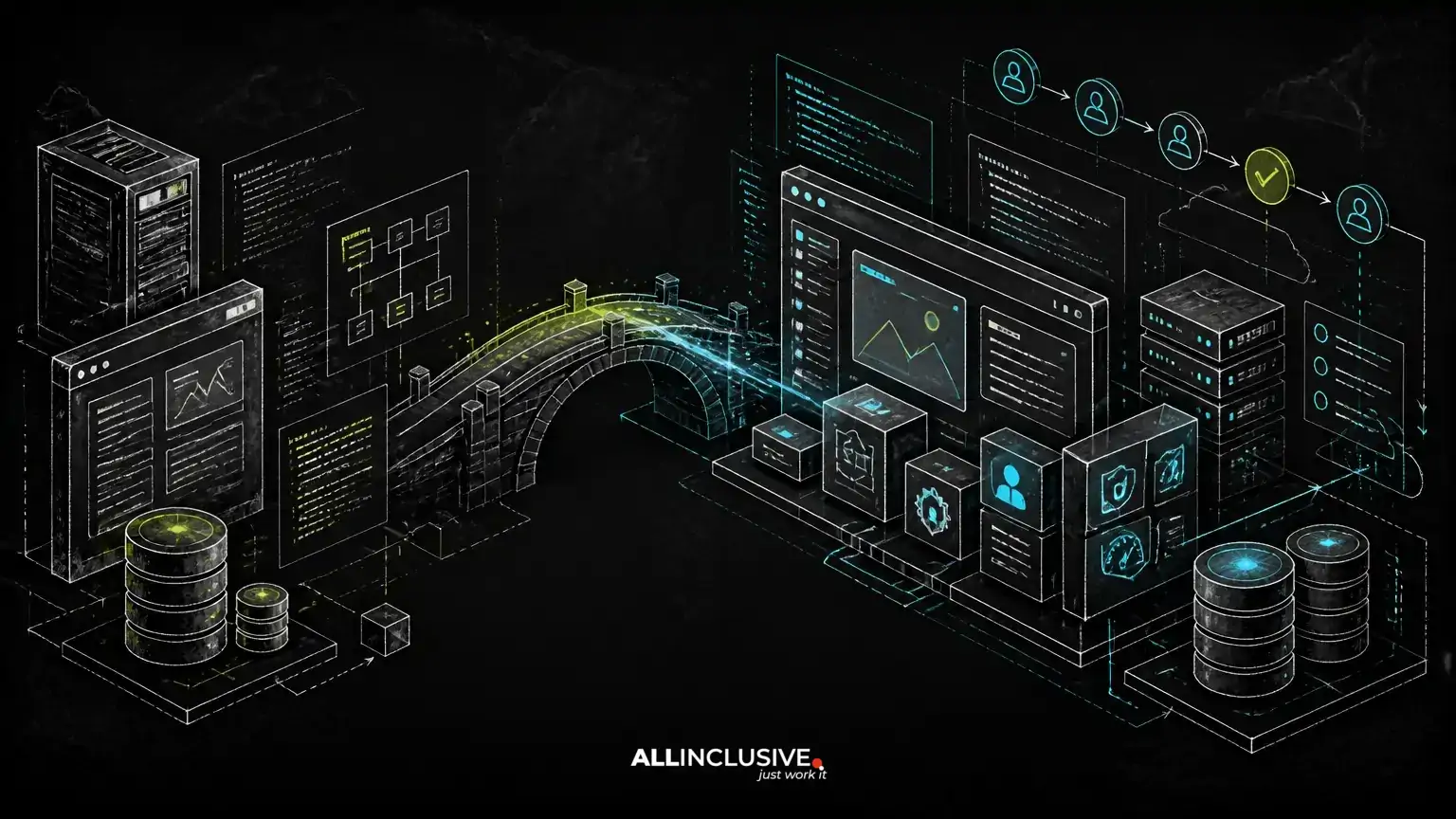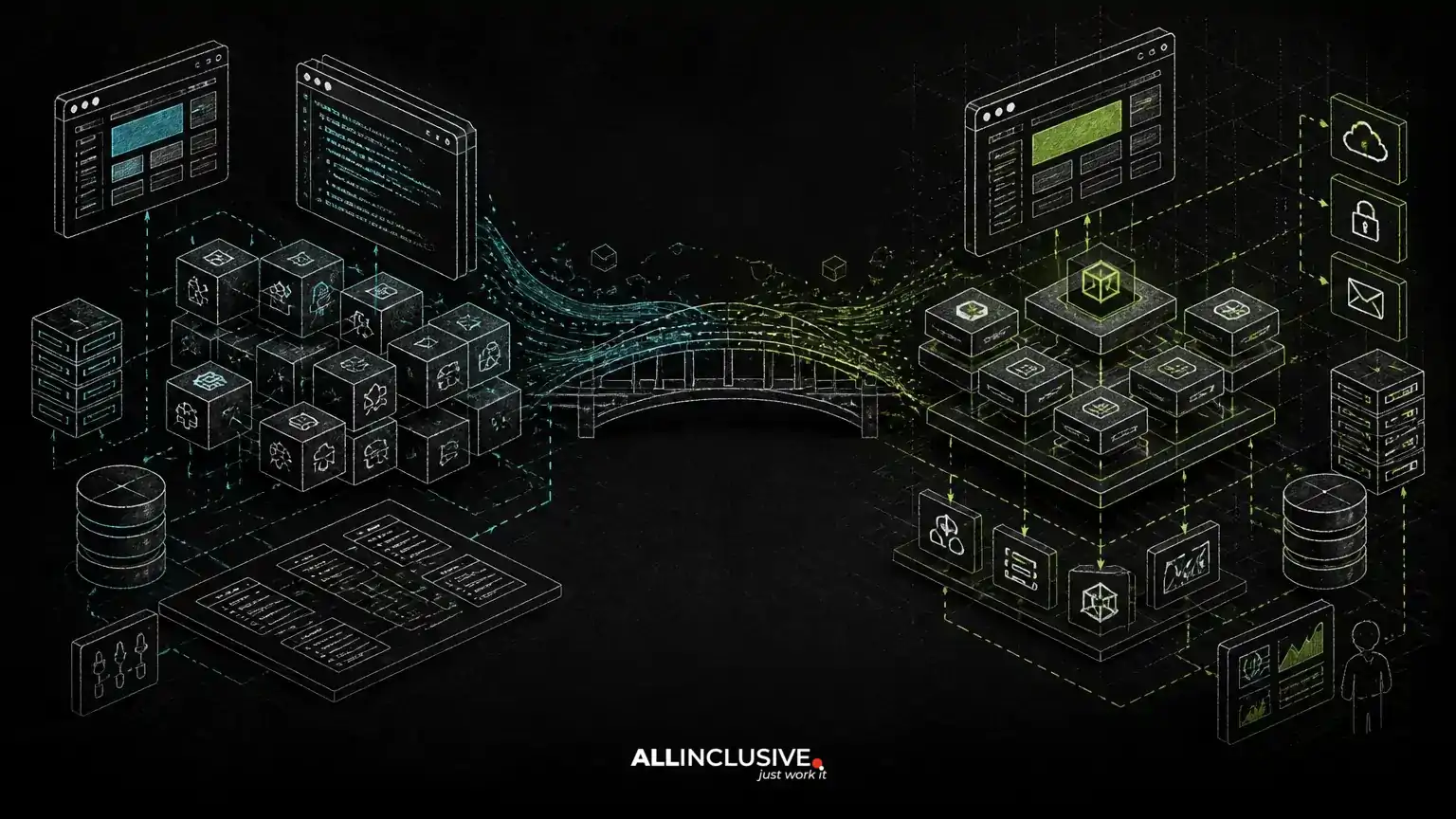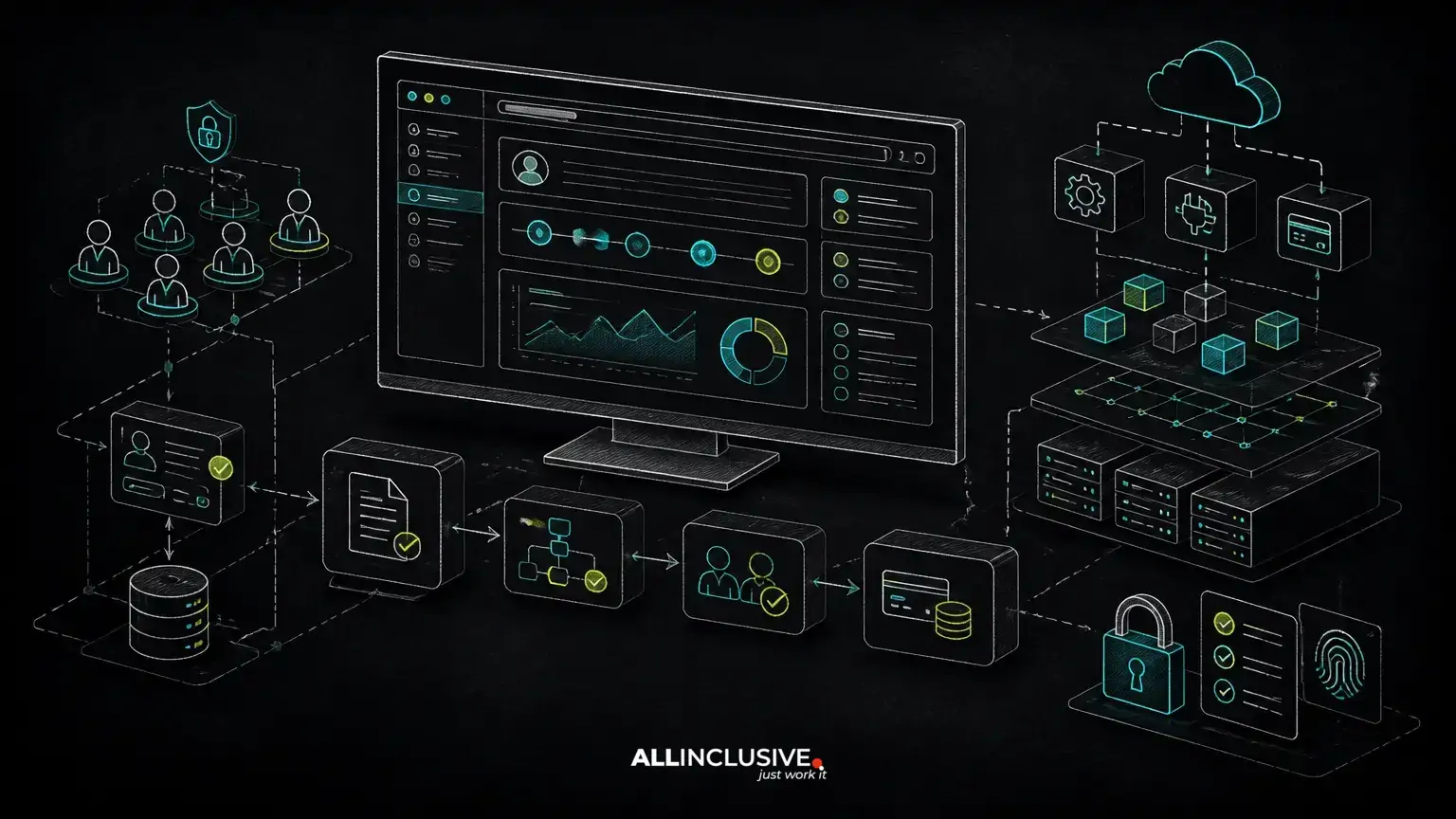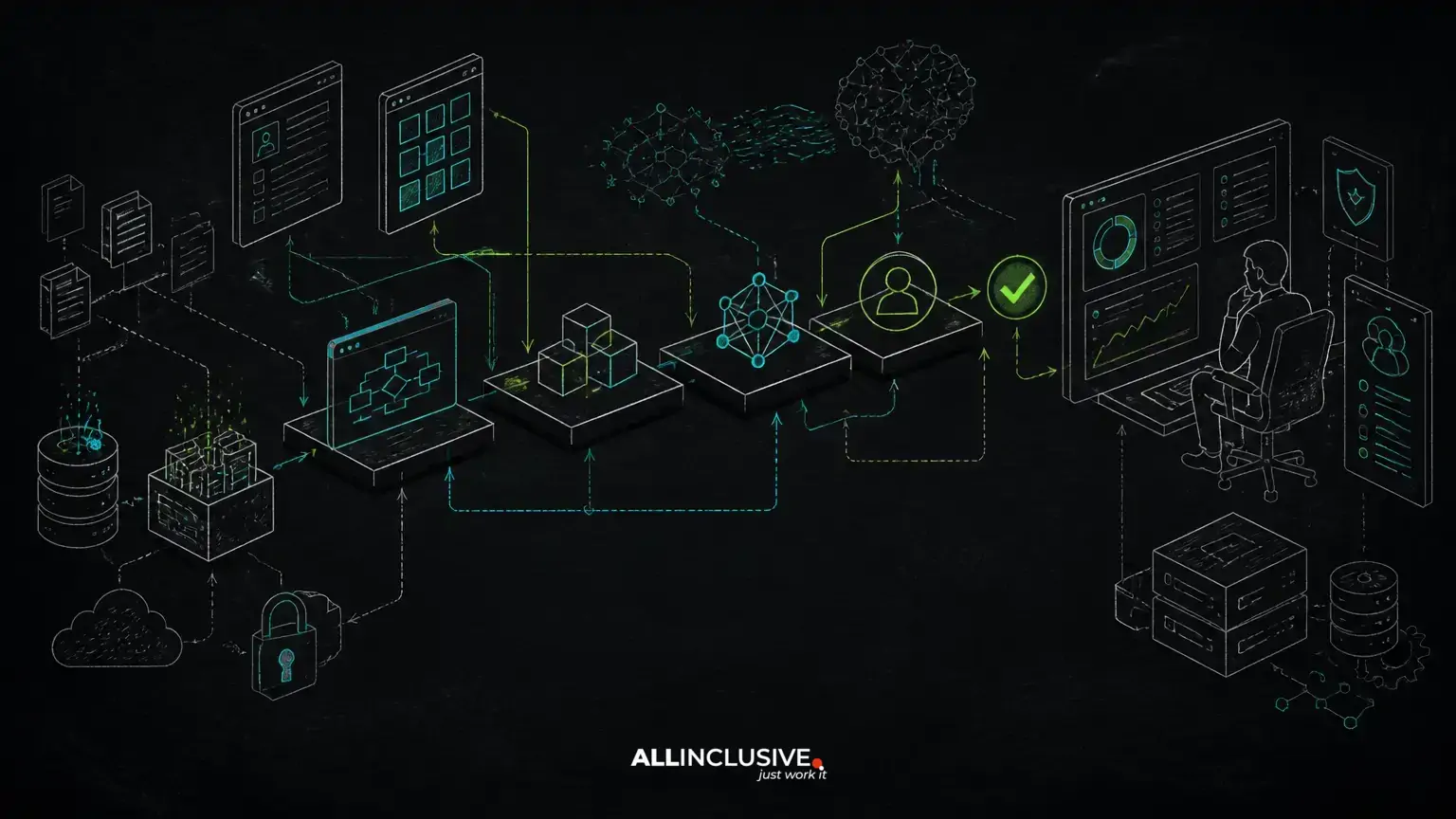
AI automation for business processes works best when the workflow is designed first and the model is selected second. A language model may summarize a case, extract fields, classify an inquiry or recommend a next action, but it does not automatically solve the surrounding problems: permissions, source data, exception handling, auditability, latency, cost and human accountability.
For software teams, the practical goal is not to add a chatbot to an existing application. It is to improve a defined business process while preserving control over the decisions that matter. That usually means combining an application layer, AI services, business rules, integrations, evaluation methods and an operational path for people to review uncertain or high-risk outputs.
Choose a workflow before choosing an AI model
Start by mapping the current process from trigger to outcome. Identify who initiates it, which systems are involved, what information is required, where decisions are made and what happens when the normal path fails. This exposes opportunities where AI can reduce repetitive work without obscuring ownership.
Good early candidates often have a clear input and output, a meaningful volume of repetitive work, accessible source data and a reviewable result. Examples include:
- classifying incoming requests and routing them to the right queue;
- extracting structured fields from documents for validation;
- summarizing account or case history for an employee;
- drafting responses from approved internal information;
- identifying missing information before a process advances.
A workflow is a weaker candidate when the desired outcome is vague, the source data is unreliable, errors are difficult to detect or the process requires autonomous action with little opportunity for review. In those cases, process redesign or better data governance may create more value than an AI component.
Separate deterministic workflow logic from probabilistic AI work
Production systems should make a clear distinction between tasks that must be predictable and tasks where an AI-generated result is acceptable. Authentication, authorization, financial limits, required fields, status transitions and retention policies generally belong in deterministic application logic. Classification, summarization, semantic search and draft generation may be suitable for model-based processing.
This separation reduces operational risk. The model can suggest that a request belongs to a category, while application code determines whether the request can be routed, approved or escalated. If the model is unavailable, the workflow can fall back to a manual queue or a simpler rule-based path rather than failing silently.
A Laravel or another web application layer may own users, workflow state, permissions, notifications and audit records. Python can own model orchestration, document processing, retrieval pipelines or evaluation jobs where that separation suits the system. The important design question is ownership of responsibilities, not whether one language must control the entire product.
Teams evaluating the broader implementation can use the AI development practice as a reference point, while the development hub provides wider context on custom software delivery.
Design the data path before adding retrieval or agents
Many automation projects need access to internal information. Retrieval-augmented generation, or RAG, can help a model answer using selected documents rather than relying only on its general training. A typical retrieval path involves ingesting approved sources, splitting content into usable sections, generating embeddings, searching for relevant passages and supplying those passages to the model.
Retrieval is not automatically reliable. Poor chunking, stale documents, incomplete metadata or ambiguous access rules can return context that is technically related but operationally wrong. Systems may also need keyword search, metadata filters, reranking or structured database queries alongside vector similarity.
Permissions must apply during retrieval, not only after generation. A user should not receive information merely because it exists in an index. Access control should reflect the business system’s actual ownership, tenancy and role rules. Retrieved sources and the final response should also be traceable when employees need to verify an answer.
Agents require an additional level of caution. An agent can choose tools, sequence actions and respond to changing information, but each tool expands the system’s risk surface. Define which actions are read-only, which require confirmation and which are prohibited. Limit tool inputs, validate outputs and record the reasoning-relevant events needed for investigation without treating generated explanations as proof that an action was safe.
For a deeper treatment of document workflows, see AI document processing. If the automation depends on external tools exposed to agents, MCP server development offers a related perspective on controlled tool connectivity.
Build human review into the workflow, not around it
Human review should be a designed state in the process rather than an informal fallback. Define when a person must approve, correct or investigate an output. Triggers may include low confidence, conflicting sources, missing fields, a sensitive request, a material business impact or a tool action outside the normal pattern.
The review interface should show the original input, the proposed output, relevant source passages, validation warnings and the action available to the reviewer. A reviewer should be able to correct the result without repeating the entire process. Those corrections can later support evaluation and process improvement, subject to appropriate privacy controls.
Not every AI output needs a confidence score, and a model’s stated confidence is not a dependable safety guarantee. Use observable signals such as retrieval coverage, schema validation, agreement between checks, business-rule violations and reviewer outcomes. These signals can support routing decisions more effectively than presenting an unexplained number.
Evaluate the complete process, not just the model response
A model can produce fluent text and still fail the business task. Evaluation should use representative examples from the actual workflow, including ambiguous, incomplete, adversarial and out-of-policy inputs. Measure the properties that matter for the process: correct routing, required-field accuracy, citation or source relevance, escalation behavior, unauthorized disclosure and successful completion.
Separate evaluation data from development examples where possible, and keep a versioned record of prompts, retrieval settings, model choices, tool permissions and expected outcomes. When changing a model or prompt, compare it against a fixed test set before releasing it into the workflow.
Production monitoring adds another layer. Track failure categories, review rates, latency, token or inference usage, tool errors, retrieval misses and fallback frequency. Monitoring should help the team identify whether a problem comes from source data, orchestration, application rules, model behavior or user interaction.
The article on AI evaluation frameworks covers this measurement problem in more detail. Model routing can also be useful when different tasks have different quality, speed or cost requirements; the relevant trade-offs are discussed in multi-model AI routing.
Plan for privacy, permissions and operational failure
Before sending business information to an AI service, document what data is processed, where it travels, how long it is retained and who can access logs or derived artifacts. Sensitive fields may require minimization, redaction or a processing path with stricter controls. Privacy requirements should influence architecture before prompts and integrations become difficult to change.
Failure planning should cover more than provider downtime. Consider malformed model output, empty retrieval results, slow responses, rate limits, duplicate events, tool timeouts, partial workflow completion and a user ignoring a review request. Structured outputs and schema validation can prevent a free-form response from being treated as an executable instruction. Idempotent jobs and explicit workflow states can prevent retries from creating duplicate actions.
Fallbacks may include a rules-based classifier, a smaller or different model, a delayed queue, a manual review state or a request for more information. The right fallback depends on the business consequence of delay versus error. A low-risk internal summary may tolerate a retry, while an approval or customer communication may require explicit human control.
Estimate value using the process, not an AI feature list
Business value depends on the complete operating model. Assess the time spent on the current task, rework caused by errors, queue delays, review capacity, integration effort and the cost of maintaining the data and evaluation system. Include ongoing expenses for inference, storage, observability, support and changes to source systems.
A narrow workflow with measurable acceptance criteria is usually easier to operate than a broad autonomous assistant. Start with one process boundary, establish a baseline, instrument the result and expand only when the controls and evaluation evidence support expansion. Custom software is useful when the workflow, permissions or integrations are specific enough that a generic tool cannot represent them safely.
A production readiness checklist for AI process automation
- Workflow: Is the trigger, owner, desired outcome and exception path explicit?
- Role of AI: Is the model performing a bounded task rather than deciding everything?
- Data: Are sources current, permission-aware and traceable?
- Architecture: Are application rules, orchestration, model calls and integrations separated clearly?
- Quality: Are representative test cases and acceptance criteria defined?
- Safety: Are sensitive actions gated by validation or human approval?
- Operations: Are latency, cost, failures, retries and fallback behavior observable?
- Ownership: Does someone own prompts, retrieval sources, evaluations and workflow changes?
The strongest AI automation initiatives improve a process without making it less accountable. Begin with the work people perform, define where software can assist, keep critical controls deterministic, and treat models as components that require testing and supervision. That approach creates a clearer path from prototype to maintainable production software.