AI document processing is more than sending a PDF to a language model and asking for a JSON response. Reliable systems must identify document types, extract fields, preserve context, validate outputs against business rules, protect sensitive data and route uncertain cases to people.
The most effective architecture treats document processing as a controlled workflow. Specialized models and language models may perform different tasks, while an application layer manages permissions, states, audit records, retries and human approval. Python is often a strong fit for model and data-processing workloads; Laravel or another application framework can own the surrounding product workflow and operational interface.
What AI document processing actually includes
Document processing usually combines several capabilities rather than one model call:
- Ingestion: accept files, email attachments, scans or records from external systems.
- Preprocessing: detect file types, render pages, improve image quality and identify whether OCR is required.
- Classification: determine whether a document is an invoice, contract, claim, form, statement or another supported type.
- Extraction: map text, tables and layout into a structured schema.
- Validation: compare extracted values with rules, reference data and related records.
- Review: send low-confidence or high-risk cases to an appropriately authorized person.
- Delivery: write approved data to business systems with traceability and error handling.
This separation matters because extraction confidence is not the same as business correctness. A model can read a number accurately while still assigning it to the wrong field, currency or accounting period.
Extraction starts with document structure, not just text
Plain OCR converts pixels into characters, but many business documents depend on layout. Tables, headers, footnotes, signatures, checkboxes and repeated line items can change the meaning of extracted text.
A production pipeline should preserve useful structure where possible: page numbers, bounding regions, reading order, table relationships and source references. Each extracted value should be traceable to the page or region from which it came. This makes review easier and gives engineers evidence when a parser fails.
Schema design is equally important. Define field types, required fields, allowed values, normalization rules and whether a field may be null. For example, an invoice schema might distinguish the supplier's invoice number from a purchase order number, preserve the original currency, and represent line items separately from totals.
When to use language models
Language models can help with variable layouts, ambiguous labels and documents that require contextual interpretation. They are less suitable as an unbounded replacement for deterministic validation. A useful pattern is to constrain model output to a versioned schema, capture the raw response, validate it independently and reject or review outputs that do not meet the contract.
For repetitive, stable documents, dedicated OCR, layout models or deterministic parsers may be more predictable and economical. For mixed document collections, model routing can select different processing paths based on document type, page quality, sensitivity or required accuracy. The decision should be driven by evaluation results and operating constraints rather than model novelty.
Classification determines the rest of the workflow
Classification is often treated as a preliminary convenience, but it controls downstream behavior. A contract may require clause detection and legal review; an invoice may require supplier matching and tax validation; an identity document may require stricter retention and access controls.
Classification can use metadata, filename patterns, visual features, extracted text or a language model. In practice, a layered approach is often safer: inexpensive deterministic signals handle obvious cases, while a model handles ambiguous cases. Store the classification result, confidence, model or rule version, and any alternatives considered. This supports troubleshooting when a document enters the wrong workflow.
Validation turns plausible output into usable data
Validation should occur at several levels:
- Schema validation: confirm types, required fields, formats and permitted values.
- Document validation: check totals, dates, page consistency and internal relationships.
- Business validation: compare suppliers, account codes, policy limits or purchase orders with authoritative systems.
- Cross-document validation: reconcile related documents such as an invoice, receipt and purchase order.
- Risk validation: apply stricter rules to sensitive actions, unusual amounts or regulated records.
Validation should produce explicit reasons, not merely a pass or fail flag. “Total does not equal line-item sum,” “supplier not found,” and “date is outside the permitted period” lead to different review and remediation paths.
Retrieval can support validation when the system needs current internal reference data. A retrieval-augmented workflow may fetch supplier records, policy rules or contract terms before evaluating an extraction. Retrieved content must be permission-aware, versioned where necessary and treated as supporting evidence rather than unquestionable truth. Embeddings can help find relevant passages, while metadata filters and reranking can improve precision for specific document questions.
Human review is part of the design
Human review is not a failure of automation. It is a control for ambiguity, exceptions and consequential decisions. The objective is to automate routine cases while giving reviewers enough evidence to resolve uncertain ones quickly.
A useful review interface should show the original document beside extracted fields, highlight source regions, explain validation failures, and distinguish model suggestions from approved values. Reviewers should be able to correct fields, reject a document, request more information and record a reason for the decision.
Routing rules should consider more than a single confidence score. Review may be required when fields conflict, a document type is unsupported, a policy threshold is exceeded, sensitive data is present, or the requested action changes a financial or legal record. Different roles may review different decisions, and approval should be enforced by the application rather than assumed from the model output.
A production architecture for AI document processing
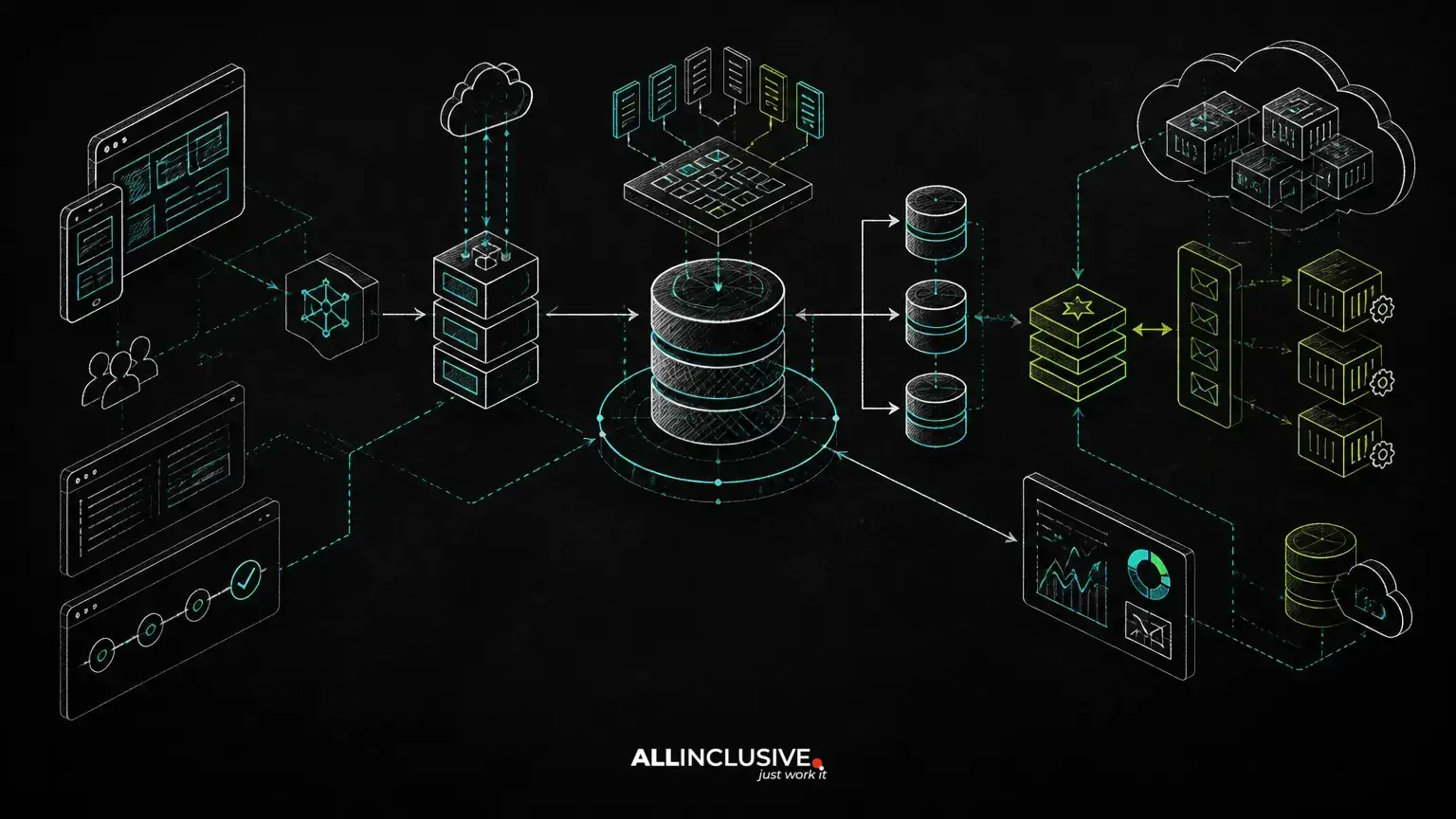
A maintainable implementation usually separates ingestion, processing and business workflow:
- Application layer: manages users, permissions, uploads, workflow states, review screens and audit history.
- Processing services: perform file handling, OCR, classification, extraction and validation, often asynchronously.
- Model gateway: centralizes provider access, model selection, schema instructions, timeouts, redaction and fallback behavior.
- Data stores: retain original files, derived text, structured results, evidence references and version metadata according to retention policy.
- Integration layer: sends approved results to ERP, CRM, case-management or document systems with idempotency and reconciliation.
Python can own the processing services because its ecosystem supports data and machine-learning workloads. Laravel or another web application layer can own the authenticated product experience, workflow orchestration and administrative controls. The boundary should be explicit: use queues or APIs, define stable contracts, and avoid embedding model-specific assumptions throughout the business application.
For broader guidance on selecting and connecting application components, see custom software development. Teams evaluating Python for model-serving or data-processing services can also review Python development.
Privacy, permissions and operational controls
Documents often contain personal, financial or commercially sensitive information. Privacy controls should be designed before model selection.
- Limit access to original files and extracted data by role and tenant.
- Encrypt data in transit and at rest using the controls appropriate to the deployment environment.
- Define retention and deletion behavior for originals, intermediate files, prompts, outputs and logs.
- Minimize the data sent to external model providers and understand applicable processing terms.
- Redact or tokenize sensitive fields where full values are not required.
- Record who viewed, changed, approved or exported a document.
- Separate development and production data, and avoid using real documents for testing without appropriate controls.
Permissions must also apply to retrieval. An agent or processing service should not retrieve a document merely because it is technically available. Access checks should be enforced against the requesting user, tenant and workflow context.
Evaluation, observability and fallback behavior
Evaluation should measure the fields and decisions that matter to the workflow. Useful measures include field-level exactness, normalization accuracy, document classification, validation outcomes, review rate, unsupported-document rate and downstream correction rate. Evaluate representative document variation, including scans, unusual layouts, missing fields and multi-page files.
Maintain a labeled test set with document versions, expected outputs and business rules. Run it when prompts, parsers, models, retrieval sources or schemas change. This is where an AI evaluation framework becomes practical: it makes quality a release concern rather than a subjective demo impression.
Production observability should connect technical events to business outcomes. Track processing duration, queue age, token or provider usage where relevant, retries, timeout rates, validation failures, review decisions and integration errors. Store correlation IDs so an approved record can be traced back to the input file, processing version and evidence used.
Design explicit fallbacks. A failed model call may be retried within limits, routed to another approved model, sent through a deterministic parser or placed in a review queue. A fallback should not silently lower controls for high-risk documents. Latency and cost also need boundaries: page limits, payload limits, timeouts, concurrency controls and model-routing rules should be part of the service contract.
Agentic behavior can be useful when processing requires tools such as supplier lookup, policy retrieval or case creation. Keep tool permissions narrow, validate arguments, log tool calls and require human approval before consequential actions. A document workflow rarely needs an unconstrained agent; predictable orchestration is usually easier to test and govern.
Common failure modes to address before launch
- One prompt for every document: mixed formats and different business rules produce inconsistent outputs.
- Trusting confidence scores blindly: confidence may not reflect business correctness or field importance.
- Skipping source evidence: reviewers cannot efficiently verify or correct extracted values.
- Writing directly to core systems: an unapproved or duplicated result can create costly downstream errors.
- Ignoring partial failures: page-level, field-level and integration failures need recoverable states.
- Testing only clean samples: production files include scans, rotations, missing pages and unexpected layouts.
- Logging sensitive payloads indiscriminately: debugging data can become a privacy and access risk.
These issues are why AI automation should be designed around the workflow and its controls, not only the selected model. The related guide on AI automation for business processes provides a broader way to scope that work.
When custom AI document processing is justified
Custom software is most defensible when document variation, integration requirements, permissions or review rules are central to the business process. A configurable product may be sufficient for common formats and low-risk tasks. Custom development becomes more valuable when the workflow must connect to proprietary systems, preserve detailed evidence, support tenant-specific rules, or improve through measured feedback.
Start with one document family and a clear approval boundary. Define the target schema, acceptable error types, escalation rules, retention requirements and integration behavior. Then build an evaluation set and a review workflow before expanding coverage. This approach reduces the risk of creating an impressive extraction demo that cannot safely operate inside the business.