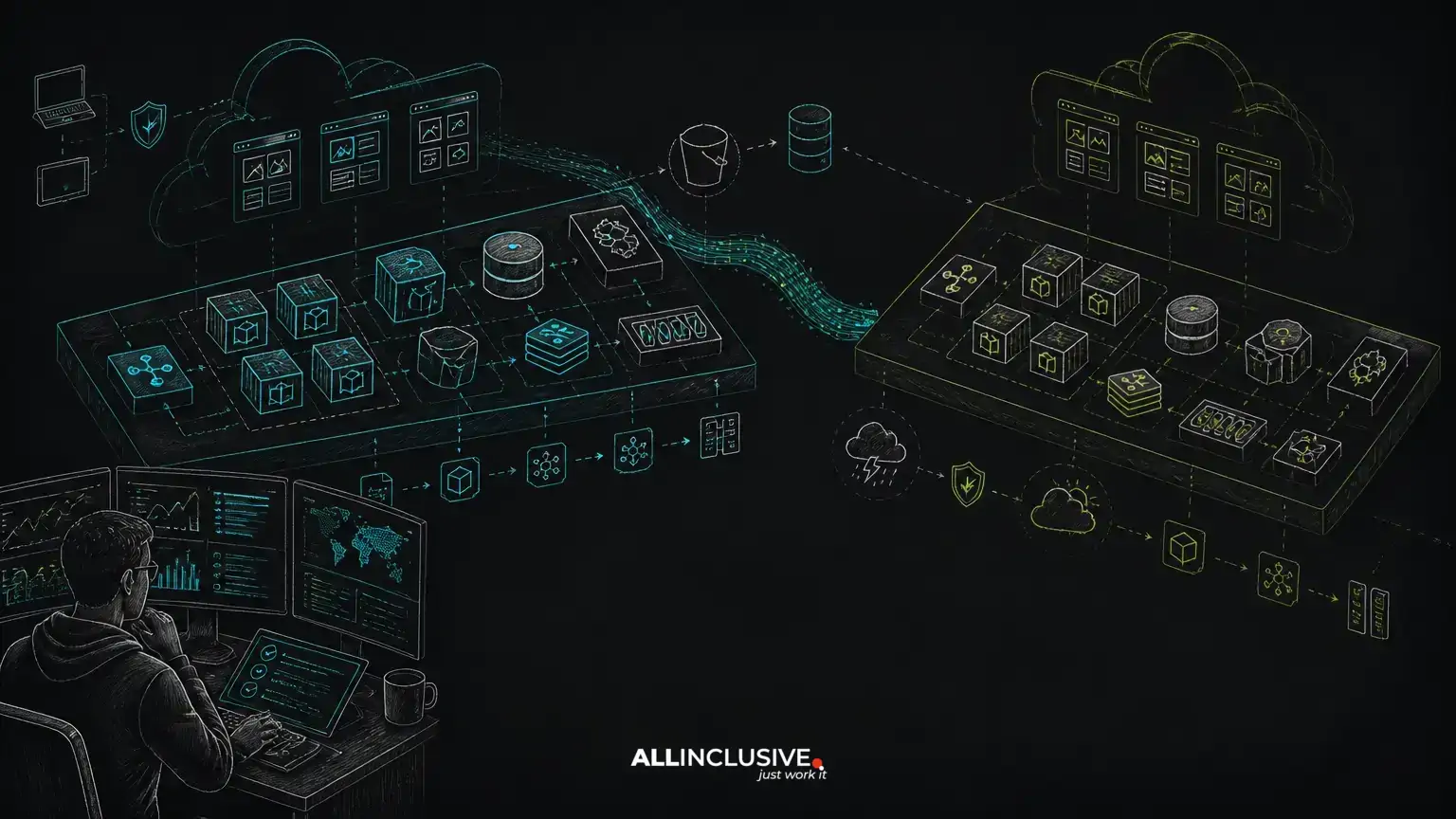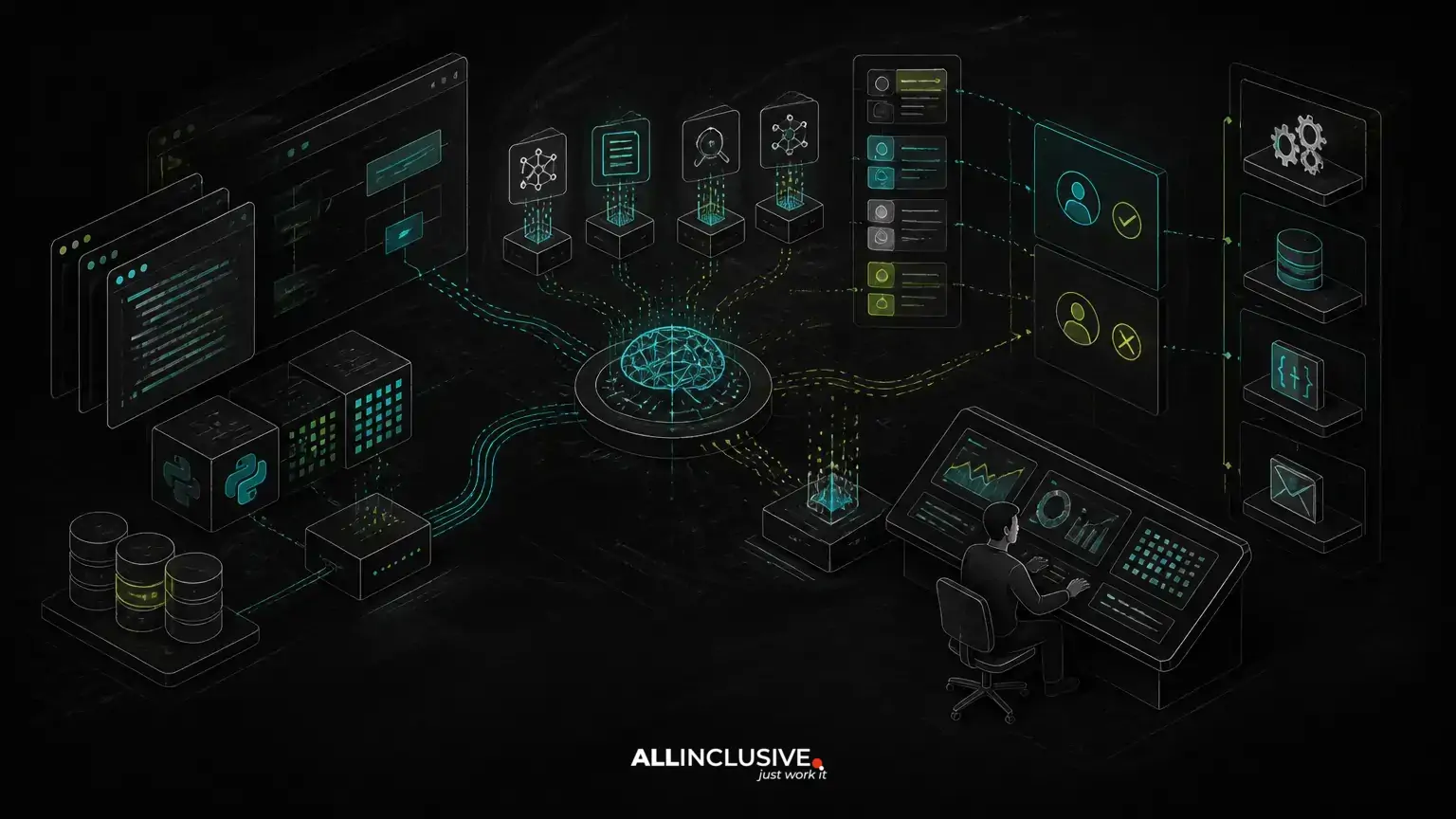
Agentic workflow automation is most valuable when a business process requires more than a single prediction or generated response. The system must interpret a request, retrieve relevant information, choose an action, call one or more tools, check the result and sometimes ask a person to approve the next step.
That does not mean every process needs an autonomous AI agent. For stable, deterministic work, conventional application code is usually easier to test, govern and maintain. Agentic systems earn their complexity when the inputs are variable, the required path depends on context and the cost of manual coordination is meaningful.
This distinction matters for production software. A demonstration can show an LLM completing a plausible sequence. A dependable product must also control permissions, validate tool inputs, record decisions, manage latency and cost, handle failures and provide a clear human fallback.
What agentic workflow automation actually changes
A conventional automation follows a predefined path: when an event occurs, run step A, then step B, then notify a user. An agentic workflow has a bounded objective and can select from approved actions based on the information it observes.
For example, an internal operations workflow might:
- Classify an incoming request and identify the relevant account or order.
- Retrieve policy documents and records from authorized systems.
- Determine whether the request requires a standard response, additional evidence or escalation.
- Draft a response or prepare an update through a business-system API.
- Pause for human approval when the action is consequential or ambiguous.
The agent is not a replacement for the application. It is a decision-making component inside an application that still owns identity, permissions, state, audit records and business rules.
Where multi-step AI can save meaningful work
Processes with variable paths
Agentic approaches fit workflows where the next step depends on language, documents or changing context. Triage, research, support resolution, compliance preparation and account operations often contain this kind of variability.
A useful test is whether experienced staff repeatedly interpret similar evidence and choose among a known set of actions. If the decision can be bounded by explicit policies and tools, AI may reduce the amount of routine investigation without granting unrestricted system access.
Processes that combine unstructured and structured data
Many business workflows begin with an email, ticket, contract, call transcript or uploaded file and end with structured changes in a product database. Retrieval-augmented generation can provide the relevant context, while tools can expose carefully scoped operations.
Retrieval quality remains critical. Embeddings can support semantic matching, but production systems may also need metadata filters, keyword search, reranking and source citations. A fluent answer based on the wrong document is still a workflow failure. See how semantic search with embeddings affects relevance and failure modes for a deeper treatment.
Processes with expensive coordination
Some work is not difficult because one step is technically complex. It is costly because people move information between systems, check status, request missing details and repeat the same investigation. An agent can coordinate these steps while leaving irreversible decisions under explicit controls.
Examples include preparing a case summary from multiple sources, checking whether required documentation is present, routing a request to the correct team and assembling a draft for review.
Where deterministic automation is the better choice
Agentic workflow automation is a poor fit when the process is already stable and rules-based. Calculating an invoice, enforcing a permission, applying a known transformation or moving a record through a fixed state machine should generally remain conventional software.
Agents also introduce avoidable risk when they are allowed to make high-impact changes without review. Financial transfers, access changes, legal commitments, production deployments and destructive data operations require stronger controls than a generated recommendation.
A practical architecture often combines both approaches: deterministic code defines the workflow boundaries, while an LLM handles bounded interpretation, prioritization or tool selection within those boundaries.
A production architecture for agentic workflows
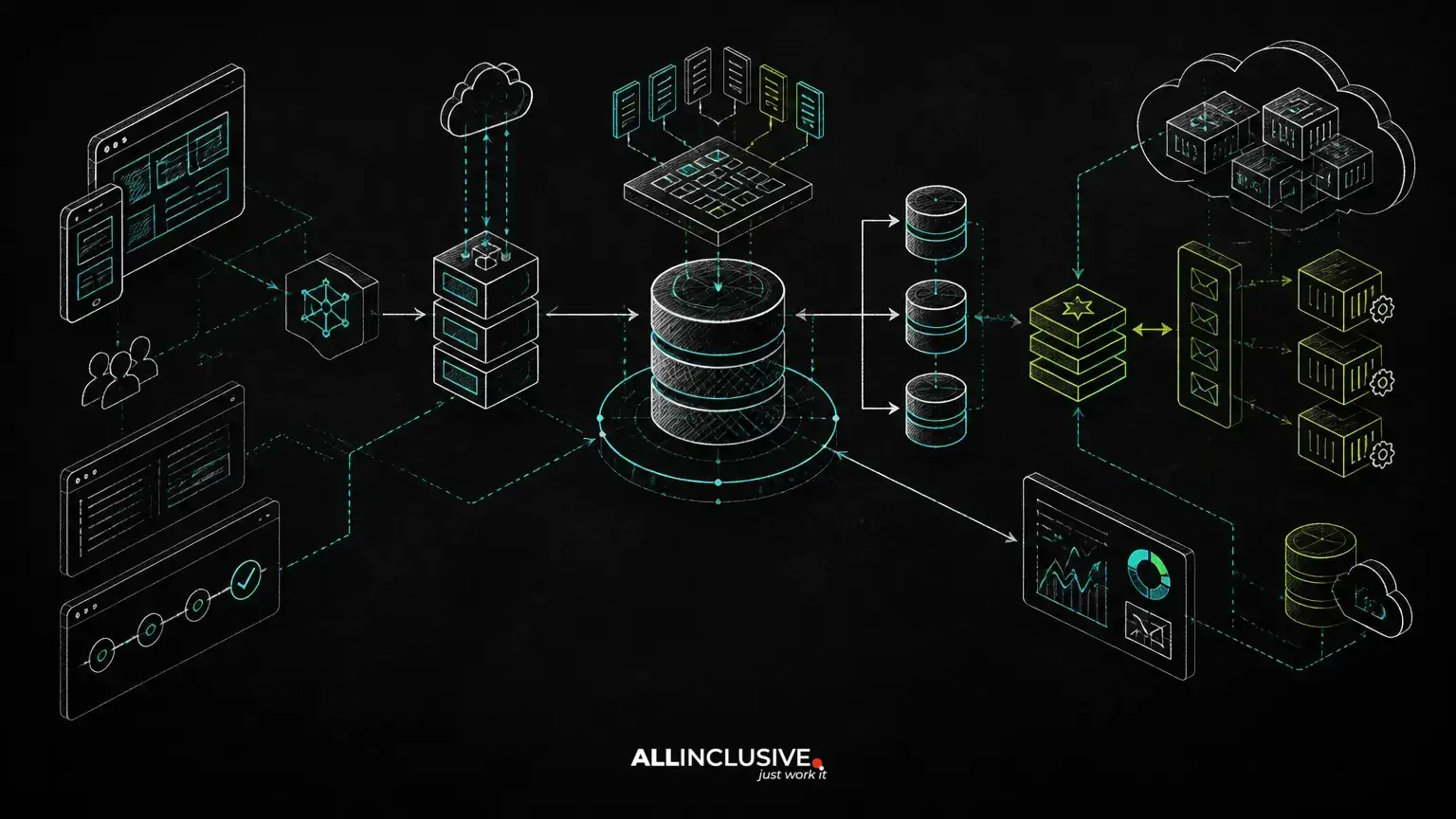
A reliable implementation separates the reasoning layer from the systems that enforce business behavior. A common design includes:
- Application layer: owns users, workflow state, permissions, notifications and the product interface.
- Orchestration layer: manages tasks, retries, timeouts, tool calls, approvals and state transitions.
- Model layer: provides classification, extraction, planning or response generation, with routing based on task requirements.
- Retrieval layer: searches approved sources, applies access filters and returns evidence with provenance.
- Tool layer: exposes narrow, typed operations rather than unrestricted database or network access.
- Evaluation and observability layer: records inputs, outputs, tool calls, latency, token usage, failures and human decisions.
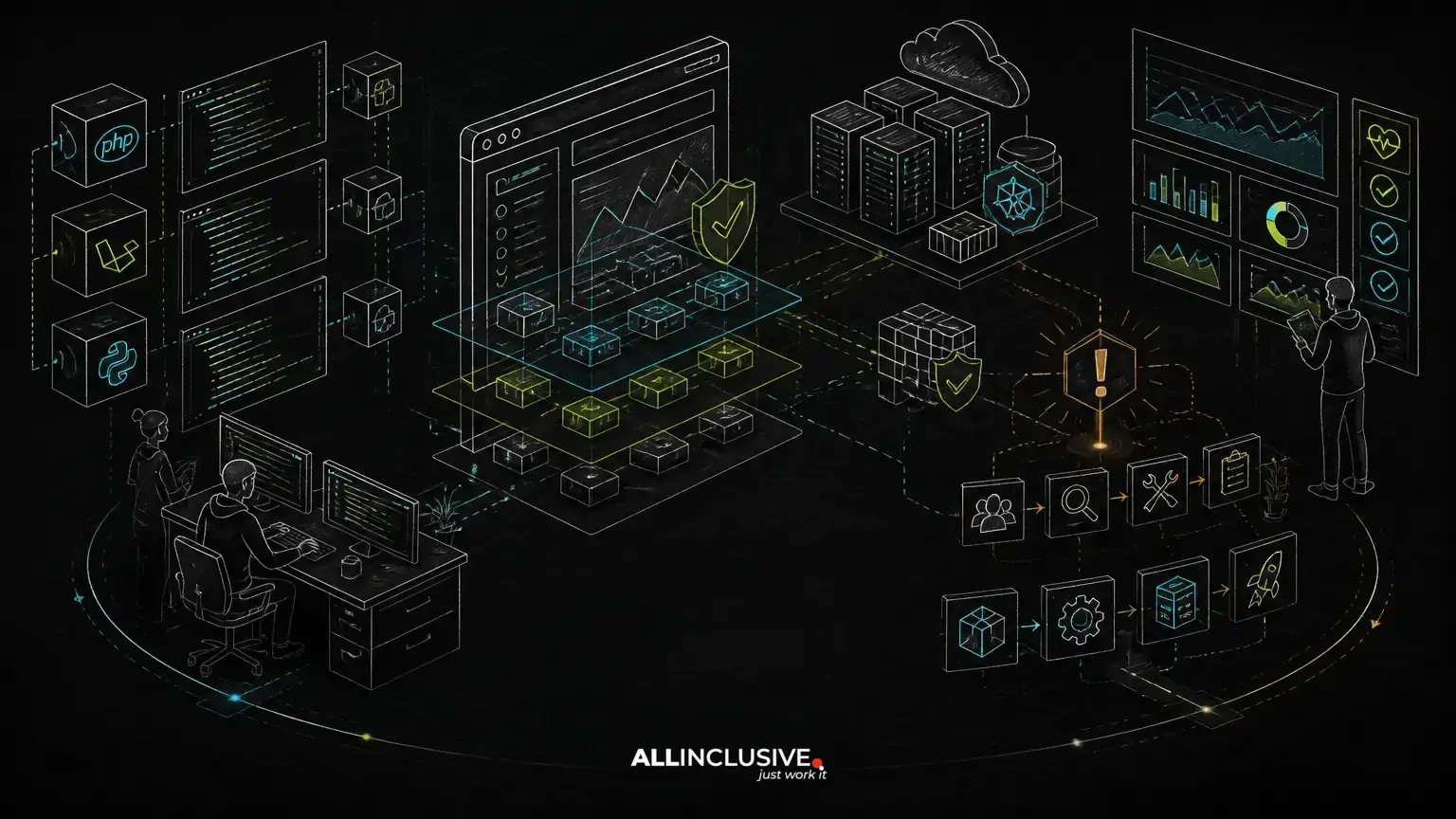
Python is often a practical home for model calls, retrieval and orchestration experiments, while Laravel or another application layer manages product workflows and business data. The boundary should be explicit: the AI service can request an action, but the application verifies whether that action is permitted and valid.
Teams planning this boundary can use an LLM integration architecture to separate model-dependent behavior from the rest of the product. Broader application concerns belong in a maintainable web development architecture rather than inside prompts and agent state.
Designing tools that agents can use safely
Tools are the agent's connection to reality, so they deserve the same design discipline as public APIs. Each tool should have a narrow purpose, typed inputs, explicit authorization checks and predictable error responses.
Prefer an operation such as create_refund_request with validated fields over a generic tool that permits arbitrary database updates. Separate read tools from write tools. Return structured results that identify whether an action succeeded, failed validation or requires human intervention.
Idempotency matters when retries are possible. A workflow that times out after creating a record should not create duplicates when the agent tries again. Tool calls should also carry correlation identifiers so operators can trace an action from the user request through the model, orchestration service and application logs.
Human review should be part of the workflow design
Human review is not merely a fallback added after an agent performs badly. It is a deliberate control for uncertainty, impact and policy boundaries.
Useful review triggers include:
- Low confidence or conflicting retrieved evidence.
- Missing information needed to complete the task.
- A proposed action with financial, legal, privacy or access implications.
- A tool error that cannot be safely retried.
- A request outside the agent's supported scope.
The review interface should show the evidence used, the proposed action, the expected effect and any uncertainty. A reviewer should be able to approve, edit, reject or return the task for more information. These decisions can also become valuable evaluation data, provided privacy and retention requirements are respected.
Evaluation, observability and operational controls
Traditional unit tests are necessary but insufficient because model outputs vary and workflow quality depends on context. Production evaluation should include representative cases, adversarial cases, permission scenarios, retrieval failures and tool errors.
Useful measures include task completion, correct routing, citation or evidence quality, inappropriate tool calls, escalation quality, latency, model usage and cost. The exact metrics depend on the workflow; a drafting assistant and an automated operations process should not be judged by the same standard.
Tracing should make each run inspectable. Record the workflow version, model configuration, retrieved sources, tool calls, validation results, approval events and final outcome. Avoid logging sensitive content unnecessarily, and define retention and redaction rules before collecting production traces.
Fallbacks should be explicit. The system may route to a smaller or different model, retry a transient provider error, switch to keyword retrieval, use a deterministic rule or hand the task to a person. A fallback that is not observable is difficult to trust.
Privacy, permissions and model routing
Agentic systems can expose more data than a conventional search box because they may gather context across several systems. Authorization must be applied at retrieval time and again when a tool action is requested. The model should not be treated as the enforcement point for access control.
Data handling decisions include which content may be sent to a model provider, whether sensitive fields should be redacted, how prompts and traces are retained and how tenant boundaries are enforced. These are application and governance decisions, not prompt-writing details.
Model routing can reduce unnecessary cost and latency when different tasks have different requirements. A lightweight model may handle classification or extraction, while a more capable model handles ambiguous reasoning. Routing should be evaluated against accuracy, failure severity and operational complexity rather than treated as an automatic optimization.
A decision checklist before building an agent
- Is the process variable enough to justify model-based decision-making?
- Can the agent's possible actions be bounded by a finite tool set?
- Which steps must remain deterministic?
- What information is required, and can retrieval enforce user and tenant permissions?
- Which actions require approval, and what will the reviewer see?
- How will tool calls be validated, retried and made idempotent?
- What constitutes success, escalation, or an unsafe result?
- How will quality, latency, usage and cost be measured in production?
- What is the fallback if the model, retrieval service or downstream system fails?
Start with one workflow where the baseline process and failure consequences are understood. Build a narrow vertical slice that includes retrieval, tools, authorization, review and tracing—not just a successful model response. That approach reveals integration and governance problems before they spread across the product.
Agentic workflow automation saves work when it removes repetitive interpretation and coordination while preserving clear system boundaries. The strongest implementations do not ask an agent to run the business. They give a bounded AI component the context and tools it needs, then let conventional software, observability and human judgment control what happens next. For teams evaluating that architecture alongside broader custom software decisions, the development practice provides the wider engineering context for turning an AI workflow into maintainable product software.