
OpenAI API integration is straightforward to demonstrate and considerably more involved to operate inside a real web application. A production implementation must handle authentication, user permissions, prompt and model changes, structured outputs, retries, timeouts, sensitive data, cost controls, evaluation and human review.
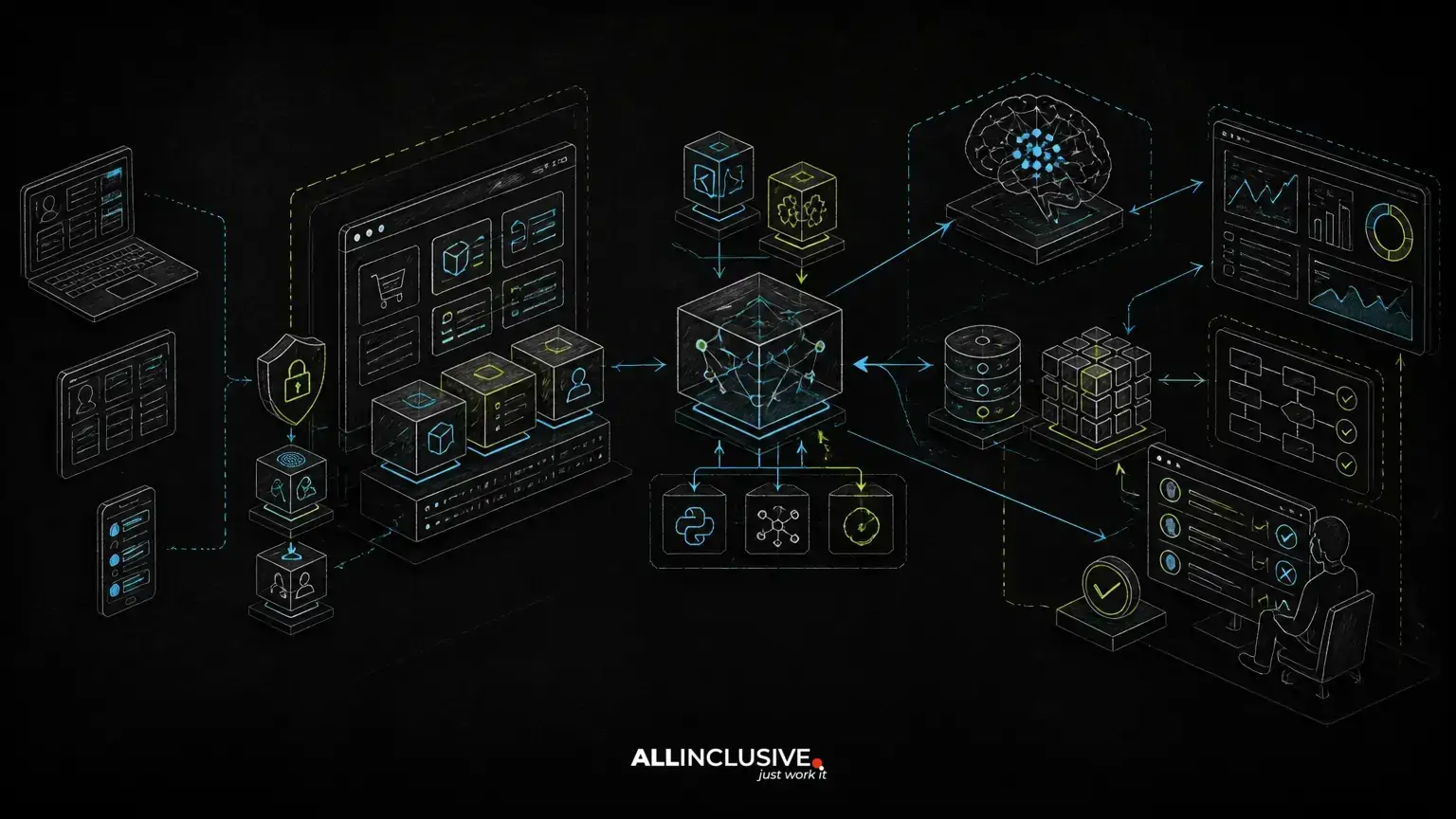
The most maintainable approach is to treat the model as one component in a broader software system. A Laravel or other application layer can own users, workflows, billing and permissions, while Python services handle AI-heavy tasks such as retrieval, document processing, evaluation and orchestration. The exact split depends on the product, but the boundaries should be explicit before the first prompt reaches production.
This article explains the main patterns, failure modes and design decisions involved in building dependable OpenAI-powered web features.
Start with a product workflow, not a model call
A model call should support a defined user or business workflow. Examples include drafting a response, extracting fields from a document, answering questions over internal content, classifying a request or proposing an action for approval. Each workflow has different requirements for accuracy, latency, data access and review.
Before selecting a model or designing prompts, specify:
- Input contract: what data the feature accepts, including size, format and validation rules.
- Output contract: whether the result is prose, structured fields, citations, a classification or a proposed tool action.
- Authority: what the system may read, change or send on the user’s behalf.
- Failure behavior: what happens when the model times out, refuses, produces invalid output or lacks sufficient context.
- Review path: which decisions require a person before they affect customers, records or external systems.
This framing prevents a common mistake: treating a successful response in a local demo as evidence that the feature is ready for production.
Choose an application architecture with clear ownership
For a conventional web product, the application layer should normally remain the source of truth for identity, authorization, business rules and durable records. It can call an AI service through a narrowly defined interface rather than allowing model logic to spread across controllers, jobs and templates.
A Laravel application might manage a request from the browser, authorize access to a workspace, create an AI task and enqueue background processing. A Python service can then perform document parsing, retrieval, model orchestration or evaluation. Results return through an API, queue or event, and the application stores the approved business outcome.
This separation is useful when AI workloads need Python libraries or independent scaling, but it is not mandatory. A smaller feature may be implemented within one application if its data boundaries, tests and operational responsibilities remain clear. The architectural decision should follow workload and ownership rather than a preference for one language.
For a deeper discussion of the split between application logic and AI workloads, see Laravel and Python AI architecture. Teams assessing broader product architecture can also review web development services and the software development hub.
Keep OpenAI API access behind a controlled service boundary
Do not scatter direct provider calls throughout the codebase. Create an internal AI service or adapter that centralizes provider authentication, request construction, model configuration, timeouts, retries, response validation and telemetry.
A useful boundary might expose operations such as:
- Generate a response from an approved prompt version.
- Extract validated fields from a document.
- Answer a question using supplied context and citation metadata.
- Classify an item using a versioned label set.
- Propose a tool action without executing it.
The boundary should return a typed result rather than an unexamined text string. Include status, parsed data, model metadata, usage information where available, prompt version, trace identifiers and an error category. This makes provider changes and operational debugging less disruptive.
Keep API credentials server-side and separate from browser code. Use environment or secret-management facilities appropriate to the deployment, restrict access to the minimum required services and rotate credentials through an established operational process.
Use structured outputs for workflows that depend on data
Free-form prose is appropriate for some drafting features, but it is a weak interface for business logic. If the application needs fields such as a priority, customer identifier, due date or recommended action, define a schema and validate the result before it reaches downstream code.
Validation should check both syntax and meaning. A syntactically valid object can still contain an unknown category, an impossible date or a value the current user is not allowed to select. Treat model output as untrusted input, just as you would treat a browser request.
When validation fails, the system can retry with a constrained repair request, route the item to review or return a clear partial-result state. It should not silently coerce uncertain output into a durable business record.
Decide when retrieval and RAG are necessary
OpenAI API integration does not automatically give a model access to an organization’s current knowledge. If a feature must answer questions about internal policies, product documentation, tickets or customer records, the application needs a controlled retrieval design.
A typical retrieval-augmented generation pipeline includes:
- Ingest and normalize approved source content.
- Split content into useful passages while retaining document and permission metadata.
- Create embeddings and store them in a suitable search system.
- Retrieve candidate passages for a user query.
- Optionally rerank candidates using a more precise method.
- Pass only authorized, relevant context to the model.
- Return an answer with citations or source references where users need to verify claims.
Retrieval is not a substitute for authorization. Filtering must account for the user, tenant, document status and any record-level restrictions before context is assembled. Content that a user cannot view in the application must not become available through a conversational interface.
RAG also introduces its own maintenance work: indexing changes, deleted documents, stale content, duplicate passages, retrieval quality and source attribution. The article RAG development and retrieval architecture covers these concerns in more detail.
Separate model suggestions from tool execution
Tool use and agents can make an AI feature operationally valuable, but they also increase its authority and risk. A model may propose a search, database lookup, ticket update or outbound message. The application should decide whether that operation is permitted, validate its arguments and determine whether approval is required.
Use narrow tools with explicit schemas rather than exposing a general-purpose database or unrestricted network access. Apply authorization outside the model. Log the requested action, the validated arguments, the acting user and the final execution result.
For consequential actions, use a staged workflow:
- The model proposes an action.
- The system validates permissions, scope and arguments.
- A user or policy engine approves the action.
- The application executes it through a controlled service.
- The result is recorded and shown to the user.
This pattern supports useful automation without treating model output as an authorization decision. For systems that expose business tools to agents, see MCP server development and safe tool connectivity.
Design for latency, cost and provider failure
AI calls are remote dependencies with variable response time and usage-based cost. A synchronous request may be acceptable for a short classification or drafting action, but document analysis, batch enrichment and multi-step retrieval usually belong in background jobs.
Production controls should include:
- Explicit connection and overall request timeouts.
- Bounded retries with backoff for transient failures.
- Idempotency for jobs that may be retried.
- Queue limits and concurrency controls.
- Maximum input and output sizes.
- Cancellation or expiration for stale work.
- Fallback behavior, such as a smaller model, a queued retry or human handling.
- Per-user, tenant or feature budgets where appropriate.
Model routing can reduce unnecessary cost and latency by sending simple tasks to less capable models and reserving more capable models for complex or high-risk cases. Routing rules should be evaluated with representative data; a cheaper call is not economical if it creates more review work or incorrect downstream actions.
Protect privacy and tenant boundaries
Privacy work begins before the API request. Identify what personal, confidential or regulated information the feature needs, and minimize the payload wherever possible. Redaction, field-level filtering and tokenization can reduce exposure, but they must be tested against the task’s actual requirements.
Define retention, access and deletion behavior for prompts, retrieved passages, outputs, traces and evaluation data. Do not assume that an application’s normal database permissions automatically protect AI logs. Observability data can contain the same sensitive content as the original request.
For multi-tenant software, carry tenant identity through every stage: ingestion, retrieval, queue processing, model calls, storage and review. Test cross-tenant isolation deliberately, including unusual identifiers, deleted records and asynchronous retries. Additional guidance is available in AI security and privacy for LLM applications.
Evaluate quality before and after release
Prompt inspection is not an adequate evaluation strategy. Build a representative test set that reflects real inputs, difficult edge cases, incomplete information and unacceptable outputs. Define task-specific criteria such as extraction accuracy, citation support, refusal behavior, policy compliance or reviewer acceptance.
Use deterministic checks where possible. For open-ended responses, combine rubric-based review, targeted human assessment and regression tests. Version prompts, retrieval configuration, model selection and application code so a change can be associated with a quality shift.
Evaluation should continue after launch. Monitor sampled outputs, correction patterns, escalation rates and newly observed failure modes. A model update or source-content change can alter behavior even when application code has not changed.
Make observability useful to engineers and product owners
AI observability should connect a user-visible workflow to its internal steps. Capture trace identifiers, feature name, tenant-safe request metadata, prompt and model versions, retrieval details, latency, token or usage data where available, validation outcomes, tool calls and fallback paths.
Avoid logging unrestricted prompts and outputs by default. Apply redaction, access controls and retention limits, and provide a way to investigate failures without creating a second uncontrolled data store.
Operational dashboards should distinguish provider errors, application errors, invalid model output, retrieval misses, policy blocks and human-review decisions. These categories lead to different fixes. More information on this topic is available in AI observability, monitoring and LLM quality operations.
A production readiness checklist for OpenAI API integration
- The feature has a defined workflow, output contract and failure state.
- Provider access is isolated behind a tested service boundary.
- Secrets remain server-side and are managed through deployment controls.
- Outputs are schema-validated and treated as untrusted input.
- Retrieval enforces user and tenant permissions before context assembly.
- Tool calls are narrow, authorized and logged outside the model.
- Timeouts, retries, idempotency and fallback behavior are implemented.
- Input limits, usage controls and cost monitoring are in place.
- Prompts, models, retrieval settings and evaluations are versioned.
- Privacy, retention and review policies cover prompts, outputs and traces.
- Human approval is required for actions with material business or customer impact.
Build the integration around ownership and change
The strongest OpenAI API integrations are not the ones with the most elaborate agent loop. They are the ones whose boundaries remain understandable when requirements, models, data sources and regulations change.
Keep business authority in the application, AI-specific processing in appropriate services, and operational decisions visible through tests and telemetry. Start with a narrow workflow, establish evaluation criteria, then expand retrieval, tool use or automation only when the product has evidence that the added complexity improves the user outcome.


