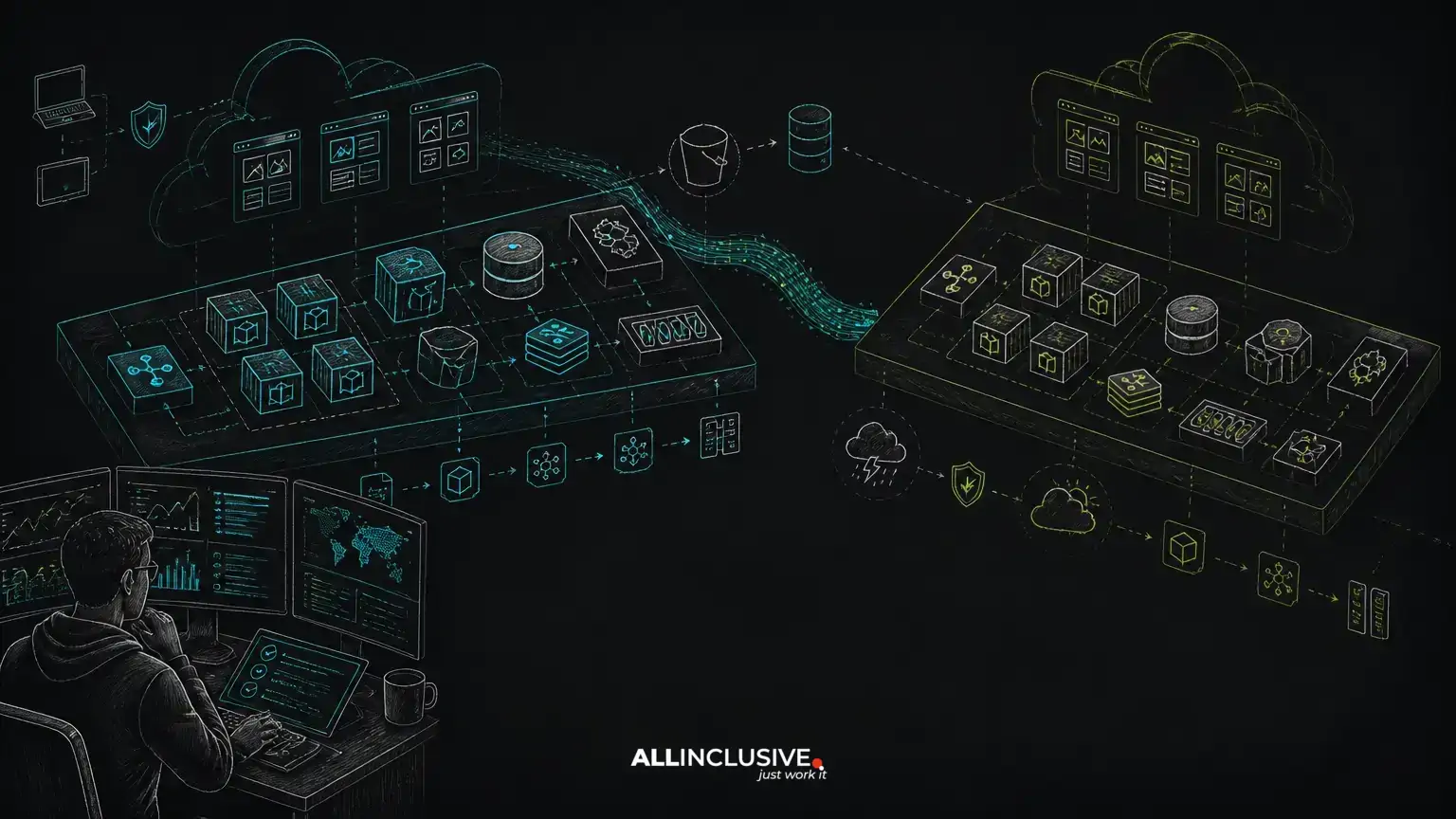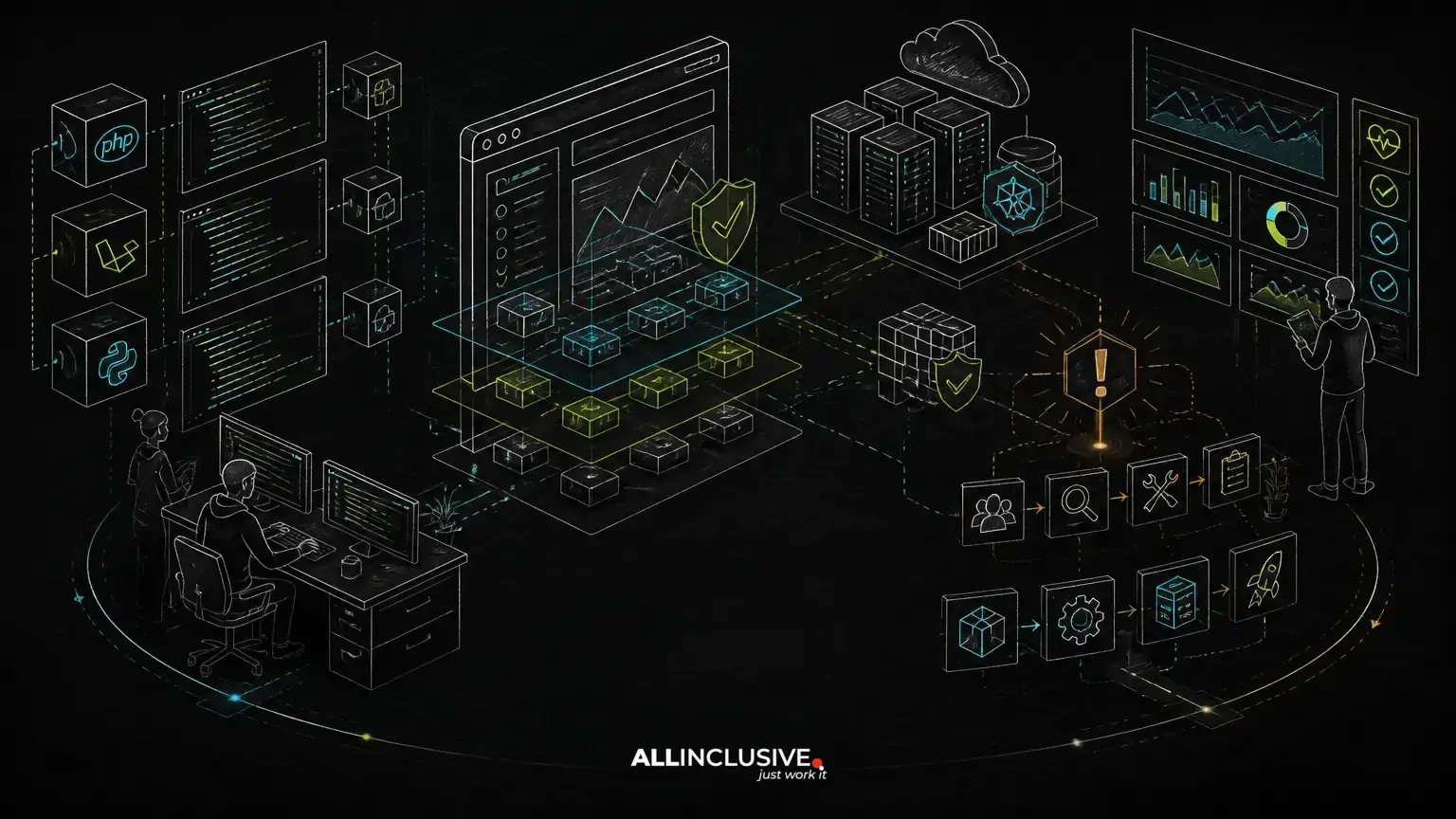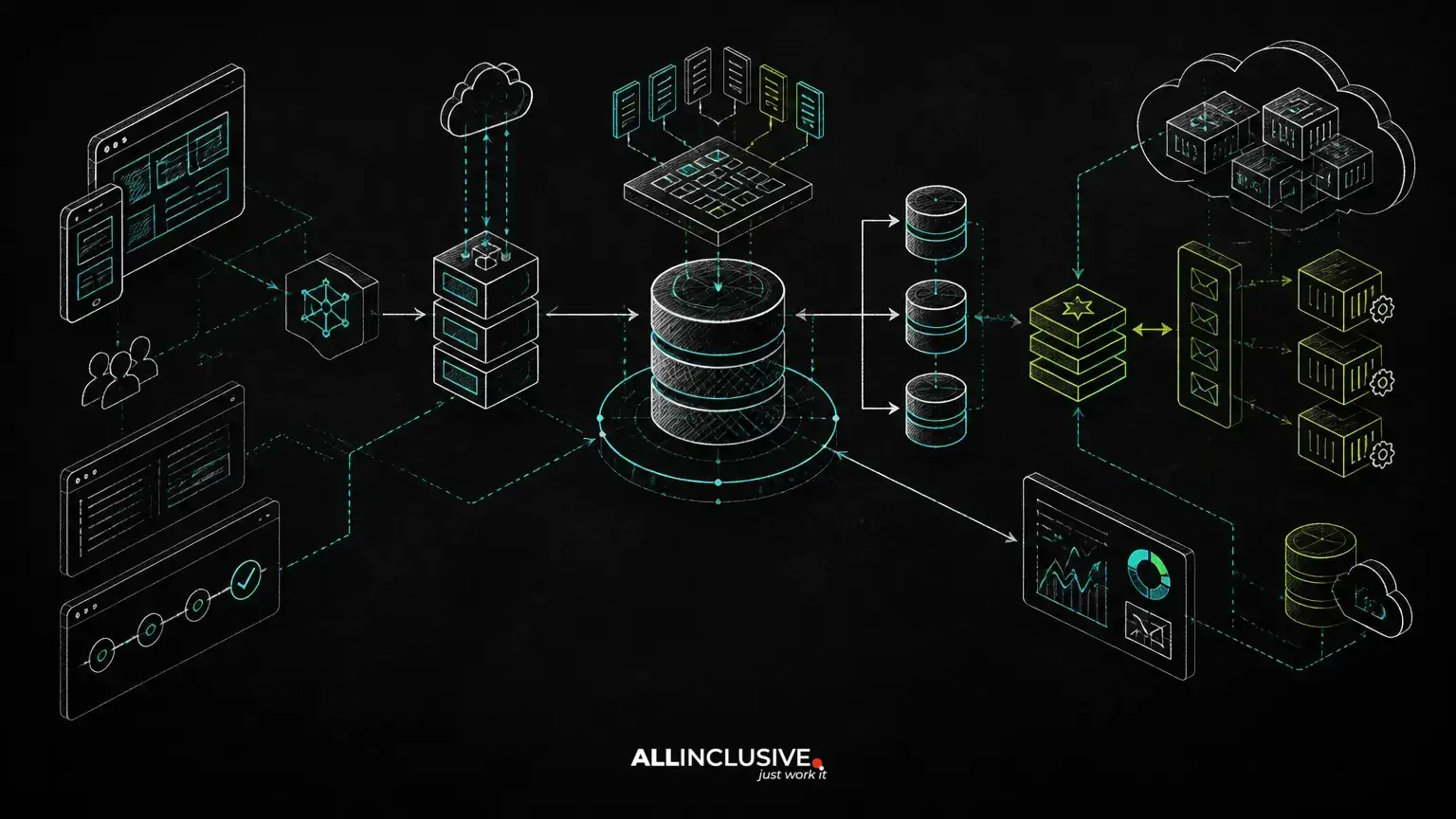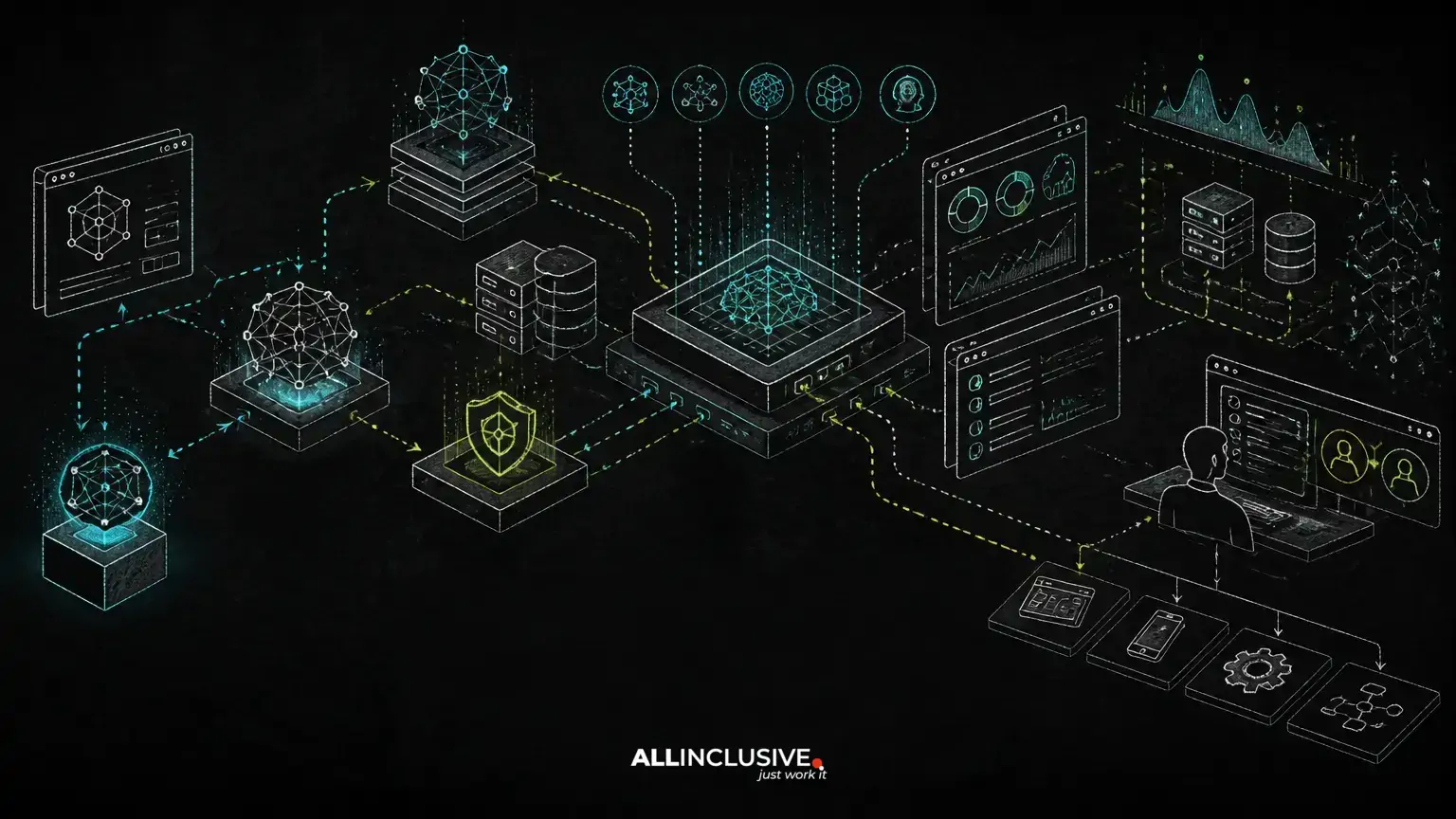
AI development cost is determined by the system around the model, not just the model API. A prototype that sends prompts to an LLM can be relatively narrow. A production system may need retrieval, embeddings, reranking, tool access, permissions, human review, evaluation, observability, privacy controls, fallbacks, and integration with existing software.
That difference is why two projects described as “an AI assistant” can require very different budgets. A useful estimate starts by defining the user workflow, business risk, data boundaries, integration surface, and operational expectations. The goal is not to predict a false-precision number; it is to identify the scope variables that will move the budget.
This article explains the main AI development cost drivers from prototype through production and provides a practical framework for comparing implementation options.
What an AI development budget actually includes
AI work usually combines product engineering, application development, data work, model integration, and operational infrastructure. The budget may include:
- Discovery, workflow design, and technical architecture
- Prompt and model integration
- Data preparation, document processing, embeddings, and retrieval
- Application interfaces and integrations with business systems
- Permissions, privacy controls, auditability, and human review
- Evaluation datasets, quality testing, and regression checks
- Monitoring for quality, latency, failures, and usage cost
- Deployment, support, model changes, and ongoing optimization
A prototype may intentionally omit several of these areas. That can be appropriate when the purpose is to test a workflow or validate demand. It becomes risky when prototype assumptions are treated as a production estimate.
The main factors that drive AI development cost
1. Workflow complexity
A single-turn question-and-answer feature is simpler than a system that coordinates several steps. Cost rises when the product must classify a request, retrieve information, call tools, update records, ask for confirmation, and produce an auditable result.
Workflow complexity also affects testing. A response can be technically fluent while still taking the wrong business action. Teams must define what the system is allowed to do, which actions require confirmation, and what happens when information is missing or contradictory.
2. Model strategy and routing
Model selection affects implementation, latency, usage cost, and quality. Some tasks may require a more capable model, while others can use a smaller or specialized option. A production architecture may route requests according to sensitivity, complexity, response-time requirements, or cost constraints.
This is not simply a matter of choosing the cheapest model. A lower-cost model that creates more retries, human corrections, or incorrect downstream actions can increase total operating cost. The appropriate comparison includes model usage, engineering complexity, quality controls, and the business consequence of failure.
3. Data quality and retrieval requirements
Retrieval-augmented generation, or RAG, allows a system to ground responses in selected business content instead of relying only on model training. Implementing reliable retrieval may require document ingestion, cleaning, chunking, metadata, embeddings, access filtering, search, reranking, and source citations.
The cost depends heavily on the condition of the source data. Well-structured, stable content is easier to index than scattered documents with conflicting versions and unclear ownership. If users must only retrieve information they are authorized to see, permissions need to be enforced in the retrieval path—not added as a cosmetic filter after generation.
RAG is not automatically the right answer. If the task depends on current transactional data, a structured API or database query may be more reliable than semantic search. Choosing between retrieval, direct system integration, or a combination of both is an architecture decision with budget implications.
4. Integrations and application architecture
AI features rarely operate in isolation. They may need to connect to a CRM, ticketing platform, document store, billing system, internal API, or custom database. Each integration introduces authentication, data mapping, error handling, rate limits, testing, and ownership questions.
A common architecture separates AI workloads from the primary application layer. Python may handle model orchestration, document processing, evaluation, or data pipelines, while Laravel or another application layer manages users, permissions, business workflows, and the product interface. This separation can improve maintainability, but it also creates service boundaries, deployment responsibilities, and observability requirements.
For broader application architecture context, see Allinclusive’s software development resources. The relevant choice is not whether one language is universally better; it is how the AI component fits the product that must operate around it.
5. Agents and tool use
An agentic system can select tools, plan actions, and continue across multiple steps. That flexibility can support useful workflows, but it adds more failure modes than a constrained generation feature.
Budget usually increases when agents need:
- Tool schemas and validation
- Permission-aware actions
- Limits on loops, retries, and spending
- State management across a task
- Approval or human handoff before consequential actions
- Detailed traces for debugging
Many business workflows benefit from a controlled sequence of known steps rather than an open-ended agent. A narrower design may be less impressive in a demo but easier to test, explain, and operate.
6. Evaluation and quality assurance
Traditional software tests can verify deterministic behavior. AI systems also require evaluation of relevance, factuality, instruction following, refusal behavior, tool selection, and consistency across representative inputs.
Evaluation work may include creating a test set, defining acceptable outputs, comparing model or prompt changes, testing adversarial cases, and reviewing failures with domain experts. Without this work, a team may ship a feature that appears effective in a handful of demonstrations but degrades on real requests.
Evaluation should be planned before production implementation, because it influences data collection, logging, prompt design, and release processes. Learn more about the transition from demonstration to operational system in AI proof of concept versus production.
7. Privacy, security, and permissions
AI systems often process internal, personal, confidential, or regulated information. Requirements may include data minimization, tenant isolation, encryption, retention rules, redaction, access controls, audit logs, and clear handling of provider data.
Security scope depends on the use case and deployment environment. A public content assistant and an internal system that can modify financial or customer records should not receive the same controls or budget assumptions. Privacy decisions also affect model choice, hosting, logging, and whether sensitive content can be sent to an external service.
8. Observability, latency, and reliability
Production AI needs visibility into more than application uptime. Teams may need to monitor latency, token usage, retrieval quality, model errors, tool failures, fallback frequency, user corrections, and safety events. Logs must be useful for diagnosis without exposing data that should not be retained.
Latency requirements can create additional architecture work. Caching, streaming, parallel retrieval, model routing, queue-based processing, and asynchronous workflows may all be appropriate depending on the user experience. Reliability planning should also cover provider outages, malformed responses, unavailable integrations, and exceeded limits.
Prototype budget versus production budget
A prototype typically answers a narrow question: can the model perform this task well enough to justify further investment? It may use a small dataset, limited integrations, manual review, and temporary infrastructure.
Production answers different questions:
- Can authorized users access only the right information?
- Can the system fail safely and explain what happened?
- Can quality be measured after prompts, models, or source data change?
- Can the team control usage cost and response time?
- Can operators investigate errors without exposing sensitive information?
- Can the workflow be maintained by the product team over time?
Moving from prototype to production does not mean rebuilding everything. It does mean identifying which shortcuts were exploratory and replacing the risky ones with deliberate controls. A prototype that uses a manual upload may evolve into an ingestion pipeline. A chatbot that only drafts text may need permissions, approval states, and audit history once it can influence business records.
How to estimate AI development cost before implementation
A practical estimate can be organized into six scope layers:
- User workflow: Define who uses the feature, what outcome they need, and where human judgment remains necessary.
- Knowledge and data: Identify source systems, data quality, update frequency, ownership, and access restrictions.
- Model behavior: Decide whether the system generates, classifies, extracts, retrieves, reasons across steps, or invokes tools.
- Application integration: Map required interfaces, records, permissions, notifications, and failure handling.
- Quality and operations: Specify evaluation, monitoring, latency, fallback behavior, support, and release controls.
- Growth assumptions: Consider users, request volume, data growth, tenancy, regional requirements, and future workflows.
Then separate one-time engineering from recurring operating cost. Engineering includes architecture, implementation, data preparation, testing, and deployment. Recurring cost may include model usage, storage, search, monitoring, support, human review, and ongoing evaluation.
Questions to ask an AI development partner
Commercial proposals are easier to compare when they explain assumptions rather than presenting a single unexplained figure. Ask:
- What is included in the prototype, and what is explicitly deferred?
- How will quality be evaluated against representative business examples?
- Which data enters the model or retrieval system, and how are permissions enforced?
- What happens when the model is uncertain, unavailable, or returns malformed output?
- How are prompts, models, indexes, and evaluation data versioned?
- Which application team owns the AI service after launch?
- What usage, latency, support, and review assumptions affect ongoing cost?
A partner should be able to explain trade-offs between a constrained workflow and an agent, between direct API access and RAG, and between a quick integration and a maintainable service boundary. For guidance on evaluating providers, read how to choose an AI development company.
Reducing cost without creating avoidable rework
Cost control is most effective when it reduces unnecessary complexity rather than removing essential safeguards. Start with a narrow, valuable workflow and define success criteria before expanding. Use structured data access when it is more reliable than broad retrieval. Keep agent permissions narrow. Route simple tasks to appropriate models. Cache stable results where privacy and freshness allow it.
It is also important to preserve an upgrade path. Temporary shortcuts are acceptable when documented and isolated. Hidden dependencies, untested prompts, unowned data pipelines, and unmonitored model calls are not savings; they move cost into later debugging and operational risk.
For the runtime side of the equation, see AI cost optimization. The right target is total cost of ownership while maintaining the quality and controls the workflow requires.
A production-oriented way to think about the budget
The most reliable AI development estimate connects every technical decision to a business requirement. A lightweight assistant may need only model integration and a carefully bounded interface. A system that searches private knowledge, updates records, and supports regulated decisions needs a broader investment in retrieval, permissions, evaluation, observability, and human review.
That is why AI development cost should be discussed as a range of scope scenarios rather than a model price or a generic feature list. Define the workflow, identify the risk of wrong answers or actions, map the data and integrations, and decide what must be measurable in production. Those decisions produce a budget that is more useful for planning—and a system that is more likely to remain maintainable after launch.