
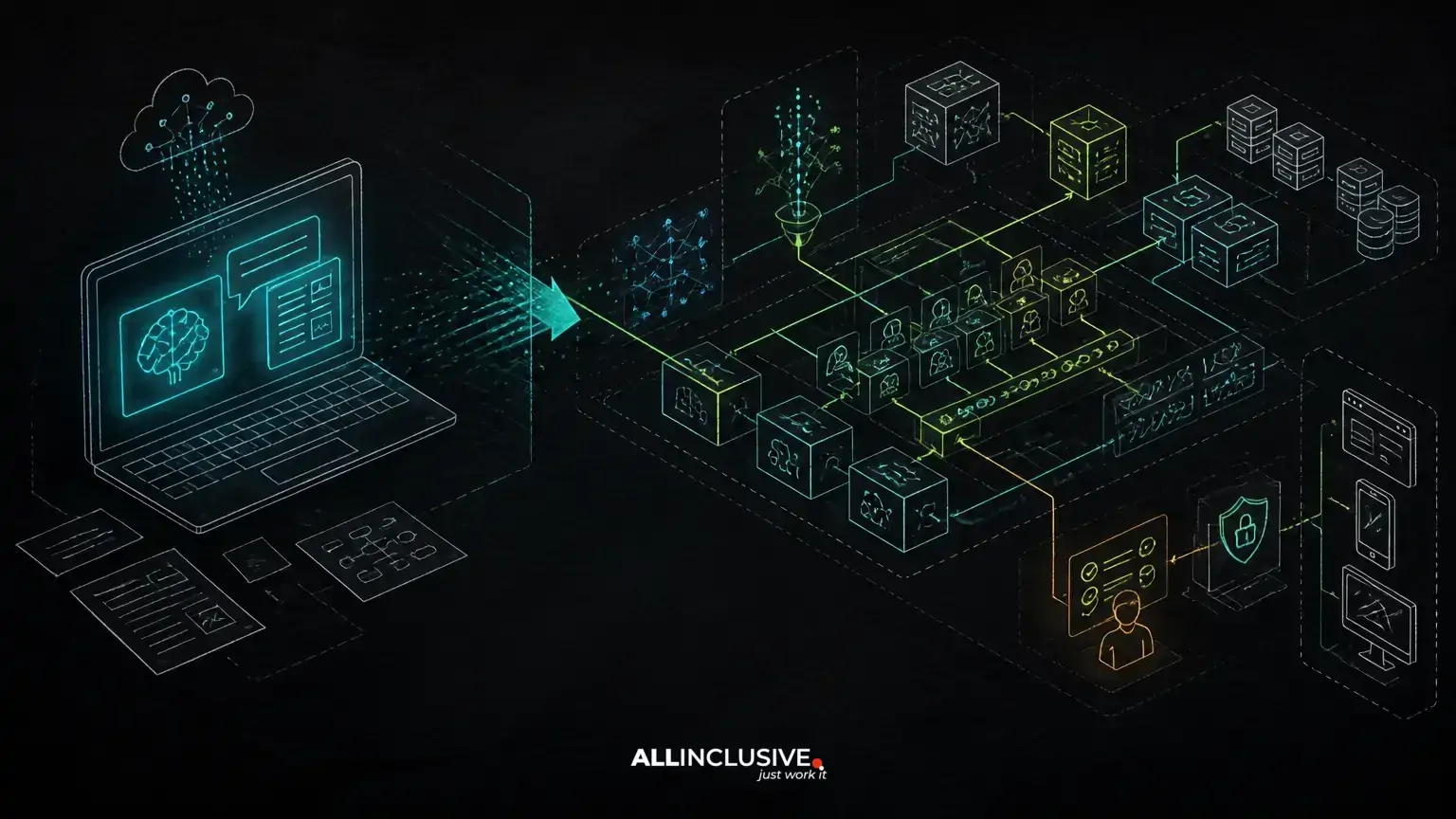
An AI proof of concept can show that a model answers questions, summarizes records or completes a workflow. That is useful, but it does not establish that the feature is ready for production. The difference between an ai proof of concept vs production system is the engineering work required to make behavior dependable under real data, real permissions, real traffic and real business consequences. The ai proof of concept vs production workflow also connects to the guidance in custom software development.
A prototype optimizes for learning: can the idea work? A production system optimizes for controlled outcomes: does it work consistently, safely and affordably for the right users, with a clear recovery path when it fails?
This distinction matters when planning AI development. The demo is often the smallest part of the problem. Data contracts, retrieval quality, evaluation, observability, privacy, integration and operational ownership determine whether the feature becomes a product or remains an experiment.
What an AI proof of concept is designed to prove
A proof of concept should answer a narrow technical or product question. For example:
- Can an LLM extract structured fields from representative documents?
- Can retrieval augmented generation provide useful answers from an approved knowledge base?
- Can an agent call a limited set of tools to complete a workflow?
- Will users accept a copilot that drafts rather than automatically executes?
At this stage, it can be reasonable to use a small dataset, manual testing, a simple prompt, one model and a basic interface. The goal is to reduce uncertainty before investing in a broader architecture.
That simplicity becomes a problem when stakeholders mistake a successful demonstration for production readiness. A demo may use clean inputs, a familiar user, a short session and human correction outside the system. Production must handle ambiguity, incomplete data, authorization boundaries, model changes, retries, outages and unexpected user behavior.
The main changes after the demo
1. The workflow becomes an owned product capability
A proof of concept may sit in a notebook, script or isolated web page. A production feature must have an owner, a defined user journey and an explicit boundary around what the AI can and cannot do.
That means specifying inputs, outputs, approval points, error states and escalation paths. If an assistant drafts a response, the product should make review and editing clear. If an agent can create a record or trigger an action, the system needs authorization checks and a deliberate confirmation model.
Production AI is therefore not only a model integration. It is a workflow implemented in software, with the model occupying one controlled component.
2. Prompts become versioned application logic
A prototype often relies on a prompt edited directly in code or an experimentation tool. Production systems need versioned prompts, structured output rules and a process for changing them safely.
Prompt changes can alter tone, extraction accuracy, tool selection or refusal behavior. They should be tested against a representative evaluation set before release. Where possible, outputs should be constrained by schemas and validated before downstream code accepts them.
This does not make model output deterministic. It makes the surrounding system more explicit about what counts as an acceptable response and what happens when the response does not meet that standard.
3. RAG becomes a data pipeline, not a file upload
A retrieval augmented generation prototype can work with a handful of documents loaded once. A production RAG system needs dependable ingestion, indexing and retrieval behavior.
Important decisions include:
- Which sources are authoritative and who owns them?
- How are documents parsed, chunked, tagged and updated?
- How are embeddings generated and refreshed when content changes?
- Should keyword search, vector search or a hybrid approach be used?
- When is reranking valuable for improving the order of retrieved passages?
- How are tenant, role and document permissions enforced during retrieval?
- What should the application do when evidence is missing or conflicting?
Retrieval quality affects answer quality, but access control is equally important. A system must not retrieve confidential content merely because it is semantically relevant. Permissions should be applied as part of the retrieval design, not added after generation.
4. Agents receive narrower authority and stronger controls
An agent demo may successfully call tools in a controlled sequence. Production agent development requires careful limits on tool access, arguments, retries, cost and side effects.
Read-only tools are generally easier to govern than tools that change data or contact external parties. High-impact actions may require explicit user confirmation, a second validation step or human approval. Tool calls should be logged with the requesting user, selected arguments, result status and failure reason.
In many products, a constrained workflow with a few model-assisted decisions is safer and easier to maintain than an open-ended autonomous agent. The right choice depends on the consequences of an incorrect action, not on how impressive the demonstration appears.
Architecture: from experiment to maintainable system
A production architecture separates the application workflow from model-specific behavior. A Laravel or other application layer may own authentication, permissions, billing, records, notifications and user-facing workflows. Python may own document processing, retrieval pipelines, evaluation jobs or model orchestration. These components can communicate through well-defined APIs or asynchronous jobs.
The exact stack is less important than the boundaries. The application should not depend on undocumented prompt behavior, and the AI service should not silently bypass business rules. A useful architecture typically includes:
- Application layer: user identity, permissions, workflow state and business transactions.
- AI orchestration layer: model selection, prompt versions, structured outputs, tool policies and fallback logic.
- Knowledge layer: source ingestion, metadata, embeddings, retrieval and permission filtering.
- Evaluation layer: test cases, scoring, regression checks and human review workflows.
- Operations layer: logs, traces, metrics, alerts, usage records and incident procedures.
For organizations evaluating broader custom web development, this separation helps keep AI capabilities integrated with the product rather than isolated as a disposable experiment.
Evaluation replaces “it looked good”
Manual demonstrations are valuable for discovery but weak as a release gate. Production teams need an evaluation set that represents real input variation and meaningful failure modes.
Evaluation criteria depend on the use case. A document extraction feature may be measured against field-level correctness and schema validity. A RAG assistant may be assessed for answer relevance, citation or evidence alignment, refusal when evidence is insufficient and protection against unauthorized content exposure. An agent may require checks for correct tool selection, argument validity, action completion and safe handling of ambiguous requests.
Not every quality dimension can be reduced to one score. Combine automated checks with targeted human review, especially where responses affect legal, financial, medical, employment or customer-facing decisions. Store evaluation cases so model, prompt, retrieval and application changes can be compared over time.
Reliability requires fallbacks and human review
Models can produce incorrect, incomplete or poorly formatted output even when a prompt worked during testing. Production design should assume occasional failure.
Useful controls include:
- Schema validation and safe rejection of malformed outputs.
- Confidence or evidence thresholds that trigger clarification or escalation.
- Fallback models or deterministic code for narrowly defined operations.
- Retries with limits, timeouts and idempotent job handling.
- Graceful degradation when a provider, retrieval index or external tool is unavailable.
- Human review for high-impact or irreversible actions.
Human review is not a sign that the AI has failed. It is a product control that allocates responsibility appropriately. The review experience must be designed as part of the workflow, with enough context for a person to approve, edit, reject or route the result.
Privacy, permissions and security move to the foreground
A prototype may use copied sample data. Production systems must define what data can be sent to which model or service, how long it is retained and who can access prompts, retrieved passages, outputs and logs.
Privacy design should cover tenant isolation, redaction where appropriate, secrets management, access control, audit records and deletion behavior. Logs require particular care because they can contain the same sensitive information as the original request. Teams should establish whether full prompts and outputs are needed for debugging, and apply appropriate minimization when they are not.
Security also includes prompt injection and indirect instruction attacks. Retrieved documents, web pages and user-provided content should be treated as untrusted input. A system should not allow retrieved text to redefine tool permissions or override application policy.
Latency and cost become product constraints
A proof of concept can tolerate slow responses and manual model selection. A production feature must meet the expectations of its workflow and its budget.
Latency may be affected by retrieval, reranking, multiple model calls, tool execution and serialization. Cost may depend on input context, output length, model choice, retries, indexing volume and background jobs. Model routing can help assign simpler requests to less expensive models while reserving more capable models for difficult cases, but routing itself must be evaluated for quality and failure behavior.
Useful controls include context reduction, caching where data freshness permits it, bounded agent loops, asynchronous processing for long jobs and usage reporting by feature or tenant. These decisions should be made alongside product design, because a technically impressive feature may not be viable if its response time or operating cost does not fit the workflow.
Observability turns failures into diagnosable events
Application logs alone are rarely enough to explain an AI failure. Production observability should connect a user request to the relevant prompt version, model, retrieved sources, tool calls, validation results, latency and cost indicators, while respecting privacy requirements.
Teams should monitor more than uptime. Useful signals include malformed output rates, retrieval failures, escalation frequency, user corrections, tool errors, latency by workflow, token or usage trends and evaluation results after releases. When a response is wrong, engineers need to determine whether the cause was the source data, chunking, retrieval, model behavior, prompt logic, permission filtering or downstream application code.
A practical readiness checklist
Before moving beyond a proof of concept, ask:
- Is the supported workflow and user population clearly defined?
- Are model output contracts, prompt versions and application fallbacks documented?
- Is the knowledge pipeline current, permission-aware and observable?
- Do evaluation cases reflect normal, ambiguous and adversarial inputs?
- Are high-impact actions subject to confirmation or human review?
- Can the system handle provider, tool, retrieval and parsing failures?
- Are privacy, retention, tenant isolation and audit requirements addressed?
- Can the team measure quality, latency, usage and cost after release?
- Does a named team own incidents, model changes and ongoing evaluation?
If several answers are no, the next step may be a production-readiness phase rather than a larger model or a more elaborate demo. Teams assessing the broader scope of custom AI work can also review what custom AI development should include beyond an API wrapper and the requirements for production-ready AI agent development.
When a proof of concept should remain a proof of concept
Not every promising demo deserves production investment. Stop or narrow the project when the expected user benefit is unclear, the required data is unavailable, errors carry unacceptable consequences without a workable review process, or operating costs do not fit the business case.
A proof of concept has done its job when it produces a credible decision: proceed with a defined production scope, revise the workflow, test a different architecture or discontinue the idea. Treating that decision as the deliverable prevents teams from confusing technical novelty with product value.
The bottom line
The transition from AI proof of concept to production system is a change in engineering standard, not simply a deployment step. The production version needs explicit workflows, governed data, permission-aware retrieval, evaluated behavior, bounded tool use, fallbacks, observability, privacy controls and accountable human review.
The strongest implementation may use an LLM, RAG, an agent or none of these in every part of the workflow. The deciding question is whether the complete system can deliver useful outcomes reliably while remaining maintainable, explainable enough for its context and affordable to operate.


